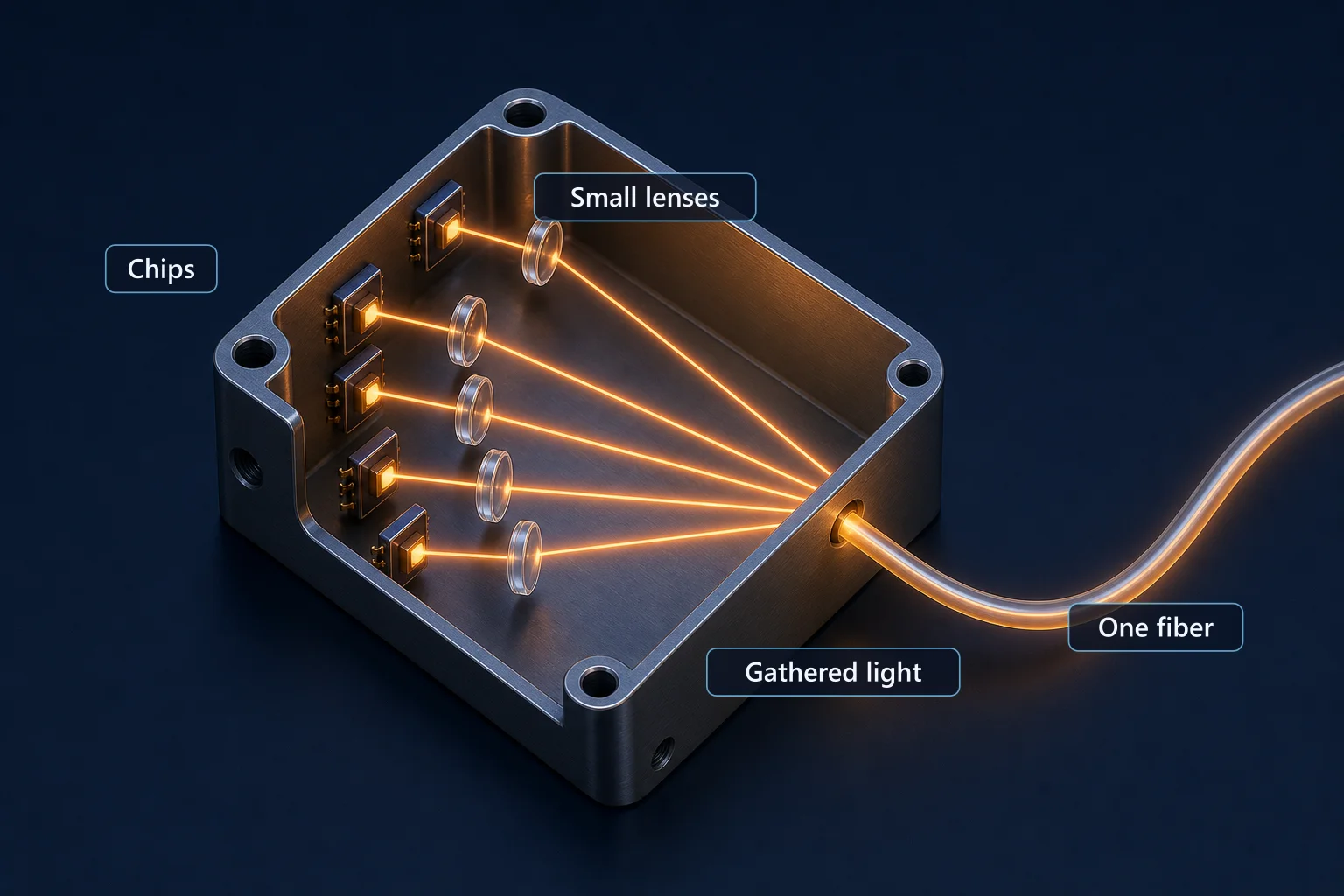
A thin fiber leaves a small metal box. Inside the box sit several semiconductor chips called pump diodes, and the light from each chip gathers into that one strand. In a laser weapon, this box is the second link, between the chips and the amplifier.
Gathering the light of many chips into one fiber sounds easy. But a fiber is a container with a fixed area and a fixed angle for taking in light. This article covers the shape of that container, the trade-off when a lens gathers light, why dense packing matters, and why the wavelength is held in place.
One chip is not enough
A single chip can only give so much light, so pumping a high-power laser takes the light of many chips. Some designs line up many single emitters, chips with one emitting spot each. Others use a bar, a long chip with a row of emitters.
The light gathered this way is uneven and has low beam quality, but the gain fiber absorbs it and turns it into a good beam. The shapes of emitters and bars, and why the wavelength must match an absorption line, are explained in "Pump diodes: the part that turns electricity into light".
This article follows the next step. How does the scattered light of many chips get into the end of one thin glass thread?
A container for light: area and angle
The end of a fiber is a tiny round window. Light has to land inside the area of that window to get in.
Area is not the whole story. The numerical aperture (NA) is set by the refractive indices of the core and the cladding, and it fixes the angle at which the fiber takes in light. Even light that lands on the window cannot travel along the fiber if it comes in at a steeper angle.
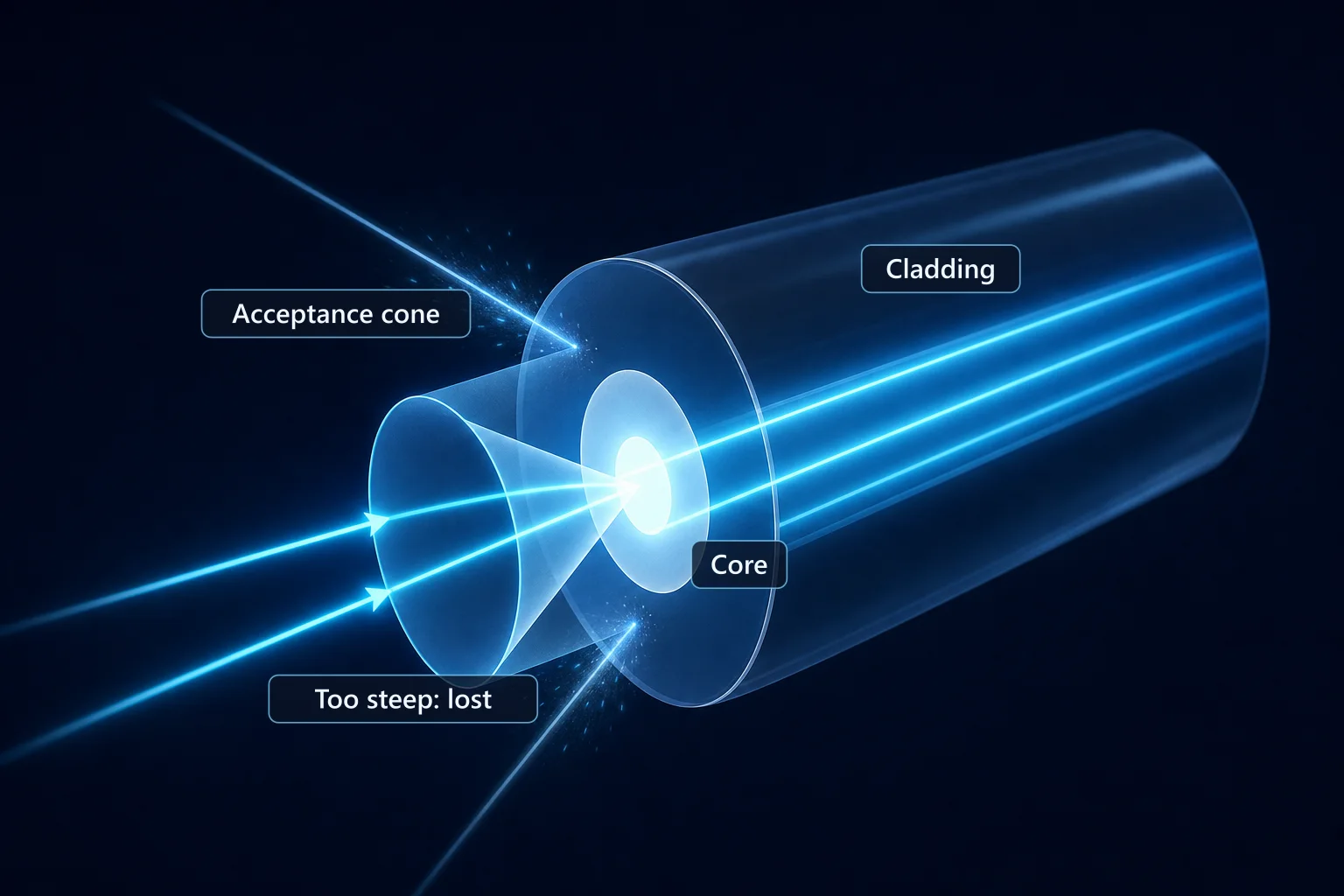
So the fiber container has two fences. One is the area of the end face, and the other is the acceptance angle. The only light it can hold is light that comes in "inside this area, within this angle."
With this container in mind, the word brightness carries more weight. A textbook defines brightness as power per unit area. For the same power, light packed into a smaller area is brighter.
The same book notes that lasers with high repetition rates usually rely only on high-brightness pumps, because the gain medium needs its pump light squeezed into a very small spot. The more light that must go into a small spot, the brighter the source has to be.
The trade-off when a lens gathers light
Light from the chips is gathered with lenses. Could a strong lens squeeze the light into a tiny point and fit it into any container? No. Shrinking the area makes the angle grow.
The beam propagation formula in the textbook shows this. The narrowest part of a beam is called its waist. Read from the formula, the tighter the waist, the sooner the beam spreads out again, and at a wider angle.
So pushing light into a small area makes it spread at a wider angle, and narrowing the angle takes a larger area.
A funnel gets the first half right. It takes in a wide flow and sends it through a small hole. Light is different. Water can leave the end of a funnel in any direction without trouble, but light that is squeezed tighter fans out at a wider angle.
So a module has to make both area and angle fit inside the container, and shrinking only one of them does not solve the problem.
The unevenness of chip light comes back here. The textbook notes that a beam with low spatial coherence, like the light from a diode array, can still be treated with Gaussian beam formulas by using a modified wavelength. In those formulas, a beam spreads faster when its wavelength is longer.
Uneven light can therefore be pictured as light with a stretched wavelength, which spreads at a wider angle from the same area. That makes it harder to fit into the container.
What happens inside the box
The work inside a module can be seen as three moves. The light from each chip is gathered, lined up in one direction, and sent into the area and angle of the fiber end. The trade-off above is what makes the last move hard.
To fit the light of many chips into one container, each chip's light can take up only a small share of it. The brighter each chip is, with more power in a smaller area and a narrower angle, the more chips one fiber can collect. This fitting is the module's job. One maker describes this coupling optics only as its own design and does not publish what is inside.
Fiber-coupled diodes also appear in the textbook. Discussing lasers with high repetition rates, it points out that single-mode pump diodes are short on power. Instead of awkwardly bundling many low-power diodes, it calls commercial transverse-multimode fiber-coupled diodes the more attractive choice.
It describes this approach as simple and sturdy, with high power, fairly good brightness, and lower complexity and cost. The book's context is ultrafast lasers.
In a fiber laser, the pump light sent by the module enters the outer layer of the gain fiber. Double-clad fibers are often used so that diode light with lower spatial mode quality can be put in efficiently. That path continues in "Double-clad fibers and how pump light gets in".
Holding the wavelength of the stored light
Storing the light well is not the end. A gain fiber absorbs certain wavelengths far better than others, so if the pump wavelength drifts off that absorption line, less of the delivered light gets used. Modules sold as wavelength stabilized aim at this problem.
nLIGHT presents its stabilized wavelength as barely moving even when temperature or current changes widely, so pump absorption stays even. The company's laser weapon technology chain figure also puts wavelength stabilization first under its first box, the device.
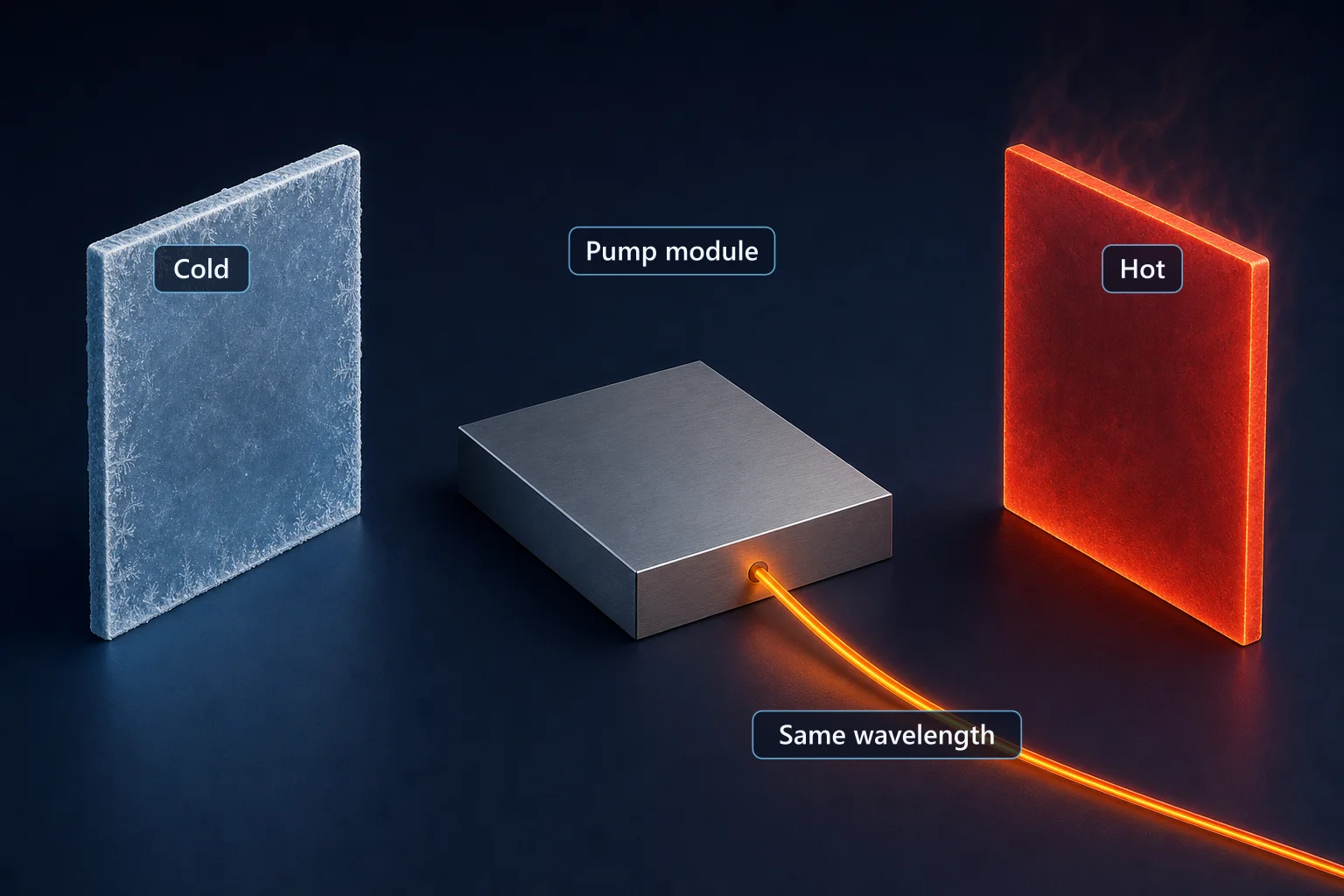
Under the second box of the same figure, the semiconductor laser module, there are three English phrases. They are Durable Locking, Instant-On and Wide Temp Operation. The figure gives no explanation, so their exact meaning is unknown.
The clear one is the third phrase, a demand to run over a wide temperature range. For equipment used where the temperature changes a lot, the pump light should not drift off the absorption line each time. Public sources do not say which part holds the wavelength in place.
Modules for defense and space are sometimes built and tested separately against military standards and space conditions. Public sources do not show which module went into which weapon.
The jobs inside a module are tied together. High brightness lets more light into the container, electricity that does not become light turns into heat, and heat in turn tests the wavelength locking. Heat and cooling equipment continue in "Cooling and thermal management: where the heat that did not become light goes".
What to read next
- "Double-clad fibers and how pump light gets in": how the pump light from the module enters the gain fiber.
- "Oscillators and amplifiers: making light, then growing it": the next link, where pump light and seed light meet and the signal grows.
- "Following One Laser Weapon: From Chip to Effector": this article's place on the five-stage map.