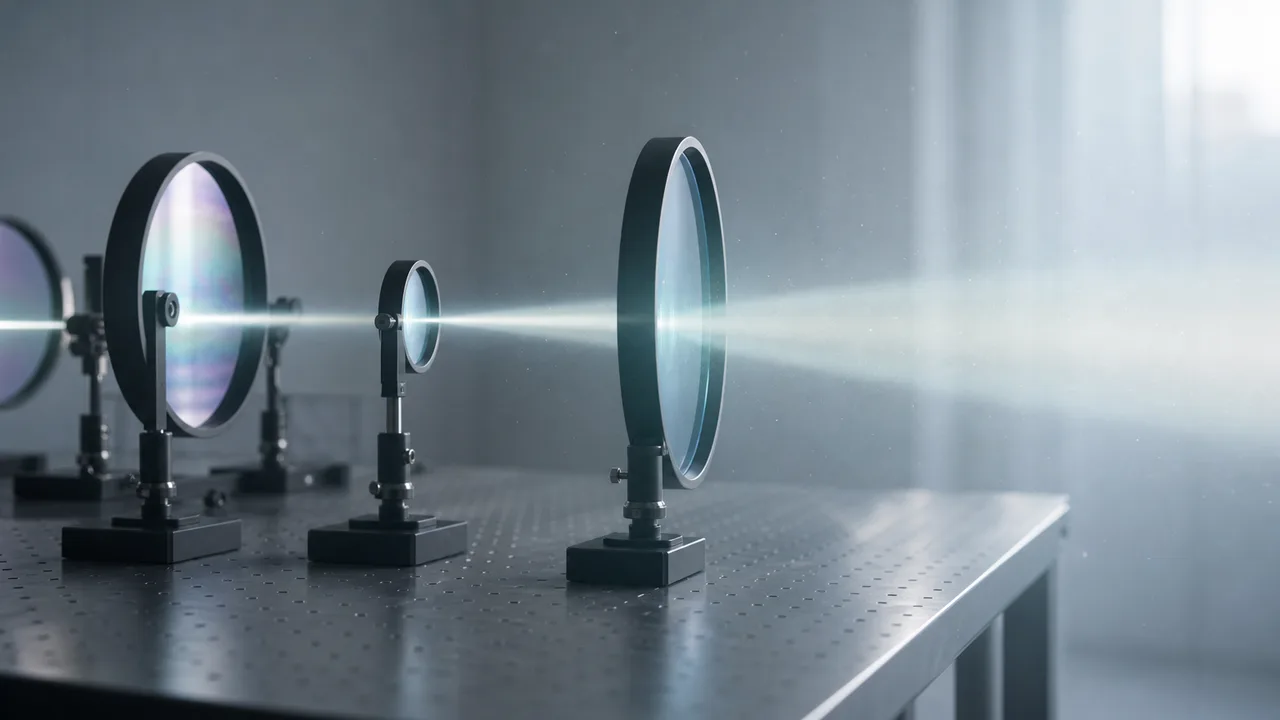
The light from a laser source is not yet a weapon's light. Something still has to take that light and send it, well focused, to one small spot far away. A U.S. Air Force research topic released in 2025 asks the beam director to be an optical device that can send a well-focused beam to a non-cooperative target.
A beam director is an optical system built from lenses or mirrors. This article looks at those optics from the system side, not part by part. It asks why the beam goes out wide, what a large aperture gains and what it costs, and why coatings matter where strong light crosses a surface.
The mirror and coating parts themselves are covered in "Mirrors, lenses and coatings". The whole layout of a laser weapon appears as one block diagram in "A laser weapon is more than a laser".
What the optics of a beam director do
In the system block diagram, the beam director is the box right after the laser source. The Air Force topic asks that the beam director send out a high-energy laser while keeping jitter low and focusing the beam well on a non-cooperative target. A non-cooperative target is one that does not hold still to help the beam.
The topic has one more line worth noting. Devices flight-tested before were mostly subscale models, built to check certain parts of aero-effects mitigation. They were not fully working optical beam directors that could send a well-focused beam to a target. Sending the beam "well focused" is the heart of the job.
The basic tool for bringing light to one place is a lens. A lens takes parallel light arriving from one direction and brings it to a fixed spot in its focal plane, one focal length away. "Focusing" in a beam director means putting that meeting spot far away instead of on a lab bench.
A beam director does not work alone. The topic first asks for the interfaces with the laser, the beam control system and the aircraft to be defined. A later phase integrates the beam director with an Air Force laser and beam control system.
A beam that starts wide spreads less
As shown in "Why a beam spreads", a laser beam has a narrowest place. That place is the beam waist. The scale for the stretch near the waist where the beam hardly widens is the Rayleigh length.
L = π w₀² / λ
L is the Rayleigh length, w₀ is the waist radius, and λ is the wavelength of the light. The textbook formula also multiplies in the refractive index of the material the beam passes through, which is set to 1 here as an estimate for air. The key point is that the waist radius enters as a square.
The calculation makes the difference plain. Double the waist radius and the Rayleigh length grows four times; make it ten times wider and it grows 100 times. Turned around, a narrow stretch 100 times longer needs a waist radius only 10 times larger.
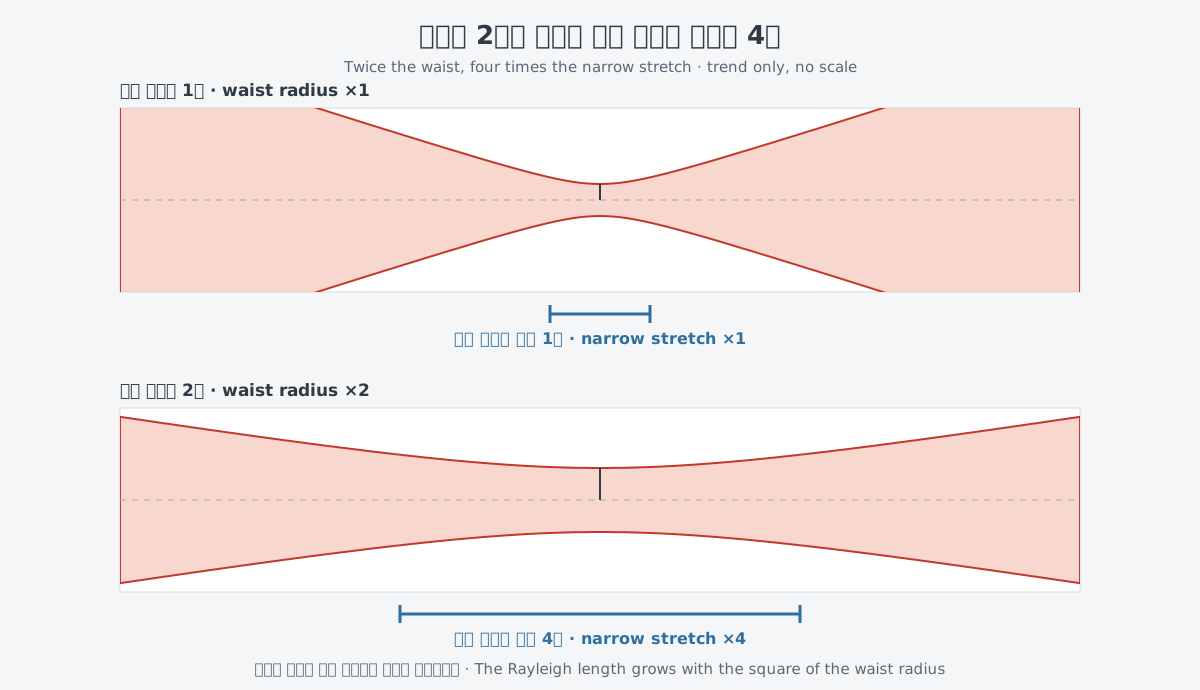
Read through the Rayleigh length formula, a beam that starts wider keeps its starting width for longer. Sending out a wide beam needs a wide exit. Aperture means the opening that light passes through, or its size. This is why the size of the exit matters in a beam director.
Wavelength is in the formula too. Because it sits in the denominator, halving the wavelength at the same waist doubles the Rayleigh length.
Light gathered by a lens does not become a point with no size, either. In optical imaging, light through a hard-edged round opening makes a pattern with side lobes because of the Airy disk, and that pattern blurs the image. Even where light comes together, diffraction leaves a size.
The telescope that widens the beam
A beam expander is an optical system that increases the diameter of a laser beam, and it is also called a telescope. FiberBridge Photonics, a maker of high-energy fiber lasers, also names beam expanders as one example of the optics after the laser that shape and control the beam precisely.
A telescope can be built from two lenses. In the telescope arrangement the textbook covers, the ratio of the focal lengths of the first and second lens sets the angular magnification. The drawing below shows the idea of widening a narrow beam with a small lens and a large lens.
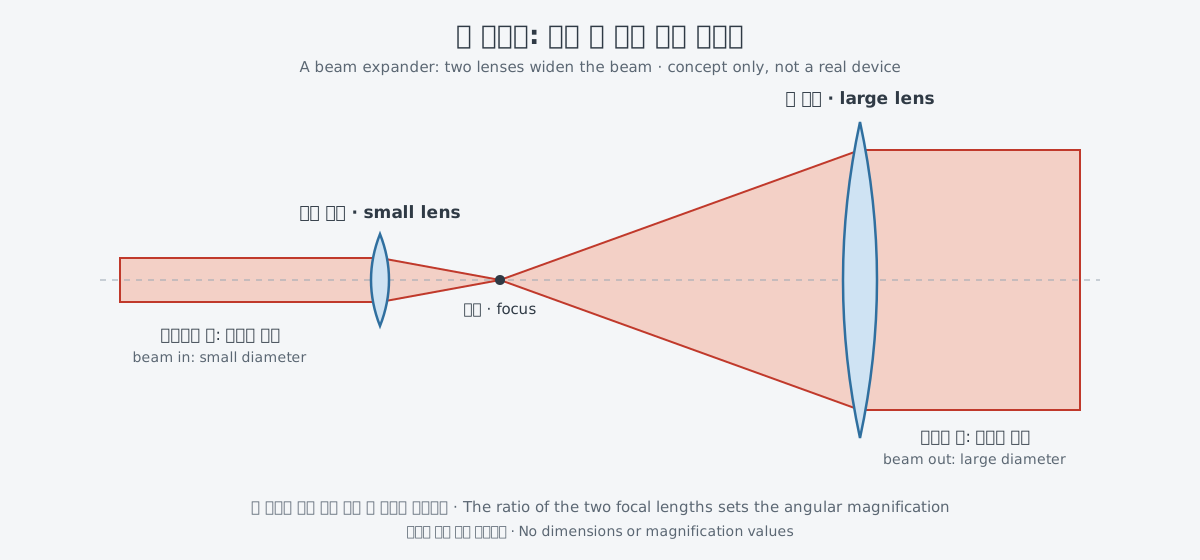
The narrow beam passes the small lens, meets at one point and spreads again. When the large lens catches the spreading beam and sends it out straight, the beam leaves much wider than it came in. A beam widened and sent out straight like this is a beam that starts wide, and by the formula above its narrow stretch is long.
What happens far away? A Lincoln Laboratory Journal article notes that when an optical system reshapes a laser beam, the product of the beam diameter and its far-field divergence stays the same. In the ideal case, widening the beam with an expander therefore makes it spread at a smaller angle far away.
The lenses in the drawing only show the idea, not the optical layout of any real system. Sending out a widened beam still needs an exit that large, which means a large aperture.
What a large aperture costs
A large aperture is not free. Larger optics need a larger, heavier frame to hold them. What the Air Force topic asks for is a lightweight beam director that can be integrated onto a small aircraft.
The constraint that ties the whole laser weapon together is size, weight and power (SWaP). The Congressional Research Service (CRS) names two issues of technical maturity for directed-energy weapons. One is raising beam quality and control to militarily useful levels, and the other is meeting SWaP and cooling requirements for integration into current platforms. The beam director's optics share that budget too.
On an aircraft, the airflow joins in. The Air Force topic says aero-effects significantly degrade the performance of airborne laser systems, and that earlier development and testing succeeded in mitigating many of them.
After the beam leaves, the atmosphere is waiting. A 2014 U.S. Army article says atmospheric turbulence over long paths makes the beam spread, and the beam control system may need complex adaptive optics (AO) to correct it. Atmospheric conditions such as rain, fog and obscurants can also limit range and beam quality, along with SWaP and cooling requirements.
In short, the Rayleigh length formula describes an ideal beam in empty space. A large aperture is the way to gain what that formula offers, but it also pays in weight and space, airflow and the atmosphere.
Why coatings matter in the system
The optics of a laser weapon carry coatings too. A NASA report on damage threshold testing defines an optical coating as material deposited in one or more layers on an optical substrate. It is designed to change how the part reflects or transmits light. In a system where strong light passes through, a coating does more than set those properties: it also has to withstand the light.
That report measures the light an optical surface receives as fluence. Fluence is the applied laser energy divided by the cross-sectional area of the incoming beam, or energy per area. The calculation shows that putting the same energy into a beam twice as wide makes the area four times larger and the fluence one quarter.
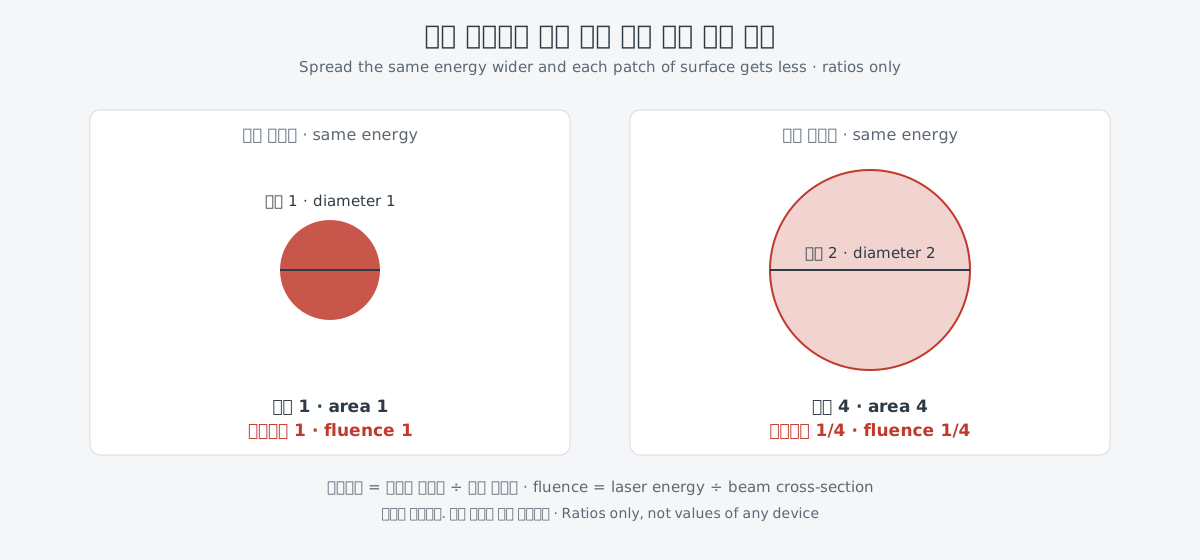
Spread the same amount of butter on a small slice of bread and a large one, and the large slice gets a thinner layer. In reality, light keeps arriving over time, and the share a surface absorbs turns into heat, which butter does not do. Still, the arithmetic is the same: spread it wider and each spot gets less.
Back in the beam director, the large optical surfaces after a beam expander share the same energy over a wide area. The surfaces where the beam is still narrow, in turn, receive more per area.
An MIT Lincoln Laboratory Journal article on beam combining lists the light on optical surfaces as one limit of such devices. The intensity on the surface of optical components has to stay below a critical damage level. It also has to stay below the point where heat-driven optical effects start to cause significant aberrations.
The yardstick for what a surface can take is the laser-induced damage threshold (LIDT). In the NASA report, the threshold test is a destructive test that finds the highest fluence at which no damage to the optical material is seen.
Light a surface absorbs turns into heat, and some layer structures lower the damage threshold. The reasons are in "Mirrors, lenses and coatings". Coatings on laser weapon optics also get their own lines in production and upkeep.
Making and keeping the optics
These optics are not easy to make, either. A U.S. Navy budget document for fiscal year 2026, quoted by CRS, describes one project. It aimed to improve the industrial base's ability to produce laser weapon beam director components and subsystems, and to reduce production lead times of laser weapon system optics.
The same project also worked to improve quality and cut production time for fast steering mirrors (FSM) and deformable mirrors. The budget document says the contractors on this work could supply these "highly critical, difficult to manufacture components" in future laser acquisition contracts. Work on the project ended in the third quarter of fiscal year 2025.
Coatings appear on that list as well. An earlier edition of the same report quotes the fiscal year 2024 budget request. It supported finishing the production capability work on beam director components and "coating chambers for laser weapon optics." The equipment that applies coatings was named on its own as part of production capability for laser weapon optics.
Once built, the optics have to be kept up. A 2004 report by the U.S. Government Accountability Office (GAO) looks at an aircraft-mounted laser weapon prototype. Once fielded, it would need unique maintenance such as re-calibration and re-coating of beam control subcomponents. That prototype used a chemical laser, and re-coating appears as an upkeep item after fielding.
Citing GAO, CRS also notes that the internal mechanisms of directed-energy weapons are sensitive and typically need a specialized clean room for repairs. The fiber laser company mentioned earlier also says it weighs environmental conditions such as temperature stability, contamination control and mechanical robustness when building its optics.
The optics of a beam director must be made large for distance, coated to withstand strong light and kept from drifting out of shape. The official websites of companies that make optical parts are gathered on the Makers page.
What to read next
- "Gimbals, pointing and tracking: holding the beam on one spot": the side of the beam director that turns and follows a target.
- "Adaptive optics: restoring a blurred beam": how a beam blurred by atmospheric turbulence can be restored.
- "Beam quality: M², divergence and brightness": why beams of the same power come together differently far away.