The two previous articles looked at the walls that a single fiber runs into. When strong light travels a long way down a thin core, the glass creates new light through stimulated Brillouin scattering (SBS) and stimulated Raman scattering (SRS). Once the average power passes a certain threshold, heat also sets off transverse mode instability (TMI), which makes the beam flicker. Enlarging the core to avoid scattering left another problem: modes.
If one fiber cannot be pushed further
A review paper published in 2018, which surveys work on combining the light of several ultrafast fiber lasers, points to the same walls. When the review was written, TMI was what limited the average power of diffraction-limited beams from fiber lasers in femtosecond pulse operation. For raising pulse energy and peak power, the highest power within a pulse, nonlinear effects and, ultimately, self-focusing, where light pulls itself together inside the fiber, set the upper limit. The review said fiber lasers might still improve, but it did not expect a single fiber to deliver drastically higher performance in the near future.
This is not only a fiber problem. A 2014 article in MIT Lincoln Laboratory's journal starts wider: any class of laser has a power level that is hard to exceed without degrading beam quality. The main obstacle to raising power while keeping a diffraction-limited beam has been linked to thermo-optical distortions in the laser gain medium. A diffraction-limited beam is one with the best beam quality, spreading only as much as physics allows.
If one fiber, or one laser, is not enough, why not combine several? That is how simple the basic idea of beam combining is. The outputs of several lasers are combined to reach performance that one laser alone cannot. The 2014 article presents beam combining as a modular way to raise power while preserving beam quality.
Combining the beams of a laser array to scale up power with a diffraction-limited beam is an old concept. Advances in laser technology later made it practical. By the time of the 2014 article, beam combining was a well-accepted avenue for raising laser power. Combining light by matching its phase was already demonstrated in 1970, using two semiconductor oscillators.
So what adds up when two streams of light are combined into one? And what does each combining approach have to control, and what does it cost? When the 2018 review sets the scope of coherent combining, there is one thing it looks at first. It is whether the light being combined can interfere.
Adding light: when intensities add and when fields add
In linear optics, which deals with light as waves, the wave equation is linear, so the superposition principle holds. This principle says that when two waves overlap, the sum of their fields is itself a new wave. For the intensity of light, though, the principle does not generally hold.
When two beams can interfere, the intensity where they overlap is not simply the sum of the two intensities. Where crest meets crest, the light is reinforced and gets brighter; where crest meets trough, it cancels and gets darker.
There are cases where superposition works for intensities too. They occur when the electromagnetic fields do not meet the conditions for interference. Examples are two waves whose polarizations are perpendicular to each other, or two waves that are fully incoherent. In those cases, the intensities of the two beams simply add.
Without interference: combined intensity = intensity of beam 1 + intensity of beam 2
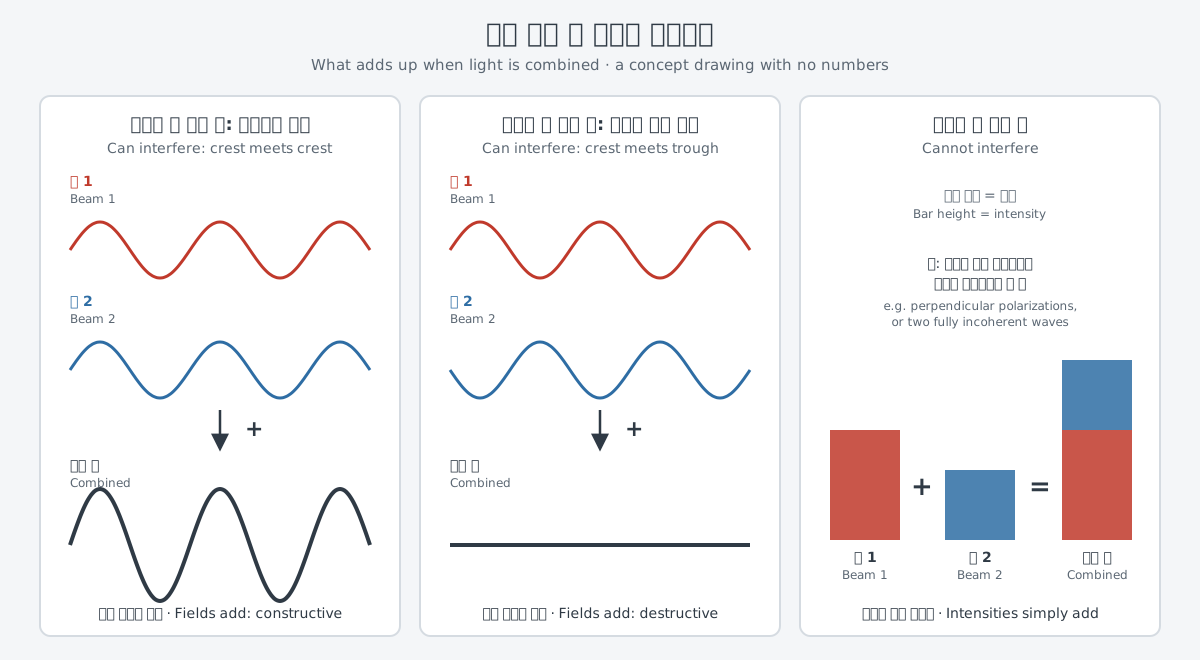
Picture two people pushing a swing. If they push in rhythm, their forces add and the swing goes higher; if they push out of step, they work against each other. The real thing differs in an important way. What adds up in light is the electromagnetic field, not a force, and two beams that cannot interfere add only their intensities, no matter their timing.
The name coherent combining comes from this. In the strict sense, combining is called coherent only when the beams from the emitters, the individual lasers that give off the light, are able to interfere with each other. This is where coherent combining, which combines light that can interfere, parts ways with combining that does not.
Either way, some work is shared. Whether the combining is coherent or uses light of different wavelengths, the direction in which each beam points has to be controlled so that the beams overlap. This is called pointing control. If the directions do not match, the beams do not land in the same place.
Combining without coherence
When the 2018 review on coherent combining sorts the field, it first separates out non-coherent techniques for combining beams. Techniques such as spectral combining, which combine light at different wavelengths, therefore fall outside the scope of coherent combining. The review adds that these concepts often pursue similar performance scaling goals.
Different sources sort the approaches differently. The 2014 article divides the basic approaches to beam combining into two: coherent combining and wavelength beam combining. Even with different sorting, both sources set the approach that combines light of different wavelengths apart from coherent combining.
A sidebar in the 2014 article explains that, for the same focusing angle, the intensity at the focus is proportional to the beam's brightness, not just its power.
The article carries this point over to diode lasers. Conventional diode laser arrays that are simply placed side by side, without beam combining, do not give beams with the brightness needed for metal cutting and welding. For the diode lasers in the article, it is an example of how placing them side by side alone does not reach the brightness needed.
Combining by color: spectral beam combining and the diffraction grating
A prism or a spectrometer spreads the light mixed in one beam into its colors. Spectral beam combining (SBC) does this in reverse. In this approach, also called wavelength beam combining (WBC), a dispersive optical element such as a diffraction grating is used to overlap beams of different wavelengths in space.
A diffraction grating bends light in a different direction for each wavelength. This property is called angular dispersion, and long-wavelength red light is bent more strongly than short-wavelength blue light. A spectrometer uses it to split the colors of one beam into different directions. Spectral combining does the opposite, overlapping beams of several colors that arrive from different directions into one beam.
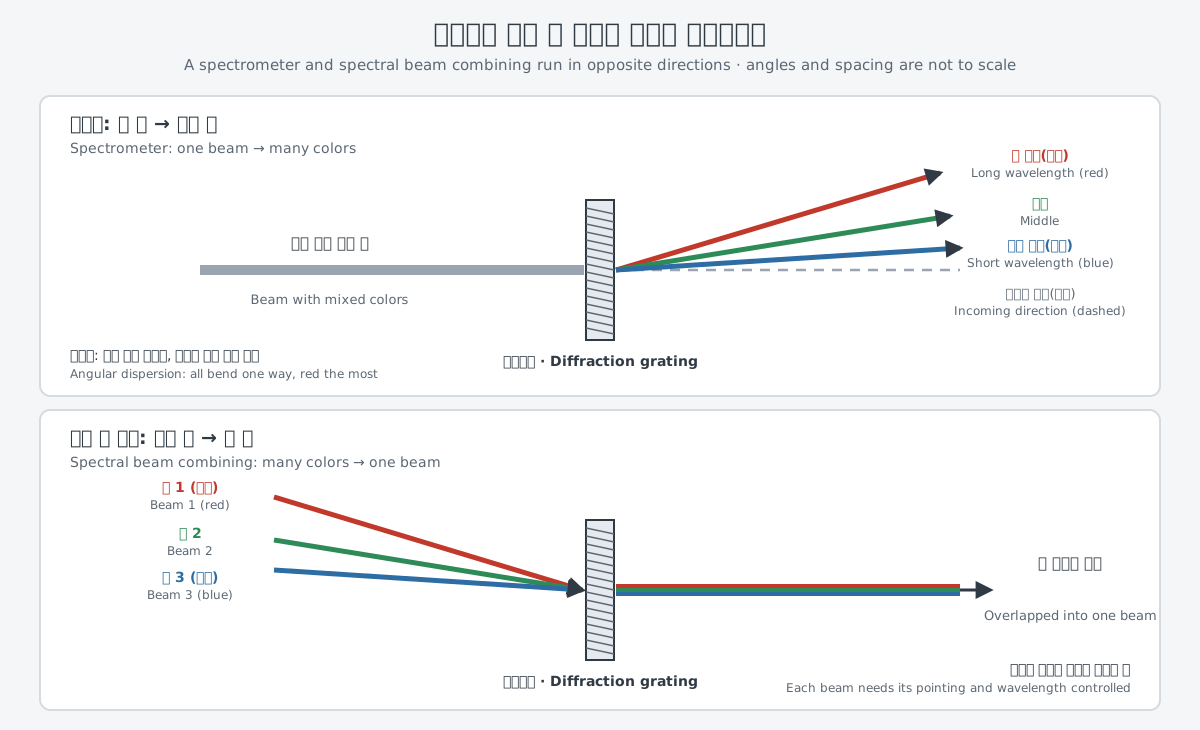
Spectral combining is also similar to wavelength-division multiplexing, which optical communications use to increase the number of channels one fiber can carry.
In spectral combining, two things have to be controlled. Besides the pointing of each beam, its wavelength has to be controlled too. The 2014 article sees this as the easier approach compared with coherent combining. Controlling wavelength is not as challenging as controlling phase, as coherent combining requires.
Power is not the only thing that grows. Wavelength beam combining can raise brightness as well as power. Assuming each emitter's spectrum is very narrow, combining diffraction-limited beams gives a combined beam that is also diffraction limited.
There are limits too. The first is bandwidth. The number of beams that can be combined is the total available bandwidth divided by the bandwidth given to each beam. The minimum bandwidth per beam is set by the dispersive optics that combine them.
The second is the surface of the optical parts. The intensity on those surfaces has to stay below the level that causes damage, and also below the point where thermo-optical effects start to cause significant optical aberrations.
The third is the linewidth of each beam. Linewidth is how widely the light's frequency is spread. As more beams are combined and each beam gets a narrower slice of bandwidth, at some point a beam's linewidth is no longer narrow enough. Its spectral content is then spread out by the grating, and the beam far away is no longer diffraction limited.
Combining in step: coherent beam combining
Coherent beam combining (CBC) combines beams that can interfere with each other by matching their phases. When several amplifiers are combined, they can all be fed light from a seed laser through a common frontend. The frontend is the front part that makes the seed light and sends it to the amplifiers. That creates the precondition for coherence between the output beams after amplification.
The flow can be pictured like this. Light from the frontend is split into several amplifier channels by a beam splitter, each channel is amplified separately, and a beam combiner brings the beams back together. However the combiner is built, the beams must be phased correctly so that they interfere constructively.
The trouble is that the phase does not stay still. During operation, drifts caused by heat and the environment in each channel cannot be avoided, so active stabilization is generally required. The 2014 article also names the challenge: with such short wavelengths, passive phase control without active sensing and control has proven difficult, with only limited success. By the time of the article, active phase sensing and control had made scaling to large arrays possible.
Continuous-wave and pulsed light also differ. Here, the coherence length is the value that sets the distance over which several beams can interfere with each other. When combining continuous-wave light, the coherence length of the output beams is longer than any path-length mismatch between channels, so phase control is often enough. In pulsed operation, the coherence length is much shorter, so the distances the pulses travel must also be precisely matched, in addition to the phase.
There are two main shapes for combining the beams. In the tiled-aperture approach, many beams are placed next to each other to build one larger beam, and they naturally spread as they travel until they overlap far away. It needs no combining element, but closing the gaps between beams is hard. The combined beam's intensity is uneven across its cross section, so a lot of power is lost to side lobes far away, which lowers the combining efficiency.
In the filled-aperture approach, the beams are overlapped both close up and far away. If their spatial phases and shapes are the same, the combined beam cannot be told apart from any single beam, so beam quality is kept. In return, it needs a combining element that actually overlaps the beams.
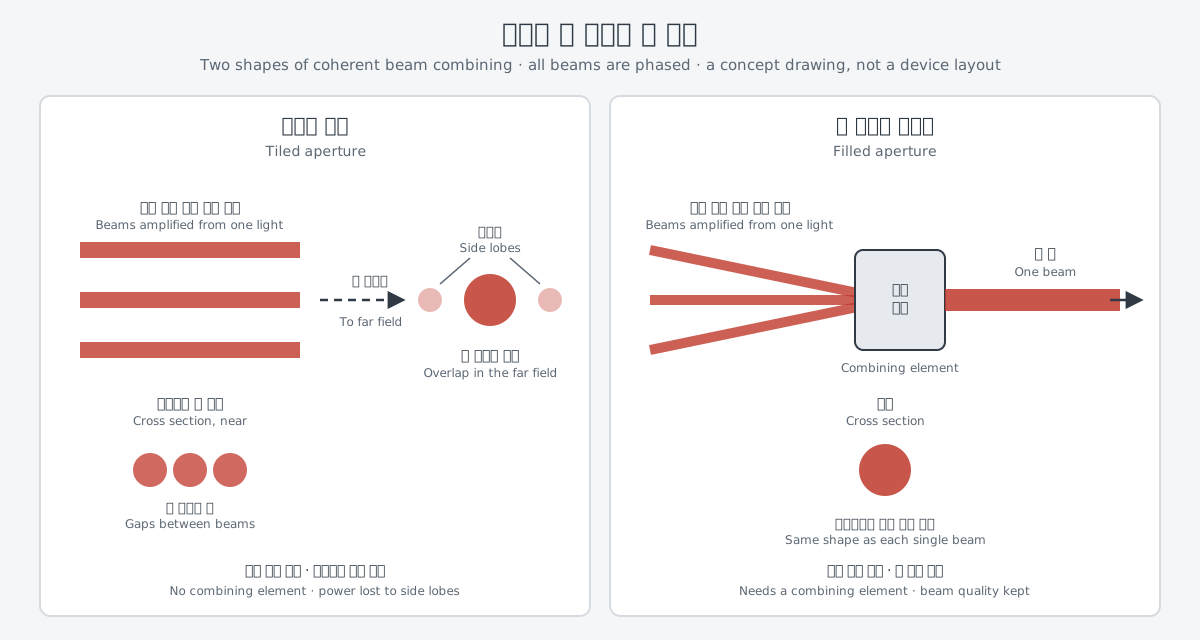
How well beams are combined is measured by the combining efficiency. The 2018 review names power efficiency as the most important performance figure in combining. Spatial combining efficiency is the ratio of the power in the combined beam to the sum of the power from all channels.
The higher the combining efficiency, the closer the properties of the combined light are to those of each channel. So lasers built on coherent combining mostly keep properties such as beam quality from the single amplifiers.
The review also offers an analogy that ties back to an earlier article. This spatial combining can be thought of as artificially enlarging the fiber's mode field diameter, without harmful side effects such as lower beam quality. Compare that with "Limits of a single fiber (1)," which said that enlarging the core to avoid scattering leaves another problem: modes.
Why fibers in particular? The concept of coherent combining does not depend on the amplifier design; it works as long as the amplifiers give mutually coherent beams. Even so, until the review was written, coherent combining had mostly been used with fiber lasers. One reason the review gives is that fiber lasers emit a high-quality, reproducible beam, which allows high combining efficiency.
There is a cost. The 2018 review holds that building systems with more and more amplifier channels, while keeping their complexity and cost under control, is still a focus of development. An ultrafast laser textbook puts the same concern this way. Coherent beam combining opens the way to even higher energy and average power, but it makes the whole system even more complex.
Today, coherent combining covers a wide range of implementations. The conclusion of the 2018 review opens by saying that coherent beam combining has matured from proof-of-principle experiments into a viable method for scaling laser performance.
Spectral and coherent combining in one table
The table sets side by side the two approaches that public sources explain in detail and compares what each has to control and what each costs.
| Item | Spectral beam combining (SBC) | Coherent beam combining (CBC) |
|---|---|---|
| Beams overlapped | Beams of different wavelengths | Beams that can interfere with each other |
| Coherence between beams | Outside the scope of coherent combining (2018 review) | Required. When amplifiers are combined, feeding them seed light from a common frontend creates the precondition |
| What must be controlled | Pointing and wavelength of each beam | Pointing and phase of each beam; for pulses, also the distance traveled |
| What overlaps the beams | A dispersive optical element such as a diffraction grating | A combining element for the filled aperture; none for the tiled aperture |
| Advantages named in the sources | Easier to achieve because controlling wavelength is not as challenging as controlling phase (2014 article). Raises brightness as well as power | With high combining efficiency, mostly keeps properties such as beam quality from the single amplifiers (2018 review) |
| Limits and costs named in the sources | Total available bandwidth, intensity and heat on optical surfaces, linewidth of each beam | Active stabilization needed because of drifts from heat and the environment. Complexity and cost grow with more channels. Tiled aperture loses power to side lobes |
Coherent combining is also tied to SBS from the earlier article. The coherence length, which sets the distance over which several laser beams can interfere, is in turn set by the laser's linewidth. Broadening the linewidth shortens the coherence length.
As "Limits of a single fiber (1)" showed, SBS is a particular problem in single-frequency amplifiers, which boost light with a very narrow linewidth. A 2026 review chapter on these amplifiers, an arXiv preprint, holds that broadening the linewidth suppresses SBS very effectively and keeps useful coherence for certain applications. Light broadened that way, though, goes beyond what is usually called a single-frequency laser. Broadening the linewidth to hold back SBS in one fiber also shortens the distance over which the beams can interfere.
Where beam combining is used
The 2018 review deals with ultrafast lasers. High-repetition-rate ultrafast laser systems have become an enabling technology for many industrial and scientific uses, from materials processing to exploring high-field physics. High-field physics deals with the fields of extremely strong light. These uses demand ever higher performance, and the 2018 review names coherent beam combining as one way to meet that demand.
Spectral combining looks toward industrial processing. The 2014 article says wavelength beam combining could let diode lasers replace other types of lasers in industrial uses such as metal cutting and welding. Its closing section looks ahead to direct-diode lasers using this technology that may, in time, replace fiber, disk and other lasers in demanding materials processing.
The same article's outlook mentions other uses too. If the lasers could be switched on and off one by one, new uses such as tailoring the wavelength for various spectroscopic sensing applications might become possible. The capability could also apply to optical, or infrared, laser communications that use several wavelengths.
There is also beam combining work aimed at defense. MIT Lincoln Laboratory published the 2014 article. Its Laser Technology and Applications group introduces itself as developing solid-state, fiber and diode laser technologies for science and defense. In the same introduction, it lists beam-combining techniques for high-energy laser systems.
What to read next
- "The principles of coherent beam combining: reading public review papers": takes the coherent combining introduced here only as a concept and reads one step further into it through public review papers.
- "Beam quality: M², divergence and brightness": shows how the "diffraction-limited beam" and "brightness" mentioned here are measured with M² and divergence.