It is easy to picture a laser as one machine that does two jobs at once: it makes light, and it makes that light strong. Some lasers hand those two jobs to separate parts.
This article follows what the two parts are, why anyone separates them, and which difficulties remain, using two diagrams and public sources. The part that makes the light is the oscillator. The part that makes it stronger is the amplifier.
A layout that makes weak light in an oscillator and then strengthens it in an amplifier has a name: the master oscillator power amplifier (MOPA). The part that makes the light first is the master oscillator, also called the seed laser.
The oscillator: where light is made
First, a short reminder of the three parts of a laser from the previous article. The gain medium is a material that can make passing light stronger, and pumping is putting energy into that material from outside. The optical resonator is a device that sends light back into the gain medium so it passes through many times. The previous article, "The three parts of a laser: gain medium, pump and resonator," explains these three parts in detail.
An oscillator is a device that has all three of these parts. A resonator is attached to the gain medium as the feedback device, and together they make light.
The letters in LASER, though, point to amplification, not oscillation. They stand for light amplification by stimulated emission. In stimulated emission, a photon of the right energy meets an excited atom, and the atom releases one more photon. The new photon travels in the same direction, with the same frequency and the same phase as the first one.
So a device that amplifies light and a device that makes light oscillate get separate names: the first is a laser amplifier, and the second is a laser oscillator. A 2005 review paper by H. Cao (Journal of Physics A) draws this distinction and cites Siegman (1986) for it. Lasers are sometimes used as amplifiers alone, but oscillation is the more common case, and it needs both amplification and feedback.
The two names also appear side by side in the Nobel record. The 1964 Nobel Prize in Physics went to fundamental work that led to "the construction of oscillators and amplifiers based on the laser-maser principle."
The amplifier: where incoming light is made stronger
An amplifier is an oscillator with the mirrors taken away. It has a pumped gain medium, and light that comes in from outside grows by stimulated emission as it passes through.
The condition for an amplifier is net gain. That means the gain the light receives must exceed the losses. A device that meets this condition is an amplifier, and it needs feedback as well before it becomes an oscillator.
Take a gas as an example. A gas that is pumped to achieve inversion and used to amplify light via stimulated emission is an optical amplifier. The diagram and table below put the two devices side by side.
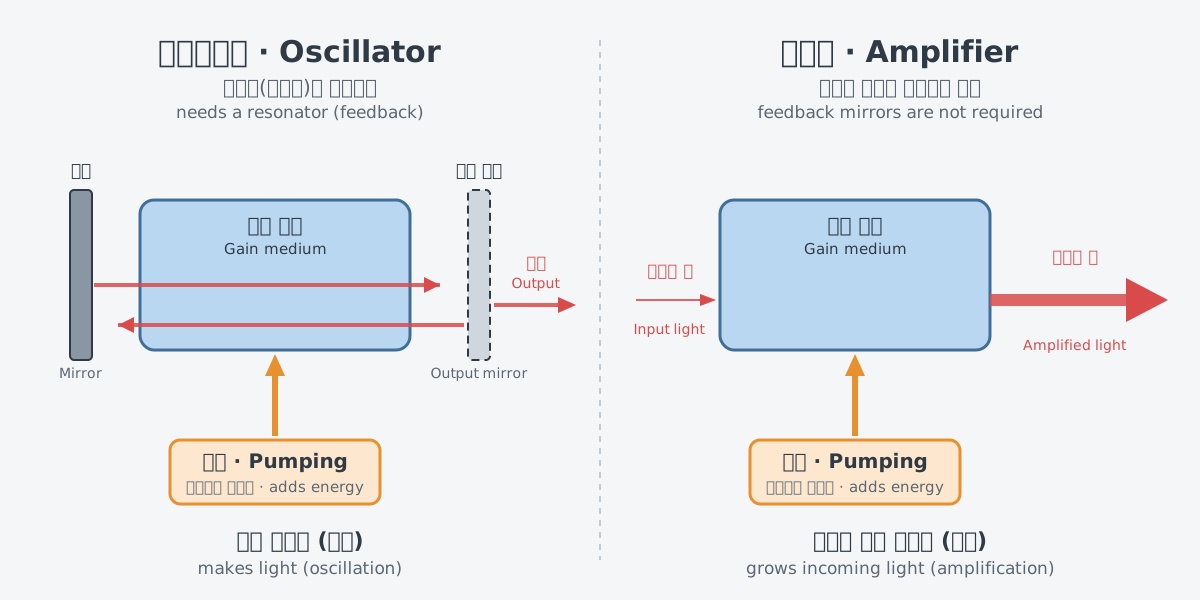
| Comparison | Oscillator | Amplifier |
|---|---|---|
| What the name refers to (Cao 2005) | Oscillation of light | Amplification of light |
| What it must have (Illinois notes) | Both amplification and feedback | The net gain condition |
An oscillator is like an instrument that makes a sound, and an amplifier is like a sound amplifier that makes that sound louder. In practice, the two differ from this picture. An oscillator also has a gain medium inside that makes light stronger.
An amplifier can give off light even with no input. An excited atom can drop to a lower state on its own and give off a photon, which is called spontaneous emission, and an amplifier can strengthen those photons. The section "What goes wrong during amplification" comes back to this effect.
Why not build one big laser from the start
Why not simply keep raising the output of the oscillator? When the output has to be very high, there are cases where one oscillator cannot easily give the light that is wanted. Take the fiber laser: the hard cases are high-energy pulses with tunable pulse duration and repetition rates, or high-power light at a single frequency. A high-power oscillator has thermal and nonlinear constraints, so this kind of light is not easy to get from the oscillator directly.
This is where a structure that separates the two jobs comes in. In the words of Coherent, a manufacturer, generating a seed pulse in one step and amplifying it to high power in another helps with several critical challenges. Maintaining pulse quality at high power or energy levels is one such challenge, and ensuring spectral purity is another. Spectral purity means how close to a single color the light is.
In fiber lasers, with making and amplifying kept apart, there is much greater flexibility and much more room to control performance than in a simple oscillator. When the required power is very high, the required linewidth, wavelength tuning range, beam quality or pulse duration can be easier to reach with a MOPA. Linewidth is a measure of how narrow a range of wavelengths the light covers, and pulse duration is the time one pulse lasts.
A 2014 arXiv paper on fiber lasers shows how both sides stood at that time. On the oscillator side, there was a report of 1 kW output. It came from a fiber laser with linear polarization, meaning one fixed direction, in a resonator that uses a pair of fiber Bragg gratings (FBGs) as its two mirrors. The paper calls the design of an FBG that can withstand multi-kilowatt power a technological challenge, and it expects that raising the power further may bring difficulties.
Separating the jobs does not remove every difficulty. In this paper's view, fiber laser systems based on MOPAs are typically capable of reaching high output powers. They also offer more flexibility in linewidth and polarization control than a simple grating-based laser. Even so, scaling linearly polarized MOPAs to the multi-kilowatt level was, at that time, limited by the onset of mode instabilities.
MOPA: make it small, then amplify
In the glossary of Coherent, a manufacturer, a MOPA is an architecture used in high-performance laser systems, and it has two main parts. The first part, the master oscillator, generates a "seed" signal with specific characteristics such as wavelength, linewidth and pulse duration. This signal is low in power and tailored to the performance the application requires.
The second part, the power amplifier, is the amplifier described earlier, and it significantly boosts the output power of the seed signal. Coherent says the original qualities of the seed signal from the oscillator are maintained in this step, and it calls the master oscillator the heart of the MOPA system.
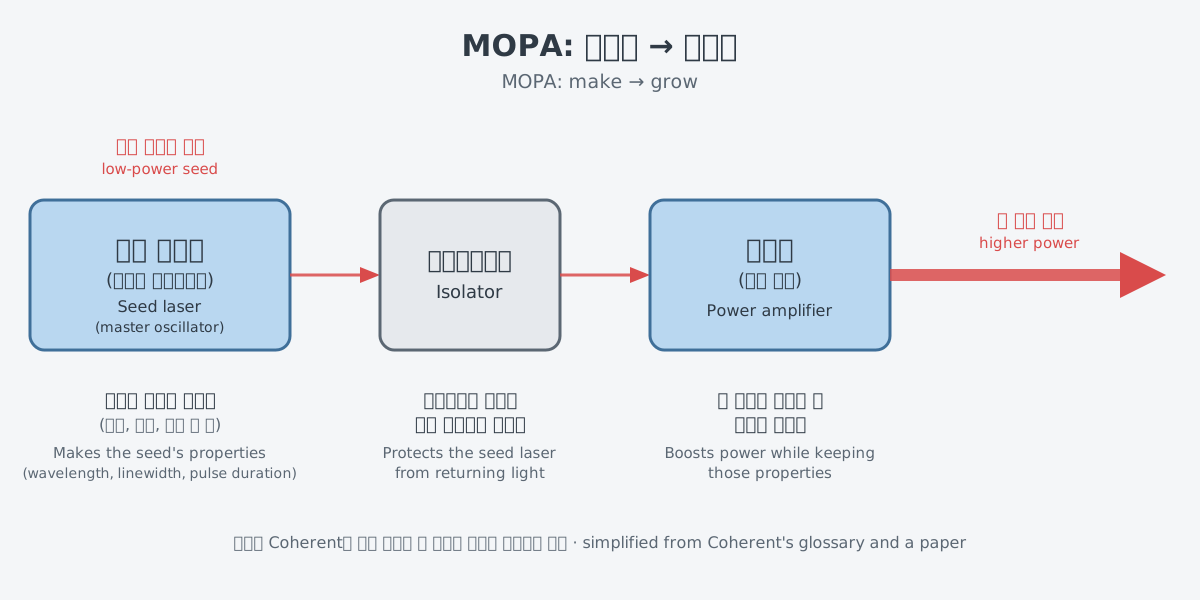
The front of a MOPA is where the properties of the light are set. The back is where the power grows while those properties are kept as far as possible. The problems that appear during that growth are covered below.
The idea of making a small amount of light and then strengthening it also appears in the description of the National Ignition Facility (NIF) at Lawrence Livermore National Laboratory (LLNL). NIF laser pulses are generated in the Master Oscillator Room from an optical fiber laser. The equipment in that room generates low-energy laser pulses, which are then amplified before being injected into the NIF laser amplifiers.
The name MOPA does not appear in the LLNL description. That the master oscillator is a fiber laser describes NIF; it is not a general rule for MOPAs.
Papers on high-power fiber lasers describe this layout too. The 2014 paper mentioned above says that most high-power fiber laser systems with random polarized output were then based on MOPA, reaching output power as high as tens of kilowatts.
A 2026 arXiv chapter on fiber amplifiers gives its own assessment. A MOPA made of double-clad active fibers, it says, has so far proven one of the most effective architectures for high power with diffraction-limited performance and the desired optical properties. Active fibers are fibers that act as the gain medium, and diffraction-limited means a beam that is focused as tightly as theory allows.
What goes wrong during amplification
The amplifying side has four difficulties of its own.
- Returning light. Light scattered backward (linear and nonlinear backscattering) can destabilize or damage the seed laser. This is why, in the 2026 arXiv chapter on fiber MOPAs, the first thing the seed signal passes through is an optical isolator. An isolator transmits light in one direction but not in the opposite direction, and it protects the seed laser from returning light.
- Gain saturation. When increasing the signal power yields only a marginal increase in gain, the amplifier shows gain saturation. Most excited ions, the particles that make light stronger, are already contributing to amplification. An amplifier has a limit to how much it can make light stronger.
- Amplified spontaneous emission (ASE). In the absence of input light, photons that excited atoms emit by spontaneous emission are amplified instead. This is the effect described earlier, where an amplifier gives off light even with no input.
- Damage to the amplifying material. Researchers have tried to make more intense pulses ever since lasers were invented. But according to the Nobel Foundation's 2018 popular information, by the mid-1980s it was no longer practically possible, for short pulses, to increase the intensity of the light without destroying the amplifying material.
Oscillators also have something called gain saturation. A mode is a pattern of light that survives and oscillates in the resonator, and the gain of such a mode stays clamped at its threshold value. The threshold value is where stimulated emission just makes up for the losses in the resonator. This clamping is also called gain saturation, but its context differs from the amplifier case above.
What to read next
The article below is the suggested next read.
- "Q-switching and mode locking: two ways to make short pulses": it continues with two ways an oscillator can send out light as short pulses.