The problem of feeding strong pump light into a thin core
A fiber laser amplifies light in its core, the thin path down the middle of a glass fiber. The energy for that comes from outside, as pump light. The more output a laser needs, the stronger its pump light has to be.
So why not send strong pump light straight into that thin core? It is harder than it sounds. A single-mode core lets light travel in only one pattern. To couple pump light into such a core efficiently, the pump source itself has to be a single-mode laser.
A high-power fiber source can be set up so that a seed laser makes weak light and a fiber amplifier builds it up. This setup is called a master oscillator power amplifier (MOPA), and the light being amplified is called the signal.
A review chapter on high-power single-frequency fiber amplifiers, posted as a preprint on arXiv in 2026, shows the problem well. In a single-mode fiber amplifier with only one layer of cladding, the single-mode pump laser it needs is typically limited to around 100 mW. Enlarge the core to use a much stronger pump, and higher-order modes appear. The signal output then often turns speckled, and the beam quality suffers.
There is a way to take in strong pump light and still keep the beam clean: give the pump light and the laser light separate paths. A double-clad fiber (DCF) holds both paths in a single strand.
Two paths in one fiber: the double-clad structure
Double-clad fibers were pioneered by Snitzer and colleagues. The idea was to decouple the core size for the pump light from the core size for the signal light. The review chapter cites two conference talks from 1988 and 1989 for this point, and the title of the 1988 talk already includes the words "offset core."
The cross-section has three layers. In the middle is a single-mode core doped with a rare-earth element such as ytterbium. Two undoped claddings surround it. The refractive index is highest in the core and lowest in the outer cladding.
In a double-clad fiber amplifier, the signal to be amplified goes into the core, and the pump light goes into the inner cladding. The signal stays inside the doped core. The pump light travels through a larger "core" made of the inner cladding and the doped core together. Seen from the pump light's side, the inner cladding is a big core wrapped in the outer cladding.
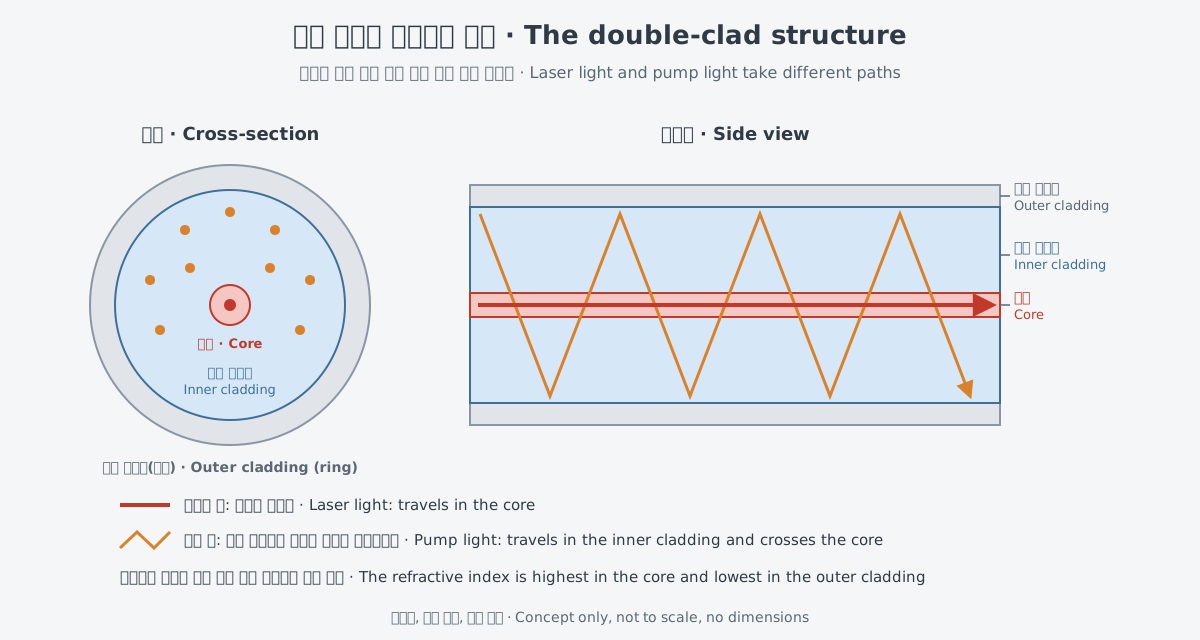
Splitting the paths pays off. The inner cladding can be much larger than the core, and its numerical aperture (NA) can be much larger too. That makes it possible to couple strong pump light efficiently even from low-brightness sources, such as multimode single-emitter or multi-emitter diode lasers.
Here, "low brightness" is measured against the laser output. Diode-pumped solid-state lasers are typically pumped by high-power semiconductor diode arrays or bars. The individual diode lasers in an array or bar are not coupled to each other, so the spatial coherence of the emitted beam is greatly reduced. Even so, the light from such an array is still much brighter than a normal flashlamp.
Light with such low coherence is hard to put efficiently into a thin single-mode core. As noted above, efficient coupling into that kind of core needs a single-mode pump laser. A wide inner cladding with a large NA can take in this light as well.
A 2010 review abstract by Richardson, Nilsson, and Clarkson describes a dramatic rise in output power from rare-earth-doped fiber sources over the decade before, through cladding-pumped designs. It credits that success largely to the fiber's geometry, its long, thin shape. That shape gives considerable resilience to heat generated in the core and makes it easier to efficiently convert fairly low-brightness diode pump light into high-brightness laser output.
How the core absorbs the pump light
Picture a large room with a single pillar in the middle and several balls bouncing off the walls. A ball only touches the pillar when it happens to pass by it. The thinner the pillar, the rarer those touches become.
Real pump light does not move like a few balls. In a multimode laser, each spatial mode lases on its own, and their intensity patterns add up incoherently. As a result, the intensity of the pump beam spreads out almost evenly across the inner cladding and the core, and the part that overlaps the core is absorbed. The comparison only holds on one point: light is absorbed only where it passes through the core.
IPG Photonics describes this process when it presents its own side-pumping technique. The pump light reflects many times inside the cladding and often crosses the single-mode core. There, rare-earth ions in the core absorb the light and emit it again.
The catch is that only a small share is absorbed at a time. The absorption coefficient of a cladding-pumped fiber is lower than with core pumping, and it scales roughly with the ratio of core area to cladding area. The absorption coefficient tells how much pump light is absorbed over a given length. The smaller the core's share of the cross-section, the weaker the absorption.
Why the shape of the inner cladding matters
How much pump light gets absorbed depends a great deal on the shape of the inner cladding. The simplest design makes all three layers, the core, the inner cladding, and the outer cladding, round and centered on the fiber axis. It is easy to make, and pump light is easy to couple in.
But a round cross-section carries many higher-order pump modes that barely overlap the core. That light is not absorbed, and a significant amount of pump power goes to waste. In terms of the comparison above, these are balls that keep circling the pillar without ever touching it.
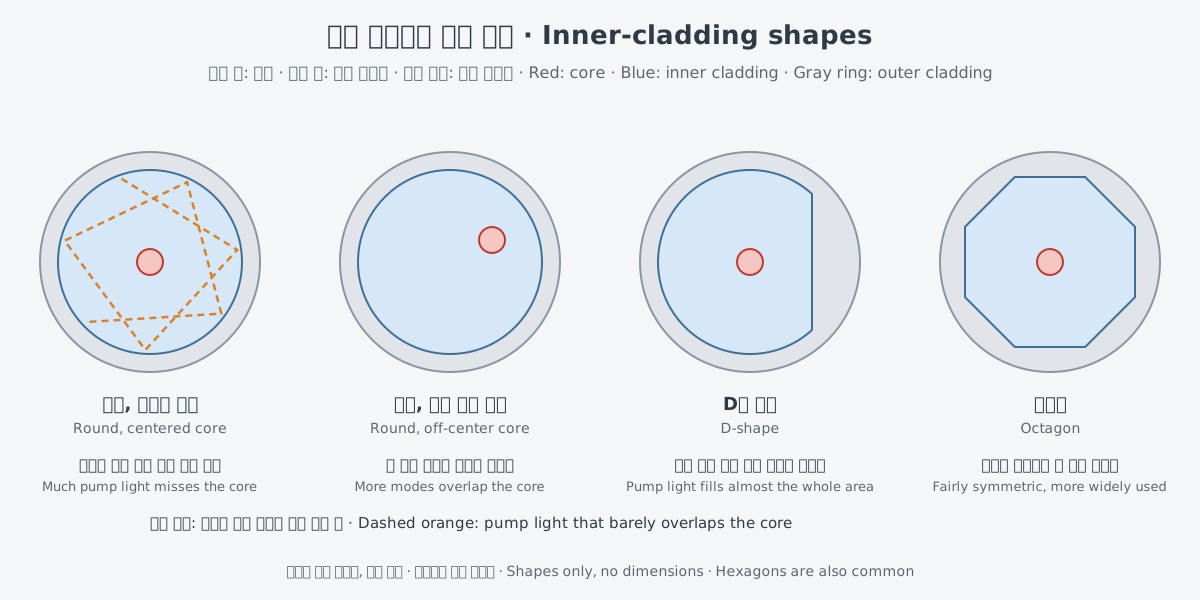
An effective way to raise absorption is to break the round symmetry. One way is to move the core off center, so more modes overlap it. Another is to give the inner cladding a shape that is not a circle. Chaotic shapes, such as a D-shape, which is a circle with one straight cut, or a stadium shape, push the pump modes across almost the whole cross-section and raise absorption.
Is a more irregular shape always better? No. Irregular shapes make it hard to launch pump light with low loss. That is why fairly symmetric shapes, such as hexagons or octagons, are more widely used.
Where the pump light goes in: the end and the side
The part that couples pump light into the gain fiber is called a pump–signal combiner. Some are built entirely from fiber, and others go through free-space optics in open air.
The name depends on where the combiner sits. At the fiber input it is co-pumping, at the output it is counter-pumping, and at both ends it is bidirectional pumping. In distributed pumping, the combiner sits partway along the gain fiber to extend the length over which the light actually grows.
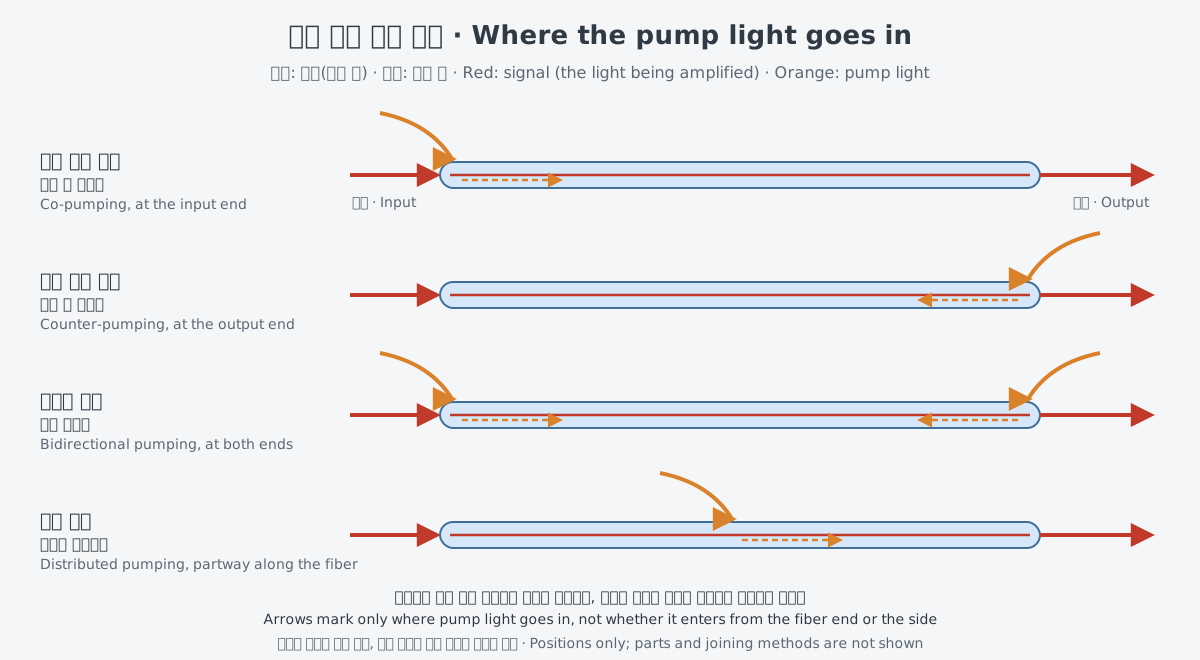
In all-fiber setups, pump light enters from the fiber end or the side. In an end-pump combiner, the diameter of the signal core changes along the combiner, which can hurt performance in some uses. Side-pump combiners work for co-, counter-, and distributed pumping, and the core that carries the signal keeps the same width from one end of the device to the other.
Some companies build on the side approach. IPG states that the cornerstones of its fiber laser technology are a cladding side-pumping technique and a distributed single-emitter diode pumping architecture. In the company's account, this technique efficiently couples the light from many pump diodes into the cladding of the gain fiber.
Solid-state lasers built on crystals have a similar-sounding split. Diode-pumped solid-state lasers are typically divided into longitudinal pumping and transverse pumping. In the low-power range, longitudinal pumping generally gives a much better pump efficiency, because only the volume of the laser mode in the crystal is pumped. The names look alike, but this split is about crystal lasers, so it should not be read as the same thing as end and side pumping in fibers.
Pump diodes
Fiber amplifiers are commonly pumped by fiber-coupled diode lasers. A laser diode used this way as the pump source is called a pump diode. It can be a single emitter, with one emitting spot, or a laser bar, with a row of emitters in one dimension. The choice depends on the power, brightness, and coupling setup that are needed.
Which diode to use goes hand in hand with where the pump light goes. Pumping the core directly needs single-mode diodes, and their average output power is relatively low. For higher power, multimode pump diodes such as broad-area chips or laser bars are the most practical option.
Light from a multimode diode has a large beam size and spreads more, because of its higher-order modes. That light is hard to fit into a small core. The double-clad fiber gets past this problem. It lets the pump light couple efficiently into a large inner cladding with a high NA.
Pump diodes make heat too. According to the pump-laser section of the review chapter, high-power pump modules have a wall-plug efficiency of around 50–80%, the share of electricity they turn into light. The power that does not become light turns into heat. That heat often has to be removed with liquid-cooled metal plates, called cold plates, or with thermoelectric coolers.
The pump wavelength is a choice as well. When a diode heats up, the wavelength of its light shifts a little. Pumping inside a broad, flat absorption band makes the system less sensitive to this wavelength drift in the pump.
The review chapter gives an example: in lasers and amplifiers built on ytterbium-doped fiber (YDF), it is common to pump around 915 nm or 940 nm instead of 976 nm. Absorption peaks at 976 nm, but that peak is spectrally narrow.
Some systems instead pump closer to the signal wavelength. In diode-pumped solid-state lasers, too, heating effects drop further when the pump energy is close to the laser energy. In a fiber amplifier, moving the pump wavelength toward the signal likewise aims to cut heating from the quantum defect. When no high-power diode exists at the desired wavelength, a fiber laser can serve as the pump instead, an approach called tandem pumping.
Fibers with a larger core: large-mode-area (LMA) fibers
Compared with bulk gain media such as laser crystals, fiber amplifiers have clear advantages. Light guiding gives excellent beam quality, a long gain length gives high pump efficiency, and a large surface-to-volume ratio sheds heat well. But packing a lot of power into a small core makes the intensity very high. That readily triggers nonlinear optical effects, which limit how far fiber lasers can scale in power.
What happens when the core gets bigger? A larger core area gives a larger effective mode area, so the intensity drops for the same power. The review chapter, which is about single-frequency amplifiers, treats this as one way to suppress stimulated Brillouin scattering (SBS).
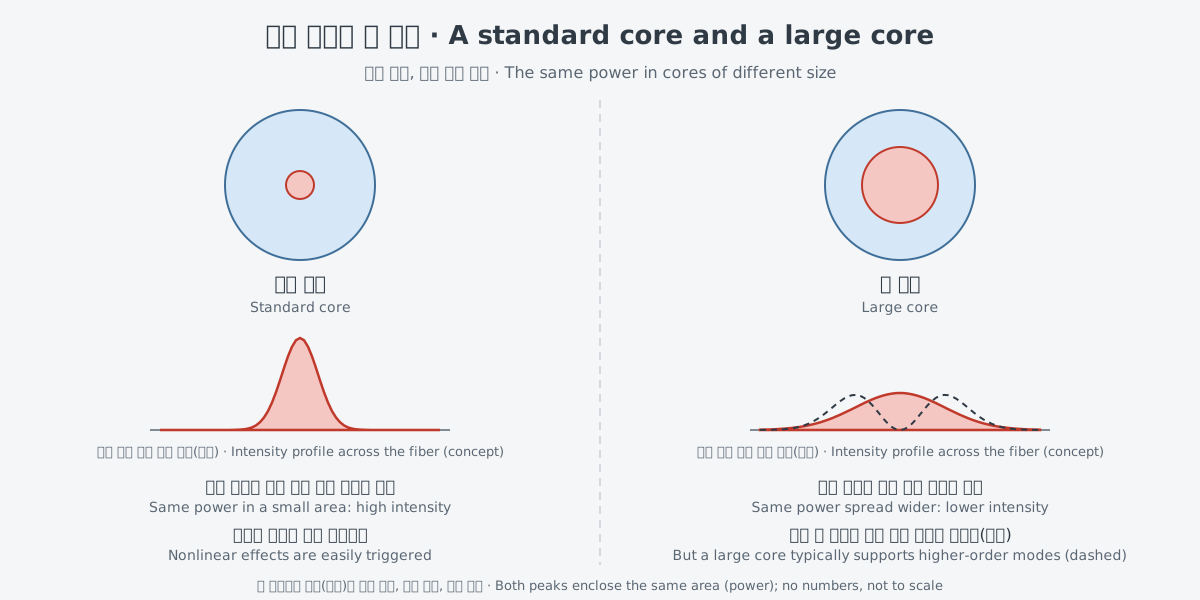
There is a price. A large core typically supports higher-order modes too, and their interference makes the output beam speckled. That is why various fiber designs have been developed to enlarge the core while keeping single-mode operation. A fiber whose mode covers a larger area, as the name says, is called a large-mode-area fiber (LMA fiber).
One common approach is to lower the NA of the core to offset the larger core area. The trade-off is that the fundamental mode is only weakly confined. As a result, such a fiber loses light more easily when it bends.
Another route is mode-filtering designs, including photonic crystal fibers. The cladding structure is engineered so that higher-order modes in the core resonate with cladding modes and leak away first. An LMA photonic crystal fiber also appears in an ultrafast-laser textbook, as an example of a new fiber for compressing pulses at high average power.
Product descriptions show the same trade-off. Coherent (formerly Nufern) lists a "few-moded" core design as a feature of its LMA ytterbium-doped double-clad fiber. In the company's description, this design makes a single-mode beam easy to keep through the fiber and its components. A bigger core lowers the intensity, but keeping the modes under control becomes the new task.
The limits that remain
Double cladding and larger cores have not solved every problem. The 2010 review abstract names the key factors that limit fiber laser performance in different operating regimes, in particular thermal management, optical nonlinearity, and damage.
Heat also builds up outside the core. Pump modules turn the power that does not become light into heat, as shown above. All-fiber combiners may contain several splice points that carry strong pump light, and pump light can scatter at those interfaces. When that stray light is absorbed, it causes significant heating, so removing the heat well is essential to prevent damage.
In single-frequency fiber amplifiers, the nonlinear effects with the lowest thresholds are stimulated Brillouin scattering and transverse mode instability (TMI). SBS is the nonlinear backscattering of light by sound waves induced by optical forces. TMI is a dynamic coupling between the fundamental mode and higher-order transverse modes, driven by thermo-optic effects.
Higher-order modes show up in TMI too. They are worth keeping in mind alongside the earlier point that a bigger core lowers intensity but typically supports higher-order modes as well. What these two effects are, and why they limit output, are the subjects of the next two articles.
What to read next
- "Limits of a single fiber (1): nonlinear effects (SBS, SRS)": explains the idea behind the scattering effects that appear as output rises.
- "Limits of a single fiber (2): heat and mode instability": explains how heat can shake the beam quality.