Some systems bring the beams of many fiber lasers into step and merge them into one. Their first stage is a single light source with a very fine linewidth. After that light is amplified a little, it soon goes into a phase modulator that broadens its spectrum. Why widen light that took such care to make narrow?
Because two demands collide. Combining many beams calls for light with good coherence and a narrow line. But when narrow light is amplified hard in a fiber, light starts coming back the wrong way. This article covers what a seed source does, why narrow light invites that effect, how shaking the phase widens the line, and how far to go.
The seed source: the front of the amplifier chain
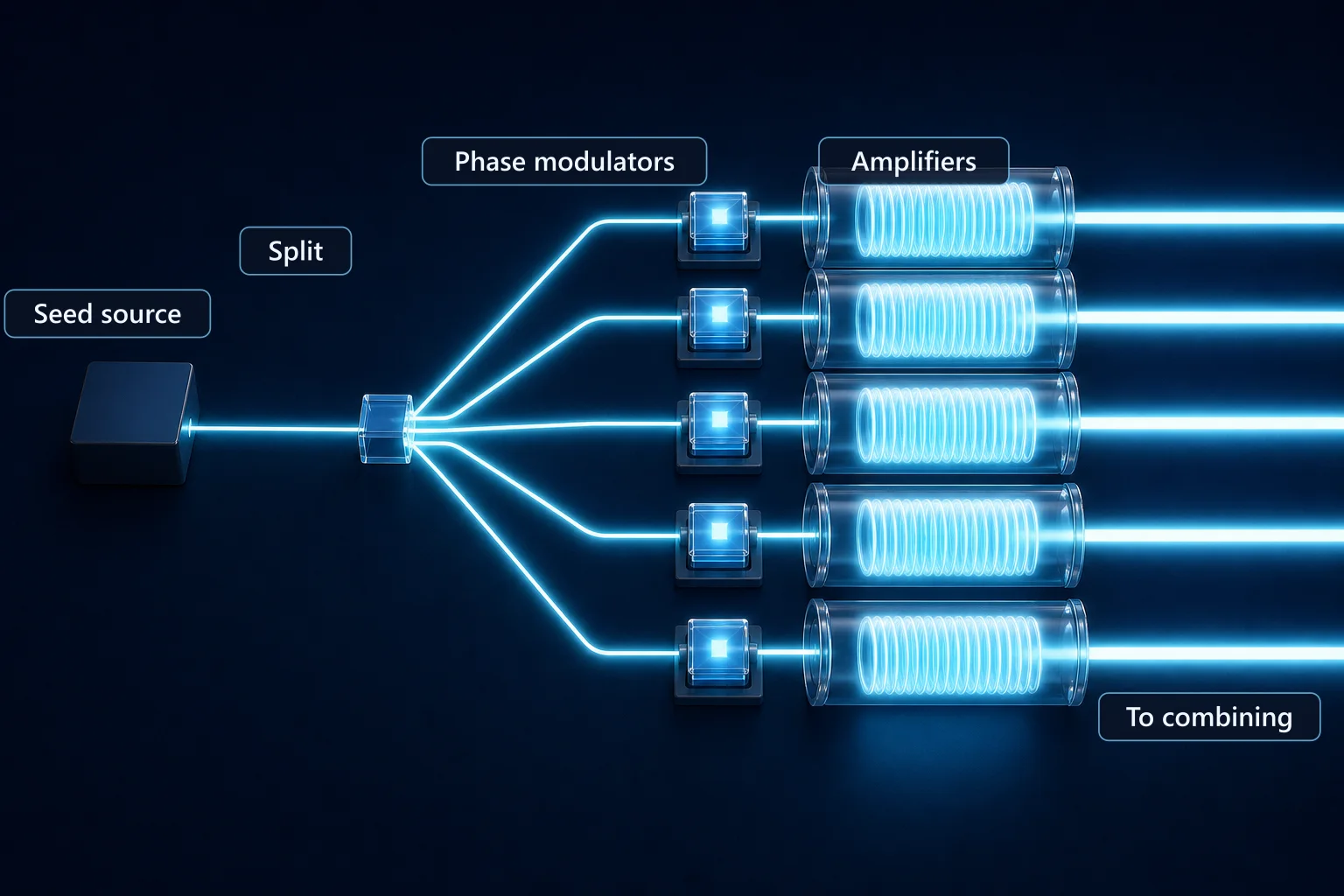
Strong light does not have to be made from the start. One layout makes a small light first and then grows it with amplifiers. Its short name is MOPA, for master oscillator power amplifier, and the part that makes the first light is the seed laser, or seed source.
The seed has little power, but it decides what the light is like. Wavelength, linewidth and pulse duration are set here, and the amplifiers that follow raise the power a lot while keeping those qualities.
It is a bit like a big amplifier that cannot change the character of a recording made in the studio. The real case differs, though. A light amplifier can create new problems at high power that the seed never had, and that problem is the subject of this article.
In a laser that combines beams, the seed has one more job. When several amplifiers take their seed light from a common front end, this creates the precondition for coherence between the amplified output beams. Because the light was split from the same seed, it can be brought into step later.
What a narrow linewidth means
Linewidth tells how widely the frequencies in a light are spread. Light with a narrow linewidth oscillates at almost a single frequency. The coherence time is roughly the time span over which two parts of a laser field can stably interfere, and it grows as the line gets narrower.
Both main ways of combining beams want this. Coherent beam combining (CBC) makes beams interfere into one beam, so the longer and steadier they interfere, the better. Spectral beam combining (SBC) gives each beam its own wavelength. Even there, each channel needs a narrow spectrum to keep its beam quality after the combining element.
Why narrow light is prone to SBS
When strong light travels through a fiber, it can set up sound waves in the glass. Light can then bounce off those sound waves and head backward.
This is stimulated Brillouin scattering (SBS). The returning light can grow and damage parts upstream. How the sound waves form and what sets the threshold are covered in "Limits of a single fiber (1): nonlinear effects (SBS, SRS)".
Why is narrow light especially at risk? The band of frequencies in which Brillouin scattering adds gain, its gain spectrum, is very narrow. A 2026 review chapter on single-frequency amplifiers, posted as a preprint, explains the result. When the laser line is much narrower than that band, nearly every frequency part of the light feeds SBS together.
Think of a radio receiver tuned to a single frequency. If a station puts all its power on that one frequency, the receiver rings loudly. If the same power is spread across many frequencies, the share reaching that receiver drops.
The real case differs. In SBS the "receiver" is not a separate device. It is a sound wave the light itself creates in the glass, and a large share feeds back and makes it grow.
Shaking the phase widens the line
So the line is widened. Broadening the laser line is the established fix for the Brillouin effect, and the part that does it is an electro-optic phase modulator. When the same energy is spread over a wider range of frequencies, less of it falls inside the narrow gain band, and SBS grows less. Laser systems are used outdoors, so this modulator also has to be insensitive to temperature changes.
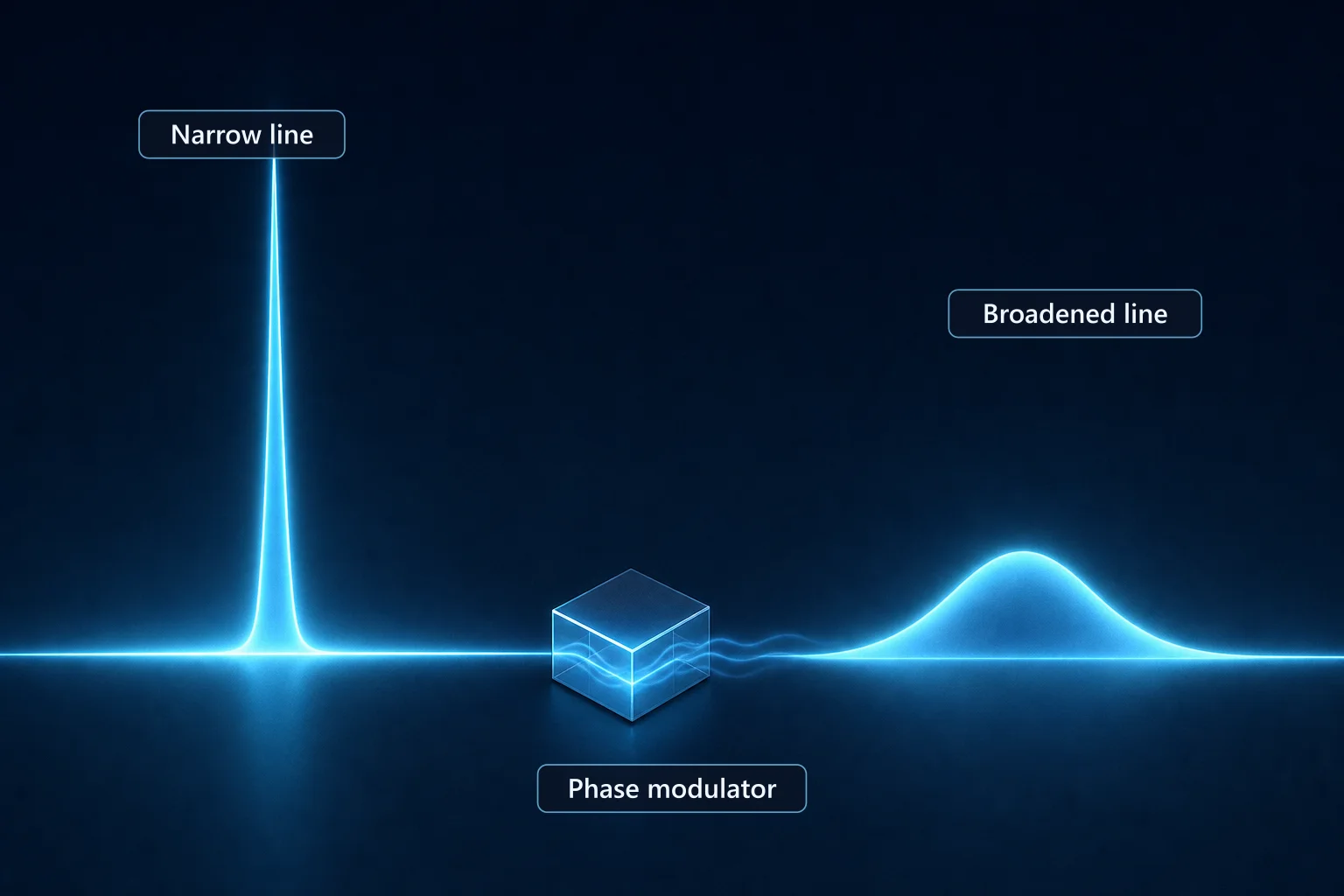
How does shaking the phase widen the frequency? How far the instantaneous frequency of light strays from its original value is set by how fast the phase changes over time. So if the phase is shaken to run faster and slower, the frequency drifts a little from its original value moment by moment.
Gather those shifted frequencies, and the needle-like line becomes a low, wide hill. Phase noise broadening a single-frequency laser's line is the same story, and a phase modulator causes this effect on purpose, in a controlled way.
The energy does not vanish. The same energy is laid out over a wider range of frequencies, so the peak gets lower. What changes is how the energy is arranged across frequency.
Widening with noise, widening with a fixed pattern
There is also a choice in how to shake the phase. Common drive signals for the modulator are white noise, pseudo-random bit sequences (PRBS), and blends of several sine waves. The company nLIGHT also offers a seed source whose line is broadened by built-in white noise.
White noise is noise that does not depend on frequency. Shaking the phase with such a signal spreads the light's energy fairly evenly over a wide range.
A sine wave is different. A shake that repeats on one beat moves energy to set spots around the original frequency. A textbook passage on active mode locking makes the same point: periodic modulation moves optical energy into neighboring frequencies.
PRBS mixes the two characters. It is a bit sequence made by a fixed rule, yet it looks random from the outside. Public sources do not say which signal a given system picks.
How far to widen: the trade-off
Wider lines mean weaker SBS, but the line cannot be widened freely. The fiber and the layout of the amplifier set how much widening is needed, and the widening is held to what is truly required. The cost shows up on the combining side.
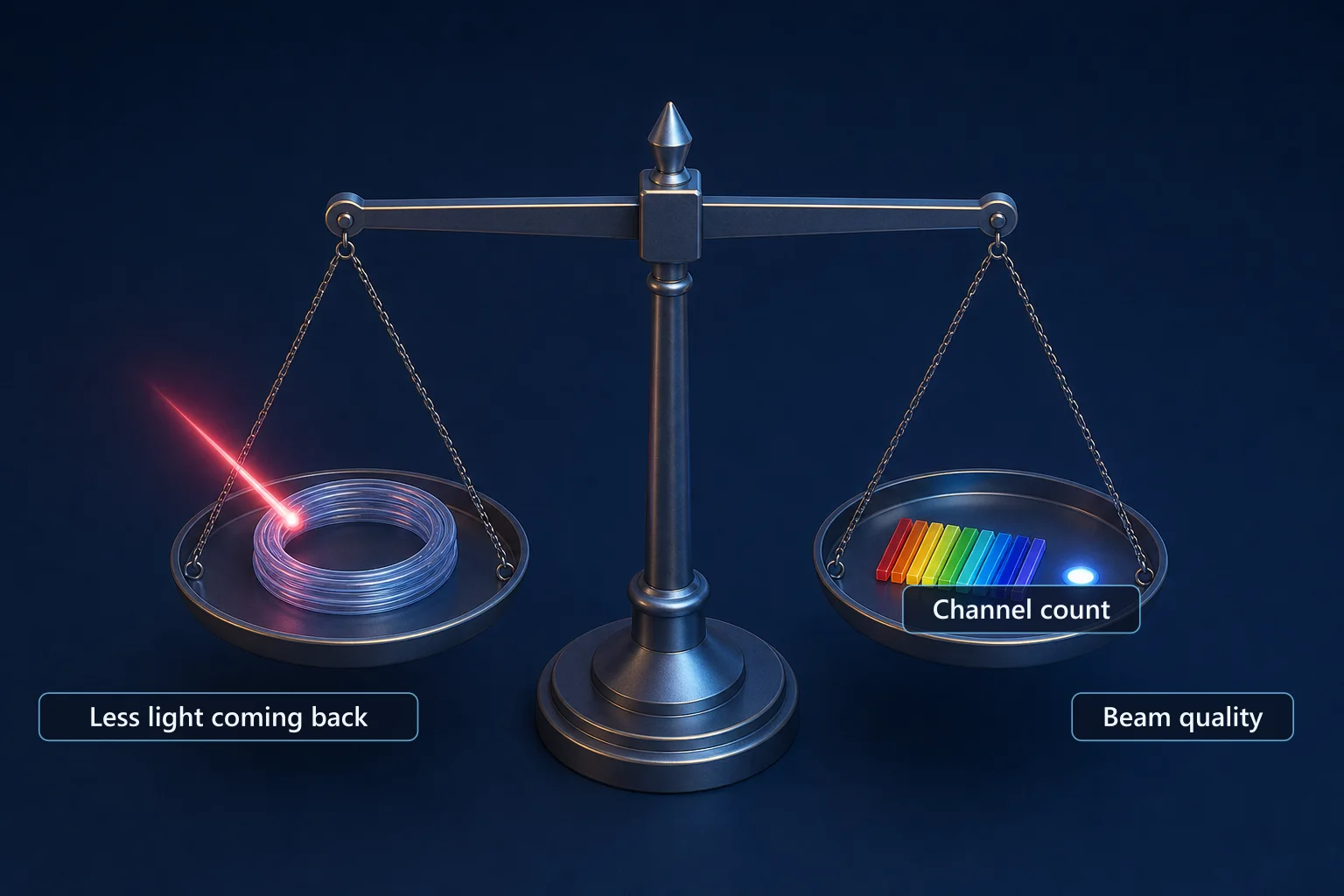
In spectral combining, the cost shows up in the beam's shape. A dispersive part such as a diffraction grating sends each wavelength in a different direction. If one channel's line is wide, the many wavelengths inside it bend at slightly different angles, and one beam fans out.
So a wider line lowers beam quality after combining and leaves room for fewer channels within the fixed gain band. How channel slots are shared continues in "Spectral beam combining in detail".
In coherent combining, the cost shows up as length. A wider line shortens the coherence length, so the path each beam travels has to be matched more precisely. One maker's coherent combining setup includes a variable optical delay line on each beam to even out path lengths.
When the seed drops out
In coherent combining, the same kind of phase modulator also keeps the beams in step. That flow is covered in "Walking Through a Coherent Beam Combining System: From Seed to One Beam". Here the focus is one risk on the seed side.
The seed is the starting point of the whole amplifier chain, and the widened line also comes from the seed and the modulator after it. So a problem at the seed can put the amplifiers behind it at risk. The company nLIGHT says its narrow linewidth amplifiers include systems that guard them in cases such as losing the seed, but it does not say how they work.
A small seed and a phase modulator are easy to overlook inside a laser weapon. Even so, how many beams can be combined, and how far one amplifier can be pushed, are both tied to the choice of these two parts.
What to read next
- "Pump Modules: Putting Chip Light into One Fiber": how pump light, the fuel that grows the seed light, is put into fiber.
- "Limits of a single fiber (1): nonlinear effects (SBS, SRS)": a deeper look at the SBS that made the line widening necessary.
- "Walking Through a Coherent Beam Combining System: From Seed to One Beam": the whole system that splits the seed and keeps the beams in step.