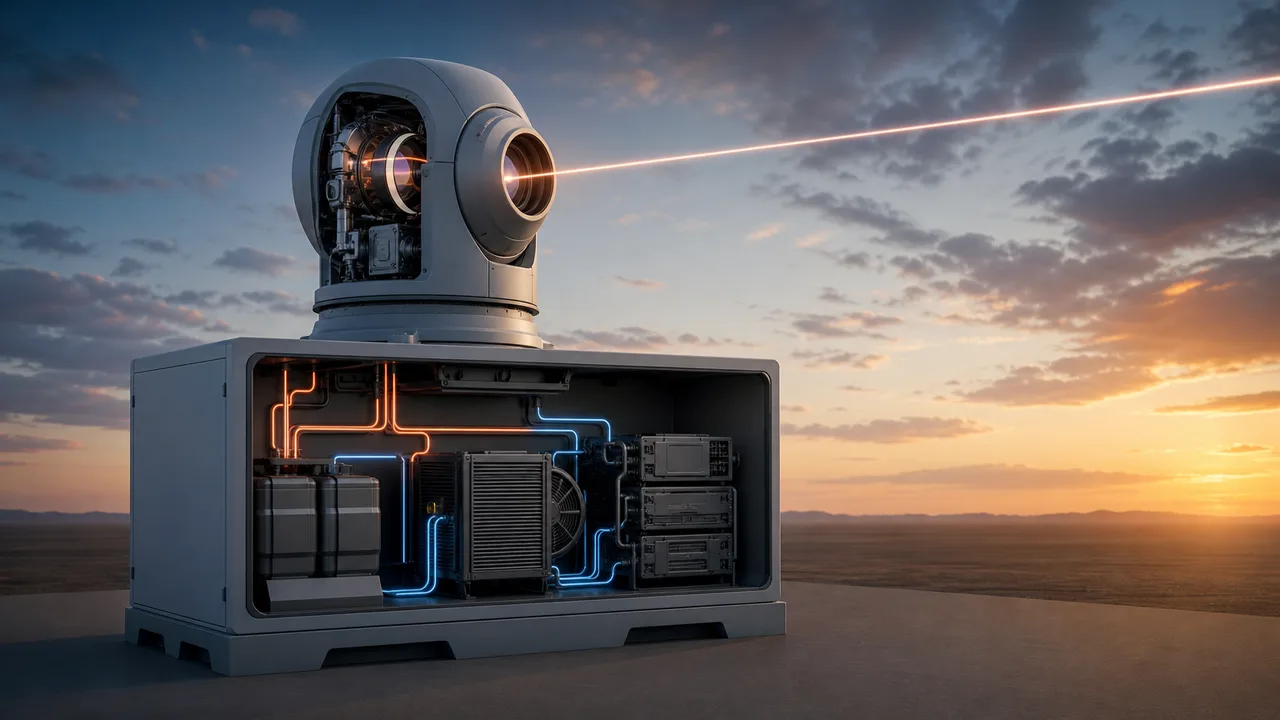
Say "laser weapon" and most people picture a single beam of light. Yet when the U.S. Navy estimated the cost of future, higher-power shipboard laser weapons in an October 2021 information paper, the laser was only one line. The estimate also covered the beam director, beam control, power and thermal management, combat system integration and installation.
The device that makes the light is just the first item on that list. The light has to travel to one distant spot and stay there. All the while, something has to supply electricity and remove heat. This article draws these blocks in one diagram and then walks through what each block does.
First, a word to pin down. The U.S. Department of Defense defines a directed-energy weapon (DEW) as one that uses concentrated electromagnetic energy instead of kinetic energy. The group includes high-energy laser (HEL) weapons and high-power microwave weapons. How the two differ is covered in Lasers and high-power microwaves: two kinds of directed energy.
What a laser weapon actually does is the subject of What is a laser weapon?
The system on one page
Public sources describe a laser weapon as a set of subsystems. A Congressional Research Service (CRS) report quotes U.S. Army budget documents on a laser prototype for defending bases. That prototype includes a vehicle, a laser subsystem, a power and thermal subsystem and a beam control subsystem. These are integrated with battle management, command, control and communication software.
A test system in a 2014 U.S. Army article was built along similar lines. It took a commercial laser, added beam control, power and thermal subsystems, and integrated them all onto one military truck. The names vary from source to source, but the main blocks overlap.
Put the sources together and five main blocks emerge. The laser source is the whole part that makes the light, which official sources call the "laser" or "laser subsystem." The beam director and beam control send that light to the target and hold it there, power supplies electricity, and thermal management deals with heat. Command and control software ties everything into the combat system, and the diagram below puts these five blocks on one page.
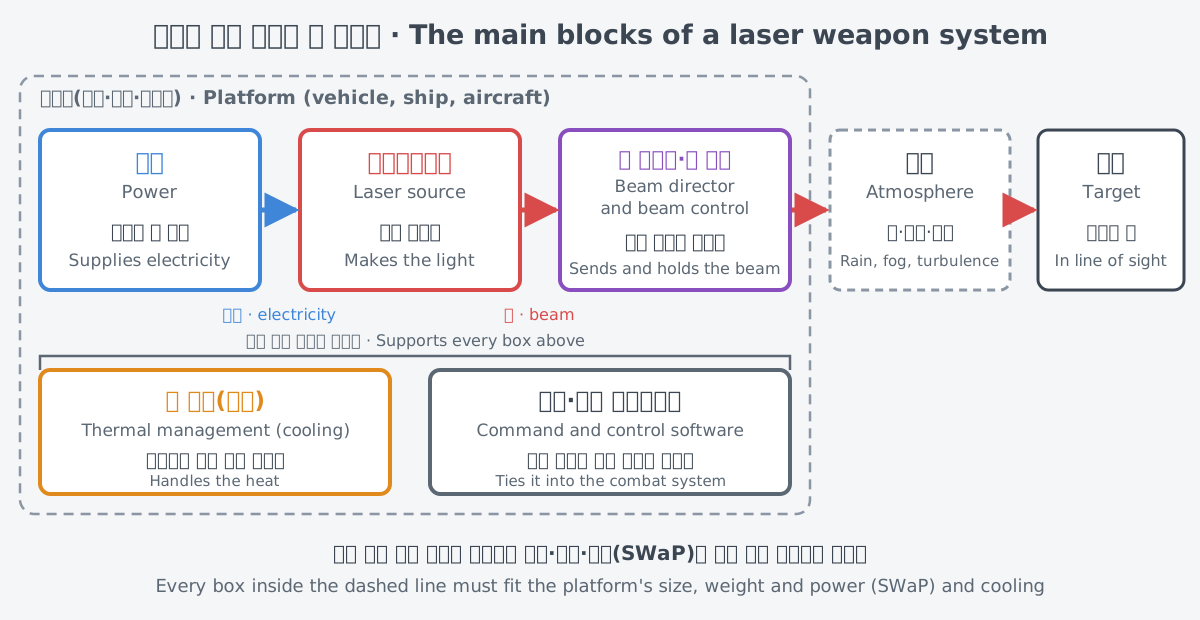
Light flows from left to right. Power feeds electricity to the laser source, and the beam director takes the laser's beam and sends it out through the atmosphere. Laser light crosses the atmosphere on an almost straight path, so a high-energy laser weapon can only engage targets in its line of sight. It cannot reach targets beyond the horizon or hidden behind something.
The dashed line marks the platform. Whether the platform is a vehicle, a ship or an aircraft, every box inside the line has to ride on it. That condition leads to the size, weight and power (SWaP) problem later in this article.
The command and control software in the bottom row links the system to the outside. In the Army budget documents, the laser, power, thermal and beam control subsystems are integrated with battle management, command, control and communication software. The Navy's cost list also gives "combat system integration" its own line. A laser weapon is not a stand-alone device but one part of a larger combat system.
The laser source: where the light is made
The laser source takes electricity and turns it into the light used as the weapon. How a laser makes light is covered in What is a laser? Many current U.S. programs use solid-state lasers, which run on electrical power. Why programs moved here from chemical lasers is covered in A history of laser weapons: from chemical to electric lasers.
Running on electricity shapes the whole system. A solid-state laser on a ship draws its power from the ship's overall electrical supply. It can fire over and over, as long as the laser keeps working and the ship has fuel to make electricity. Electricity and fuel take the place of ammunition, so the laser source always travels with the power subsystem.
Raw output is not the only thing asked of a laser source. The Defense Department's High Energy Laser Scaling Initiative (HELSI) aims to show higher laser output while keeping or improving beam quality and efficiency. Output, beam quality and efficiency all ride together.
When the laser source changes, the neighboring blocks change too. New electric lasers run at much shorter wavelengths and lower powers than the chemical lasers before them. That shorter wavelength and lower power shifted more of the performance burden onto the beam control system.
Beam director and beam control: sending the light and holding it
The beam from the laser source does not reach the target by itself. The optical device that takes the beam and sends it toward the target is the beam director. A 2025 U.S. Air Force research topic calls beam directors optical devices that send a well-focused beam to the target.
Two things are asked of it. It must send a high-energy laser beam from a flying platform and keep the beam's shaking, called jitter, low. It must also keep the beam well focused on a non-cooperative target. Such a target does not hold still to help.
A beam director is not a stand-alone part. The next step listed in the Air Force topic is to tie the beam director into an Air Force laser and beam control system. In the Navy's cost list, too, the beam director and beam control sit side by side as separate items.
The 2014 Army article calls the beam control system "the other high tech component" of a high-energy laser weapon. The beam control system must point the laser precisely at the target and hold the beam on it. That target can be the size of a soft drink bottle and many kilometers away from the laser.
Picture keeping a flashlight beam on a rolling ball from far away, and the difficulty starts to show. In reality, a machine does the aiming instead of a hand and an eye, and the air the light passes through also shakes the beam. Turbulence over long paths spreads the beam, and the beam control system must correct for this, sometimes with complex adaptive optics (AO).
Power and cooling: the housekeeping behind the light
In public sources, power and heat often come as a pair. The "power and thermal subsystem" in the Army budget documents and the "power and thermal management" in the Navy cost list are each a single block. In the 2014 article, an Army official said they were developing support subsystems for long run-times at higher laser power.
Supplying electricity and dealing with heat do not make light directly. Still, the laser source can only work for long at high power when these two hold it up. It resembles the backstage crew that keeps a show running to the end. Unlike a backstage crew, though, this housekeeping must ride on the same vehicle or ship as the stage.
This is where the constraint that binds the whole system appears: size, weight and power, or SWaP. CRS names two questions about the technical maturity of directed-energy weapons. One is raising beam quality and control to militarily useful levels. The other is meeting SWaP and cooling requirements for integration into current platforms.
Some systems are small enough to fit on military vehicles. Many, however, need larger or fixed platforms, which can narrow where they can go and how they can be used. As the diagram below shows, every part of the system shares what one platform can give.
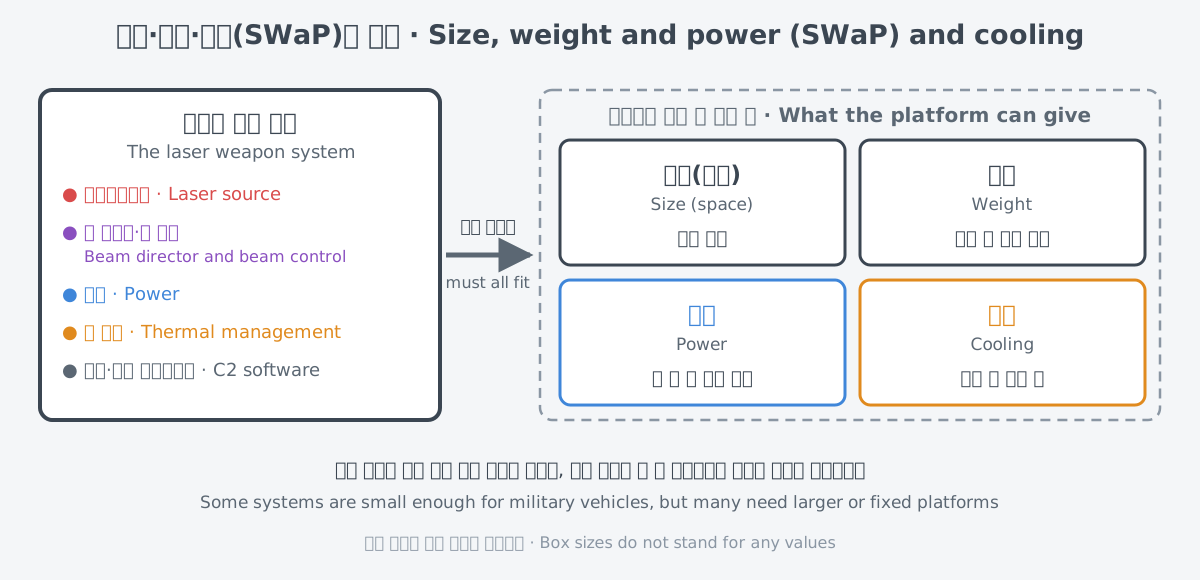
Ships face much the same issue. In a January 2024 press report, a U.S. Navy admiral overseeing laser weapons said directed energy needs space, weight, power and cooling. He added that this can be a challenge on current surface combatants. Whether future ships will have enough space, weight, electrical power and cooling for solid-state lasers is also raised as a question for Congress.
SWaP is not only a question of room. Along with weather such as rain, fog and obscurants, SWaP and cooling requirements can limit the range and beam quality of directed-energy weapons. What a platform can carry is tied to how far, and how clean, a beam it can send.
Why many fields must solve it together
Taken one at a time, each block belongs to a different field. In the table below, the subsystem names come from official sources, while the roles and fields are this article's own addition. The fields are grouped from the names alone, so they may differ from how a real development team is organized.
| Subsystem | What it does | Fields it touches |
|---|---|---|
| Laser source | Turns electricity into light | Lasers, optics |
| Beam director and beam control | Sends the beam to the target, aims it and holds it there | Optics, mechanics, control |
| Power | Supplies electricity to the laser source | Electrical |
| Thermal management | Deals with the heat the system makes | Thermal |
| Command and control software | Ties the system into the combat system | Software, communications |
The split looks tidy, but in practice the blocks are tangled. When the laser's wavelength and output changed, the burden on beam control grew. Higher output also calls for support subsystems that can sustain it for long run-times. The weapon's overall effect comes from the laser and the beam control system combined, and all of it has to fit within SWaP.
The list of remaining challenges brings many fields together too. A Navy technology development and demonstration effort lists remaining technical challenges that include atmospheric turbulence, precision tracking, advanced beam control and higher-power laser development. The physics of air, mechanics and control, and the laser itself sit side by side on one list.
Building and repairing these systems add their own problems. The October 2021 Navy information paper says the industrial base for major laser weapon subsystems and components is not yet mature in production capacity. A Government Accountability Office (GAO) finding quoted by CRS adds that the internal mechanisms of directed-energy weapons are sensitive. Repairs typically require a specialized clean room.
The people running the programs speak plainly. The Navy admiral mentioned above summed up the technology in two words, "It's hard," and said the Navy and industry should talk about laser weapons more honestly. Together, these official sources show that no single block can carry the system on its own.
Guide to this series
The system integration series opens the diagram in this article one box at a time. Each article in the table below takes one box.
| Article | Box it opens | What it covers |
|---|---|---|
| Gimbals, pointing and tracking: holding the beam on one spot | Beam director and beam control | What a gimbal is, and what acquisition, tracking and pointing mean |
| Beam director optics: lenses, mirrors, coatings and a large aperture | Beam director and beam control | Aperture, focusing far away, and coatings |
| Power and efficiency: the share of electricity that becomes light sets the size of the system | Power | Efficiency and the power and cooling load |
| Cooling and thermal management: where the heat that did not become light goes | Thermal management | Removing leftover heat |
| Weight and platforms: fitting on a vehicle, ship or aircraft | Platform | The different conditions of each platform |
| Vibration and shock: protecting optics on a moving platform | Platform | Shaking and optical alignment |
| Fast steering mirrors: small, quick mirrors that cancel shake | Beam director and beam control | The fast shake that FSMs handle |
| Environmental durability: rain, dust, heat, cold and salt | Platform | What outdoor equipment must withstand |
| Light through air: absorption, scattering, turbulence, thermal blooming | Atmosphere | How weather and air affect the beam |
| Adaptive optics: restoring a blurred beam | Beam director and beam control | How adaptive optics restores a blurred beam |
The series also links to the laser weapon basics. Why the job does not end the moment the beam lands is in Why a laser weapon does not finish "the instant it fires". The strengths and limits named in official reports are in Strengths and limits of laser weapons. Words like "kW-class" and "range" in the news are in How to read laser weapon news.