Imagine splitting the light of one laser into two, amplifying each part on its own, and then letting the two beams meet again in a component with two outputs. The two beams may leave together through one output, or they may split between both. Which one happens is set by the difference in their timing, that is, their phase.
Coherent beam combining (CBC) uses this behavior to gather several beams into one. Why do beams merge into one when their phases are matched? And what has to be the same for beams to interfere with each other?
The guides here are two published review papers and textbooks. The reviews appeared in 2016 and 2018, and both survey coherent combining of ultrafast fiber amplifiers and lasers that emit femtosecond pulses. Some conditions therefore apply only to pulses, and those are pointed out as pulse conditions.
What it takes for two beams to become one
The basic idea is very simple. The outputs of several laser emitters are combined to reach performance that a single emitter cannot. The 2018 review writes that this approach has become established as a way to scale power beyond the physical limits that hold back a single fiber.
"Coherent" has a strict meaning, though. Beams from several emitters are called coherently combined only if they are able to interfere with each other. However the combiner is built, the beams have to be phased correctly so that they interfere constructively.
The previous article drew the big picture. Amplifiers can take seed light from a common front end, which creates the precondition for coherence. Drifts during operation make active stabilization necessary, and combining efficiency measures how well the beams were combined. This article goes one layer down, to how the light actually adds up.
Coherent beam combining was first implemented for continuous-wave lasers and then extended to pulses. The 2016 review sees a natural idea for further scaling the peak and average power of femtosecond fiber amplifiers. It is to spread the power over several beams in space and several pulses in time. That idea leads to the concept of coherent combining.
Interference: fields add and the light goes one way
Start again from the superposition principle seen in the previous article. In linear optics, which treats light as waves, the fields of two overlapping waves simply add, but intensities generally do not. Intensities simply add only when the light does not meet the conditions for interference, as when the polarizations of two beams are perpendicular or the beams are fully incoherent. Carried inside a combining device, this principle reveals the heart of combining.
The simplest combiner is a beam splitter, which reflects part of the light and transmits the rest. If the beam splitter shares light equally between its two outputs, two identical beams sent into it can leave the two ports with their combined power in any ratio. What sets that ratio is the phase difference between the incoming beams.
With the right phase difference, the output can be gathered into one port. Such a component therefore becomes a beam combiner when the phases of the beams can be controlled. When the phases drift apart, part of the power escapes through the other, unused port.
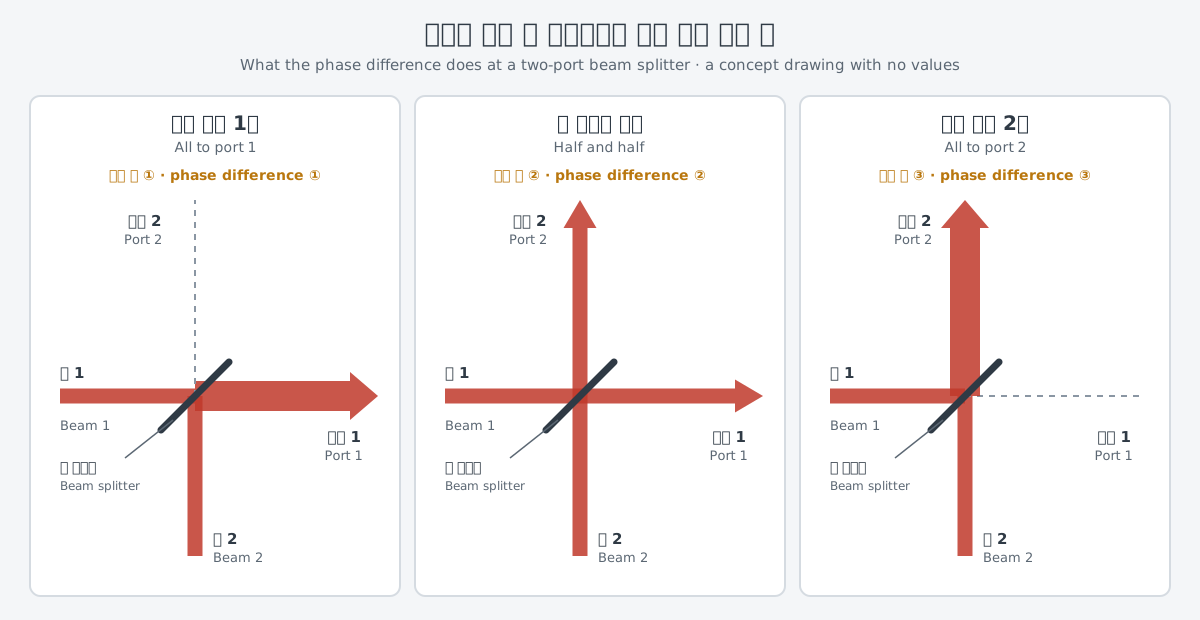
The phase difference acts like a knob that shares the light between the two outputs. Turn the knob all the way to one end and all the light goes to one port; around the middle, it splits half and half. In reality there is no separate knob to turn. The phase each beam picks up along its path sets the ratio, and that phase does not stay still.
Conditions ①: the same frequency and a lasting rhythm
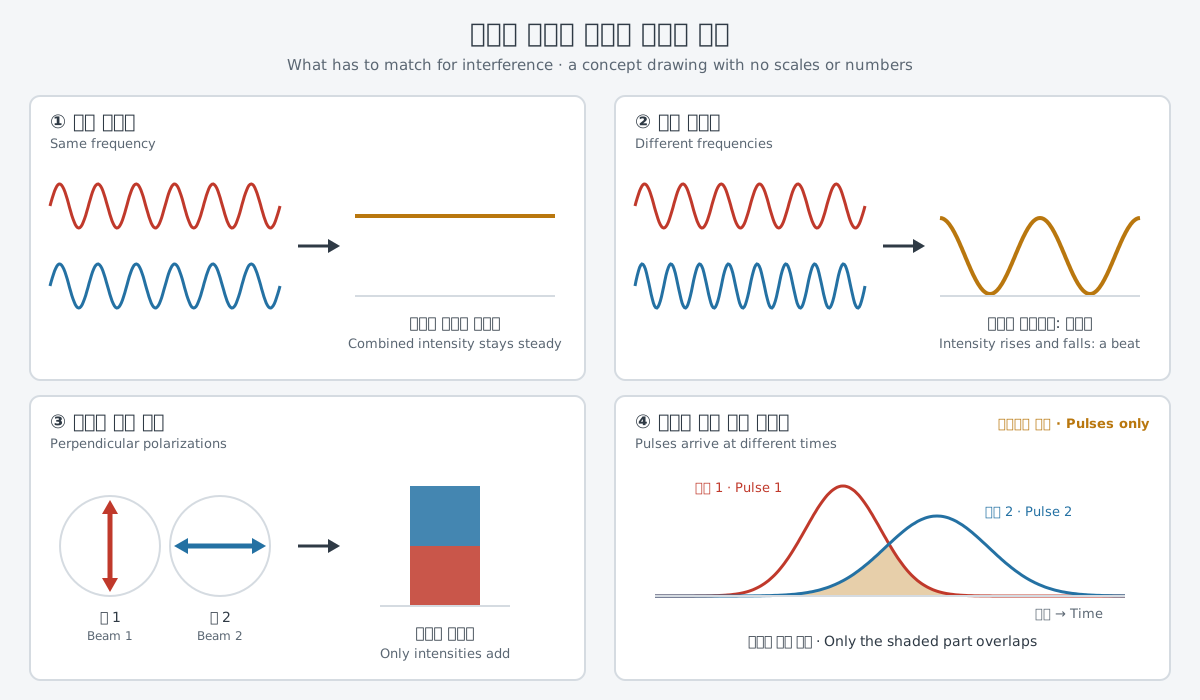
When two beams of different frequencies overlap, the intensity does not stay still. For two beams of equal intensity, the combined intensity rises and falls at the difference between the two frequencies. This rise and fall is called a beat.
The point comes up in an ultrafast laser textbook, in the part on measuring frequency combs. If the detector cannot follow the fast rise and fall, the intensity is averaged over time, and the result equals the incoherent superposition of the two intensities. Turned around, two beams whose phases are locked to each other also have the same frequency.
The reviews of coherent combining contain a matching condition. For setups that combine pulses, one of the conditions the 2016 review sets for the beams is the same spectral content.
Having the same frequency does not mean the rhythm stays in step forever. The coherence time is the approximate time difference over which two components of a laser field can stably interfere. It is usually measured with an optical interferometer, and because its definition is somewhat arbitrary, different texts define it a little differently.
A narrow linewidth, which appeared in the previous article, means a long coherence time. A review chapter on single-frequency fiber amplifiers ties linewidth to distance. The laser linewidth sets the coherence length, and the coherence length sets the distance over which several beams can interfere. That is why, as the previous article showed, pulses, with their much shorter coherence length, need the distances they travel matched as well as their phase.
Conditions ②: same polarization, same shape, same timing
Matching frequencies is not the end of it. Two beams with perpendicular polarizations do not interfere; only their intensities add. The 2016 review, which surveys combining experiments, points out that the polarization state at the output of the amplifiers must also be fixed. Polarization-maintaining fiber can guarantee this.
The conditions span both space and time. Constructive interference has to hold in space as well as in time and spectrum. Since most setups are designed to combine identical beams and pulses, the beams must share the same spatial profile and wavefront, and the same spectral content and spectral phase.
Of these, the need for even the spectral phase to match belongs to ultrafast combining. When pulses are combined, they must reach the combining element at the same time.
How alike the channels are also decides the outcome. The smaller the differences between channels, the higher the combining efficiency that can be reached. Pulses may change inside the amplifiers through dispersion, saturation and nonlinear effects, which is fine as long as every channel changes in a similar way. Differences between channels, such as unequal fiber lengths or coupling losses, hurt the combining efficiency and must be kept small.
A combiner is an interferometer
One view ties these conditions into a single picture. The 2016 review writes that every experimental setup for coherently combining femtosecond pulses can be seen as an optical interferometer with amplifiers in its several paths. The combined field at the output is the coherent sum of the electric fields from each path. The efficiency of the setup depends on controlling the phase built up in each path, so that interference stays constructive at one output of the interferometer.
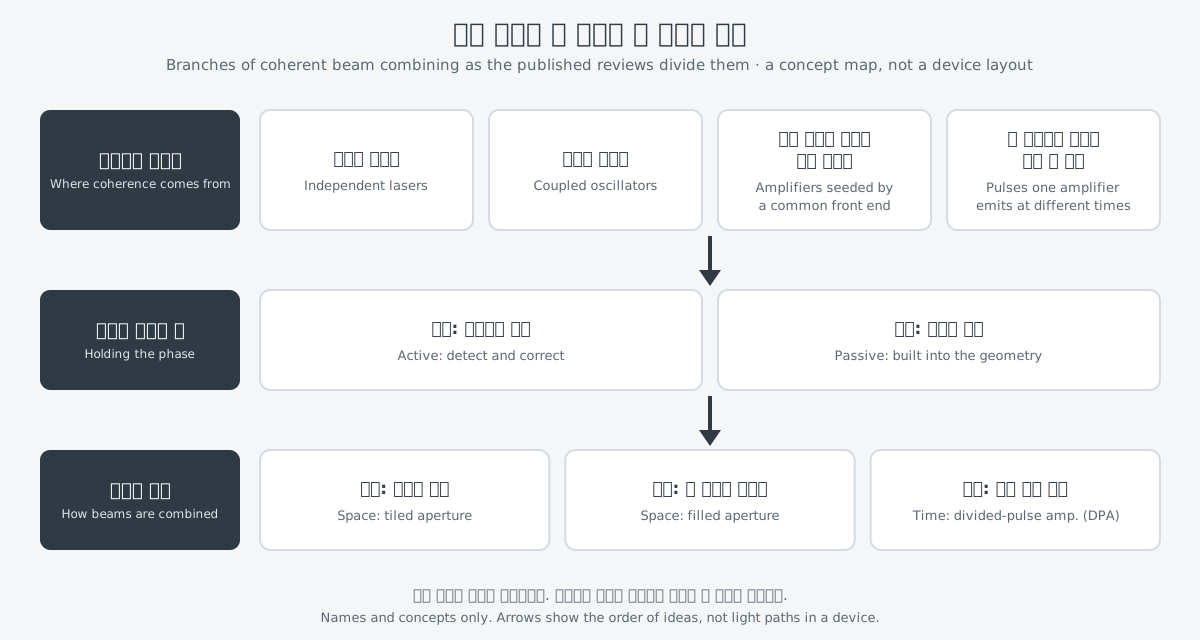
Where does the coherent light for each path come from? The emitters to be combined can be independent lasers, coupled oscillators, or amplifiers. Several pulses that one amplifier emits at different times can also serve as emitters.
In coupled oscillators, the coupling process itself creates the mutual coherence. Amplifiers can take seed light from a common front end, which creates the precondition for coherence between the output beams after amplification. The last branch, pulses emitted at different times, leads to combining that divides the light in time rather than in space.
The components that split and combine light also come in branches. The simplest are two-port components such as beam splitters and polarizing beam splitters. These inherently combine two beams at a time, and cascading them can in principle split and combine any number of beams. The cost is that component losses build up along the cascade, and the number of parts grows roughly in proportion to the number of beams.
For that reason, the 2018 review counts combiners that join many beams at once, without cascading, as being of great interest. One such component is a diffractive optical element (DOE). It is a phase grating designed to split one incoming beam into several beams, and because light propagation is reciprocal, it can also be used backwards. When the beams arrive at the angles and phase relationship the design expects, the output is mostly carried by a single beam.
Femtosecond pulses have a broad spectrum, which can make them a poor match for this component. Like any grating, a DOE produces the angular dispersion seen with the diffraction grating in the previous article. The color components of the recombined beam then fan out in slightly different directions, which is called angular chirp. Depending on the bandwidth and the DOE design, though, the effect can be small enough to ignore.
Light can also be combined by polarization. In this approach, an s-polarized beam and a p-polarized beam, two mutually perpendicular polarizations, are overlapped into one beam whatever their power ratio. The advantage the 2018 review gives for this approach is its flexibility with respect to the input power ratio.
Perpendicular polarizations do not interfere, as noted earlier, so how can they be combined coherently? Two perpendicular polarizations make no intensity pattern, but the relative phase of the two beams does not vanish; it stays in the polarization state of the combined light. In other words, the polarization state of the output beam depends on the relative phase of the two beams. So the phase has to be held fixed for the output to be one beam with a set polarization.
The two shapes from the previous article can also be seen through interference. In the tiled aperture approach, the beams are simply placed next to one another in the near field, and combining happens only in the far field. Controlling the phases of the sub-beams forms a single far-field lobe, and the filling factor of the composite beam sets its share of power. The filled aperture approach is closer to the idea of an interferometer.
Light can also be divided and recombined in time instead of space. Divided-pulse amplification (DPA) makes several time-shifted copies of an incoming pulse, amplifies them, and recombines them coherently. It works like an artificial lengthening of the pulse, so it can raise the achievable pulse energy and peak power.
In this setup, though, a single beam travels through the whole system from start to finish. DPA therefore cannot be seen as a way to scale average power. Because it spreads the power out over time, it can also be seen as a discrete version of chirped pulse amplification (CPA).
Two ways to hold the phase: active and passive
The phase built up in each path of the interferometer does not stay still. In combining experiments where one femtosecond oscillator seeds several fiber amplifiers, the phase fluctuations between the beams come solely from the amplifiers. Experiments that measured these fluctuations with laboratory amplifiers in continuous-wave combining showed that they are dominated by environmental heat and acoustic noise (sound and vibration). These are results from laboratory environments, and because the noise is mostly thermal and acoustic, it can vary widely with experimental conditions.
There are two broad ways to hold a drifting phase. Active methods hold the relative phase between pulses with feedback control, while passive methods build phase matching into the geometry of the setup itself.
The active approach has two parts. One part detects the phase differences between the beams, and phase actuators make up for those differences. The 2018 review names this active phase stabilization as the last component that most coherent combining setups need. Each combiner architecture has several ways to implement it.
The passive approach combines two amplified beams without active detection or feedback. Its principle is an amplifying interferometer in which all arms share the same overall optical path. The only difference between arms is the order in which they meet each path element. This ensures that even the spectral phases match on their own when the beams are combined.
The passive approach has limits too. Interferometer arrangements that extend this principle to more beams and amplifiers can be devised, but they are of limited use with fiber amplifiers. Each beam must pass through every amplifier and build up nonlinearity, which is exactly the effect that limits performance.
Other combining schemes in which the path lengths match on their own face a similar problem: they generally cannot be scaled to more channels. That is why most setups rely on active stabilization.
The difficulties the reviews point out
To begin with, phase mismatch itself is a difficulty. When the phases of the beams or pulses to be combined drift apart, the combining efficiency drops. Power then leaks heavily into the unused output ports of the interferometer, or the combined peak power falls. As basic interferometry predicts, the combining efficiency is much more sensitive to phase changes than to intensity differences between pulses.
The environment is not the only thing that shakes the phase. Self-phase modulation (SPM), named as one face of the Kerr effect in "Limits of a single fiber (1)", gets in the way here. In coherent combining setups, the most important effect of SPM is that it turns fluctuations in power into fluctuations in phase, which disturbs the combining.
Heat gets in the way too. At high average power, thermo-optic effects usually create optical aberrations, distortions in the spatial intensity and phase of a beam. These aberrations have to match across the beams being combined, which makes efficient combining harder.
Parts that handle the strong beams, such as the combiners themselves or lenses, also have to be chosen carefully to avoid thermal effects. Thermal effects can harm the output beam quality and can also lower the overall combining efficiency.
So how far can the channel count go? The 2018 review names the ability to scale to a high channel count as the most prominent question in coherent beam combining. It is possible in theory, but hard to achieve in actual experiments. When the review was written, the parts in almost all setups were the same as in single-amplifier systems, so the part count grew in proportion to the number of channels.
The reviews were not pessimistic, though. The conclusion of the 2018 review is that the approach can be applied to any laser architecture. It suits fiber laser systems especially well, thanks to their comparably simple setup and reproducible beam parameters. Many combining and phase stabilization methods can be chosen, depending on the performance targeted.
The 2016 review sees coherent combining as a promising route to future ultrafast sources for uses such as particle acceleration and high-power secondary sources of extreme ultraviolet light and X-rays. Its conclusion ends by noting that the concept of coherently adding ultrafast optical fields is also used beyond fiber lasers, and is becoming a general toolbox in ultrafast optics.
What to read next
- "Beam quality: M², divergence and brightness": how the beam quality that combining tries to keep is measured.
- "Interference and diffraction: how light adds up and spreads": the basics of interference, set up here only as far as needed, built from the ground up together with diffraction.