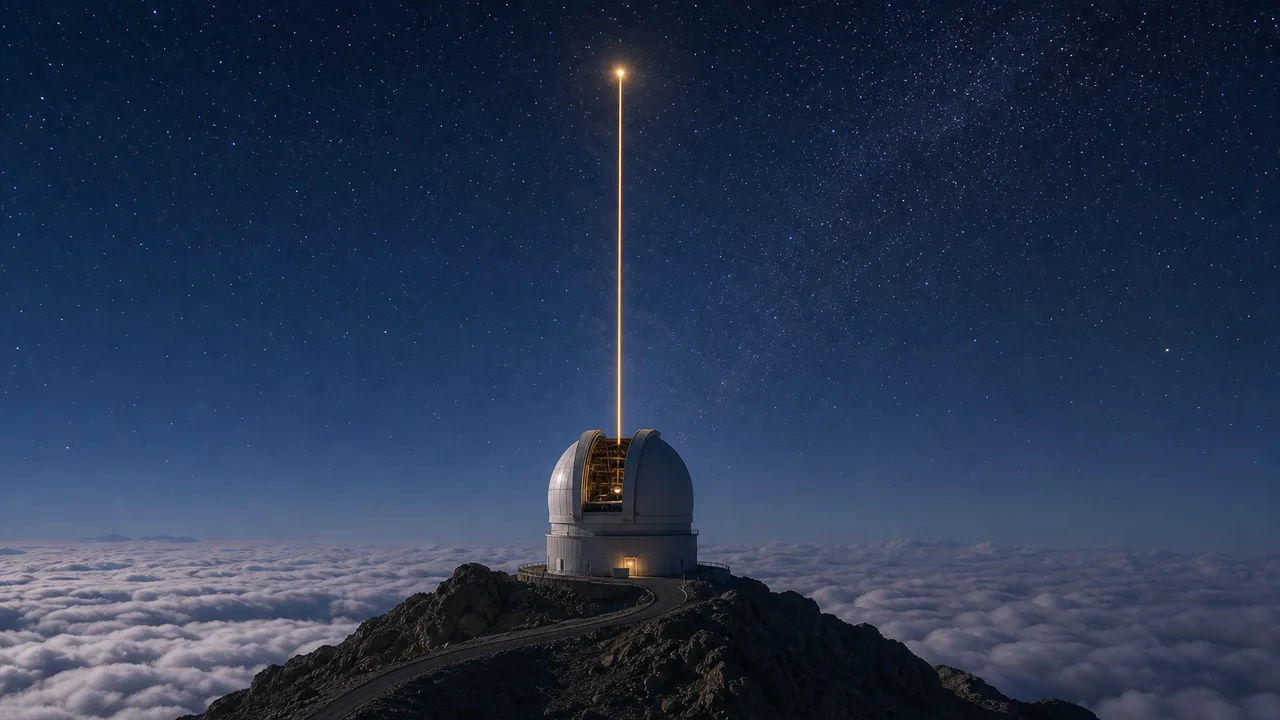
On a clear night, the stars do not hold still. They twinkle. The European Southern Observatory (ESO) puts it this way: twinkling delights poets but frustrates astronomers. A twinkling star is a blurred star, and the blur wipes out the finest details of the cosmos.
The twinkling does not come from the star. It comes from the air just above the telescope. A laser beam fired from the ground or a ship passes through the same air, and atmospheric turbulence can defocus it too.
Adaptive optics (AO) measures that shaking and changes the shape of a mirror to undo it. In "A laser weapon is more than a laser", it appeared in a single sentence: the beam control system must correct beam spreading using potentially complex adaptive optics. Behind that sentence is an idea an astronomer put forward in 1953. How does air blur light, and how can a mirror undo it?
Why stars twinkle: atmospheric turbulence
Air is not one smooth block. It is a mix of parcels with slightly different temperatures and densities, and a different density means a different refractive index, the measure of how much light bends. This uneven churning of the air is atmospheric turbulence.
When light passes through such air, the length of its path differs from place to place and changes from moment to moment. It is much like the way the scene behind a campfire seems to ripple. Large temperature differences create pressure differences and winds, and the winds stir together air of different densities.
Most of this turbulence comes from the troposphere. The troposphere typically reaches a height of about 15 km and holds 80% of the mass of the atmosphere. Starlight crosses this whole thick layer just before it reaches the telescope.
Choosing a good site does not get rid of it. Even at the best sites in the world for astronomy, such as Paranal in Chile, turbulence distorts the images. A telescope in space avoids the atmosphere, but space telescopes cost much more to operate than ground-based ones, which limits their size and scope.
One number, taken from two points in a review paper on astronomical adaptive optics, shows how large the blur is. In the review's reference seeing of 1 arcsecond, at visible wavelengths, turbulence leaves an image about as sharp as a telescope about 10 cm across would give in still air. A telescope with a much larger mirror is held to roughly that level without adaptive optics. Why a larger aperture can see more sharply is part of the story of diffraction in "Why a beam spreads: divergence, focus and aperture".
The wavefront: the front of a light wave
Light is a wave. For water waves, you can draw a surface through the points that rise and fall in step, such as the crests. For light, that surface is called the wavefront. How waves add up and spread is shown in "Interference and diffraction: how light adds up and spreads".
Light from a very distant star arrives at the top of the atmosphere with a flat wavefront. As it passes through the air, the originally flat front becomes distorted, and the image the telescope forms becomes blurred and unsteady. The path length differs slightly across the wavefront, so some parts arrive a little late and others a little early.
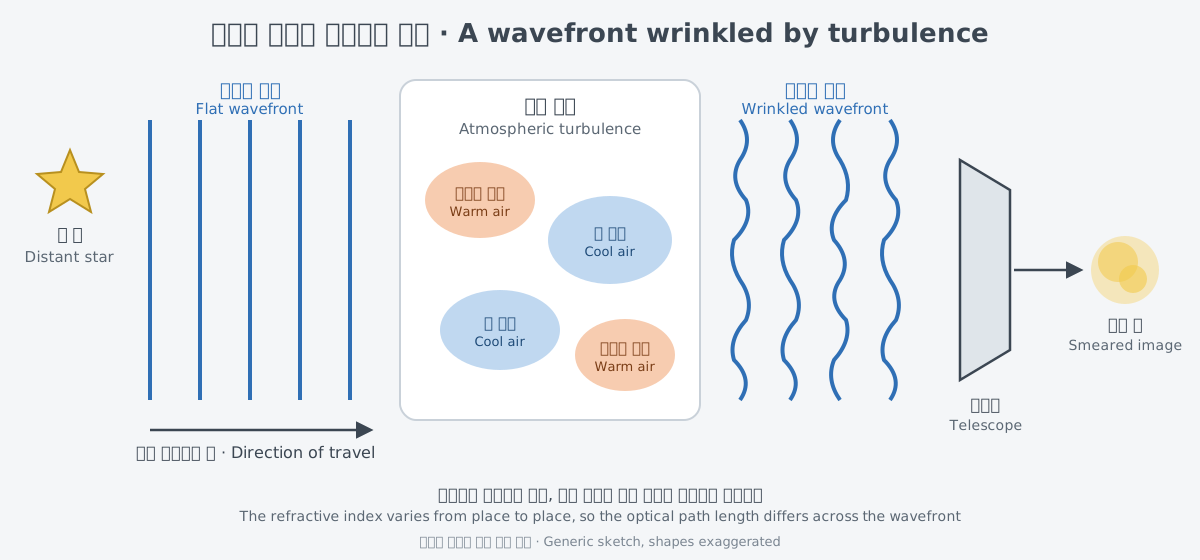
Picture a line of people walking side by side across a yard with patches of mud. Those who step in the mud fall behind, and the line comes out wavy. In reality, light does not stop or stumble; it is only delayed by a tiny amount, and the "mud" in the air keeps changing shape all the time.
That makes the job of adaptive optics clear: flatten the wrinkled wavefront again. A Lawrence Livermore National Laboratory page says that some telescopes use adaptive optics to "straighten" the wavefronts of light, which improves image resolution and contrast.
Measure, correct, measure again
An adaptive optics system has three parts. A wavefront sensor (WFS) measures how wrinkled the wavefront is. A deformable mirror (DM) changes shape to undo the wrinkles. A control computation takes the measurements and decides where and how much to move the mirror.
Three kinds of wavefront sensors are in use today: pyramid, Shack-Hartmann and curvature sensors. A Shack-Hartmann sensor is a grid of many small lenses. Each lens forms one spot of light, and where the spot lands shows how much the wavefront is tilted over that small patch. A flat wavefront gives evenly spaced spots, and where it is wrinkled the spots shift sideways.
A deformable mirror is, as the name says, a mirror that changes shape. It usually has an array of actuators attached behind a thin mirror surface, and when an actuator extends, the surface bends at that spot. Pushing and pulling the surface a little at each spot makes up the path difference between the parts of the wavefront that ran ahead and the parts that fell behind.
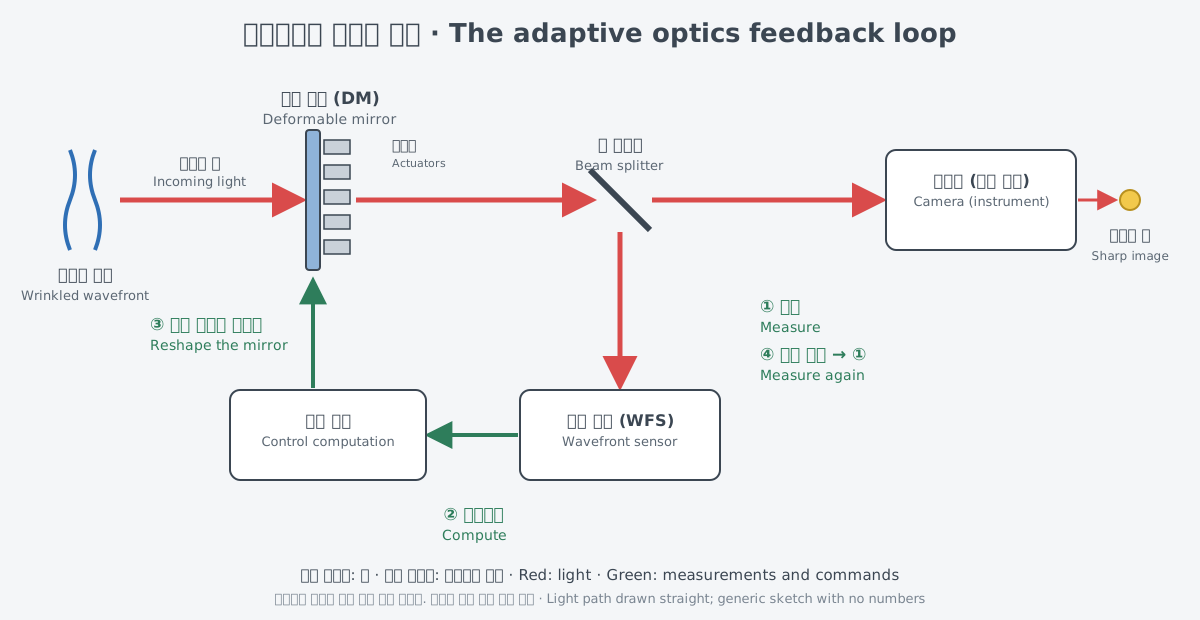
The three parts do not correct once and stop. After the mirror changes shape, the light is measured again and the remaining error is corrected again. This is called a feedback loop. Because the air never stops changing, the loop never stops either.
When it works, the result is large. According to ESO, deformable mirrors controlled by computers can correct the distortion from atmospheric turbulence in real time. Images from the ground can then become almost as sharp as those taken in space. That lets a telescope see finer details of much fainter objects than is otherwise possible from the ground.
Reference stars and laser guide stars
To measure a wavefront, there has to be light to measure. That light must come from above the atmosphere and from almost the same direction as the object being observed. So an observatory wants a fairly bright reference star very close to its target. Its light shows how the local air blurs the view, and the deformable mirror corrects for that.
The problem is that such stars are not found everywhere in the night sky. Light for measuring the wavefront is very often in short supply, and in many cases no bright enough natural guide star (NGS) is available.
When there is no reference star, astronomers make one. They send a powerful laser beam into the upper atmosphere to put a small spot of light in the sky: a laser guide star (LGS). Thanks to these artificial stars, almost the entire sky can now be observed with adaptive optics.
Rayleigh scattering of light in the dense lower atmosphere gives a spot up to about 30 km high. Making sodium atoms glow in their layer at about 90 km gives a spot at that height.
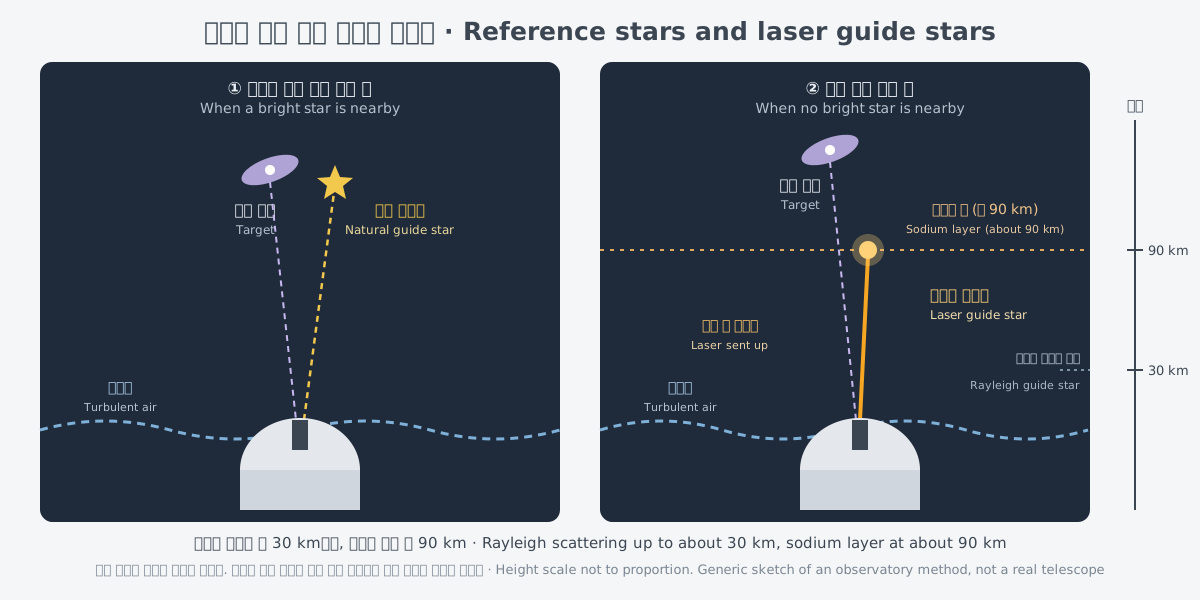
Here the laser is an observing tool that marks a reference point in the sky. The observatory measures the wrinkles in the air from the light coming down from that spot, and the telescope still studies the stars and galaxies behind it.
From a 1953 idea to working hardware
The idea is old. In 1953, Horace Babcock, an astronomer at the Mount Wilson and Palomar observatories, put forward a proposal. Keep measuring how far the rays stray across every part of the mirror, feed that information back, and correct the mirror's shape spot by spot to cancel the blur. It is the same idea as today's feedback loop.
Turning it into hardware took more than 30 years, and in the meantime the military moved first. A review paper states that the U.S. military began investing in adaptive optics in the 1970s. In 1982, it commissioned the first practical adaptive optical system on the 1.6 m telescope on top of Haleakala, on the island of Maui in Hawaii. A NASA Spinoff article likewise says that the technology was proposed in the 1950s for astronomical imaging and developed by the U.S. Air Force in the 1970s.
Laser guide stars followed a similar path. The idea of making an artificial light source with a laser first came from the U.S. military, in a classified program. A few years later, in 1985, astronomers proposed the same idea independently.
Astronomy's own instruments came in the late 1980s. The first astronomical adaptive optics instrument, COME-ON, was tested on the 1.52 m telescope at the Observatoire de Haute-Provence in France. It was later installed on ESO's 3.6 m telescope at La Silla in Chile. The first astronomical systems using laser guide stars arrived in the mid-1990s.
Adaptive optics is now part of the standard equipment at many observatories. Large ground-based telescopes such as the Keck Observatory in Hawaii and ESO in Chile rely on it to remove atmospheric distortion. A 2019 review sums up its job as basically only one task: to let the telescope work at its highest resolution without blur from the atmosphere. With three decades of experience behind it, the new extremely large telescopes and their instruments are designed for diffraction-limited observing from the very beginning.
Beyond astronomy: correcting laser beams
Measuring a wavefront and flattening it with a mirror is not only for starlight, because a laser beam can get wrinkled too. At the U.S. National Ignition Facility (NIF), the laser beams pick up wavefront aberrations as they pass through the amplifiers, from distortions in the amplifier glass and other optics. The answer its planners found was the deformable mirror.
Lawrence Livermore National Laboratory calls these computer-controlled mirrors the "eyeglasses" of NIF. The mirrors push and pull their surface to correct wrinkles in the beam from leftover thermal distortion, imperfect optical materials and surface flatness, and amplifier distortion from flashlamp heating. Correcting each beam this way gives a smaller focal spot on the target, and with it higher power density or better-controlled focal spots. What is corrected here is not the air but wrinkles made inside the laser itself.
Laser communication through the air faces the same problem. Turbulence and other interference in the air between the sender and the receiver limit the speed and accuracy of the link. A NASA Spinoff article notes that scientists are finding that correcting this distortion with adaptive optics gives a higher data rate over a longer range.
Adaptive optics is also used to correct distortions in space telescopes caused by temperature, launch impact and the absence of gravity. When that article was written, vision researchers were testing these mirrors to remove blur caused by eye tissue.
Official sources on laser weapons say the same thing. A Congressional Research Service (CRS) report explains that atmospheric turbulence can defocus a laser beam. Adaptive optics makes rapid, fine adjustments to the beam on a continuous basis in response to observed turbulence, and it can counteract those effects. A 2014 U.S. Army article notes that turbulence over long paths spreads the beam, and that the beam control system must correct this spreading using potentially complex adaptive optics.
An observatory corrects the starlight coming in. The adaptive optics in these laser weapon sources corrects the laser beam going out.
The same Army article states that the new electric lasers have much shorter wavelengths and lower power than the chemical lasers before them. That shifts more of the performance burden to the beam control system. As the laser source changed, the load on the part that shapes the beam grew.
What is still hard
Adaptive optics corrects for one direction. Correction is good only out to a certain angle from the direction it is set for. In the simplest setup, which uses a single guide star, the image gets worse again beyond that region. In astronomy, this small field of view is a major constraint.
Wavelength matters too. In astronomical adaptive optics, performance is harder to reach at shorter wavelengths, and good correction is much easier to achieve at longer wavelengths.
Laser guide stars have weak points as well. An artificial star is not infinitely far away; it floats tens of kilometers up. The light coming down from it narrows into a cone and does not cover the whole telescope aperture at the height of the turbulent layers. This cone effect gets worse for larger apertures and higher turbulent layers.
Also, the shaking of the laser on its way up mixes into the measurement, so a laser guide star cannot measure how much the whole wavefront tips to one side. So even with a laser guide star, at least one natural guide star is still needed.
Adaptive optics does not solve every problem the air causes. What it counteracts is the effect of turbulence. The same CRS report notes that even so, lasers might not work well, or at all, in rain or fog, so they are not an all-weather solution.
Building the parts is not easy either. A Navy budget document quoted by CRS describes an effort to build up the industrial base for laser weapon beam director parts. It names fast steering mirrors (FSM) and deformable mirrors among the highly critical, difficult-to-manufacture components. The list of questions for Congress also asks whether, and how, the limits of directed-energy weapons might be eased by technological developments such as adaptive optics.
The idea of removing the twinkle from stars is now also used to shape laser beams. Still, air is air. Adaptive optics can flatten a wrinkled wavefront, but it cannot change the weather along the path of the light.
What to read next
| Article | Why it follows |
|---|---|
| Light through air: absorption, scattering, turbulence, thermal blooming | Other ways, besides turbulence, that air weakens a beam |
| Fast steering mirrors: small, quick mirrors that cancel shake | A mirror that steadies the shaking of the whole beam direction |
| "Strengths and limits of laser weapons" | Where air and weather sit in the list of limits in official reports |