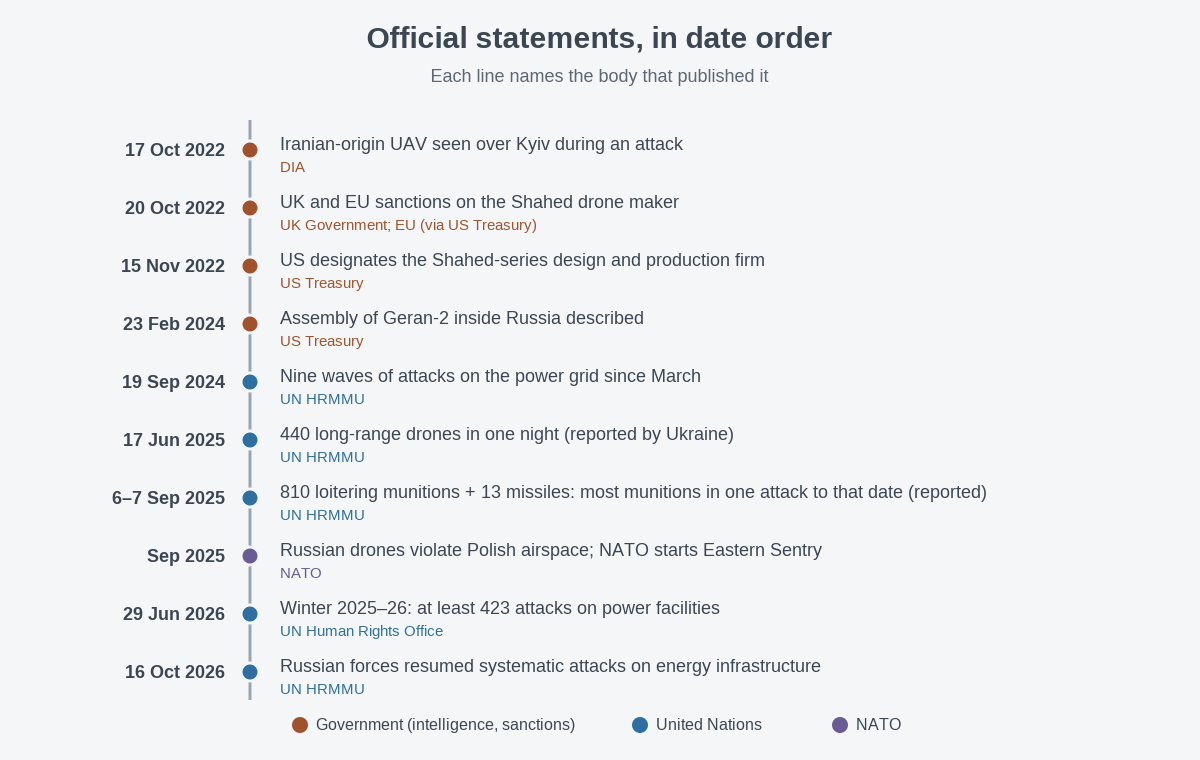
On 17 October 2022, an Iranian-origin drone was photographed in the sky over Kyiv during an attack. The U.S. Defense Intelligence Agency (DIA) put that photo on the cover of a report built from information gathered up to the 27th of that month. Over the next four years, drones of the same family appear by name in sanctions notices and inside a wider group called long-range drones in UN reports.
The official record is full of numbers. Each number, though, has a different counter. Ukrainian authorities announce how many drones were launched, the UN monitoring mission verifies civilian harm, and governments write down supply and production in their sanctions notices.
This article follows that record in date order and checks which record each number comes from. The situation keeps changing, so this article reflects the record as of October 2026.
October 2022: government confirmation
On 20 October 2022, the UK government's sanctions notice described Shahed Aviation Industries as the Iranian maker of the Shahed drones that Russia had used during its invasion of Ukraine. The DIA confirmed this by comparing photos.
The DIA report is a set of photos placed side by side. One side shows drones used by Russian forces in Ukraine, and the other shows Iranian drones used against the United States and its partners in the Middle East. Its conclusion confirmed that Russia was using several kinds of Iranian lethal drones in this war. UAV in the report's title stands for unmanned aerial vehicle, and the aircraft together with its ground control station and data links is called an unmanned aerial system (UAS).
The report also recorded the pairs of names. Iran's Shahed-136 was renamed Geran-2 by the Russians, and the Shahed-131 became Geran-1. How names and airframe numbers split apart is covered in detail in The Shahed series: same name, different drones.
Sanctions started in the same month. In that 20 October notice, the UK government placed an asset freeze on the company. It said that the actions of Iran and Russia violate UN Security Council Resolution 2231.
The European Union sanctioned the same company and three Iranian military leaders that day. On 15 November, the U.S. Treasury designated the company as the firm responsible for designing and producing the Shahed-series drones that Russian forces use in Ukraine.
From imports to assembly inside Russia
The first records told one story: drones made in Iran had gone to Russia. By 2024, U.S. government statements add another. On 23 February 2024, the Treasury wrote that a special economic zone in Russia had a contract under which it assembled, for the Russian military, Geran-2 drones shipped from Iran. It added that the zone was increasing its ability to make many of the parts for these Iranian-designed drones inside Russia.
In that statement, the Geran-2 is the "Russian version" of the Shahed-136, and such drones are Iranian-designed one-way attack drones, "also known as kamikaze drones." How one-way attack drones resemble and differ from missiles is explained in Loitering munitions: between missile and drone.
Two months later, on 25 April, another statement followed. A company under Iran's defense ministry plays a key role in designing, building and selling thousands of drones. Many of them ended up in Russia for use in the war against Ukraine. The Treasury wrote that such drones had been used against critical infrastructure and civilian targets in Ukraine, and the United Kingdom and Canada imposed sanctions on the same day.
A sanctions notice is that government's own judgment. Because it carries a date, it is still useful for reading the pattern. The 2022 story of "drones sent from Iran" becomes, in the 2024 statements, "Geran-2 drones assembled inside Russia."
The name in the UN record: long-range drones
Press releases from the UN Human Rights Monitoring Mission in Ukraine (HRMMU) rarely use the names Shahed or Geran. One example is the release of 10 July 2025, which puts the name in a group: "Shahed loitering munitions and decoy drones."
The words the mission mostly uses are "loitering munitions" and "long-range drones." Its press release of 17 June 2025 spells out long-range drones as "loitering munitions and decoy drones." When it counts causes of harm, it keeps long-range weapons (missiles and drones) apart from short-range drones. The small drones near the front line connect to the first-person view (FPV) drones covered in FPV drones: flying through the drone's eyes.
In the UN record, "long-range drones" is a group that combines loitering munitions and decoy drones. The long-range drone counts in this article are therefore not counts of Shahed or Geran drones alone. Shahed and Geran are names of an aircraft family, while "long-range drone" is a wider group the UN uses when it counts causes of harm.
The numbers announced for a single night
Two press releases from January and February 2024 either give no count at all or say only "dozens." On 2 January 2024, Russia launched waves of missile and drone attacks toward Kyiv and Kharkiv. On 7 February, "dozens" of missiles and drones were launched at places including Kyiv, Kharkiv and Mykolaiv.
In 2025, single-night numbers climb into the hundreds. Ukrainian authorities reported 440 long-range drones and 32 missiles launched on the night of 16–17 June, with 175 drones and 14 missiles aimed at Kyiv. For the first 17 days of that month, at least 3,340 long-range drones were reported. The mission wrote that this night's attack appeared to have killed more people in Kyiv than any attack in nearly a year.
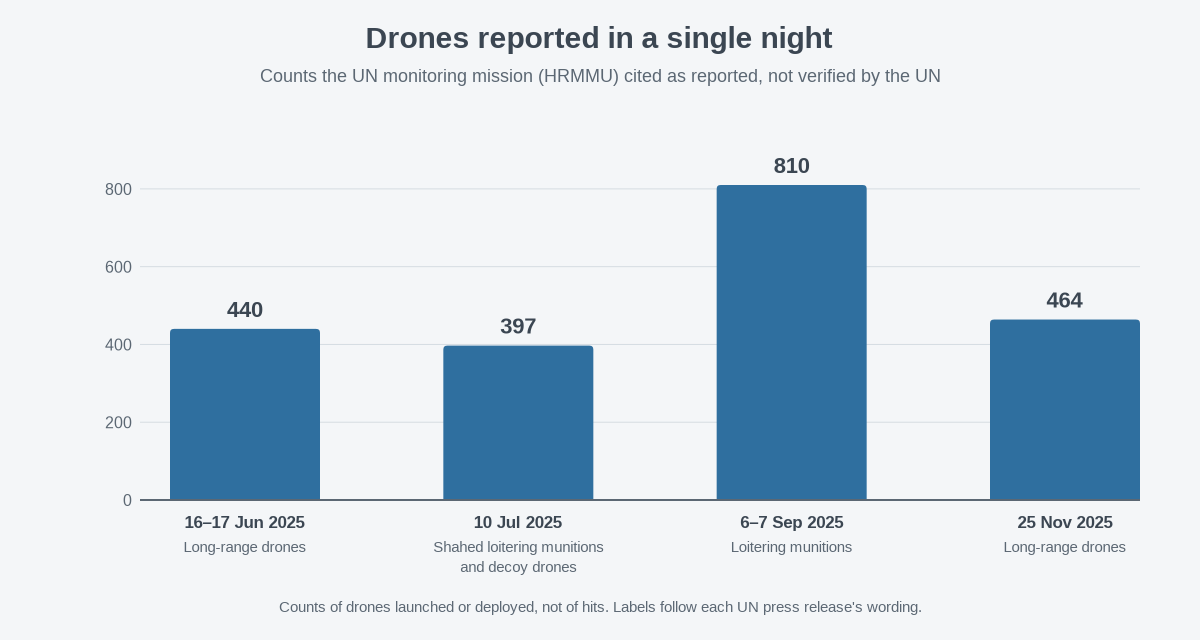
On the night of 10 July, 397 Shahed loitering munitions and decoy drones were reportedly used, and on 6–7 September, 810 loitering munitions and 13 missiles. The mission wrote that no single attack since 24 February 2022 had used more munitions up to that time. On 25 November, 464 long-range drones and 22 missiles were reported. On 2 July 2026, Russia fired 74 missiles and almost 500 long-range drones, and the harm fell mainly on Kyiv city.
There are monthly comparisons too. In June 2025, Russian missile and loitering munition attacks were ten times those of June 2024. Civilian deaths and injuries were recorded in at least 16 regions and the city of Kyiv. In November, the mission summed up that Russia had sharply increased its use of long-range weapons in 2025.
These are numbers launched or deployed, not numbers that hit. The UN passed most of these launch counts on as Ukrainian authorities' figures or with the word "reportedly." What the mission says it verified is the civilian harm figures. Launch counts and harm counts usually come from different counting bodies to begin with.
Energy facilities and winter
On 19 September 2024, the mission released a report on attacks on the power system. Between 22 March and 31 August 2024, Russian forces carried out nine waves of attacks that hit power facilities in 20 of the 24 regions that Ukraine controls. The attacks combined missiles, loitering munitions and drones. Around 9 gigawatts of generating capacity was destroyed, equal to half of what Ukraine needs in winter.
What was hit also changed. In the 2022–2023 winter, the attacks mainly targeted transmission facilities, while those since March 2024 targeted generating facilities to a much larger extent.
The record for the 2025–2026 winter is in a report released by the UN Human Rights Office on 29 June 2026. From October 2025 to March 2026, Russia attacked facilities that generate, transmit and distribute electricity at least 423 times. Heating facilities, including combined heat and power plants, were struck at least 74 times.
Large attacks often used hundreds of missiles and long-range drones at once against several regions. The high civilian casualties of September and October 2026 coincided with Russian forces starting systematic attacks on energy facilities throughout Ukraine again.
The UN record also covers attacks in the other direction. A November 2025 press release says that Ukraine struck Russia's Krasnodar and Rostov regions with long-range drones, and civilians there were reportedly killed or injured. In the 2025–2026 winter, Ukrainian authorities attacked a power plant in Russia's Belgorod region, which, according to Russian authorities, caused temporary power and heating outages. The October 2026 press release also cites statistics from Ukraine's Unmanned Systems Forces showing 82 attacks on energy facilities in occupied territory and in Russia.
In the civilian harm record
Civilian harm figures are numbers the mission verified itself. Between January and October 2024, 434 civilians died and 2,045 were injured in long-range drone and missile attacks. In the same period of 2025, deaths rose 26% to 548 and injuries rose 75% to 3,592.
For the reporting period from December 2025 to May 2026, all causes combined killed 1,272 civilians and injured 6,871. That was 40% more than a year earlier, and long-range missile and drone attacks were still the leading cause. In January to June 2026, casualties from long-range weapons, meaning missiles and drones, rose 60% compared with the same period in 2025. These long-range attacks mainly hit cities far from the front line.
Month by month, the share is clearer. In July 2026, long-range weapons caused 38% of all civilian casualties (183 killed and 967 injured). That July had more civilian casualties than any month since March 2022. In September, at least 328 civilians died and 2,105 were injured, with long-range weapons at 53% and short-range drones at 23%.
These shares combine missiles and drones. The source does not give a separate share for drones, so these figures cannot tell how many people drones alone harmed. The records also note that near the front line, short-range drones caused most of the casualties.
Beyond the border: Polish airspace
In September 2025, the record crosses Ukraine's border. NATO launched a military activity called Eastern Sentry after Russian drones entered Polish airspace, a violation NATO calls unprecedented. NATO describes it as involving traditional capabilities alongside newer technologies such as anti-drone capabilities.
NATO's description does not name the type of drone involved. The basic structure of tying many sensors and weapons into one air defense is in Integrated air defense and sensor fusion. Why drone defense never ends with a single device is in Counter-drone systems: why one device is not enough.
Where this meets lasers: who counted the numbers
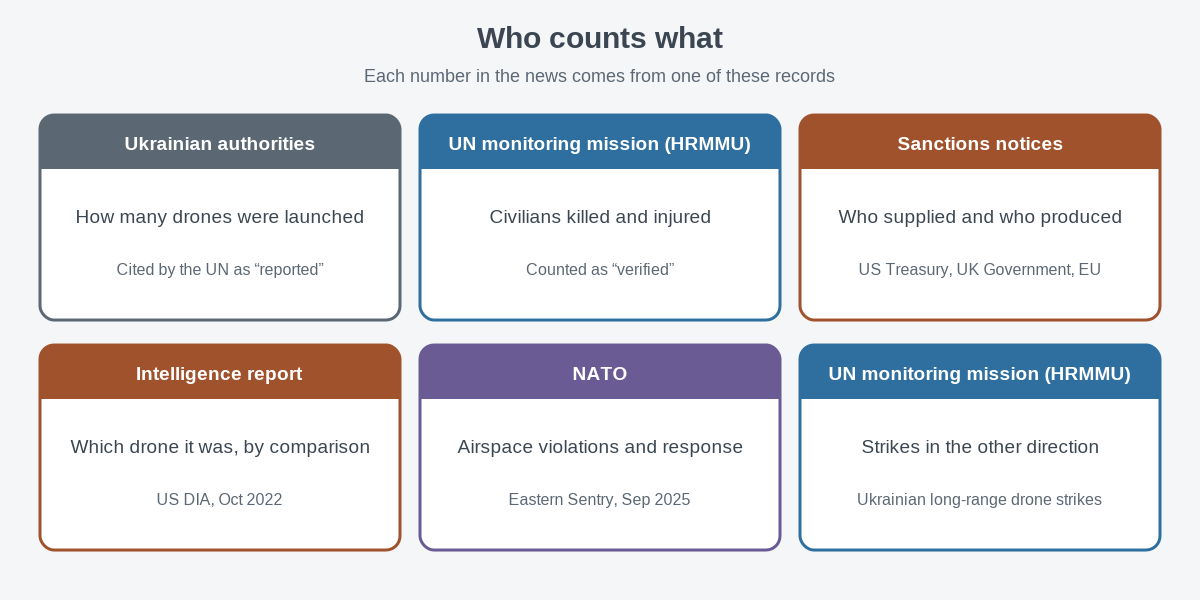
When reading the Shahed and Geran record, the first thing to check is who owns each number. Is it a launch count or a harm count? Was it announced or verified? Which date does it belong to?
The same news story reads differently once these questions are asked.
Laser weapon news needs the same habit. When a story says a system "shot down so many drones" or costs "so much per shot," check who counted, when and under what conditions. A laser weapon is one branch of directed energy weapons (DEW).
How to read that kind of story is laid out in How to read laser weapon news: "kW-class", "range" and "cost per shot". How the defending side's costs are compared is covered in The cost of drone defense.
What to read next
- The Russia-Ukraine War: A Timeline from Public Records Since 2022: dates beyond drones, such as UN votes, courts and agreements.
- The Shahed series: same name, different drones: family names, airframe numbers and how the name Geran came about.
- Drones in the War in Ukraine: A Timeline from 2022: a drone war timeline that also includes fundraising, support programs and small drones.
- How to read laser weapon news: "kW-class", "range" and "cost per shot": the same habit of checking who owns a number, applied to laser weapon news.