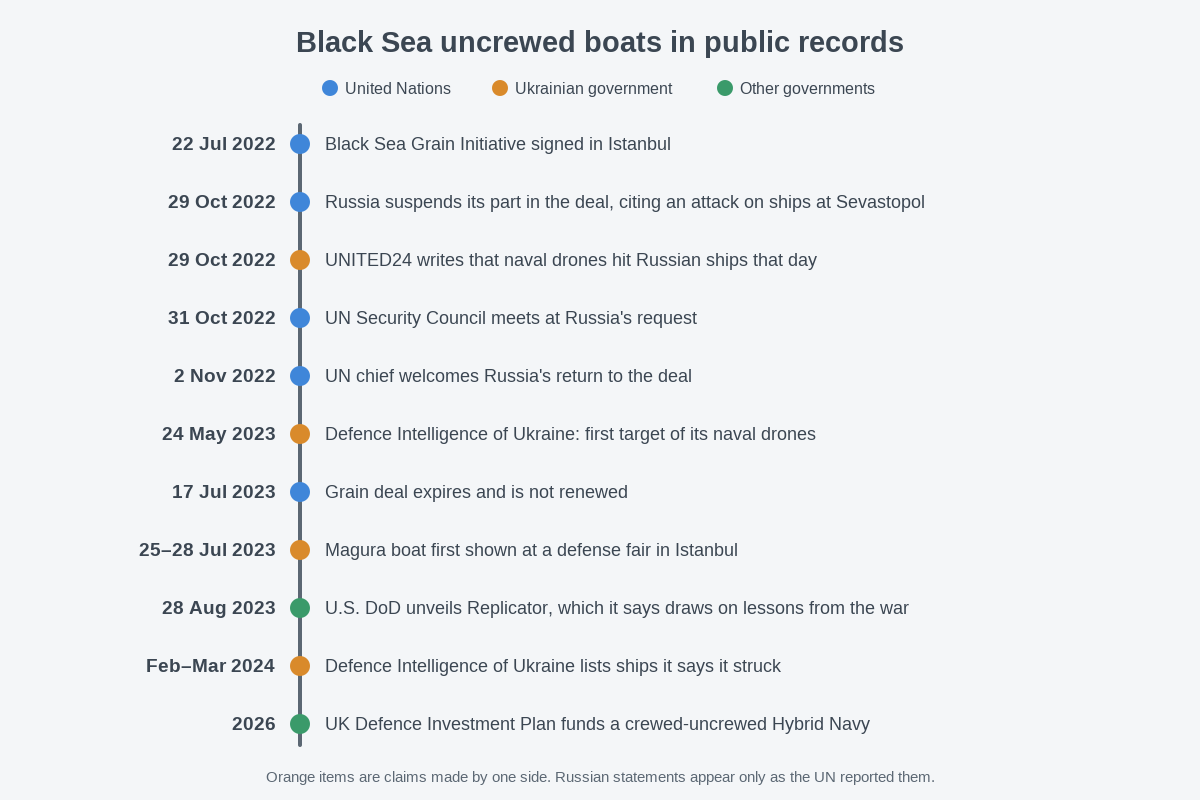
On Saturday, 29 October 2022, Russia announced that it was suspending its part in the Black Sea Grain Initiative. It said its ships at the port of Sevastopol in Crimea had been attacked. A Ukrainian government fundraising site carries its own account: naval drones hit Russian ships that day.
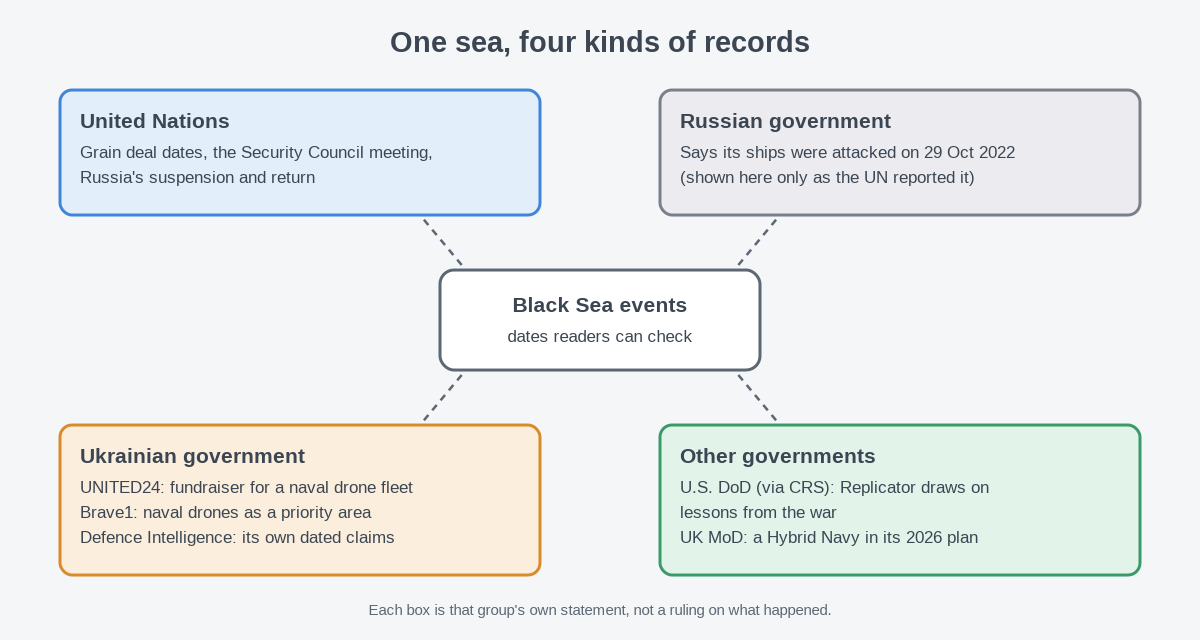
How did small boats with no one aboard enter the official record of the Black Sea? This article follows that question by date. It separates what the UN recorded, what the Ukrainian government recorded, and what other governments put in their documents. This article reflects the situation as of October 2026.
The setting: the Black Sea and the grain corridor
An unmanned surface vessel (USV) is a boat that travels on the water with no crew. The large USVs the U.S. Navy is building, and their technical hurdles, are covered in Unmanned surface vessels: ships without crews. This article looks only at what entered the record in the Black Sea.
The grain corridor came first. Signed in Istanbul on 22 July 2022, the Black Sea Grain Initiative allowed food and fertilizer exports from three ports: Odesa, Chornomorsk and Yuzhny (Pivdennyi). Its course from signing to end is covered in the Russia-Ukraine war timeline.
Ships loaded with grain sailed to world markets along an agreed route. No real road was laid on the water. As the next section shows, the UN described this route as lines drawn on a chart.
How the Ukrainian government saw the sea is recorded on its fundraising site, UNITED24. Its naval drone page counts over 4,500 missiles fired at Ukraine by the Russian army since 24 February, with 20% launched from the sea. Another line puts the loss of the Ukrainian fleet after the 2014 occupation of Crimea at 80% of its vessels. These are figures from a fundraising appeal, and no reference date appears next to them.
29 October 2022, Sevastopol
That Saturday, Russia declared it would stop taking part in the deal. It pointed to an attack on ships at the port of Sevastopol that same day. In UN News, Sevastopol appears as a Ukrainian port on the Crimean peninsula, a region Russia annexed in 2014.
Russia's suspension was "for an unspecified period of time." Russia stopped cooperating and said it would no longer guarantee safe passage for ships along the humanitarian corridor through the Black Sea. Its stated ground was a claim that Ukraine had attacked its military vessels in Crimea. At Russia's request, the UN Security Council met on Monday, 31 October.
What stopped was Russia's participation. The Ukrainian, Turkish and UN delegations agreed on a plan to move 14 ships on Monday, 31 October. At the Security Council, the Russian ambassador himself pointed out that work at the Joint Coordination Centre (JCC) had continued without Russia.
At that meeting, the UN Emergency Relief Coordinator answered Russia's allegations. No military vessels, aircraft or assets of any party were being used, or had been used, to support the deal, he said. The route the ships follow is "just lines on a chart," and it gives no cover or protection to military action, whether offensive or defensive. He added that the corridor was empty on the night the attacks were said to have happened, and that no ship reported any incident over that weekend.
The Ukrainian account of the same day is on the UNITED24 page. By that page's account, naval drones hit Russian ships on 29 October 2022, and three Russian vessels, among them the Black Sea Fleet flagship Admiral Makarov, were damaged. In its words, this was the first attack in history carried out only by uncrewed boats.
The damage figures appear only on the UNITED24 page; the UN News stories cited above give none.
Russia's suspension did not last long. A UN News story on 2 November 2022 carried the Secretary-General's welcome of Russia's decision to return. The deal was not renewed after its third term ended on 17 July 2023.
A fleet built from donations
UNITED24's naval drone page describes the events of 29 October and then announces the fundraiser. The page gives no start date for it. Its appeal says that Ukraine is starting to assemble the world's first "Naval Fleet of Drones." Its first task, it says, is to gather 100 of these boats.
The page presents the boat as a multipurpose uncrewed surface vehicle developed in Ukraine. The uses it lists include long-range sea reconnaissance and coastal watch, escorting and supporting the regular fleet, and convoying merchant ships.
The page gives a price, too: one naval drone costs 250,000 USD. What stands out is what that price covers. Along with the boat itself, it pays for a ground-based control station, a transportation and storage system, and a data processing center.
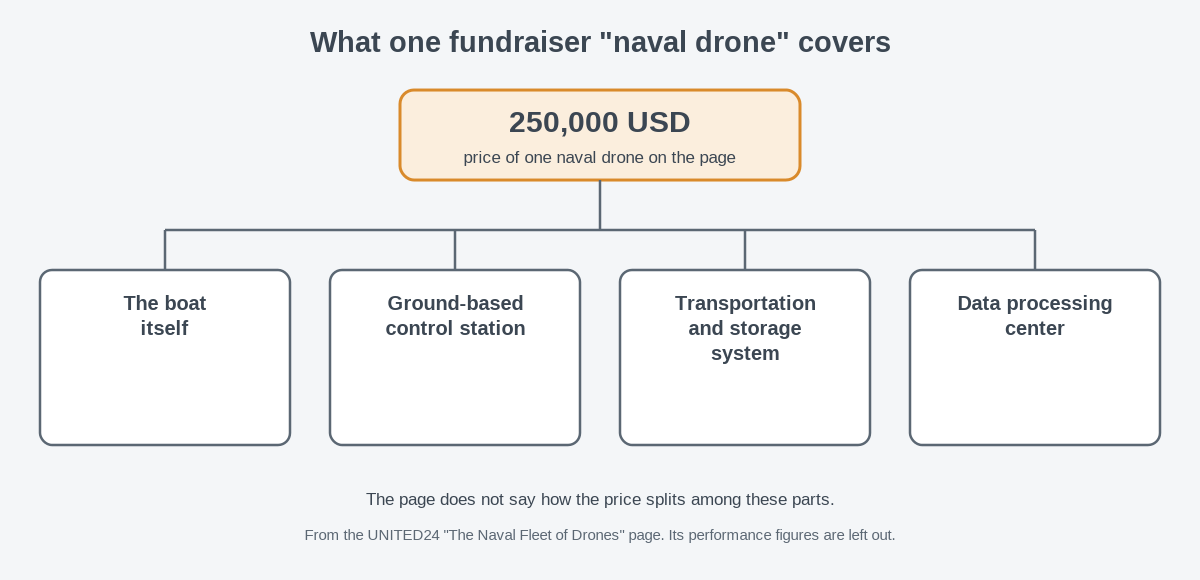
A boat with no crew does not run on the boat alone, and the fundraiser's price also includes a control station on shore and a data processing center. The page does not say how the price splits among the four parts.
Fundraising is not the only channel. Brave1 is a Ukrainian government program for developing defense technology, run by the Innovation Development Fund. It began as a grant program for defense startups.
Brave1 and the military have picked 11 areas where technology work comes first, and naval drones are one of them. More than 20 naval drone makers appear in its cluster on the home page.
Dates in a Ukrainian intelligence record
The Defence Intelligence of Ukraine (DIU) also keeps a list of naval drone dates on the operations page of its website. The agency's boat is called "Magura." Its first public showing, by the page's account, came at the International Defence Industry Fair (IDEF) in Istanbul on 25–28 July 2023.
Yet the first target the agency names comes before that fair. In the agency's list, the Russian reconnaissance ship Ivan Khurs is the first target of its naval drones, dated 24 May 2023. That is about two months before the boat was first shown in public.
In 2024, the dates on the same page grow closer together. By the agency's account, "Magura V5" boats attacked the missile boat Ivanovets on 1 February. On 14 February, the large landing ship Cezar Kunikov was sunk. On 5 March, the patrol ship Sergey Kotov was sunk.
What the Russian side said about the same dates is not on this page.
What other governments wrote down
The uncrewed systems of this war also show up in documents from governments far from the Black Sea. The U.S. Department of Defense unveiled its Replicator initiative on 28 August 2023. In a recent Congressional Research Service (CRS) report, DoD officials tie it to what was learned from the war between Ukraine and Russia, which is still going on.
Replicator 1 is meant to cover every domain, and it could include autonomous systems in the air, on the ground, on the water, under the water and in space. DoD officials have confirmed that uncrewed surface vehicles, uncrewed aircraft systems and counter-drone systems of various sizes and payloads were selected. The lessons in question come from the war as a whole, not from the Black Sea alone.
The UK government's Defence Investment Plan (2026) also says it is learning the lessons of Ukraine. The plan sets aside more than £5bn for advanced uncrewed systems for the remainder of this parliament. Of that, £1.5bn goes to turning the Royal Navy into a "Hybrid Navy."
A Hybrid Navy is a force of advanced crewed ships networked with uncrewed craft on and under the water. Uncrewed craft that travel underwater are called unmanned underwater vehicles (UUVs). The idea is less about uncrewed craft replacing crewed ships and more about using the two together.
What to read next
- Unmanned surface vessels: ships without crews: what a ship with no crew needs to follow the rules of the road and to keep going when its link is lost.
- Unmanned underwater vehicles: robots beneath the sea: the underwater uncrewed craft that make up the other half of a hybrid navy.
- Naval Mines and Mine Countermeasures: naval mines, a threat at sea far older than uncrewed boats, and the work of finding them.
- The Russia-Ukraine War: A Timeline from Public Records Since 2022: dates for the war as a whole, including the grain deal.
- Laser weapon programs that have been made public: how laser weapons carried on ships appear in public sources.
- Drones in the War in Ukraine: A Timeline from 2022, and Ukraine's Unmanned Systems Forces: A Military Branch for Drones: articles in the same series that are still being written.