A destroyer is a large warship built to cover wide stretches of sea. A missile boat is far smaller. On 21 October 1967, a real battle showed that a small boat could sink a big warship.
That day the Israeli destroyer Eilat sank off the coast of Sinai. What hit her were Soviet-made ship-to-ship missiles fired from Egyptian fast boats. The German Federal Archives describe the event as the first use of Soviet guided missiles in naval warfare.
This article looks at what happened that day, where the records disagree, and what several navies changed in the years that followed. It relies on diplomatic papers and parliamentary and archive records. How the missiles themselves work is covered in the anti-ship missile article.
A sea a few months after the Six-Day War
The Six-Day War of 1967 ended in a cease-fire, yet clashes along the lines went on. At a White House meeting on 23 October, presidential aide Rostow pointed out that this was not the first Egyptian-Israeli clash since the cease-fire. There had even been an earlier fight at sea.
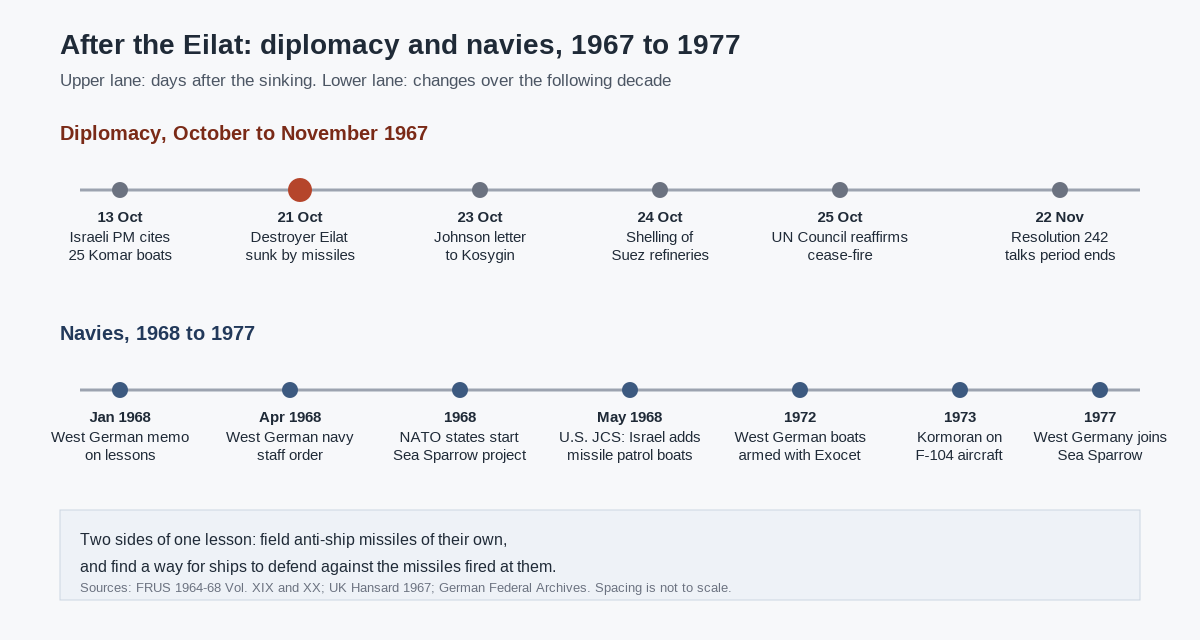
Israel was already aware of small missile boats. On 13 October, eight days before the sinking, the U.S. embassy in Tel Aviv cabled Washington with remarks from Prime Minister Eshkol. He said Egypt had 25 Komar boats carrying rockets that could shell Israel's coastal towns.
According to a Jewish Telegraphic Agency (JTA) report from the time, the Eilat was one of three destroyers in Israel's navy. She was also one of two sister ships that Britain had sold to Israel.
21 October, off the Sinai coast
The boats that fired were Egyptian Komar-class craft, built under the Soviet design known as Project 183R. The missile was the P 15, which NATO called the SS-N-2 Styx. These names come from the German Federal Archives' account.
U.S. records put the weapon ahead of the type of boat. In an editor's footnote in the State Department's diplomatic series, Foreign Relations of the United States (FRUS), the Eilat was sunk by "missile-equipped patrol craft."
How many boats fired, and how many missiles, differs from record to record. President Johnson's letter speaks of one patrol boat, while the FRUS footnote and the German account speak of several. Press reports at the time said the ship took three missile hits in a short action.
Numbers and distances that do not match
The casualty count also changed over time. The first figures, as reported by JTA on 23 October, were 15 crew dead and 36 missing. A large rescue at sea and from the air brought 151 men out of the water, 48 of them hurt.
The missing never came home. In March 1969 JTA reported that the missing crew had been officially declared dead.
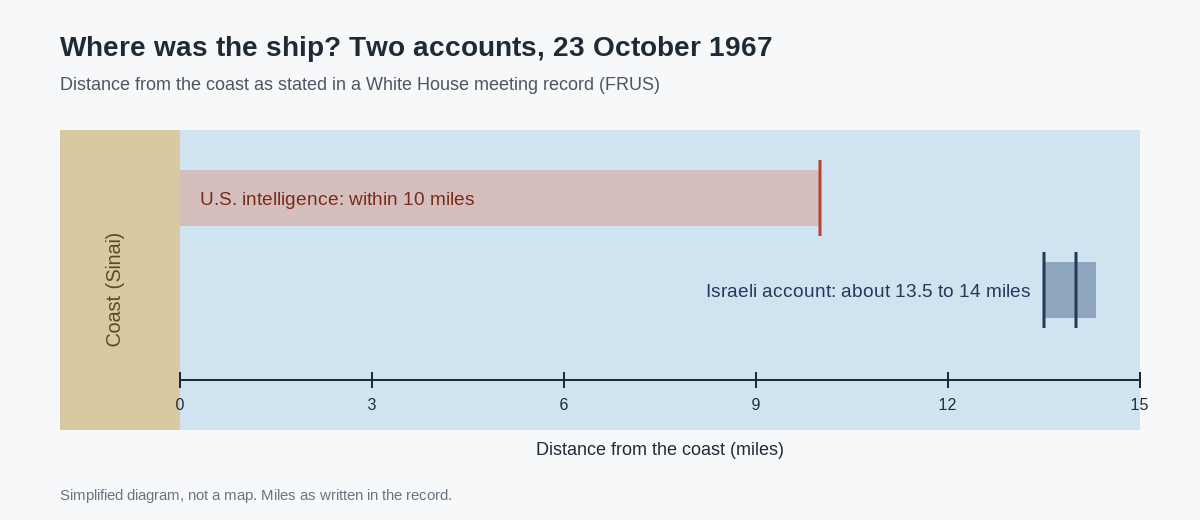
Accounts of the ship's position also split. At the 23 October meeting, Rostow said U.S. intelligence placed the destroyer within 10 miles of the Egyptian coast. Israeli Foreign Minister Eban replied that his information put it at about 13.5–14 miles. Both numbers sit side by side in the same record.
Reactions in Washington and New York
Eban opened that meeting with the sinking. He said it raised questions about both Egyptian motives and Egyptian technical skill, and he called it a "classic act of war."
On the same day, President Johnson replied to Soviet Premier Kosygin. He wrote that the news showed how explosive the situation was: an Egyptian patrol boat armed with surface-to-surface missiles had sunk an Israeli destroyer in the eastern Mediterranean. The letter named this act as the most serious in a run of threats and clashes over recent weeks.
The next day, 24 October, Israeli forces shelled Egyptian refineries at Suez. Inside the White House, a memo argued for leaving a clear record that the United States had urged restraint. The UK House of Commons record states that both events soon went to the UN Security Council. On 25 October the Council voted unanimously to reaffirm that the cease-fire resolutions must be strictly kept.
At the time, talks in New York on Security Council Resolution 242 were still under way. FRUS groups the period from 3 October to 22 November under that resolution. The sinking came right in the middle of it.
A new way of looking at small boats
The event still came up after the new year. At a meeting at Johnson's Texas ranch in January 1968, Israeli Ambassador Harman said there was a growing sense in Egypt of "feeling their strength." The Eilat incident, he said, had given morale a big lift.
Changes in Israel's navy also show up in U.S. papers. In May 1968, Joint Chiefs Chairman Wheeler sent the president a memo on the military balance. He expected Israel's relative naval strength to improve with the addition of guided missile patrol boats.
The view of the threat also widened. At a Washington meeting in November 1968, Israeli air force commander General Hod said Egypt had shipborne missiles with a 35-mile range. In his account, such missiles could be fired at the shore as well as at other ships, and could do great harm to coastal cities such as Tel Aviv.
West Germany's navy redraws its plans
The shock reached beyond the Mediterranean. The German Federal Archives sum it up this way: the Warsaw Pact's technical lead in this field put pressure on NATO navies to modernize. The Soviet Union was also supplying East Germany's navy with a growing number of Osa-class missile boats armed with the Styx.
West Germany's ships were almost defenseless against that missile. Navy leaders quickly revised their operating principles. Work already under way on Germany's own guided missiles, and on means to detect and defend against enemy missiles, gained strong momentum.
The archive holds a memo on the lessons of the Eilat incident, written by the defense ministry's technology branch on 2 January 1968. It also holds an order from the naval staff dated 1 April 1968.
Catching up took several years. With Exocet and Kormoran, missiles developed in parallel by France and Germany, West Germany closed its gap with the Styx. From 1972, Albatros-class and Tiger-class fast boats entered service with Exocet as their main weapon. From 1973, the navy's F-104 aircraft carried Kormoran.
The side that strikes and the side that defends
The lesson had two sides. One was to field anti-ship missiles of one's own. The other was to protect ships from missiles fired at them. Even with the means to strike enemy ships, the second task was still there.
One answer to it was a joint program. In response to the Eilat incident, several NATO states joined in 1968 to develop and build an interceptor missile together, and the result was Sea Sparrow. West Germany joined the program in 1977, and Sea Sparrow is still in German naval service.
Ship defense later grew into several layers. The gun systems that form the innermost layer, and how that role now leads into talk of shipboard lasers, are covered in the close-in weapon system (CIWS) article. How missiles changed the land and air war in 1973 continues in the Yom Kippur War article.
Further reading
- Anti-ship missiles: dealing with moving targets at sea: how the weapon used in this event works
- Close-in weapon systems: a warship's last layer: the innermost layer of ship defense and where lasers come in
- The Six-Day War, 1967: A War Changed by the First Day's Air Strikes: the war a few months before this event
- The Yom Kippur War, 1973: The Shock of Antitank and Surface-to-Air Missiles: the next war that missiles reshaped