
Loitering munition, one-way attack drone, suicide drone. Reports from Ukraine often carry these words together with the name "Shahed." Yet one story says Shahed-131, another says Shahed-136, and a third says Geran-2. Do they all mean the same drone?
They do not. Shahed is a series name that covers several aircraft, and the same design picks up a new name when it moves to another country. This article follows how those names split, using only documents released by the U.S. and UK governments. First, though, it looks at what kind of weapon the news means by a "one-way attack drone."
What a one-way attack drone is: a drone that does not come back
The word drone usually brings to mind an aircraft that flies a scouting mission and returns to base. Yet the U.S. Department of Defense definition of an unmanned aerial vehicle (UAV) covers both aircraft that are recovered and reused and expendable ones that are used once and lost. That definition appears in a 2012 Congressional Research Service (CRS) report. A one-way attack UAV sits at the expendable end of that range.
Think of a train ticket: this is a one-way ticket, not a round trip. The aircraft flies to its target, strikes it, and ends there along with it.
A real ticket differs in one way. A passenger with a one-way ticket gets off at the destination, while for this drone, arriving is the end of the mission. That is why a U.S. Treasury release says one-way attack UAVs designed in Iran are "also known as kamikaze drones."
There is a related name, too. An article on the U.S. Army's official site describes loitering munitions as armed drones that wait in a target area and then crash into the target. CRS, for its part, calls small one-way attack drones "loitering munitions" as well. The two names overlap: "one-way" puts the stress on not coming back, and "loitering" on being able to wait near the target.
How is this different from a cruise missile? The same UAV definition leaves out cruise missiles, along with ballistic vehicles and artillery shells. Since the definition already includes expendable UAVs, not coming back is not, by itself, what sets a drone apart from a missile. Where the line falls is taken up in "Loitering munitions: between missile and drone."
Several aircraft under one name
Think of a carmaker. One company builds both cars and trucks, and both carry the company name. The Shahed series name is the same as the name of the organization that makes the aircraft.
On November 15, 2022, the sanctions office of the U.S. Treasury (OFAC) designated the "Shahed Aviation Industries Research Center" (SAIRC). SAIRC sits under the aerospace force of Iran's IRGC. It designed and built several variants in the Shahed line, and one of them is the Shahed-136, a one-way attack drone.
The same series also holds aircraft with a very different job. SAIRC built the Shahed-129 as well, a UAV for reconnaissance and strike at medium altitude, and it leads a project called Shahed-171. The release does not say what kind of aircraft the Shahed-171 is.
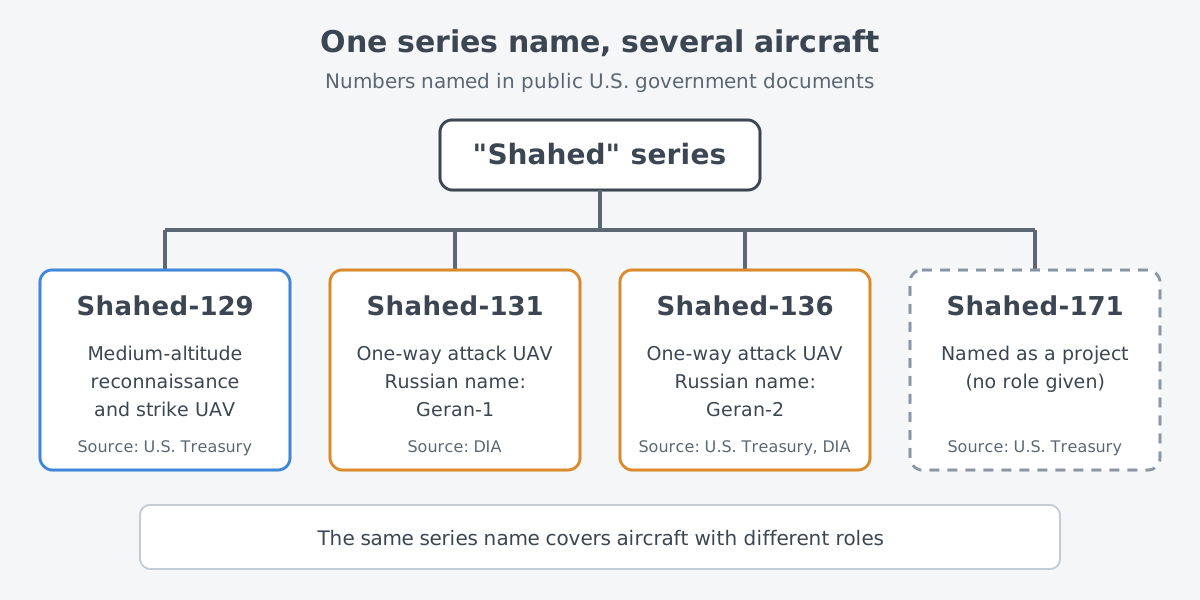
The car comparison stops there. A carmaker publishes the name and specifications of each model itself. The names and roles in this article did not come that way; they come from other governments' sanctions notices and intelligence reports. So for any number, it matters which agency's document it comes from.
A different number, a different shape
What about the Shahed-131 and the Shahed-136, one digit apart? A 2022 report by the U.S. Defense Intelligence Agency (DIA), "Iranian UAVs in Ukraine: A Visual Comparison," describes their shapes separately. The report's information cutoff date is October 27, 2022.
The Shahed-136 has a distinctive shape: a delta-wing body with vertical fins that reach both above and below the body. The Shahed-131 has a similar delta-wing body, but its vertical fins reach only above it.
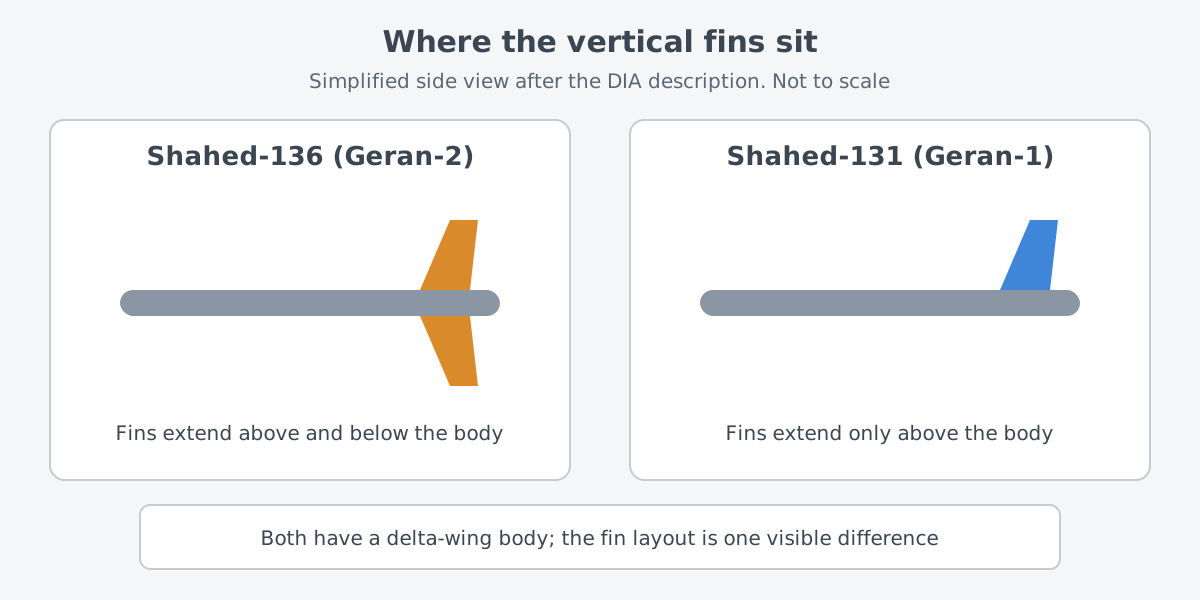
Different numbers mean different shapes. A story that says only "Shahed" does not tell you which aircraft it means. Even within one series, the number matters.
A new country, a new name: Geran
The same DIA report gives other names too. Russia renamed the Iranian-origin Shahed-136 as the Geran-2 and the Shahed-131 as the Geran-1. That is why Ukrainian reporting mixes the names Shahed and Geran.
The change went beyond the name. In a February 23, 2024 release, the U.S. Treasury sanctioned Russia's Alabuga special economic zone (SEZ Alabuga). Treasury said the zone had a deal with Russia's armed forces to put together Geran-2 units sent from Iran. The zone was also building up its ability to make many of the parts for these Iranian-designed UAVs inside Russia.
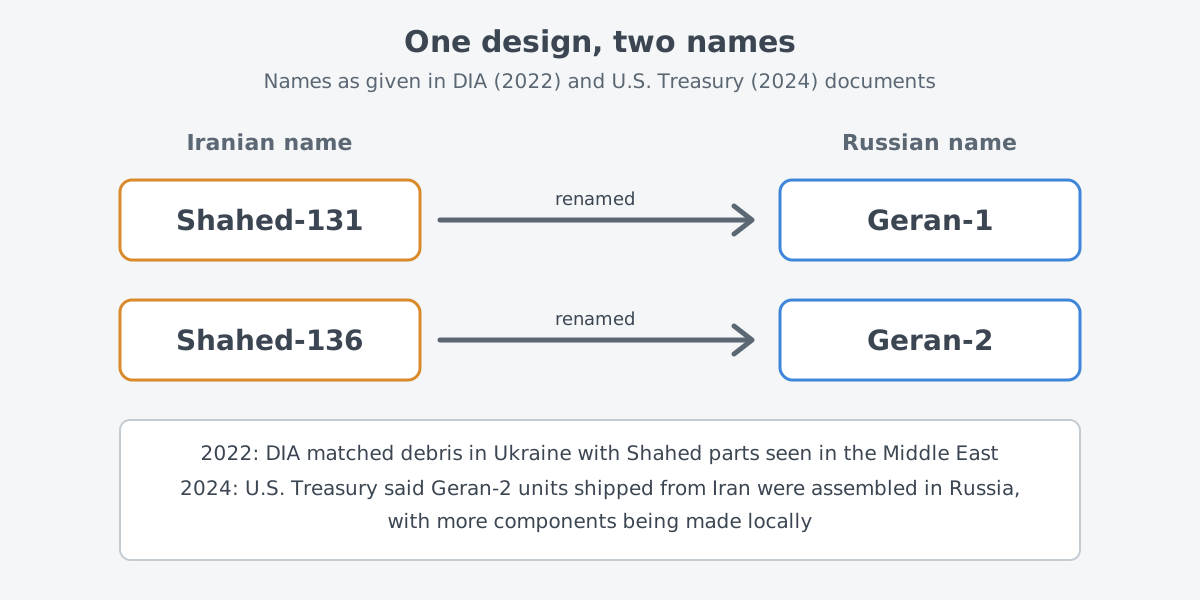
In the same release, the Geran-2 appears as the "Russian version" of the Shahed-136. The design came from Iran, while assembly and some parts production were moving to Russia. No public document found for this article says how, or how much, the Russian-built units differ from the Iranian original.
Side by side with other families
Shahed is not the only Iranian drone name. Once you know that names attach to a series, other names read the same way.
| Series name | Examples and description in public documents | Document |
|---|---|---|
| Shahed | Shahed-131 and -136 one-way attack UAVs, Shahed-129 UAV for reconnaissance and strike at medium altitude, the Shahed-171 project. Designed and built by SAIRC | U.S. Treasury (2022), DIA (2022) |
| Mohajer | The Mohajer 6 multirole UAV. Shown in public in Iran and Iraq, and easy to recognize by its distinctive tail | DIA (2022) |
| Ababil | A UAV series built, along with military aircraft, by HESA, a state-owned company under Iran's defense ministry | U.S. Treasury (2025) |
Each series has its own maker and its own uses. The phrase "Iranian drone" covers several series, and each series covers several numbers.
How government reports confirmed the names
How do you tell what an aircraft from a war zone is? The DIA report works by comparison. It sets photos of debris and parts from UAVs that Russian forces used in Ukraine next to Iranian UAVs used in the Middle East or shown at military exhibitions.
The comparison went beyond outer shape. The wing stabilizers of Shahed-136 (Geran-2) units found in Ukraine match those seen or collected in the Middle East in size, shape and markings. The engines were compared as well. For the Shahed-131, parts recovered in the two regions were very similar, and some had even broken the same way on impact.
DIA concluded that the comparison shows Russia is using several kinds of lethal UAVs from Iran in the fighting in Ukraine. That is the judgment of a U.S. intelligence agency. What a reader can take from the report is the kind of evidence behind the judgment: public photos compared with recovered parts.
Names and judgments also led to sanctions. On October 20, 2022, the UK government listed Shahed Aviation Industries as the Iranian maker of the Shahed drones and froze its assets. The UK judged that Iran's and Russia's actions violate UN Security Council Resolution 2231. That resolution requires prior Security Council approval for moving specified items to or from Iran.
According to the U.S. Treasury, the EU decided on the same day to sanction three Iranian military leaders and SAIRC. From September 2022 up to a September 2023 release, the United States issued nine rounds of designations against Iran's UAV program.
Where this meets lasers: reading names carefully
The habit of reading names carefully carries straight over to laser weapon news. Just as "Shahed" needs its number and its source document, a phrase like "XX kW-class" needs to say what was measured. Without the kind of power, the conditions behind the value, or who gave it, the number is only half the story.
Keeping government documents and company statements apart is part of the same habit. How to read laser weapon news works through phrases like "kW-class," "range" and "successful test" with these questions.
What to read next
- How to read laser weapon news: reading the numbers and phrases in weapon news together with their conditions.
- "Loitering munitions: between missile and drone": where the line between a drone and a missile falls.
- ISR drones: the official size-based groups for drones and what endurance means.