In the spring of 2022, the name "Bayraktar" kept turning up in news from Ukraine. It belongs to the Bayraktar TB2, an armed drone built by the Turkish company Baykar. By that summer, people in Lithuania and Ukraine were even raising money to buy the aircraft and send it to the front.
A famous name draws many verdicts. Stories of its successful use kept coming, and one assessment warned that heavy losses could shrink its future impact. So what does the record actually contain? This article reads papers from the U.S. Congressional Research Service (CRS), the maker's own pages, and news stories reposted on the maker's website, in order of date.
This article reflects the record as of October 2026.
What kind of drone the TB2 is
Baykar presents the TB2 as an armed unmanned aerial vehicle of the Medium Altitude Long Endurance (MALE) class. The aircraft was developed for intelligence, surveillance and reconnaissance, and it is also set up for precision strike. Taxiing, takeoff, cruise and landing are automatic.
MALE is the name for a group of drones built to stay aloft for a long time at medium altitude. What this group is, and how it differs from high-altitude types, is covered in the article on MALE and HALE drones.
In the technical specification table on the Baykar website, the wingspan is 12 m and the length 6.4 m. Maximum takeoff weight is 700 kg, and payload capacity is 150 kg. Endurance is more than 18 hours, and the engine is a 100 hp internal combustion engine.
The banner at the top of the same page shows other values, such as "20+ Hours in Air." Either way, these are the company's own figures, not values checked by another body.
The TB2 is more than one aircraft. The aircraft, a ground control station and the data link between them form a single unmanned aerial system (UAS). Think of it as a cockpit lifted out of the plane and set down on the ground. Unlike a real cockpit, though, the crew never sees the aircraft directly, only the video and data that arrive over the link.
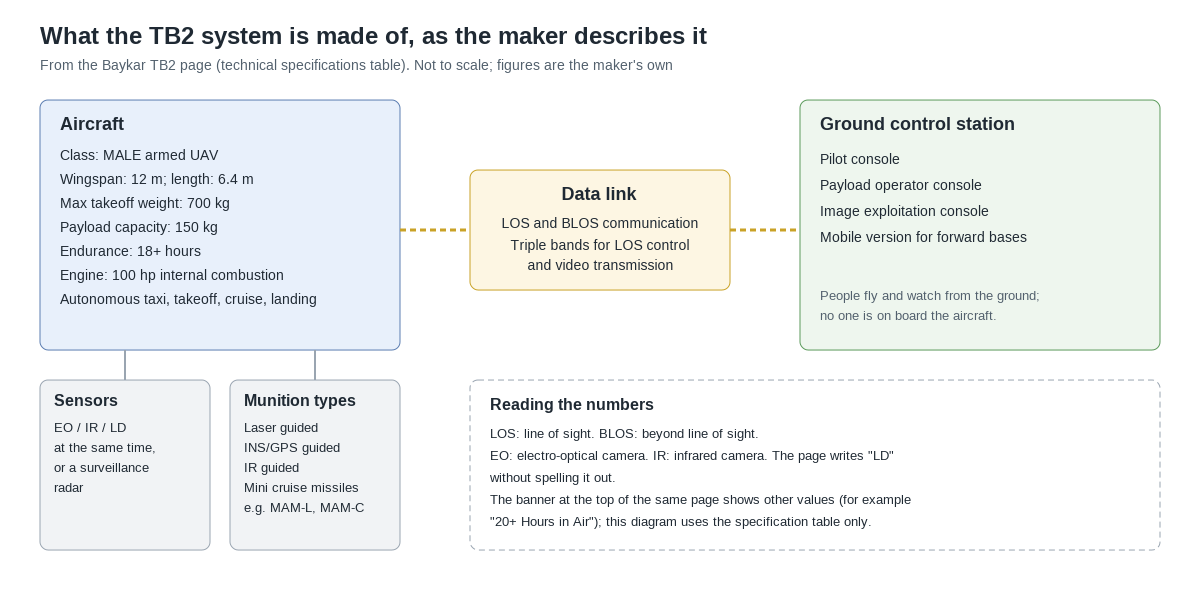
The ground control station has a pilot console, a payload operator console and an image exploitation console. Communication covers both line of sight (LOS) and beyond line of sight (BLOS). Three frequency bands carry LOS control and video. A mobile control station on a truck also exists, so the aircraft can take off and land from forward bases.
The payload is "EO/IR/LD at the same time, or a surveillance radar." EO means an electro-optical camera and IR an infrared camera, while the specifications do not spell out LD. The munitions are laser guided, INS/GPS guided and IR guided munitions plus mini cruise missiles, and the Turkish-made MAM-L and MAM-C appear as separate entries.
Before the war: imports and a navy delivery
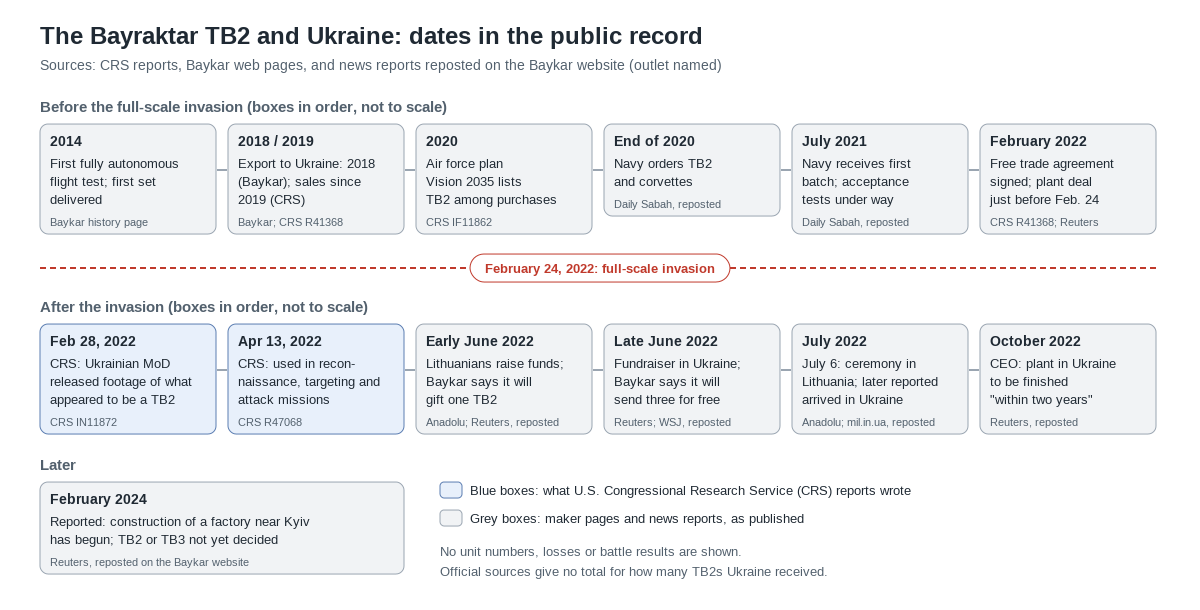
The TB2 made its first flight test run entirely by its own systems in 2014, and the first set was delivered the same year. A second set followed in 2015. Export to Ukraine appears in the 2018 slot of the Baykar history page.
The CRS paper on Turkey (January 2023 edition) carries a different year. Its sentence has Turkey selling several TB2s to Ukraine from 2019 on, as defense ties between the two countries deepened. Neither source explains why the years differ by one. Official sources also give no count of how many arrived, and the CRS wording stops at "several."
Plans to buy more were part of a larger air force program. In 2020 the Ukrainian air force launched a modernization plan called Vision 2035. The plan earmarked 320 billion hryvnia ($12 billion) for new multirole fighters, trainer jets, transport aircraft, drones and air defense systems, and the drones included the Turkish TB2.
The January 2022 edition of the CRS paper "Ukrainian Armed Forces," however, saw the sum as an ambitious projection. It came to three times what Ukraine spends on defense in a year. It also warned that the figure was likely to be revised to fit budget realities.
The navy took the TB2 as well. In July 2021 the first batch of TB2s reached the command of Ukraine's naval forces, and the defense minister at the time spoke of final acceptance tests then under way. Late in 2020, Ukraine had placed an order for the TB2s along with Turkish Ada-class corvettes. The army already had TB2s, while the navy was getting them for the first time.
Industrial ties grew too. The two countries signed several agreements from 2020 on, and in February 2022 they put their names to a wider free trade deal. That agreement was still awaiting ratification. Under a deal reached just before the February 24 invasion, Baykar agreed that its second production plant would go up in Ukraine.
What official records noted, February to April 2022
Russia's full-scale invasion began on February 24, 2022. Four days later, on February 28, a short CRS paper (an Insight) mentions the TB2. Its single sentence says Ukraine's defense ministry had put out a video of what "appeared to be" a TB2 attacking Russian ground units.
That sentence does not mean CRS confirmed the scene itself. It holds two things: the ministry released a video, and the drone in it looked like a TB2.
The first edition of a longer CRS paper, released on April 13, is a little more specific. In it, Ukrainian forces used Turkish-made TB2s against Russian forces for reconnaissance, targeting and attack. Those three words tell you what jobs the TB2 was given. The sentence makes no judgment about how well those jobs went.
How many TB2s Ukraine flew at this point, and how many it lost, cannot be found in the official record. The larger dates of the war are gathered in a separate timeline of the Russia-Ukraine war.
Crowdfunding and the maker's donations
In early June, the drone became the name of a fundraising drive. People in Lithuania were raising money to buy a TB2 for Ukraine. On hearing this, Baykar promised Lithuania a TB2 free of charge and asked that the money go to humanitarian aid for Ukraine.
Accounts differ slightly on the amount and on who made the gift. In the Anadolu Agency version, €6 million came in within three days; in the Reuters version, it was nearly €6 million. Reuters also quoted Lithuania's defense ministry as naming Turkey's Defence Industry Agency as the donor.
A handover ceremony took place in Lithuania on July 6. Lithuania's defense minister, Ukraine's ambassador in Vilnius and Baykar's general director attended. At that point the aircraft was at Šiauliai air base, waiting to leave for Ukraine. By around July 19, the TB2, named Vanagas ("Hawk"), had already arrived in Ukraine.
There was a fundraiser inside Ukraine as well. In late June, once the campaign there raised enough for "several" TB2s, Baykar announced it would send three without taking payment. It asked that the money be returned to the people of Ukraine instead.
A Ukrainian politician ran this campaign. The amount raised was some $20 million, in a Wall Street Journal story. This was the second time Baykar answered a fundraiser with a gift, after Lithuania.
The idea spread to other countries. By late July, campaigns to buy TB2s for Ukraine were also running in Norway, Poland and Canada. The targets were 55 million kroner in Norway, 22.5 million zlotys in Poland and 7 million Canadian dollars in Canada. In the autumn, a news story even mentioned that Ukrainians had written a song about the TB2.
The factory plan and what came after
The sales also carried diplomatic weight. In late June, a senior Turkish official mentioned that Russia had complained to Turkey about the TB2 sales. He argued that because Baykar is a private company, its sales were not deals between states. Baykar went on selling despite Russian objections and had signed a deal before the invasion to produce more jointly.
The factory story grows out of that deal. Baykar planned to put up a $100 million plant in Ukraine, with a center for testing, training and maintenance close by. In October 2022, the chief executive said he wanted to finish building it "within two years."
In February 2024, news came that construction of a Baykar plant near Kyiv had begun. It was to employ around 500 people. Whether it would build the TB2 there or the TB3, a TB2 version for short runways, had not yet been decided. Whether the plant has been finished does not appear in the sources behind this article.
Reading the record: who is speaking
Three kinds of record are mixed together in the TB2 story. There are CRS papers written for Congress, the Baykar website where the company describes its own product, and news stories reposted on that website. The same fact carries different weight depending on who states it.
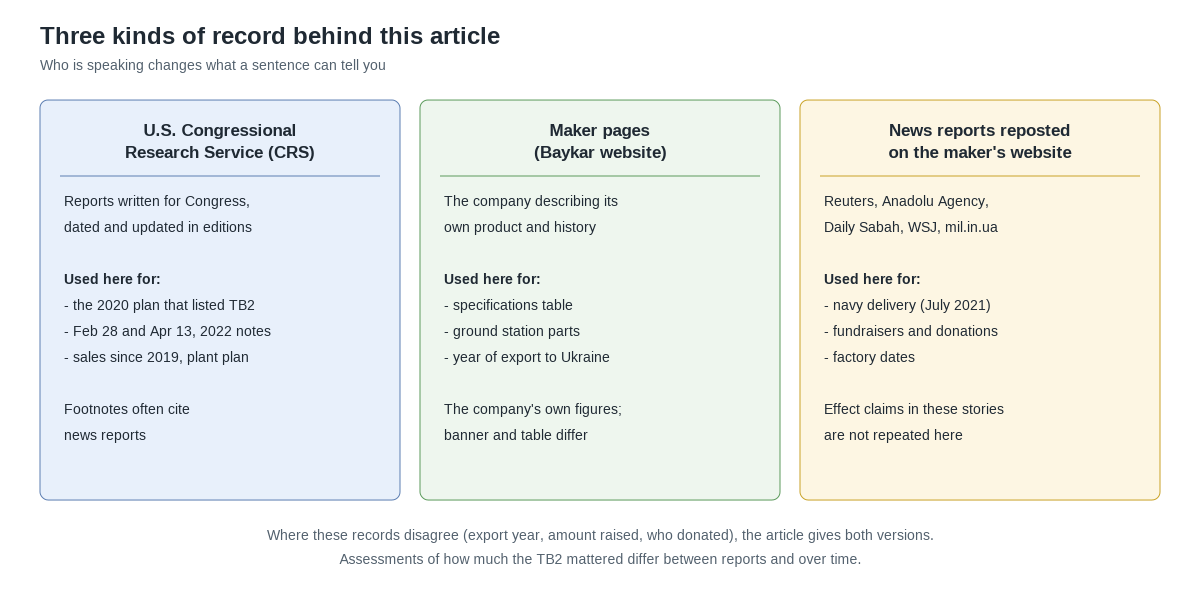
This matters most for sentences about effect. The January 2023 edition of the CRS paper on Turkey places two different lines side by side. In one, many accounts have told of Ukraine using TB2s with success. In the other, a May 2022 assessment holds that Russia may have destroyed enough TB2s to cut their future impact sharply.
Neither line is a CRS judgment; both pass on other sources. So when you meet a sentence such as "the TB2 changed the war" or "the TB2 soon stopped mattering," it is worth checking first who said it and when. Stories on the maker's website come from their original outlets, but the company posted them on its own site, which is also worth keeping in mind.
Ukraine was not where the TB2 first drew worldwide attention. How the drone was discussed during the autumn 2020 war in the South Caucasus is covered in the article on the 2020 Nagorno-Karabakh war.
Where this meets lasers
The first item on the TB2's munitions list is laser guided munitions. In laser guidance, someone shines a laser on the target, and the munition follows the light reflected back from it. The device that lights up the target is a laser designator.
How this device points out a target with light is explained in the article on laser designators. How a weapon follows the reflected laser spot is covered in the article on laser-guided bombs.
What to read next
- The 2020 Nagorno-Karabakh War: Forty-Four Days That Spotlit Drones: the war that put the TB2 in the spotlight before Ukraine.
- ISR drones: why endurance matters: what the reconnaissance and surveillance jobs the TB2 was built for involve.
- The Russia-Ukraine War: A Timeline from Public Records Since 2022: where the dates in this article sit in the war as a whole.
- Drones in the War in Ukraine: A Timeline from 2022: how drone use developed after the TB2.