Picture a patrol aircraft over the sea at night. The clouds hang low, and nobody knows what is under the water. The aircraft can use several "eyes": a camera, a thermal imager, radar, lidar, and sonar that listens underwater. Why isn't one enough?
Because each sensor takes in something different. Some need sunlight to see.
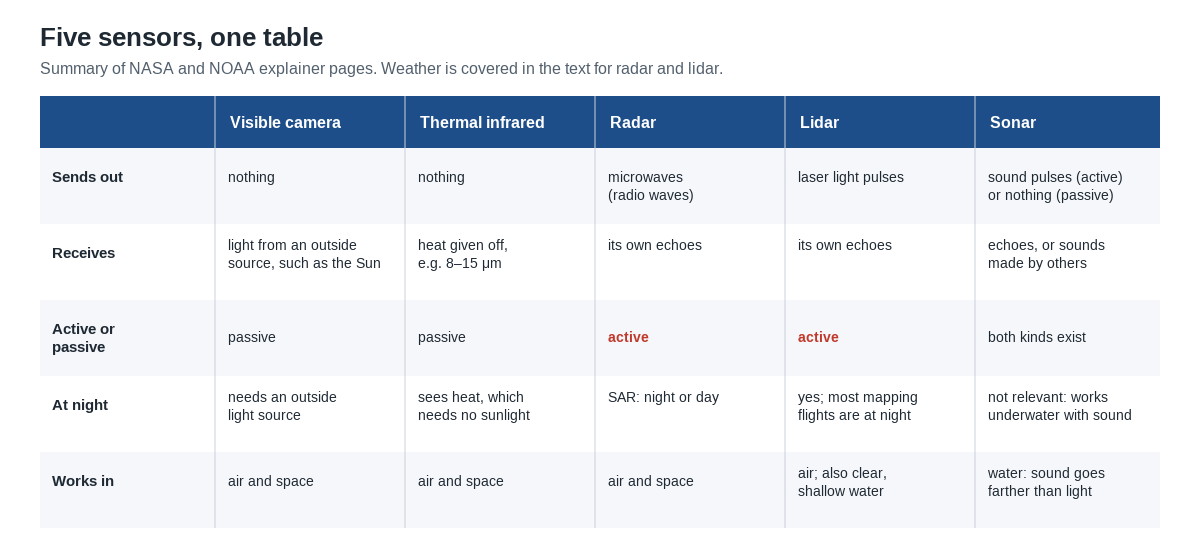
Some send out their own signal. Some cannot get through clouds. Line the five up in the same columns, and each one's blind spots show.
The first split: active and passive
Finding out about something from far away is called remote sensing. Instruments on satellites and aircraft pick up energy bouncing off or radiating from the scene below. These instruments fall into two groups by where the energy comes from.
A passive sensor only receives. It detects light made by an outside source such as the Sun, or energy that an object gives off by itself. An active sensor asks and listens for the answer. It makes energy, sends it toward a target, and measures what changes in the returning signal.
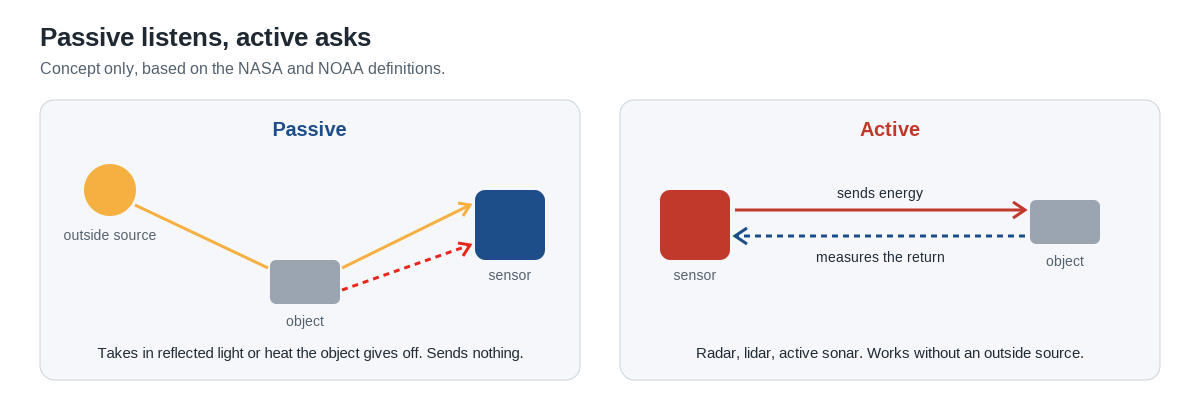
Think of looking for something in a dark room. Passive means relying on daylight from the window or the warmth of the object; active means switching on a flashlight. Real sensors differ in that they use not only light but also microwaves and sound.
Visible camera: borrowing outside light
The human eye and an ordinary camera are passive sensors. Most of what a camera takes in is sunlight reflected off objects.
So a camera needs light to work. Its strengths are clear too. It sends nothing out, so it is quiet, and it shows the scene the way a person would see it. Visible light largely passes through the atmosphere.
Thermal infrared: seeing the heat objects give off
An infrared (IR) sensor is also passive, but it takes in something else. According to NASA, wavelengths of 8–15 μm are best for studying heat radiating from Earth, so Earth scientists call that range thermal infrared.
Because it takes in heat that objects give off themselves, it can see at night without sunlight. NASA's satellite image notes show this kind of use. A scientist used temperatures in an infrared image to tell clouds from land and sea, and the clouds showed more detail in infrared than in visible light. Military examples are in Infrared search and track: seeing aircraft without emitting and Thermal Imaging Sights.
Radar: sending microwaves and hearing the echo
Radar is an active sensor. Active instruments that use microwaves include Doppler radar, scatterometers and radar altimeters. The radar sends out radio waves and measures the echoes that come back.
Its biggest strength is that weather and time of day bother it less. Synthetic aperture radar (SAR) makes high-resolution images night or day, whatever the weather. Medium-length C-band microwaves see the ground through cloud, dust, smoke, snow and rainfall, which even lets scientists watch conditions under a hurricane.
Lidar: asking with a laser
Lidar is like radar but uses pulses of laser light instead of radio waves. NOAA's guide calls lidar an active system because it emits pulses of light. The result is a dense set of precisely located height points, a "point cloud," used to draw the ground and features on it in three dimensions. With a different wavelength, bathymetric lidar can pass the water surface and measure depth out to about 70 m in clear water.
Since it makes its own light, it works at night.
In fact, NOAA says the bulk of lidar surveys are flown after dark, when the air tends to be clearer and fewer aircraft share the sky. Its weakness is weather. Unlike radar, lidar is stopped by cloud, rain or thick haze, so surveys wait for fair weather. Military uses continue in Military Lidar: Mapping Terrain and Objects with Lasers.
Sonar: sound under water
Underwater, things are completely different. According to NOAA, sound travels farther in water than radar or light waves, so sonar is used to explore and map the ocean. Of the five sensors, sonar is the only one that uses sound instead of electromagnetic waves.
Sonar also comes in active and passive kinds. Active sonar sends a pulse of sound into the water and uses the time until the echo returns to find an object's range and direction. Passive sonar sends nothing and only listens to sound arriving at it. NOAA points out that this helps warships that want to stay hidden.
On the other hand, a single passive sonar cannot tell how far away something is. Several devices used together can triangulate where a sound came from. The principles are covered in more detail in Sonar: why sound is used to see underwater.
What to keep in mind when reading the table
In weather, the two active sensors, radar and lidar, part ways most sharply. C-band microwaves pass through cloud and rain to see the ground, while lidar's laser light is stopped by cloud, rain and thick haze. A different wavelength means a different tolerance for weather.
Real systems also rarely rely on one sensor. Active sensors handle night and weather well but give off their own signal; passive sensors are quiet but depend on outside light or heat. An example of combining sensors to fill each other's gaps is Finding Drones with Cameras, Infrared and Sound.
Further reading
- Synthetic aperture radar: images from radio waves: radar images that care less about night and weather
- Military Lidar: Mapping Terrain and Objects with Lasers: uses of laser sensors
- Sonar: why sound is used to see underwater: how underwater sensing works