Flying a drone usually means looking up at it in the sky, or looking down at a screen in your hands. The pilot of an FPV drone does neither. The pilot wears goggles and watches the video sent by a camera on the front of the drone.
This way of flying now shows up in defense papers. It appears in reports from the Congressional Research Service (CRS) and in the description of a U.S. Army program and training course. This article covers what first-person flying is, how civil rules handle it, and how U.S. government papers describe its military use and the questions still open.
What first-person view means
FPV stands for first-person view. An article on the U.S. Army's official website explains the idea. A camera sits on the nose of the drone. Its picture travels live to the goggles or headset that the pilot has on.
The pilot sees the scene the drone sees, right in front of the eyes. It is a bit like sitting in a car's driver seat and looking through the windshield. The real situation is different. The pilot's body stays on the ground, and all that reaches the eyes is the video the camera sends back.
How it differs from watching a screen
Traditional remote-controlled drones work differently. The pilot looks at a screen that shows the scene from above, like a bird would see it. It is like checking where the drone is by following a dot on a map.
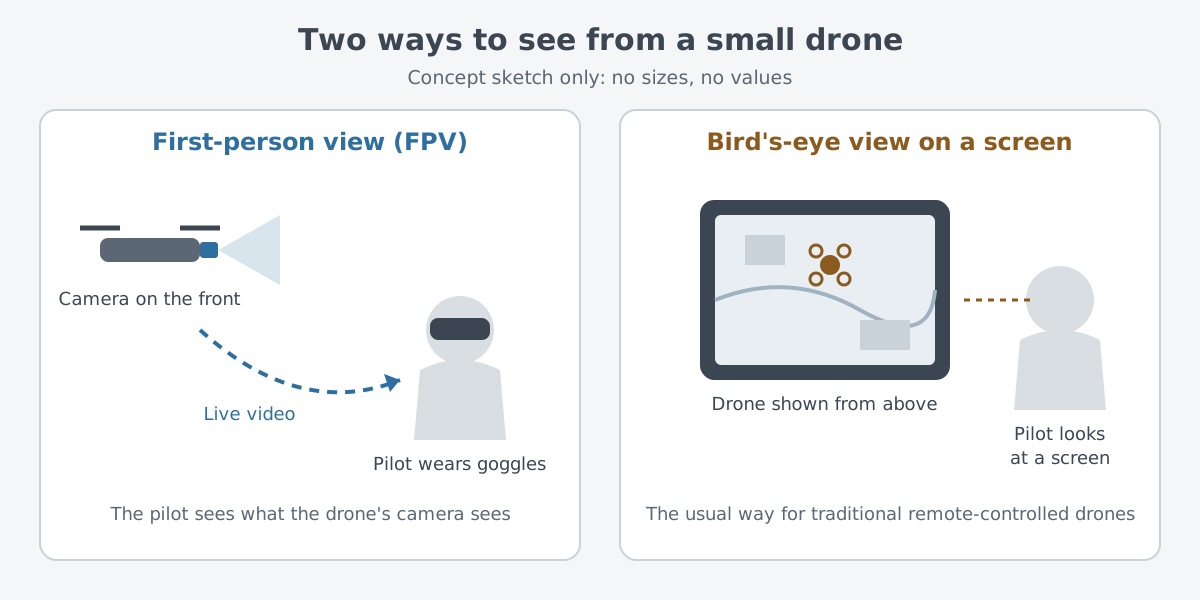
FPV moves that point of view onto the drone. What the pilot sees is not a map but the view ahead of the drone. The Army warrant officer who wrote the article calls FPV drones "the most advanced drones" and says they raise the threat to a new level. The article appears on the Army's official site, but this is one author's assessment.
Why civil rules still ask for the naked eye
The U.S. rule for small unmanned aircraft, 14 CFR Part 107 in the Code of Federal Regulations, sets out how the drone must be watched. Someone must be able to see it for the whole flight. Their eyesight may be helped only by corrective lenses and by nothing else. The rule ties this to knowing the drone's location, attitude, altitude and direction, and to watching for other aircraft and hazards nearby.
The rule does not use the word FPV. Goggle screens, though, are a device and not corrective lenses. Read as written, the rule makes it hard for a pilot wearing goggles to do this naked-eye watching on their own.
The rule lets another person take on the task. Either the pilot in charge and the person flying the controls do the watching, or a visual observer does it. The pilot in charge picks the observer, whose job is to help spot and avoid other aircraft and objects.
With an observer in place, all three roles must stay in good contact at all times. Together they must scan the airspace and keep track of where the drone is through direct visual observation.
Weight groups for small drones
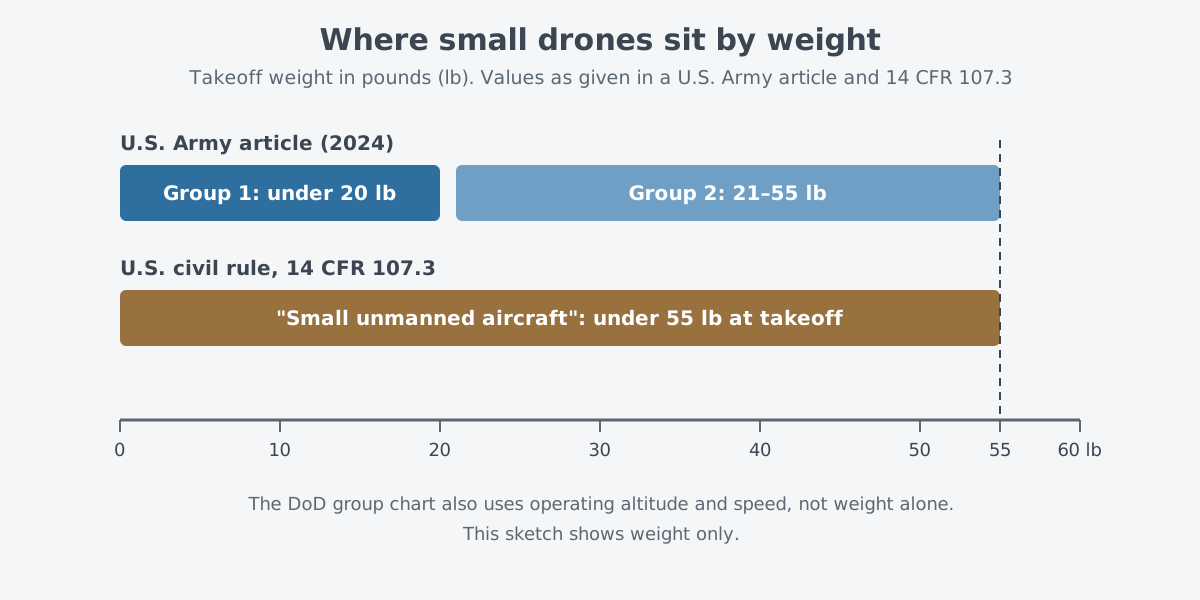
Papers about FPV drones place them among "small drones." So where is the line for small? The U.S. Department of Defense (DoD) sorts uncrewed aircraft into five groups. It looks at the heaviest takeoff weight, the height the aircraft flies at and its speed.
Group 1 holds the smallest aircraft and Group 5 the largest. According to an Army article on drone munitions, small drones that carry munitions are mostly Group 1, which means under 20 pounds. When the munition is bigger, Group 2 drones at 21–55 pounds may be needed.
Where "small UAS" (sUAS) ends depends on the paper. A CRS paper on Army programs treats Groups 1 and 2 as small UAS: under 55 pounds and flying at 3,500 feet or lower above the ground. It notes these are commonly called drones. For counter-drone work, DoD defined small UAS as Groups 1 through 3.
The civil rule draws the same 55-pound line. 14 CFR 107.3 defines a small unmanned aircraft as one weighing less than 55 pounds at takeoff, counting everything on board or attached.
Military use in public reports and government papers
Battlefield use comes to us through press reports that CRS quotes in its counter-drone report. According to those reports, both Russia and Ukraine have made more and more drones for the battlefield. Their front-line units have reportedly received explosive-carrying FPV drones meant for one-way attack, used alongside artillery ammunition and conventional missiles.
Two names overlap in that sentence. FPV says what the pilot looks at while flying. One-way attack says the drone does not come back. The Army article also keeps these apart from loitering munitions, which wait over an area and then crash into the target, and from drone-dropped munitions, which a drone releases.
The same report gives the DoD view. DoD has named uncrewed air, ground and sea systems an "urgent and enduring threat" to U.S. personnel and facilities overseas. It also said drones are the greatest threat right now, and more and more so inside the United States.
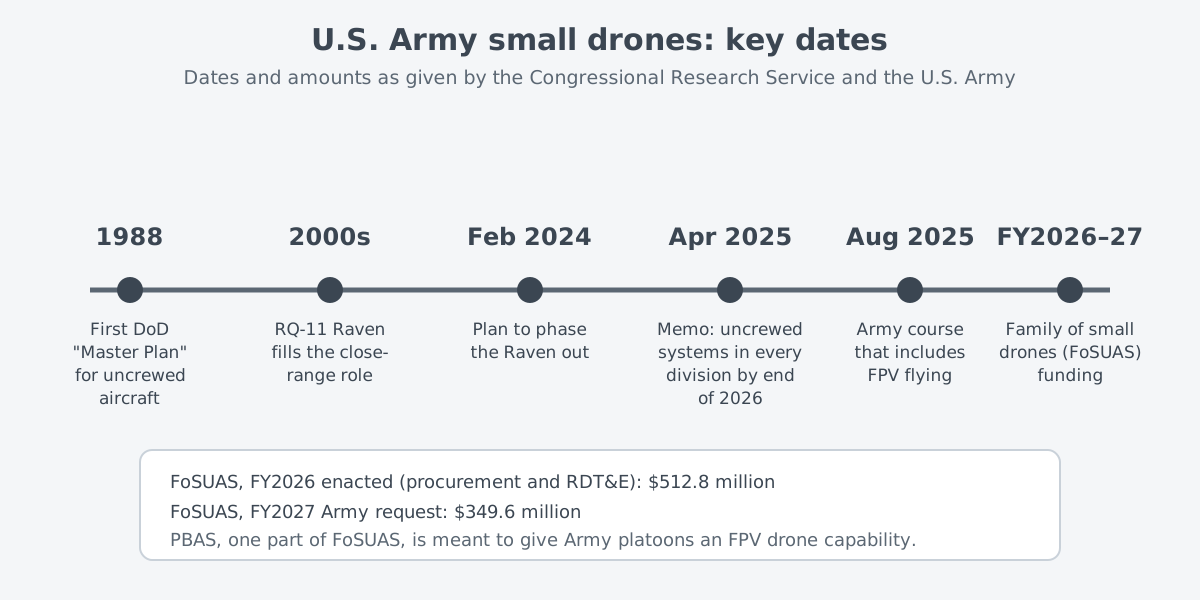
The U.S. Army is also bringing FPV into its programs. From the 2000s, the RQ-11 Raven did most of the Army's close-range small drone work. In February 2024, Army leaders announced a plan to retire it.
The Army wants to fill that gap with a Family of Small Uncrewed Aircraft Systems (FoSUAS), with drones matched to squads, platoons, companies and battalions. Within it, the PBAS program aims to give Army platoons an FPV drone capability.
As the Army describes it, PBAS consists of six aircraft of two sizes, plus modular payloads that can carry a range of lethal and non-lethal armaments. Training has started too. In August 2025, the Army Aviation Center of Excellence opened a new drone course, the Unmanned Advanced Lethality Course (UALC), that includes FPV drone operations. Students practice FPV flying with store-bought commercial drones and with flight simulation software.
Policy questions: people, production, cost
The money is already moving. CRS checked DoD budget documents. By its count, Congress gave Army FoSUAS $512.8 million for procurement and research in fiscal year 2026. The Army asked for $349.6 million for fiscal year 2027.
A Secretary of Defense memo dated April 30, 2025, directed the Army to field uncrewed systems in every division by the end of 2026.
First, people. Unlike for other equipment, the Army seems to have no dedicated job specialty in its ground forces for flying small drones. The 118th Congress considered a bill to create a separate "Drone Corps" in the Army, and the Biden Administration opposed it.
A 2025 RAND study found that the Army could not train enough operators and that its doctrine had gaps. In 2026, the Army said it was overhauling its operational doctrine across the force.
Next, production. Some members of Congress worry about whether U.S. industry can keep up with rising demand for small drones. Congress has allowed, under certain conditions, a "Sky Foundry" program in which government-owned depots and arsenals make drone parts and systems. The Army asked for $151 million for it in fiscal year 2027, and the reported goal is 10,000 drones in the first year after the money arrives.
Last, cost. Small drones may let the Army do some missions more cheaply and at lower risk. Yet some observers argue that the small drones the Army buys are still too expensive compared with commercial products and with the drones used in Ukraine. Congress could ask DoD for more detail on what these programs cost to buy and to run over their lifetime.
Where this meets lasers
As small drones multiply, the cost of stopping them comes into view too. Some DoD officials say directed-energy weapon (DEW) and high-power microwave (HPM) systems could become cheaper counter-drone options than the usual air and missile defense interceptors.
CRS attaches a condition to that comparison. A single shot may cost less than an interceptor. But building these systems in large numbers costs a lot at the start, and that could balance out or cancel the saving. Where lasers fit among counter-drone tools continues in Counter-drone systems, and how to weigh drone prices against defense costs continues in The cost of drone defense.
What to read next
- Loitering munitions: between missile and drone: what the one-way attack drone category covers.
- Counter-drone systems: why one device is not enough: why there are many ways to stop small drones.
- What is a laser weapon? Film versus reality: what the term directed-energy weapon actually refers to.