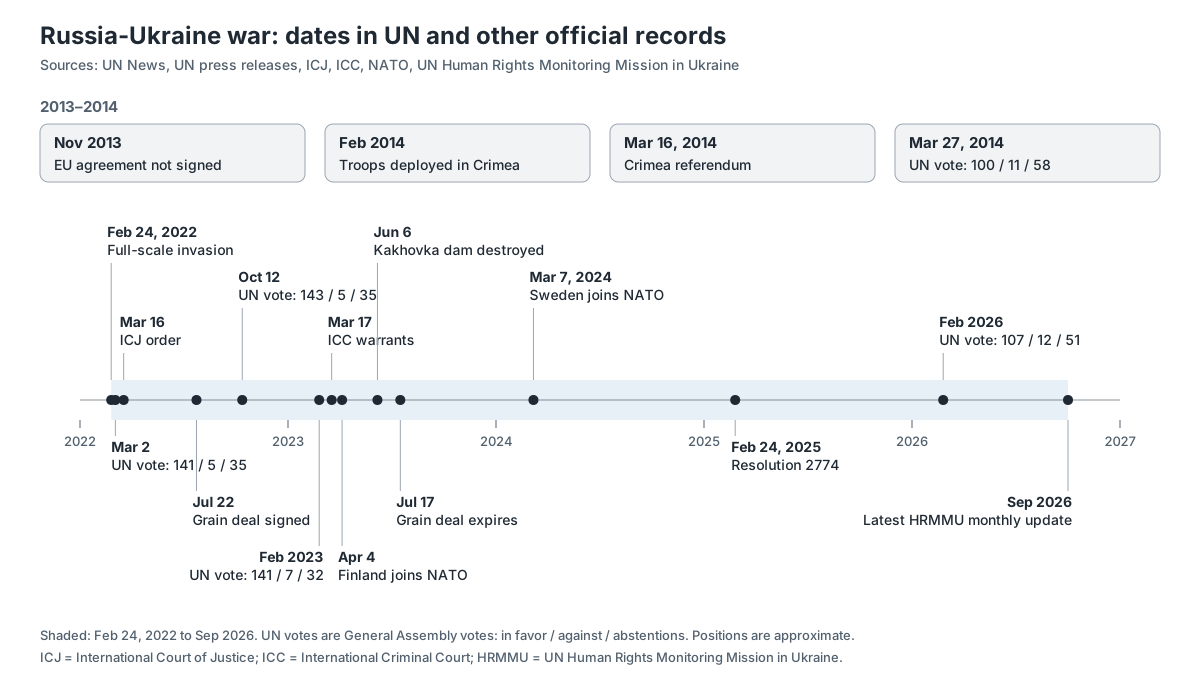
On the night of Wednesday, February 23, 2022, the UN Security Council in New York was holding its second late-night emergency meeting of the week. About an hour into the meeting, President Vladimir Putin announced in Moscow that a "special military operation" in Ukraine's eastern Donbas region had begun. This timeline puts that night in the middle and follows the major dates before and after it through records kept by the UN and other international bodies.
The war has not ended. For that reason, this article does not describe where the front lines moved or how either side's operations went.
It collects only events with a date fixed in official documents. These include UN General Assembly votes, decisions of international courts, civilian events such as the grain deal and the dam, and the growth of NATO. They also include the civilian harm that the UN human rights monitoring mission verifies case by case.
2014: Crimea and the first UN vote
The timeline starts eight years before 2022. In November 2013, the government of Ukraine decided against signing a deal for closer integration with Europe. Tension rose after that decision. In late January 2014, the capital, Kyiv, saw violent demonstrations and street clashes, and in the end Parliament removed President Viktor Yanukovych.
In February that year, Russian troops and armored vehicles were deployed in Crimea. A secession referendum followed on March 16. According to UN News, the Crimean authorities announced that close to 97% of those who voted supported joining Russia. President Putin then signed a treaty that incorporated Crimea into Russia.
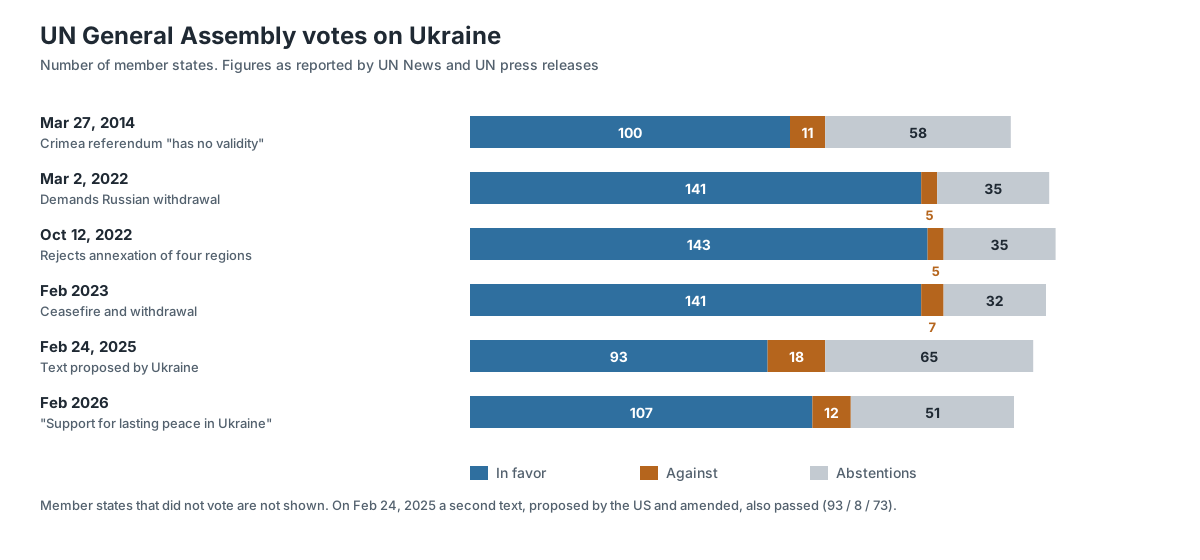
On March 27, 2014, the UN General Assembly adopted a resolution saying the referendum "has no validity," by 100 votes in favor, 11 against, and 58 abstentions. It called on all states and international organizations not to recognize any change in the status of Crimea. The same month, the UN Human Rights Monitoring Mission in Ukraine (HRMMU) was deployed. It continues to watch and publish reports on human rights in the country.
February 24, 2022
Opening the Security Council meeting that night, UN Secretary-General António Guterres urged President Putin to stop his troops. After the announcement and the end of the meeting, he called it the "saddest moment" of his time as Secretary-General. Ukraine's authorities put the whole country under a state of emergency and set out defense steps, including calling up reservists.
People started leaving their homes at once. UN humanitarian agencies reported almost at once that older people and mothers with small children were leaving. According to the UN refugee agency (UNHCR), more than 50,000 people left Ukraine in less than 48 hours after the invasion. It was the start of the fastest-growing refugee crisis in Europe.
The General Assembly votes
The Security Council carries the responsibility for keeping international peace and security. Russia, however, is a permanent member with a veto.
In late February 2022, the Council could not act because of Russia's veto. The issue moved to an emergency special session of the General Assembly, where all 193 member states sit. No such session had been called by the Council in 40 years.
On March 2, the Assembly adopted a resolution demanding that Russia "immediately, completely and unconditionally" withdraw all its forces from Ukraine within its internationally recognized borders. The vote was 141 in favor, 5 against, and 35 abstentions. Belarus, North Korea, Eritrea, Russia, and Syria voted against.
In late September 2022, Russia held so-called referendums in four regions of Ukraine and then declared their annexation. When a Security Council draft on the issue was again blocked by Russia's veto, the Assembly took it up on October 12. It described Donetsk, Kherson, Luhansk, and Zaporizhzhia as "temporarily occupied" by Russia and called on all states not to recognize any annexation claim. The vote was 143 in favor, 5 against, and 35 abstentions.
In late February 2023, one year into the war, the Assembly called for an immediate ceasefire and the withdrawal of Russian forces. That vote was 141 in favor, 7 against, and 32 abstentions. Across the three votes of 2022 and 2023, between 141 and 143 states voted in favor, and each time more than 30 abstained.
The war in court: the ICJ and the ICC
The war went before two very different international courts. At the International Court of Justice (ICJ), the parties to the case are two states, Ukraine and Russia. The International Criminal Court (ICC) tries individuals for genocide, war crimes, crimes against humanity, and aggression.
On February 26, 2022, Ukraine filed a case against Russia at the ICJ under the Genocide Convention. Ukraine argued that Russia had falsely claimed acts of genocide in Luhansk and Donetsk and used that claim to justify its military operation. On March 16, the ICJ ruled by 13 votes to 2 that Russia "shall immediately suspend the military operations that it commenced on 24 February." This order of provisional measures is binding, but the court has no direct means of enforcing it.
The case continued after that. In a judgment of February 2, 2024, the ICJ found that it had jurisdiction over one of Ukraine's claims and that the claim was admissible. Thirty-three states filed declarations of intervention in the case.
On March 17, 2023, ICC Pre-Trial Chamber II issued arrest warrants for President Putin and Maria Lvova-Belova, the Commissioner for Children's Rights in the Office of the Russian President. The charge is the war crime of unlawfully deporting and transferring children from occupied areas of Ukraine to Russia. The warrants were kept secret to protect victims and witnesses. Even so, the judges allowed their existence and the charges to be made public, since public awareness might help prevent further crimes.
Grain, a dam, and a nuclear power plant
On July 22, 2022, in Istanbul, Russia, Ukraine, Türkiye, and the UN agreed on the Black Sea Grain Initiative. It allowed commercial food and fertilizer exports from three Ukrainian ports: Odesa, Chornomorsk, and Yuzhny/Pivdennyi. Representatives of all four parties monitored it from a Joint Coordination Centre in Istanbul.
Russia decided to end the deal, and it was not renewed when its third term expired on July 17, 2023. UN News reported that Ukraine had shipped more than 30 million tonnes of grain to world markets this way by then. Secretary-General Guterres said he deeply regretted Russia's decision.
On June 6, 2023, the Kakhovka dam on the Dnipro River in southern Ukraine was destroyed. The flood came in the middle of the night. Homes went under water, thousands of lives were put at risk, and clean water became a major problem. Ukraine and Russia blamed each other for the dam's destruction.
The Zaporizhzhia nuclear power plant lies nearby. Soon after the invasion began, Russian forces took over the site of the old Chernobyl plant and gained control of the Zaporizhzhia plant. The Director General of the International Atomic Energy Agency (IAEA) went to Zaporizhzhia in person and left several international inspectors there to monitor the situation. On the day the dam failed, the IAEA said there was no "immediate threat" to the plant's cooling.
NATO grows
After the full-scale invasion, two Nordic countries joined NATO. The Allies signed Finland's accession protocol on July 5, 2022, and all 30 national parliaments ratified it. Finland deposited its instrument of accession on April 4, 2023, and became the 31st member.
Sweden deposited its instrument of accession in Washington, D.C., on March 7, 2024, and became the 32nd member. The step ended more than 200 years of non-alignment. With the two new members, NATO grew from 30 countries to 32.
2025–2026: resolutions about peace
On February 24, 2025, three years after the full-scale invasion, two draft resolutions about peace came before the General Assembly. Ukraine's text covered Ukraine's territorial integrity and accountability for crimes, and it passed by 93 in favor, 18 against, and 65 abstentions. A short text proposed by the United States was adopted by 93 in favor, 8 against, and 73 abstentions after European Union amendments were added. The United States voted against Ukraine's text and abstained on its own amended text.
On the same day, the Security Council adopted the original US text without changes, by 10 in favor, none against, and 5 abstentions. This became Resolution 2774. It was the first Council resolution on the war since the full-scale invasion. It mourned the loss of life and called for a swift end to the conflict.
In February 2026, four years after the full-scale invasion, the Assembly adopted a resolution titled "Support for lasting peace in Ukraine," by 107 in favor, 12 against, and 51 abstentions. It called for an immediate, full, and unconditional ceasefire, a swap of prisoners of war, and the return of civilians who had been forcibly moved, children among them.
The record of civilian harm
The UN human rights monitoring mission reports on civilian harm every month. It cross-checks interviews with victims, relatives, and witnesses, photos and videos, forensic records, and data from medical facilities. Only cases that meet the standard of "reasonable grounds to believe" enter the count. The numbers are therefore a verified minimum.
According to the September 2026 update, the mission verified 17,605 civilians killed and 55,846 injured from February 24, 2022 to September 2026. In September 2026 alone, at least 328 civilians died and 2,105 were hurt, the highest for any September since the full-scale invasion began. That month, long-range weapons such as missiles and drones were the leading cause of civilian casualties at 53%, and short-range drones were second at 23%.
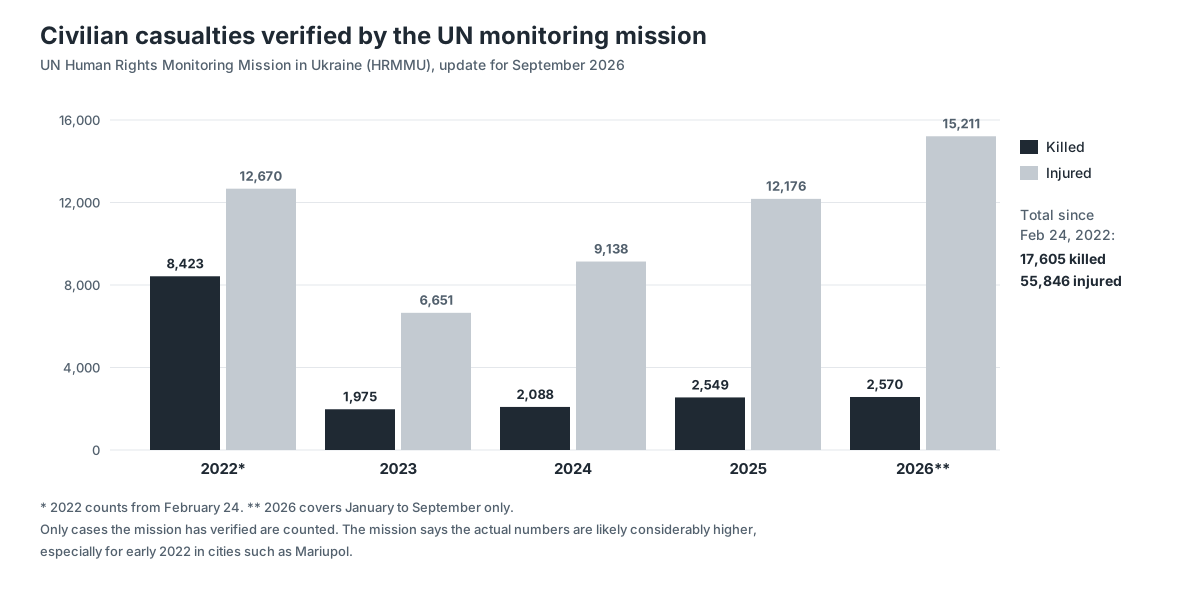
The mission says the actual harm is likely considerably higher. It expects an especially large undercount in cities such as Mariupol, where there was long, intense fighting in early 2022. Russian authorities have also announced casualties in occupied territory and in Russia, but the mission says it could not verify most of them because it has no access. Each number stands for a person with a name and a family.
How to read this timeline
Different sources give different numbers for the same question. At the Security Council in February 2025, UN Under-Secretary-General Rosemary DiCarlo said at least 12,654 civilians, including 673 children, had been killed by then. A year later, in February 2026, she said "more than 15,000" had been killed. The chart here counts to the end of September 2026, so any number you quote should carry the date it runs to.
The number of "yes" votes in the Assembly shows how many states recorded the same position in a public vote, not how the war itself went. Some decisions, like the ICJ order, are binding but have no means of enforcement. Others, like the grain deal, were agreed by the parties and actually moved ships. Knowing what kind of document a date comes from helps you read what that date means.
What to read next
- Finding open sources: where to look for government reports, papers and standards: how to find and read official records like the ones used here
- How to read laser weapon news: "kW-class", "range" and "cost per shot": reading the numbers in weapons news together with their conditions
- FPV drones: flying through the drone's eyes: how the short-range drones named in the mission's reports fly
- Counter-drone systems: why one device is not enough: the layered ways of stopping drones
- The 2020 Nagorno-Karabakh War: Forty-Four Days That Spotlit Drones: a war two years earlier that drew attention to drones