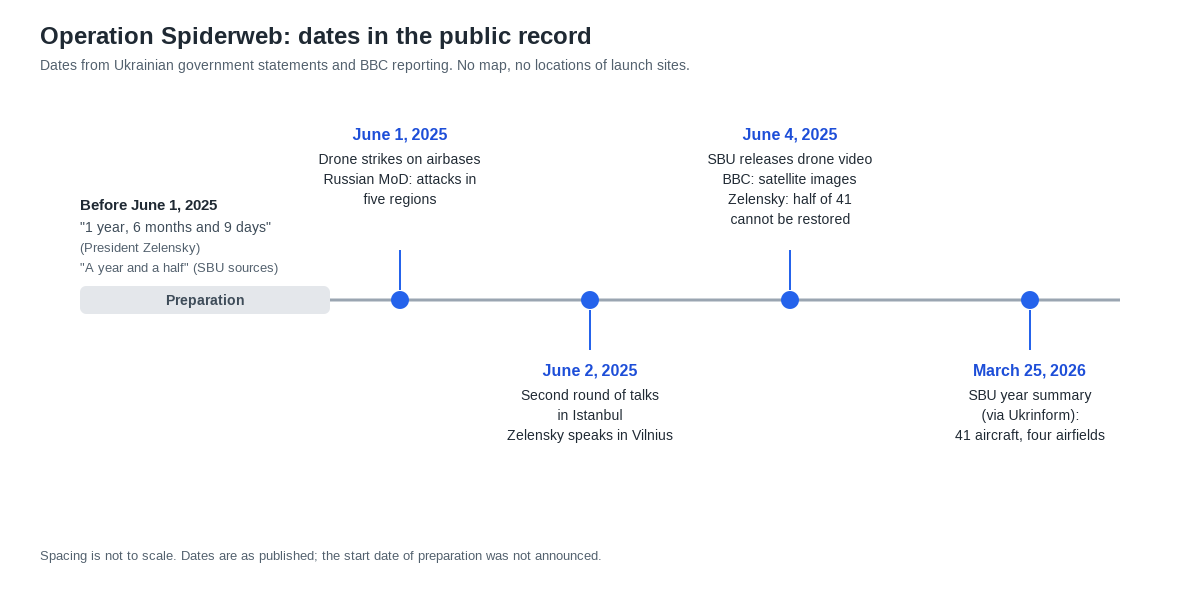
On Sunday, June 1, 2025, reports of attacks on military airfields came in on the same day from Murmansk in Russia's far north and Irkutsk in Siberia. The Ukrainian name for it was Operation Spiderweb. The Ukrainian side said it had hit 41 Russian military aircraft, while the Russian side said several aircraft had caught fire in two regions.
That is how far apart the numbers were for one event. This article separates what Ukraine announced, what Russia announced and what the press checked on its own in satellite images, and it follows who counted each number, in date order. This article reflects the situation as of October 2026.
What happened on June 1, 2025
Ukraine said that on June 1 it had carried out the largest long-range strike it had made so far in the war with Russia. The claim was that smuggled drones had hit no fewer than 40 Russian military aircraft spread across four bases. The operation was run by the Security Service of Ukraine (SBU).
The operation's Ukrainian name is «Павутина» (Pavutyna), which means spider's web. English-language reports render it as "Spider's Web" or "Spiderweb." Citing SBU sources, Ukraine's state news agency Ukrinform reported that the SBU first moved first-person view (FPV) drones into Russia.
What Ukraine announced
Ukraine's numbers did not arrive all at once. The president, the security service and a government body each released their own over several days. In the table below, each number sits next to what it counted and who released it.
| Number | What was counted | Released by | When |
|---|---|---|---|
| 117 | Drones used | The president | June 1–2 |
| 41 | Aircraft hit | The SBU | Early June |
| 34% | Share of "strategic cruise missile carriers" hit | The president | June 1–2 |
| About $7 billion | Estimated loss to Russia's strategic air force | The SBU | June 1–2 |
| At least 13 | Aircraft destroyed | Head of the government's Centre for Countering Disinformation | June 1–2 |
| Half of the 41 | Aircraft that cannot be restored | The president (press conference) | June 4 |
Ukraine's count, then, was 41 aircraft hit, of which at least 13 were destroyed. The June 4 row comes from the summary of the press conference published by the Centre for Countering Disinformation.
The head of the SBU stressed that the targets were military air bases and planes used to bomb Ukraine's peaceful cities. In his words, they were legitimate targets under the rules of war. The Russian side called the same events a "terrorist act."
Every number in the table came from the side that carried out the attack. A line in the BBC coverage of these figures makes clear that the Ukrainian claims were not independently verified.
What Russia announced
On June 1, Russia's defence ministry posted a short statement on social media. As reported by the BBC, it made five points.
- Attacks took place in five regions, and they were a "terrorist act."
- At military airfields in Ivanovo, Ryazan and Amur, "all attacks were repelled."
- In Murmansk and Irkutsk, drones were sent up from places close by, and then "several aircraft caught fire."
- All the fires were put out, and there were no casualties.
- Some of those involved were detained.
Amur is a region the SBU sources did not mention. The two sides did not even agree on the number of regions.
Regional officials also spoke. The governor of Irkutsk confirmed that the drones that attacked the Belaya base were launched from a truck. In a Telegram post, he added that the spot the drones flew from was under control and that no one's life was in danger.
The Russian side gave no figure for damaged aircraft. Up to the BBC article of June 2, all Moscow had acknowledged was that some planes were damaged.
What the press checked on its own
Video and satellite images filled the gap between the two sets of claims. On June 2, the BBC said video it had verified showed damaged aircraft at two places: the Olenya (Olenegorsk) base in the Murmansk region and Belaya in the Irkutsk region.
Satellite images taken on the morning of June 4 gave a more specific number. BBC Verify found 12 aircraft damaged or destroyed at the two bases with the clearest images: 5 at Olenya and 7 at Belaya.
The other two bases looked different. At Ivanovo, the BBC had not yet seen any image or video showing damage to aircraft. At Dyagilevo in the Ryazan region, neither the video nor the satellite images showed a clear sign of damage. On the same day, the SBU released a drone video almost five minutes long with scenes from all four bases.
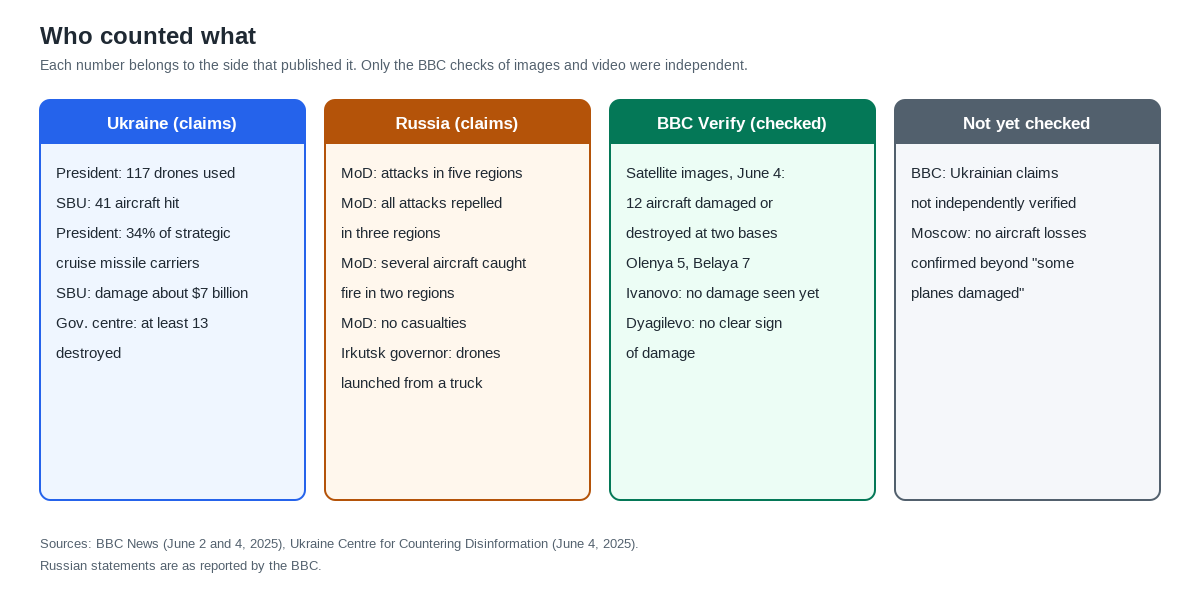
The number 12 is smaller than 41. But the two numbers do not count the same thing. Twelve is what could be counted by eye at two bases with clear images, and 41 is what the attacking side announced it had hit.
The bases and the aircraft
SBU sources named four bases to the BBC. Two are far from Ukraine: Belaya in Irkutsk region in Siberia and Olenya in Murmansk region in Russia's far northwest. The other two are in central Russia: Dyagilevo in Ryazan region and Ivanovo in Ivanovo region. Amur, the fifth region named by Russia's defence ministry, is not on that list.
As aircraft that were hit, the SBU sources listed the nuclear-capable strategic bombers Tu-95 and Tu-22M3 and the A-50 early warning aircraft. The SBU's summary of March 2026 also includes the Tu-160. Neither the Tu-95 nor the Tu-22 has been built since the early 1990s, when the Soviet Union collapsed.
Distances also vary from source to source. In an analysis by the U.S. think tank CSIS, Dyagilevo is about 470 km from the Ukrainian border and Ivanovo about 700 km from the border. Olenya is about 1,900 km north of Ukraine, and Belaya more than 4,000 km from Ukraine.
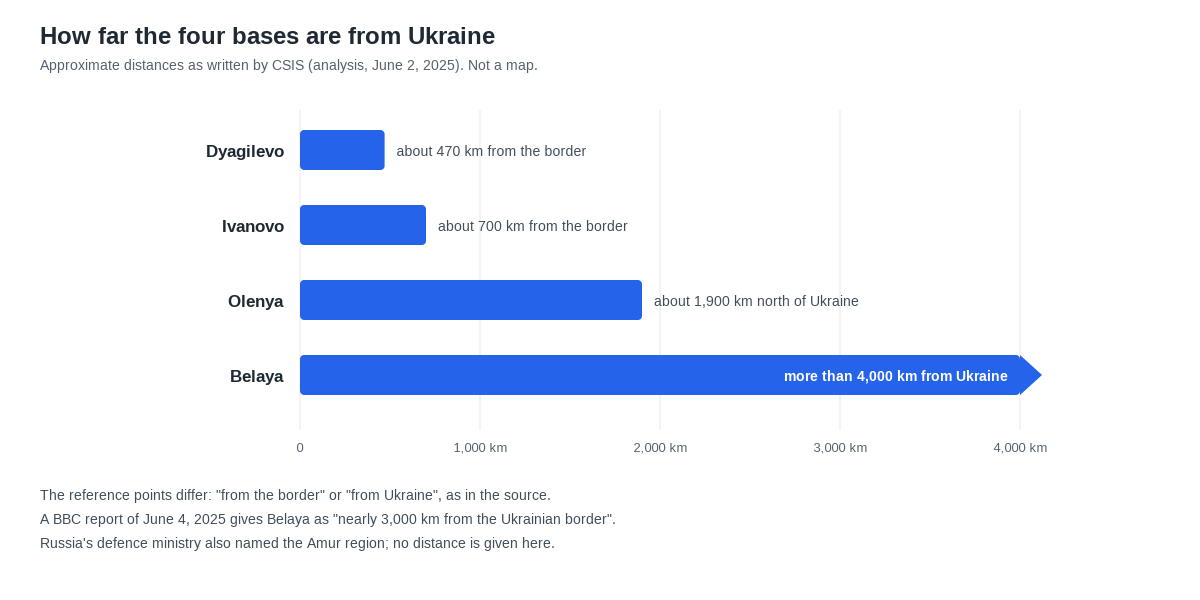
Two BBC articles also used different numbers. The June 2 report put Irkutsk more than 4,000 km from Ukraine, while the June 4 report put the Belaya base nearly 3,000 km from the Ukrainian border. The number changes with the reference point: "Ukraine" or "the border," a city or a base.
The same week
Around the time of the operation, Ukraine was also under heavy attack. Ukrainian authorities said 472 drones and 7 ballistic and cruise missiles were used against Ukraine in a single night. That figure, too, came from the Ukrainian authorities.
The next day, Monday, June 2, Russian and Ukrainian negotiators were due to sit down in Istanbul, Turkey, for their second session of peace talks. The same day, at a summit in Vilnius, President Zelensky said Operation Spiderweb had shown what Russia was worth. He also said it was better to conduct diplomacy when Russia was in a weak position.
The length of the preparation also became known around then. The president said it took "one year, six months and nine days," and SBU sources told the BBC the work had taken a year and a half. The president added that everyone involved in the operation had safely left Russia before the strikes.
Almost ten months later, on March 25, 2026, Ukrinform carried material from the SBU press service that named Spiderweb as the most successful operation the SBU had run. In that account, 41 military aircraft were hit at the same time at four airfields. In a single day, "34% of Russia's strategic aircraft were put out of action," with estimated losses over $7 billion.
Where this meets lasers: who counted the numbers
The "34% of strategic cruise missile carriers" from the first day became "34% of Russia's strategic aircraft" in the following year's material. The number stayed the same, but what it was a share of changed. The same goes for 41. "Hit," "destroyed," "caught fire" and "appear damaged or destroyed" each count something different.
The habit described in How to read laser weapon news works here too. That article shows how to look for the missing conditions behind phrases such as "a kW-class laser" or "a successful test." Reading about drone strikes calls for the same questions: who counted, what was counted, when it was counted and what it was measured from.
What to read next
- FPV drones: explains from the basics what first-person view drones like the ones in this operation are.
- Russia-Ukraine war timeline: places this event in the course of the whole war, using the records of international bodies.
- Counter-drone systems: explains how systems that find and stop small drones are put together.
- Shahed and Geran drone attacks: the pattern in official statements: covers the record of long-range drone attacks in the other direction, from Russia into Ukraine.