
News stories often say that defenders fire expensive missiles to stop cheap drones. Is that right? Half of it is, and half of the picture is missing.
This article gathers figures published by the U.S., UK and South Korean governments and sorts the cost of drone defense into layers. The cost of one shot, the cost of one system and a program budget are different layers. Each source also counts different things, so setting the numbers side by side shows why they cannot simply be divided into one another.
The yardstick called cost exchange ratio
A Congressional Research Service (CRS) report on Navy shipboard lasers (R44175) names two key limits that surface ships now face when defending against drones and anti-ship missiles. One is a shallow magazine. The other is an unfavorable cost exchange ratio.
An unfavorable cost exchange ratio means this: the air-defense missile fired to bring down one drone can cost more to buy than the attacker spent building or buying that drone. In the report's words, it may cost "perhaps much more."
That is why drones keep coming up with this yardstick. In a CRS primer on counter-drone systems (IF11426), drones appear as a possible cheap way for adversaries to watch or attack U.S. forces. The links that make up drone defense are covered first in Counter-drone systems: why one device is not enough.
Cost per shot: a different basis in each source
One end of the comparison is what the defender spends on a single shot. According to CRS R44175, U.S. Navy air-defense missiles cost from several hundred thousand to several million dollars each to procure, depending on the type. A missile is gone once fired, so this figure is the price of buying one round.
A November 2025 release from the UK Ministry of Defence gives a similar picture. It puts traditional missile systems at more than several hundred thousand pounds a shot and sets that beside £10 a shot for its new laser. The release does not say what went into either figure.
For lasers, the counting splits. A laser weapon is one kind of directed-energy weapon (DEW), and the kind used as a weapon is the high-energy laser (HEL). Because it runs on electricity instead of rounds, sources differ even on what "cost per shot" means.
So a missile figure and a laser figure can share the label "cost per shot" and still rest on different bases. The missile figure is a procurement price for the round itself. The U.S. Navy laser figure in the table below is a marginal cost, the extra spending for one more shot once the equipment is already bought. It leaves the equipment out, so dividing one number by the other compares two different things.
| Source | Figure given | What it counts |
|---|---|---|
| U.S. Navy information paper (October 2021, cited in CRS R44175) | About $1 to under $10 per shot, depending on beam power | Marginal, or recurring, cost. Much of it is fuel for making the electricity |
| CRS R46925 | No figure | Explains that for solid-state lasers run on electricity, the cost per shot equals the cost of the power used for the shot |
| UK Ministry of Defence (2024) | Typically under £10 per shot | Running the laser. Firing for 10 seconds is likened to running an ordinary heater for an hour |
| UK Ministry of Defence (November 2025) | £10 per shot | What is included is not stated |
| Korea.kr policy briefing (July 2024) | KRW 2,000 per firing | Says it runs on electricity alone with no separate ammunition. What is included is not stated |
The currencies are dollars, pounds and won, and the years differ. Even the UK government's own wording changed, from "typically under £10" in 2024 to "£10" in 2025. If figures whose contents may differ are turned into one currency and lined up, they easily look as if they measured the same thing.
Equipment and development are counted separately
A cheap shot does not make the whole laser defense cheap. Before the first shot, someone has to buy the equipment, and building that equipment takes development money. Cost splits into at least three layers.
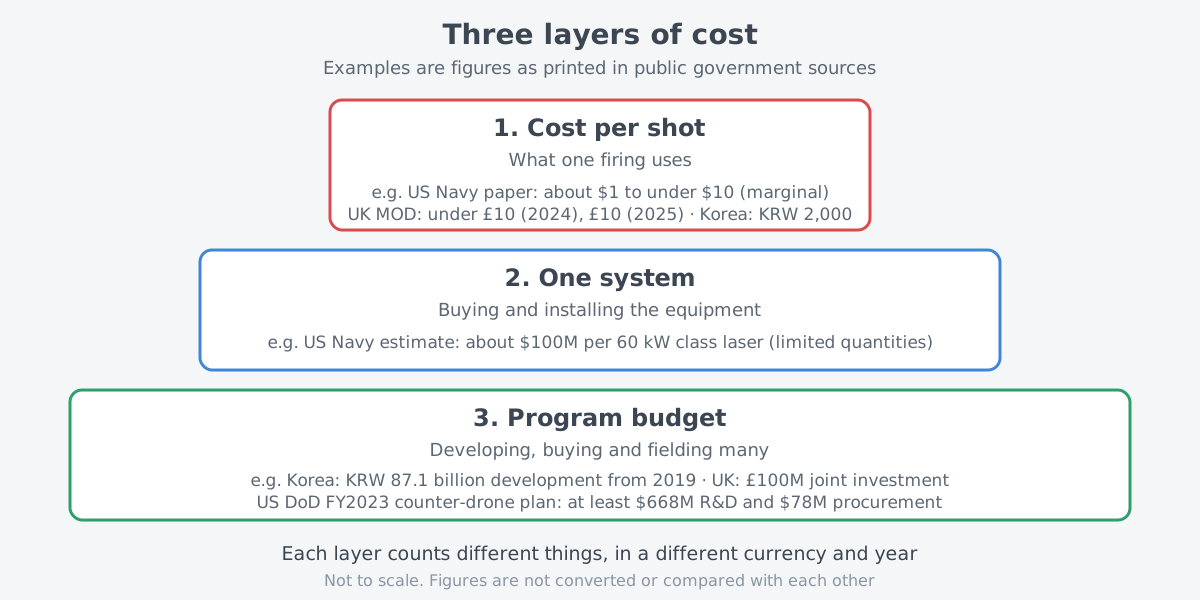
Start with the cost of one system. A U.S. Navy paper quoted in CRS R44175 estimates about $100 million per unit for a 60 kW class laser in limited quantities. That estimate comes with conditions. It assumes that beam control and integration with the ship's combat system are fairly mature, and that production runs at a moderate rate.
For the 250 kW class the estimate reaches $200 million per unit. That figure counts installation, combat system integration, power and heat handling, and the laser with its beam director and beam control, and it carries wide uncertainty from many assumptions.
On procurement cost alone, kinetic and non-kinetic weapon systems come out fairly close to laser systems, at $70 million to $150 million. The big laser saving comes afterward, in the cost of each engagement once the system is bought.
The estimated engagement cost runs from single-digit dollars up to, at most, a few tens of dollars per shot. Examples are $1.15 at 60 kW and an estimated $9.20 at 480 kW. The phrase "a few dollars a shot" carries this "after procurement" condition.
Program budgets are yet another layer. According to the Korea.kr briefing, South Korea's laser anti-aircraft weapon was developed from August 2019 on a budget of KRW 87.1 billion. That is a different layer from the KRW 2,000 per firing in the same article.
In a 2024 UK government release, the DragonFire laser came from £100 million invested jointly by industry and the Ministry of Defence. A £30 million contract had come in 2017. In November 2025 the government announced a £316 million contract for new Royal Navy systems from 2027. It also set out nearly £1 billion more for directed-energy weapon work in this Parliament.
In the United States, CRS IF11426 gives the Defense Department's FY2023 counter-drone plan. It plans at least $78 million for procurement and at least $668 million for R&D. That budget covers all counter-drone work, not lasers alone. CRS R46925 also points to a catch: directed-energy weapons may need a bigger investment at the start than older kinetic weapons before a working system is fielded.
The value of what is protected also counts
Is an unfavorable cost exchange ratio always a loss? CRS R44175 suggests it is not always so. When an adversary has only a few drones and anti-ship missiles, an unfavorable ratio can be acceptable. It protects sailors' lives and spares ships from very costly damage.
The other side exists too. Against an adversary with many drones and anti-ship missiles, an unfavorable ratio can turn into a very costly way to defend, and one that may be unaffordable. The number of attackers changes the arithmetic.
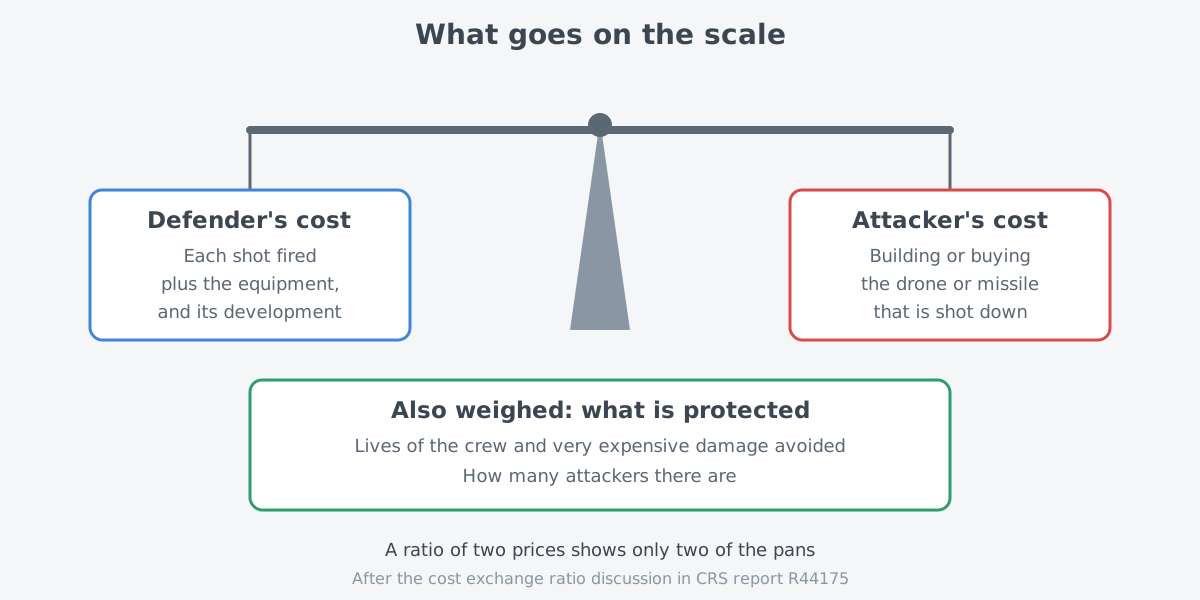
Think of a storeroom lock. The lock may cost far more than the cheap tools a thief brings, yet if it guards a whole storeroom, it is not a loss. Real defense is more complex than this. A human life cannot be priced like goods, and no one knows in advance how many attacks will come.
The same arithmetic, turned around
The cost exchange ratio is not only a defender's yardstick. On August 28, 2023, the U.S. Defense Department unveiled an initiative called Replicator. According to a CRS primer (IF12611), its first line of effort is all-domain attritable autonomous systems. Attritable systems are fairly low-cost systems whose loss the department is more willing to risk.
One stated aim is to leave the adversary with an unfavorable cost exchange ratio. In other words, the adversary would have to answer with something, for example an interceptor missile, far pricier than the system it targets. The idea of using many cheap uncrewed aircraft together is covered further in Drone swarms.
The initiative's second line of effort was set by a September 2024 memo from the Secretary of Defense to focus on countering small drones. So one side adds cheap drones while the other looks for ways to stop them. The department asked for a $300 million FY2023 reprogramming, got $200 million in FY2024 appropriations and requested $500 million for FY2025. These figures cover the whole initiative, and little is public about its total cost.
Traps in the comparison
Laying the public sources over one another shows the traps that cost comparisons often fall into.
- Mixing layers. The cost of one shot is put on the same line as the cost of a system or a development budget.
- Counting different items. The missile figure is a procurement price for the round, while the U.S. Navy laser figure is a marginal cost made up largely of fuel. The UK and Korean releases do not say what they include. Even within CRS R44175, the Navy laser figures appear both as "under $10" and as "at most a few tens of dollars."
- Different currencies and years. Even after adjusting for exchange rates and inflation, the items counted do not become the same.
- Assuming one shot is enough. A directed-energy weapon may cost less per shot, yet weather such as rain, fog and obscurants, along with size, weight, power and cooling needs, can limit its range and beam quality and so its effect. CRS R46925 raises this point.
- Reading early estimates as settled. Shipboard laser weapons have no earlier formal programs to compare against, and the industrial base for major parts is not yet mature in production capacity. The Navy paper attaches these caveats to its cost estimates.
Measures such as cost per kill are still to be refined. In the Navy paper's judgment, it is too early to put a meaningful value on what lasers alone contribute. CRS R46925 also raises the option of Congress asking for an independent review of how mature various directed-energy weapons are and what they would cost over their life.
Where lasers have an edge and where they run into limits continues in Strengths and limits of laser weapons. How lasers, interceptor missiles and guns share the work continues in Lasers, interceptor missiles and guns: how they share the work.
What to read next
- How to read laser weapon news: "kW-class", "range" and "cost per shot": reading "cost per shot" in the news together with its conditions.
- Lasers, interceptor missiles and guns: how they share the work: the three means side by side on cost, rounds on board, weather, and size, weight and power.
- Strengths and limits of laser weapons: a second look at what the cost per shot leaves out.