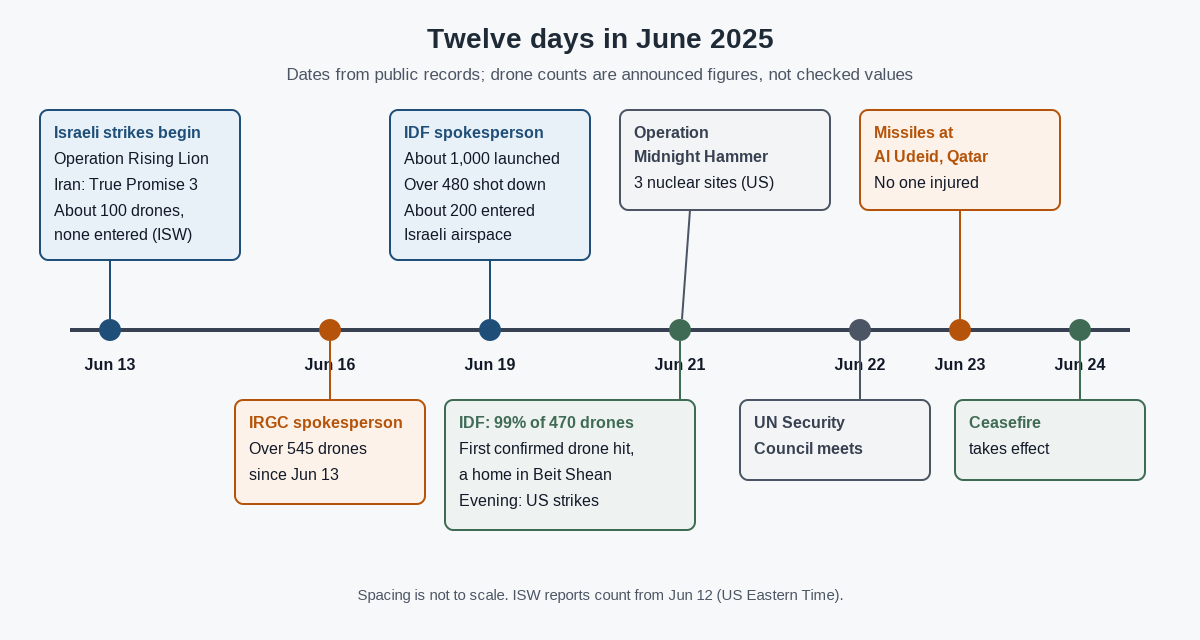
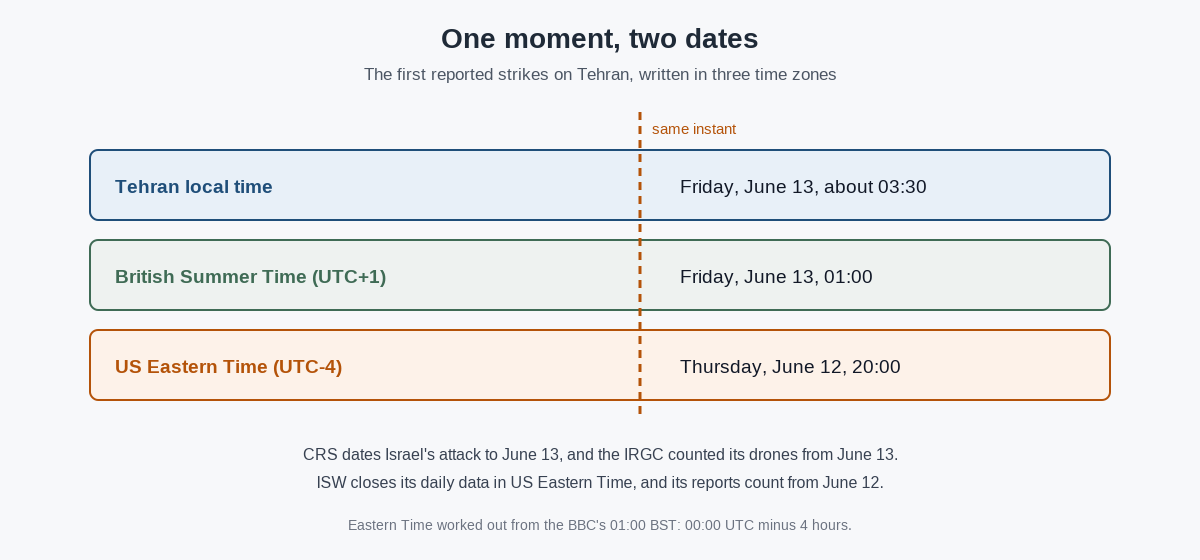
On Friday, June 13, 2025, at about 3:30 a.m. Tehran time, the first strikes were reported. Israel hit nuclear and military sites in Iran, and a few hours later Iran began firing missiles and drones at Israel. On June 21 the United States bombed three Iranian nuclear sites, and on June 24 a ceasefire took effect.
Drones show up on many of those twelve days. There are drones flown from Iran, drones Israel said it destroyed before launch, and drones aimed at bases in Iraq. Yet the number of drones changes a great deal depending on who is speaking.
This article follows the events in date order and notes where drones appear and who gave each number. It reflects information as of October 2026.
What began before dawn on June 13
Israel's name for the attack, given by Prime Minister Benjamin Netanyahu, was Operation Rising Lion. Iran's response began hours later with ballistic missile attacks, under the name True Promise 3. In that first response about 100 missiles were fired at Israel, and most were intercepted, according to the Israeli military.
This was not the first clash. Iran had also attacked Israel in April and October 2024. Both times the attacks were led by the Aerospace Force of Iran's Islamic Revolutionary Guard Corps (IRGC), which runs Iran's missile and drone programs. The April 2024 attack is covered in a separate article in this series, "Iran's April 2024 Attack on Israel: Drones, Missiles and a Multinational Defence."
This time the attack did not end in one night. In the words of the US Congressional Research Service (CRS), the two countries were "effectively at war" after Israel's June 13 attack. Day after day, Israel struck targets across Iran, and Iran fired ballistic missiles and drones at Israel.
Diplomacy stopped as well. The United States had been holding indirect talks with Iran since April 2025. After the Israeli attack, Iran canceled the sixth round, which had been set for June 15.
Iran's drones and missiles
Iran fired two main kinds of weapons. One was the ballistic missile, which climbs high and then falls very fast under gravity. The other was the drone, the aircraft part of an unmanned aerial system (UAS).
In ISW reports, Iran's drones are described throughout as one-way attack drones. That means a drone that flies once and crashes into its target.
The two fly in different ways. A ballistic missile is boosted up by a rocket and then falls, while a drone flies like an airplane, on wings and an engine. What kind of aircraft Iran's best-known one-way attack drone is can be found in The Shahed series: same name, different drones.
Drones appeared from the first day. The Institute for the Study of War (ISW) and the Critical Threats Project (CTP), two US research groups, publish daily reports on Iran. In those reports, Iran first launched about 100 drones on June 13, and none of them entered Israeli airspace. The same day, the Israeli military intercepted three drones launched from Houthi-held areas of Yemen.
Nightly numbers from later in the war are also on record. On the night of June 20 to 21, the Israeli military intercepted about 40 Iranian drones. By ISW's count, the day before had 16 and the day before that had 4.
The first confirmed drone hit came on day nine. On June 21 the Israeli military said a house in Beit Shean, in northern Israel, had been hit by an Iranian drone. ISW recorded it as the first confirmed successful Iranian drone strike since June 12.
Who counted the drones
It is the same war, yet the drone counts differ from one announcement to the next. All of the figures below are announcements as relayed in ISW daily reports.
| When | Who | What | Number |
|---|---|---|---|
| June 16 | IRGC spokesperson | Drones launched at Israel since June 13 | Over 545 |
| June 19 | IDF spokesperson | Drones launched at Israel since June 12 | About 1,000 |
| June 19 | IDF spokesperson | Of those, shot down | Over 480 |
| June 19 | IDF spokesperson | Entered Israeli airspace | About 200 |
| June 21 | IDF | Drones launched by Iran since June 12 | 470, 99% intercepted |
Put side by side, something looks odd. The IDF figure on June 19 is about 1,000, but two days later it is 470. The reports do not say what each figure counted, for example whether drones that fell short on the way were included. So it is a mistake to pick one of the two or to join them into a single line on a chart.
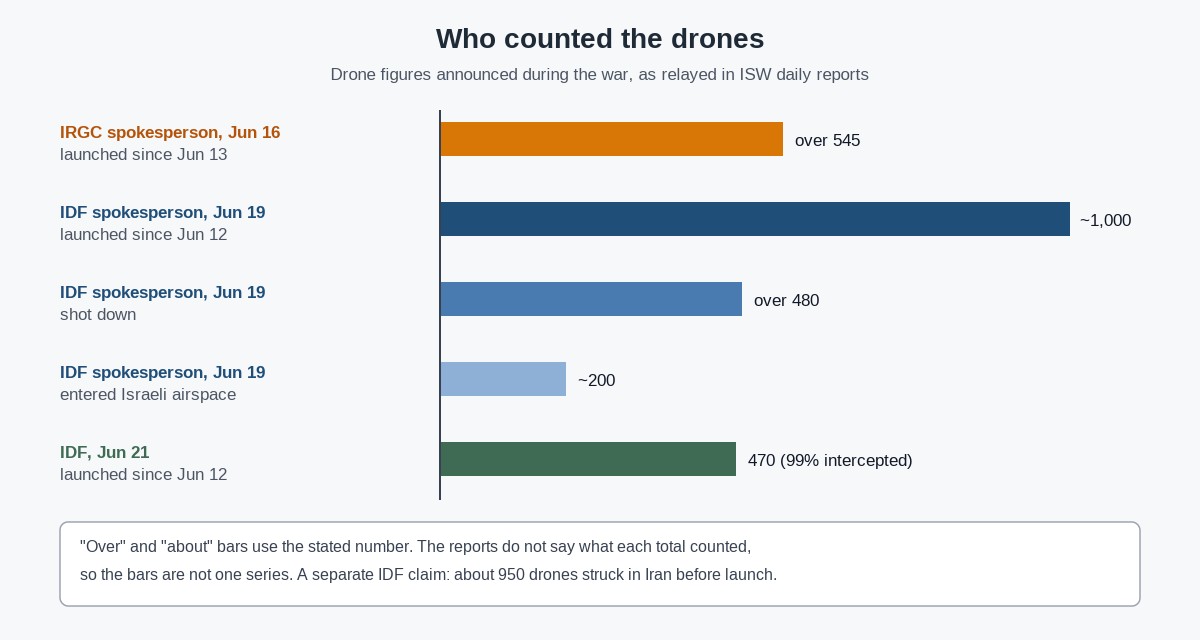
The word "intercepted" may not mean the same thing every time, either. The June 19 statement said "over 480 shot down, about 200 entered airspace," and the June 21 statement said "99% intercepted." The statements alone do not show whether drones that never reached Israeli airspace were counted as intercepted. The same report also quotes an Israeli military correspondent saying over 95% were intercepted, but that is not an official military statement.
Even the starting date differs. The IRGC and CRS count from June 13, while ISW reports count from June 12. Seen through time zones, neither date is wrong.
ISW closes each day's data in US Eastern Time. The BBC gave the time of the first strikes as 01:00 British Summer Time, which is 8 p.m. on June 12 in US Eastern Time.
It also matters who is speaking. The Israeli military and the IRGC are parties to the war. ISW is a US research institute, and its reports are an "analysis" that gathers statements and media reports. None of the sources used here checked these numbers independently.
Israel also counted drones before they flew. IDF spokesperson Brigadier General Effie Defrin said Israeli airstrikes inside Iran had hit about 950 explosive drones before they could take off. This number counts something different from drones in the air, so it is not in the table above. Israel also said that on June 21 it had killed a Quds Force commander in a drone strike while he was traveling by car in western Iran.
Defending beyond Israel's borders
Other countries lie on the air route from Iran to Israel. In a report by Germany's public broadcaster DW, Jordan shot down missiles flying from Iran toward Israel. The Jordanian military confirmed this in a statement and explained that missiles and drones could have fallen on Jordan.
US forces also took part. In the CRS summary, US forces in Israel and in international waters reportedly defended Israel by intercepting Iranian missiles.
Drones were reported in Iraq too. Iraqi media and open-source analysts reported, as relayed by ISW, that the United States had intercepted two one-way attack drones since June 15. They were near the US consulate in Erbil, in the Kurdistan region of Iraq. Whether the drones were aimed at the consulate or were on their way to another target, such as Israel, was unclear.
Just before the ceasefire, the Iraqi government spoke up. A BBC report on June 24, the day the ceasefire took effect, carried a claim by the Iraqi government that drones had gone after bases inside Iraq. Armed groups backed by Iran are active in Iraq, but what the drones were aiming at was not clear.
The US strikes and the base in Qatar
The United States joined the attacks directly on the evening of June 21. The operation was named Midnight Hammer, and its targets were three nuclear facilities in Iran.
CRS relayed the account of General Dan Caine, Chairman of the Joint Chiefs of Staff. More than 125 US aircraft took part, including seven B-2 Spirit bombers. Over 25 minutes they used about 75 precision-guided munitions (PGMs), 14 of them GBU-57 Massive Ordnance Penetrators.
Weapons also came from the sea. A US submarine launched more than two dozen Tomahawk cruise missiles, aimed at a nuclear site in Isfahan. No drones appear in this strike. At an emergency UN Security Council meeting the next day, June 22, UN Secretary-General António Guterres called for an end to the fighting and said "diplomacy must prevail."
Iran's answer came on June 23. Iran fired missiles at Al Udeid Air Base in Qatar, home to thousands of US personnel, and called it retaliation for the June 21 US strikes. For AP, it was Iran's first direct retaliation against the United States since the strikes.
The outcome is on record in the words of the governments involved. In the account of US and Qatari authorities, the missiles were stopped and nobody was hurt. US Central Command said it defended against the Iranian ballistic missile attack with US and Qatari Patriot batteries.
President Trump said 14 missiles were fired and 13 were knocked down. He thanked Iran for giving early notice, which he said made it possible for no one to be killed or injured.
The ceasefire and after
On June 23, the day of the Al Udeid attack, President Trump called the conflict the "12 day war" and announced that a ceasefire would follow. It was a phased ceasefire: Iran would hold fire from midnight on June 24, and Israel would join at noon the same day. Later the President wrote on social media that "THE CEASEFIRE IS NOW IN EFFECT," and the Israeli government gave its formal acceptance soon after.
Attacks went on until the last moment. The Israeli military confirmed it had carried out operations on the night before the ceasefire, and the reports of drones aimed at bases in Iraq came at the same time.
The human toll grew with each new report. In a CRS report dated June 23, the fighting had reportedly killed over 400 people in Iran and about two dozen in Israel. In a BBC report on June 28, Iranian authorities put the deaths in Iran at 627, and Israeli officials put the deaths in Israel at 28. Each of those numbers is a human life.
Where this meets lasers: the cost of stopping cheap drones
Across these twelve days, the drone counts ran from hundreds to about 1,000, depending on who was counting. On the problem of stopping many drones, CRS names two limits in defending ships.
The first is a shallow magazine. A US Navy surface ship fires surface-to-air missiles and close-in Gatling guns at drones and anti-ship missiles, but only up to a fixed number. Once that ammunition is gone, the ship has nothing left to fire.
The second is the cost exchange ratio. A missile used to shoot down one drone can cost more, perhaps much more, than the attacker spent to build or buy that drone. The CRS report on shipboard lasers sees solid-state lasers (SSLs) as having the potential to greatly improve both.
The word "potential" matters. How to count the cost of one laser shot differs from source to source, and that accounting is covered in The cost of drone defense. The basics of laser weapons are in What is a laser weapon? Film versus reality.
What to read next
- The Shahed series: same name, different drones: what kind of aircraft Iran's one-way attack drones are.
- Ballistic missiles: why they climb high and come down: how the missiles that flew alongside the drones work.
- Counter-drone systems: why one device is not enough: the chain of finding and stopping drones.
- Integrated air defense and sensor fusion: how air defense works when several countries and systems defend together.
- The cost of drone defense: how to compare the price of drones and the means to stop them.
- The Iran-Iraq War: Eight Years of Attrition: the eight-year war Iran fought with Iraq.
- Other articles in this series: "Iran's April 2024 Attack on Israel: Drones, Missiles and a Multinational Defence" and "Iran's Drone Programme: From the Iran-Iraq War to the Shahed."