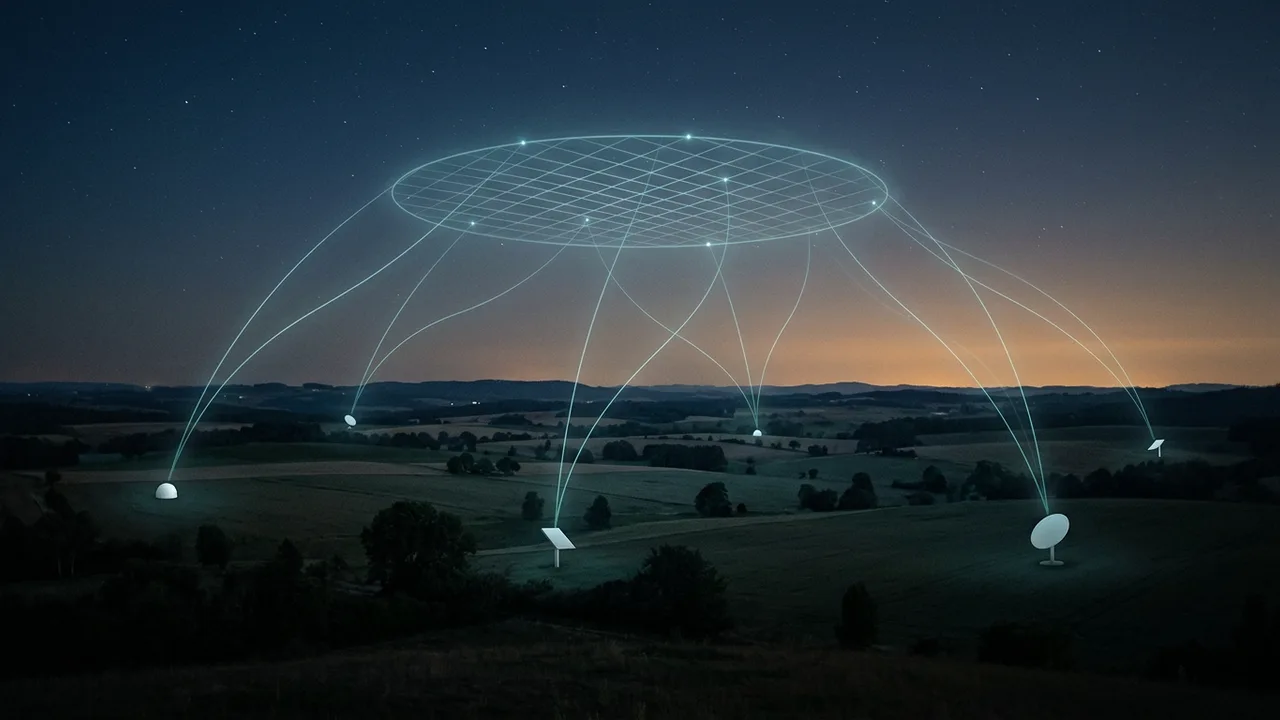
Imagine a single dot appears on a radar screen. At the same moment, a camera nearby picks up something, and a radio signal detector catches a signal. Are these three the same object, or three different ones?
Air defense deals with questions like this every day. Each sensor sees only one slice of the sky, so what many sensors see has to be fitted together into one picture. This article uses official sources to explain that idea, called sensor fusion, and what integrated air defense means.
Why one sensor is not enough
Each sensor is good at something different. Electro-optical cameras pick up shape, infrared sensors pick up heat, and acoustic sensors pick up sound. Radar and radio signal detectors are added on top. These are the ways of sensing listed in a counter-drone primer from the Congressional Research Service (CRS).
None of them is enough alone. A small target such as a little drone, whose signals are weak and whose size is small, is not always caught by these methods. That is why several methods are often combined into a more effective, layered way of sensing.
What it means to merge into one picture
Think of several witnesses at an accident. One remembers the color of the car, another the way it drove off and a third the sound, and the police piece these into one scene. Real sensor fusion is different: it uses positions and times measured by machines instead of human memory, and it has to keep redrawing the picture while objects move.
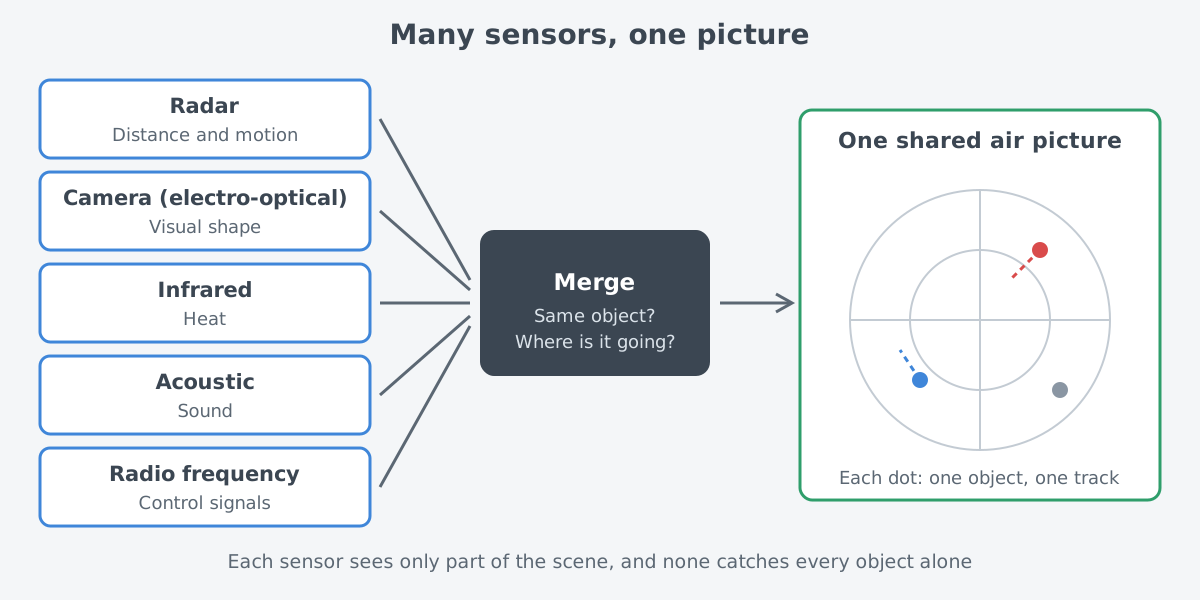
Go back to the opening question. Whether the radar dot, the thing on camera and the radio signal are one object cannot be told from any single sensor. The positions and times each sensor measured have to be laid side by side and checked against each other. If they agree, the three reports are bundled as one object; if not, they stay apart as different objects.
One check is not the end of it. Objects move, so each new report is joined to the earlier positions to draw a path. A path drawn this way over time is called a track. Of the jobs the U.S. Missile Defense Agency (MDA) gives sensors, detecting, tracking and discriminating, tracking is this one.
Merging also fills in gaps. Radar picks up distance and motion, a camera picks up shape, and a radio signal detector picks up control signals. A small target that one method misses may be caught by another. The gathered information then becomes the basis for discrimination, deciding whether the dot is a real threat.
So the three signals in the opening could be one object or three different ones. Deciding which, and then keeping a track going for each object, is the core of what sensor fusion does.
In missile defense, the command and control network does this job. An effective layered defense includes many kinds of sensors that follow a threat through every phase of flight, and Command and Control, Battle Management and Communications (C2BMC) ties them together. The United States networks sensors on land, at sea and in space, and a command, control and battle management network connects those sensors to the interceptors. A defense split into layers by phase of flight is covered in "Layered missile defense: why defense comes in layers."
The U.S. military wants to stretch this idea across all its services. The plan is called JADC2, short for a joint, all-domain approach to command and control. As a 2022 CRS primer describes it, the Department of Defense aims to join sensors from the Army, Navy, Air Force, Marine Corps and Space Force in one network. Before that, each service built its own tactical network, one that did not work with those of the others.
The reason for the hurry is time. Defense officials argue that future conflicts may demand decisions within hours, minutes or even seconds. Today, they say, studying the situation and issuing orders takes several days.
The first JADC2 exercise was held in December 2019. Aircraft, ships and ground radars from several services, plus commercial sensors, gathered and shared data in real time and showed a fuller picture of the situation.
The Department of Defense compares the goal of JADC2 to the ride-sharing service Uber, which pairs riders with drivers using location data from both sides. JADC2 is meant to link what a sensor sees with the means that can deal with it in the same way. Real air defense is different. Uber leans on ordinary cell and Wi-Fi networks, but an air defense network has to keep working even when an opponent is trying to disrupt it.
The skeleton of integrated air defense: sensors, command, weapons
NATO's Integrated Air and Missile Defence (IAMD) shows the structure clearly. By NATO's definition, IAMD is a mission that never stops. In peace, in a crisis and in war, it guards the land, people and forces of the Alliance against threats from the air, missiles included.
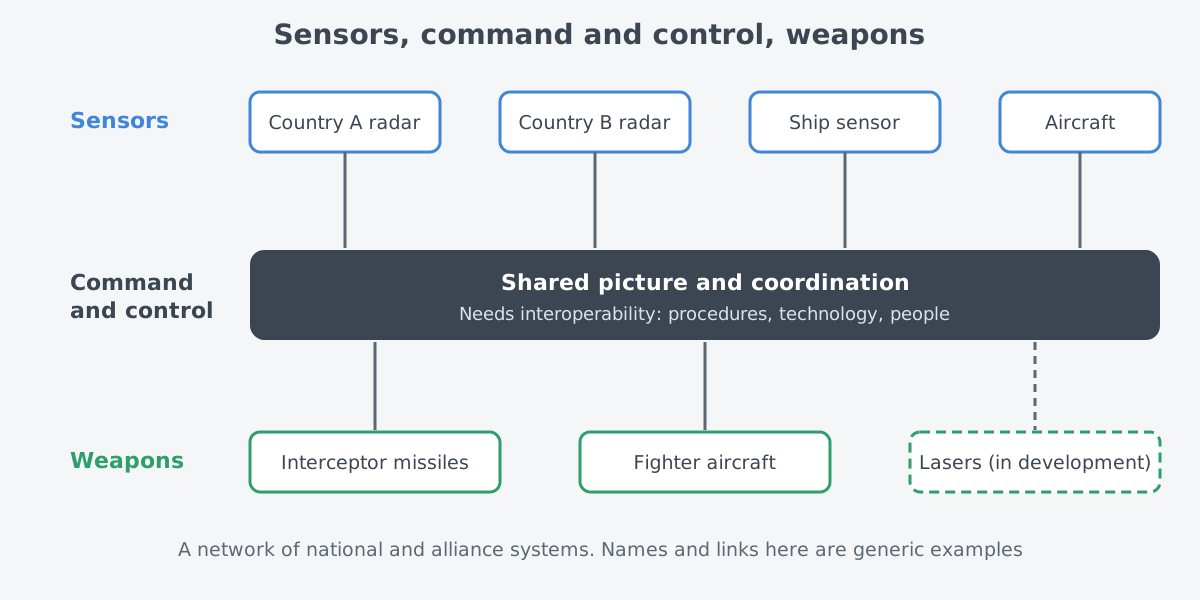
The system that carries out that mission is known as NATINAMDS. It is a network, not a single machine. National and NATO systems are linked to one another, and the network holds three kinds of parts: sensors, command and control, and weapons.
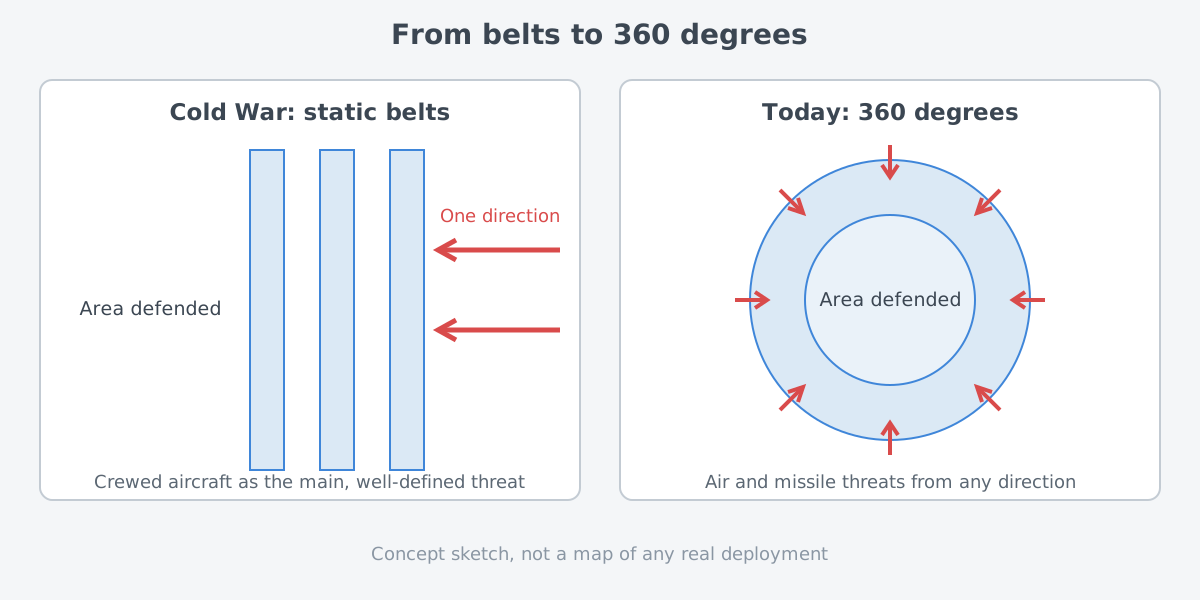
The idea is not new. NATO first put integrated air defense into practice in 1961, through a system known as NATINADS. During the Cold War, this was a largely fixed system laid out in belts, facing a single, clear threat: crewed Soviet aircraft coming from one direction.
Today's NATINAMDS is different. It has grown to face every kind of air and missile threat, coming from any direction, in a world that is harder to predict. In effect, a belt facing one way has become a circle looking all around.
Lasers may also join the weapons row. One Army concept for air and missile defense, built from six layers, holds a next-generation fires radar and a multi-mission high-energy laser (HEL) together. According to the CRS counter-drone primer, these systems are still being developed. How lasers, interceptor missiles and air defense guns share the work within this picture continues in "Lasers, interceptor missiles and guns: how they share the work."
Even with one picture, in the end one weapon has to aim at one object. When a laser weapon finds, follows and aims at one dot in the picture, the process is called acquisition, tracking and pointing (ATP). That process is the subject of "Gimbals, pointing and tracking: holding the beam on one spot."
Connecting services and countries
The lines between sensors and weapons are not only a technical matter. NATO explains that integration is essential to IAMD because it coordinates every air and missile defense capability available, and that the key precondition for integration is interoperability. That interoperability covers three sides, procedures, technology and people, and training and exercises play a large part in it.
Countries also split the work. Allies with fighter aircraft, alone or in teams of several countries, help guard the airspace of Allies that have none. This lets smaller Allies invest in other capabilities instead of an expensive national air force.
The scale is large. NATO's systems for commanding air operations (Air C2) cover an area of operations of 81 million km², not counting deployable capability. The program meant to give the Alliance one shared system for this, called ACCS, was formally set up in November 1999.
Linking things is hard even inside one country's forces. One of the Navy's main tasks in support of JADC2 is to drop its own closed network standards. That way, its systems can talk to those of the other services. If each piece of equipment speaks a different language, forces can look at the same sky and still be unable to share the picture.
What is still hard
Not everyone is optimistic, and the CRS primer sums up the questions raised by analysts who doubt JADC2. Is the technology mature enough, and is it affordable? And can a network really be fielded that links sensors to shooters securely and reliably in a dangerous setting full of electronic warfare?
The human role is also in dispute. Some ask who would hold the authority to make decisions that cross domains, how much a human is needed for real-time decisions, and whether cutting human involvement is appropriate. The technology that merges the picture quickly and the responsibility of judging what the picture shows are separate matters.
Missile defense faces the same kind of homework. The Missile Defense Reviews of 2019 and 2022 both stressed system integration and resilient sensor networks. One of the questions CRS suggests Congress might ask is whether current efforts are enough to build the sensor network and data transport needed for an integrated, effective missile defense.
What to read next
- Lasers, interceptor missiles and guns: how they share the work: looks at how weapons divide the work under one picture.
- Gimbals, pointing and tracking: holding the beam on one spot: follows how a laser stays on one dot in the picture.
- Layered missile defense: why defense comes in layers: looks at the layers that sensors and command links tie together.
- Drone or bird: what sensors look at: looks at telling what a small dot caught by a sensor really is.