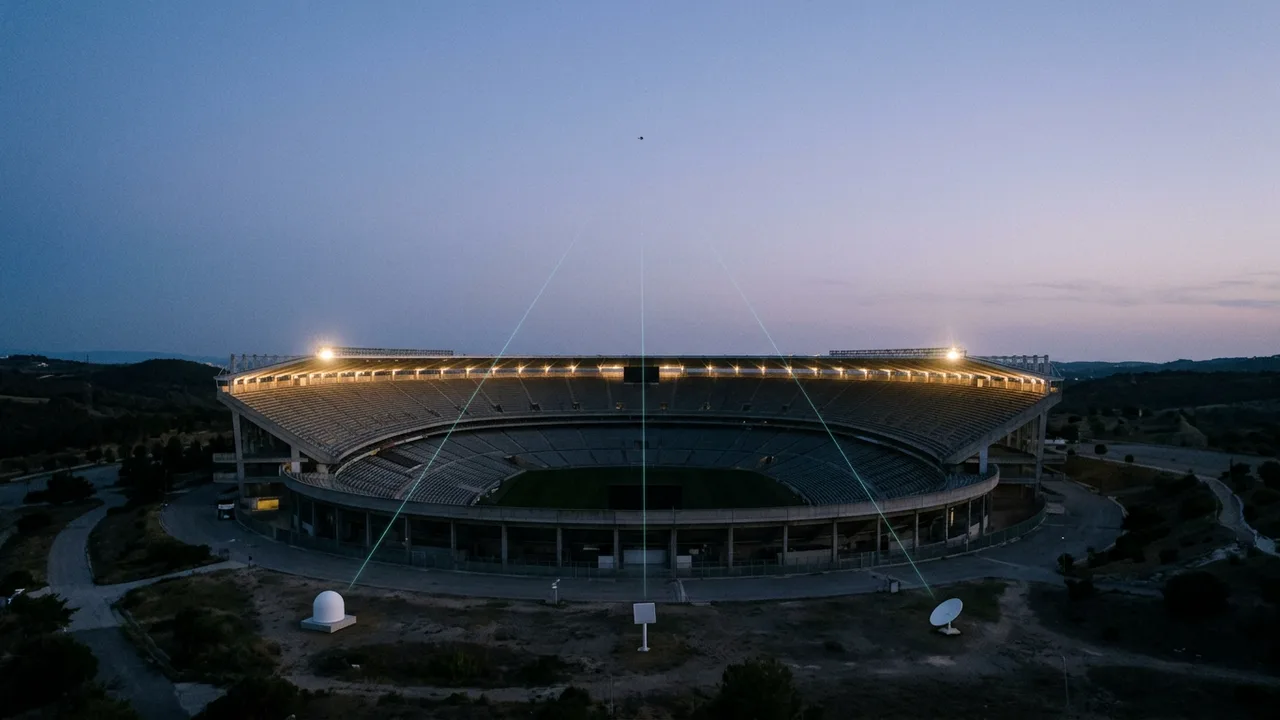
Picture a small drone hovering over a stadium. Nobody knows who launched it, what it carries or whether it can be left alone. To deal with it, someone first has to find it, then work out what it is, and only then decide what to do.
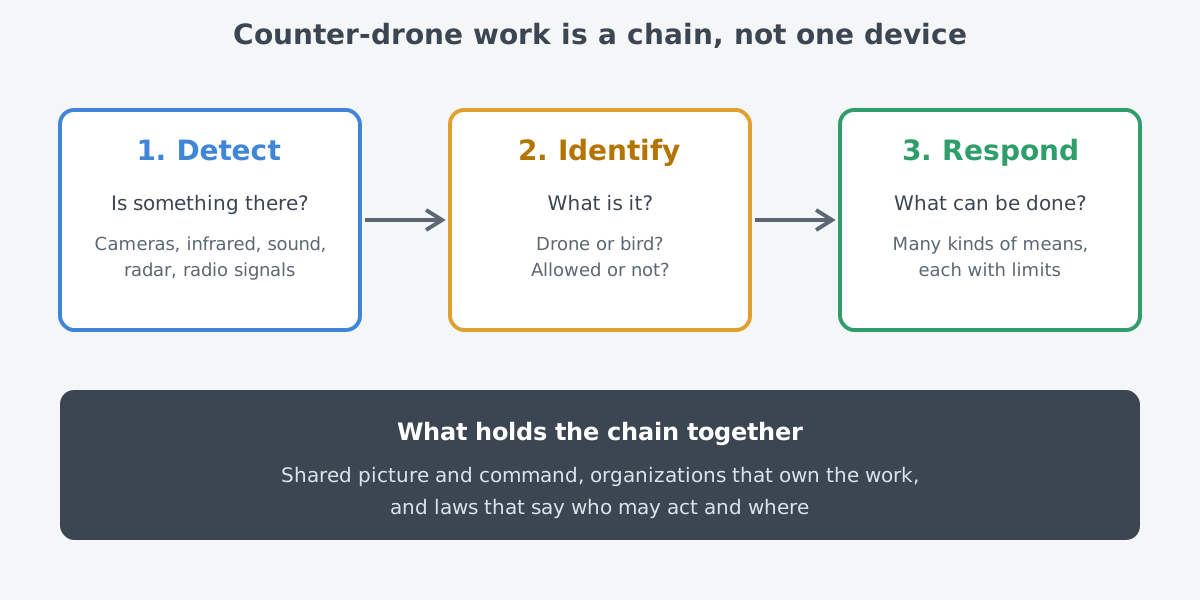
That is why counter-drone work (counter-unmanned aircraft systems, C-UAS) never ends with one device. Following official U.S. sources, this article walks through the three links of finding, identifying and responding, then the organizations and laws that bind them, and the problems still open.
Why small drones are hard to deal with
Drones have spread fast. They are now within reach of states, non-state groups and private individuals, and they can offer a cheap way to spy or to strike. Size is the problem: many small drones escape older air defense systems because of how small they are, what they are made of and how low they fly.
The civil sky is crowded too. A 2020 primer from the Congressional Research Service (CRS) gives the numbers. As of September that year, about 1.7 million drones were registered with the Federal Aviation Administration (FAA). From 2016 to 2019, airline pilots reported more than 100 drone sightings a month to the FAA on average.
In December 2018, drone sightings near the runway at London's Gatwick airport led to hundreds of cancelled flights over three days.
NATO points to the same trend. Russia's war in Ukraine showed that drones are fairly cheap and can be mass-produced and sent to the front quickly. NATO's integrated air defense had to change fast in response. NATO says it will build counter-drone solutions as key defensive capabilities.
Finding: seeing, hearing and sensing radio
There are a few ways to find a drone. The first group is electro-optical cameras, infrared sensors and acoustic sensors. They pick up a drone by its look, its heat or its sound. The second is radar, and the third is spotting the radio signals that control the drone with radio frequency sensors.
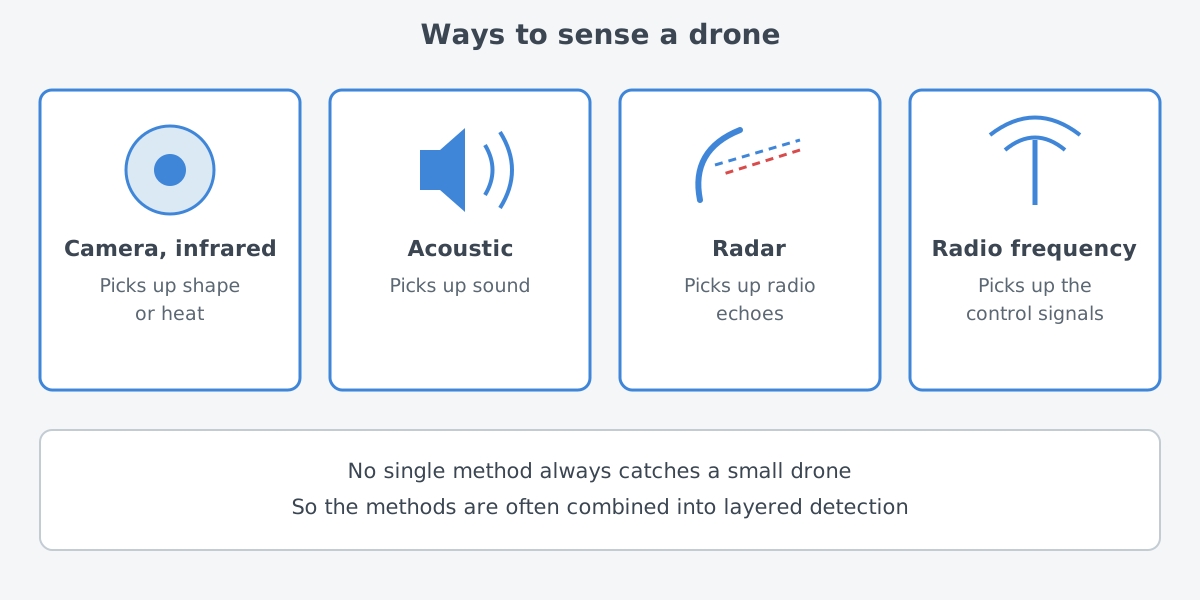
None of these is perfect. A small drone gives off weak signals and is small in size, so these methods do not always catch it. That is why several methods are often combined into a more effective, layered way of sensing. Merging what many sensors see into one picture is the subject of "Integrated air defense and sensor fusion."
Identifying: what has been found
A dot on a screen is not the end of the job. Someone has to find out whether it is a drone, a bird or a drone that is allowed to fly there. One radar study in an open journal points out that birds are about the size of drones and fly at similar heights and speeds. A dependable drone detection radar, it argues, must be able to tell the two apart, and it names birds as the main source of confusion in drone detection.
This link is built into response equipment too. The U.S. Air Force has deployed HELWS, a 15 kW counter-drone laser on a vehicle, outside the United States. By the account of its developer, Raytheon, HELWS is built to handle the step of identifying hostile or unauthorized drones as well. The CRS primer, too, passes this along as the developer's own description.
What sensors use to tell drones from birds, and where that judgment falls short, continues in "Drone or bird: what sensors look at."
Responding: a toolbox of different means
Once a drone is detected, several means can be used to engage or disable it. Electronic warfare jamming disrupts the link between a drone and its operator. A drone can also be disabled or destroyed with guns, nets, directed energy weapons (DEW) or existing air defense systems, and even with animals such as trained eagles.
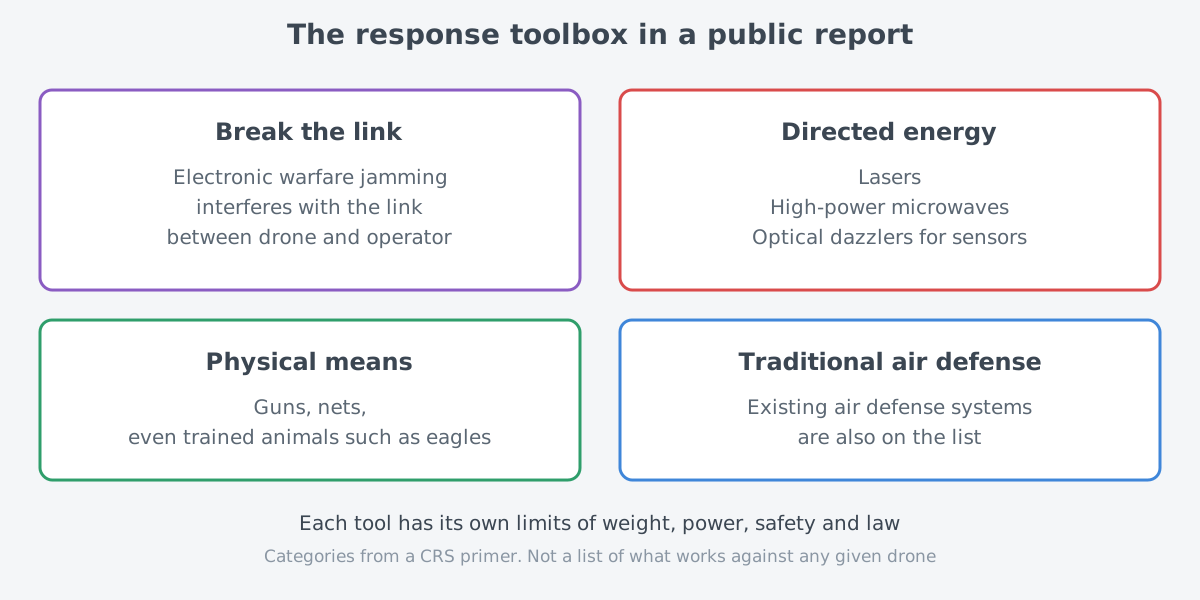
A toolbox gives a rough picture. A hammer cannot do every job, and counter-drone work also needs many tools. Real life differs from a toolbox, though. Each tool has a different weight and power need, and law and safety decide where it may be used, for example in crowded places or near airports.
Directed energy has many public examples. The U.S. Air Force is developing both high-power microwave (HPM) weapons and lasers against drones. In 2014, the U.S. Navy put LaWS, a 30 kW laser prototype, aboard the ship USS Ponce, which CRS calls the first directed energy weapon fielded for real operations. The Navy has also put two more systems on destroyers: ODIN, an optical device that disrupts drone sensors, and HELIOS, a laser of 60 kW.
Lasers are used on land as well. The U.S. Marine Corps is buying CLaWS, a compact laser weapon that was the first ground-based laser the Pentagon approved. CRS writes that it reportedly comes in 2, 5 and 10 kW versions. The U.S. Army uses it too.
What lasers do well and poorly in this toolbox is covered in "Strengths and limits of laser weapons." The difference between lasers and high-power microwaves is in "Lasers and high-power microwaves: two kinds of directed energy." How a high-energy laser (HEL) shares the work with interceptor missiles and guns continues in "Lasers, interceptor missiles and guns: how they share the work."
Tying it into a system: organizations and rules
With many tools, someone has to decide who handles what. In December 2019, the Pentagon pulled its scattered small-drone defense programs together and made the Army the executive agent in charge of all development. The defense secretary signed off on the plan for a new joint office for countering small drones (JCO) on January 6, 2020. In January 2021, the JCO issued the department's strategy for countering small drones.
Money goes in as well. For fiscal year 2023, the Pentagon set aside at least $668 million for counter-drone research and development. It planned a further $78 million or more for buying systems. How such money is weighed is the topic of "The cost of drone defense."
In the civil sky, the law comes first. As of 2020, U.S. airports, and the state and local police who protect them, had no specific legal authority to use counter-drone technology. The FAA warned that such technology could endanger crewed aircraft and the surveillance, navigation and communication signals that air traffic control relies on.
Only some agencies hold that authority. A 2018 law let the Justice Department and the Homeland Security Department, Coast Guard included, stop drones in certain cases. The purpose was to guard key infrastructure and large events chosen in advance. The 2017 defense authorization law had earlier given similar powers to the Pentagon and the Energy Department.
Problems that remain
The technology is still young. The same 2020 primer judges that drone interdiction tools are at an early stage and may not work as well as some makers and supporters claim. With no standards in place, how to judge their performance and safety is still an open question.
Carrying them is hard too. The U.S. Marine Corps tried counter-drone gear that a person can carry. The Commandant at the time told Congress in 2019 that it had "not panned out" because of weight and power needs.
Swarms of drones flying together are another task. The 2023 defense authorization law told the Secretary of Defense to assess the threat from drone swarms and the Pentagon's ability to counter them.
Sharing the sky is a problem as well. Among the questions CRS suggests Congress might ask is whether airspace management must change so counter-drone systems do not clash with other military operations. Another is how closely the Pentagon works with the FAA and with aviation regulators abroad to reduce risks to civil aircraft.
What to read next
- Strengths and limits of laser weapons: what lasers do well and struggle with in the counter-drone toolbox.
- Lasers, interceptor missiles and guns: how they share the work: the yardsticks for dividing work among different means.
- Drone or bird: what sensors look at: a closer look at the identifying link.
- The cost of drone defense: the money side of counter-drone work, in numbers from official sources.