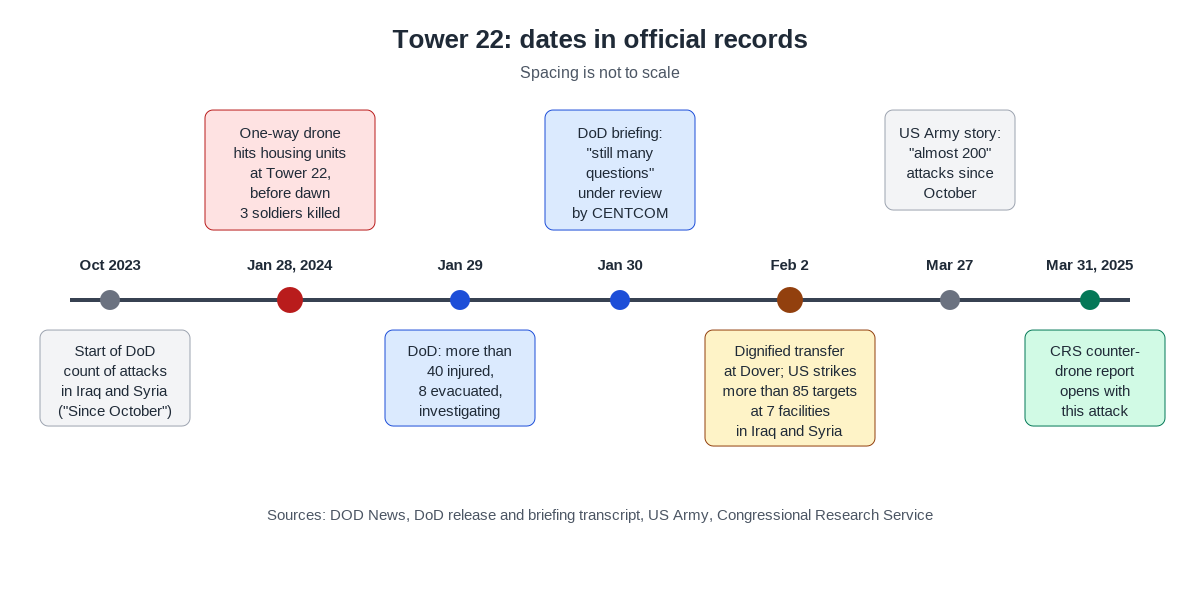
Early on January 28, 2024, at a US base in the desert where Jordan, Iraq and Syria share borders, a low and distinctive rumble filled the air. A split second later, a drone struck the container housing units where soldiers lived. Three US Army Reserve soldiers were killed and more than 40 people were injured. The base's name was Tower 22.
US forces in Iraq and Syria had come under attack many times before, but this was the first attack to kill US service members. This article follows, date by date, what the US Department of Defense, the White House and the US Army announced that day and in the days after. It ends with why the attack became the first sentence of a Congressional Research Service (CRS) report on counter-drone programs, and how base air defense meets the story of lasers. This article reflects information as of October 2026.
What Tower 22 was
Tower 22 was a US logistics support base located at a site of the Jordanian Defense Network. It sits in northeastern Jordan, near the Syrian border. As of January 29, about 350 US Army and Air Force personnel were deployed there.
They were in Jordan for Operation Inherent Resolve, the US and coalition mission to defeat ISIS. Two months later, a US Army story quoted the officer who was then deputy base commander. In his words, Tower 22 was a busy base used mainly for logistics and support.
Before dawn on January 28
The attack came in the early morning. In Pentagon releases, the weapon is a one-way unmanned aerial system (OWUAS). As the name suggests, it flies one way only and does not come back. Defense Department news stories and briefings also used the phrase "one-way attack drone."
The deputy base commander, an Army captain, later recalled the time. "It was still 5:35, 5:38, 5:40 in the morning," he said. "There's no daylight." Small fires burned from the remaining fuel, and the troops quickly began sorting and treating the wounded.
That day President Biden issued a statement. It said three US service members had been killed and many wounded the night before in a drone attack on US forces in northeast Jordan near the Syrian border. The Pentagon's casualty release ended with a single line: "The incident is under investigation."
The three who died and the wounded
All three soldiers who died were reservists assigned to the 718th Engineer Company, 926th Engineer Battalion, 926th Engineer Brigade, at Fort Moore, Georgia. William Jerome Rivers, 46, was an interior electrician. Kennedy Ladon Sanders, 24, and Breonna Alexsondria Moffett, 23, were both horizontal construction engineers. The US Army Reserve announced that Sanders and Moffett were posthumously promoted to sergeant.
The injury figures grew more detailed by the day. On January 29, the deputy Pentagon press secretary said more than 40 people had been injured and eight had been evacuated out of Jordan to the Baghdad Diplomatic Support Center. Three of the eight were due to be moved to Landstuhl Regional Medical Center in Germany. The other five had been assessed for mild traumatic brain injury (TBI) and were expected to return to duty.
At the next day's briefing, the injuries were described as ranging from cuts to possible concussions. One of the three taken to Landstuhl was reported to be in critical but stable condition.
On February 2, the President and Defense Secretary Austin attended the dignified transfer of the three soldiers' remains in Dover, Delaware.
Who officials said was behind it
In his January 28 statement, the President said the facts were still being gathered. Even so, he named militant groups backed by Iran and active in Syria and Iraq as the attackers. He added that the United States would make everyone responsible answer for it, at a time and in a way it would choose. Defense Secretary Austin said he was "outraged and deeply saddened."
On January 29, the deputy press secretary said the attack came from a militia backed by Iran's Islamic Revolutionary Guard Corps (IRGC). She said it had "the footprints of Kataib Hezbollah" but that this was not a final assessment, and that Iran was behind it. She also said officials were still assessing how a one-way attack drone was able to hit the facility, and that US Central Command was continuing to investigate.
At the January 30 briefing, the same questions were still open. The press secretary said many questions remained, including how the drone got through the facility's air defenses, where it came from, and which Iranian proxy group was responsible. At the same briefing, a reporter said Kataib Hezbollah had posted a message on Telegram telling its fighters not to attack US bases. The press secretary said he had seen those reports and answered only that "actions speak louder than words."
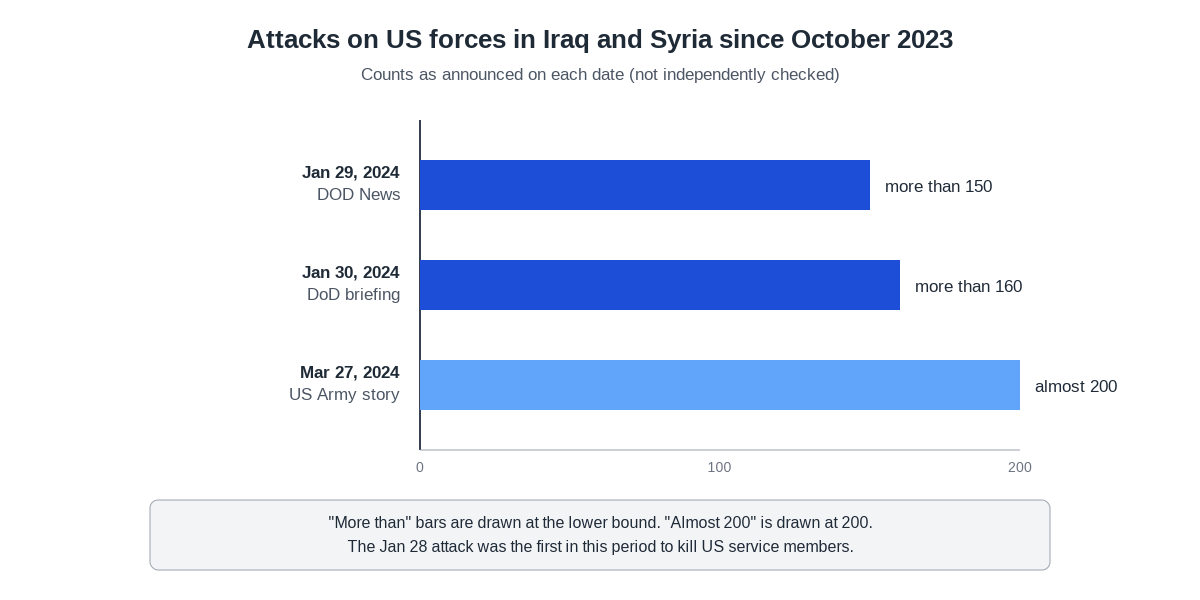
The attack did not happen in isolation. A Defense Department story on January 29 said US service members and US and coalition facilities in Iraq and Syria had been attacked more than 150 times since October 2023. At the briefing the next day the figure was "160 plus attacks," and a US Army story on March 27 put it at almost 200. All three sources agreed on one point: Tower 22 was the first attack in this period to kill US service members and the first attack in Jordan.
The strikes of February 2
On February 2, a few hours after the dignified transfer, US officials announced strikes in Iraq and Syria. A Defense Department story said US Central Command forces hit more than 85 targets across seven facilities used by groups linked to the IRGC's Quds Force. The targets included command and control centers, intelligence facilities and weapons storage facilities. Several kinds of aircraft took part, including B-1 bombers that flew from bases in the United States.
"Our response began today," the President said, adding that it would continue at times and places of America's choosing. He also said the United States does not seek conflict in the Middle East or anywhere else in the world. Secretary Austin said, "This is the start of our response."
Base air defence as an open problem
More than a year later, on March 31, 2025, the Congressional Research Service published report R48477 on the Pentagon's counter-drone programs. The first sentence of its main text is about this attack. A drone strike on a US base in Jordan on January 28, 2024, killed three US service members and injured more than 40. Defense Department officials blamed it on militia groups in Iraq and Syria that Iran supports.
Next comes the Pentagon's view of uncrewed systems in the air, on land and at sea. To the Pentagon, they are an "urgent and enduring threat" to US personnel, facilities and assets overseas. Drones are the biggest of these threats right now, and a growing one inside the United States. In response, policymakers and defense officials have called for faster investment in defensive counter-drone capabilities.
The Army's lead organization for counter-drone work is the Joint Counter-Small UAS Office (JCO). It was established by the Secretary of Defense in 2020. How each piece of counter-drone equipment works is covered separately in Counter-drone systems: why one device is not enough.
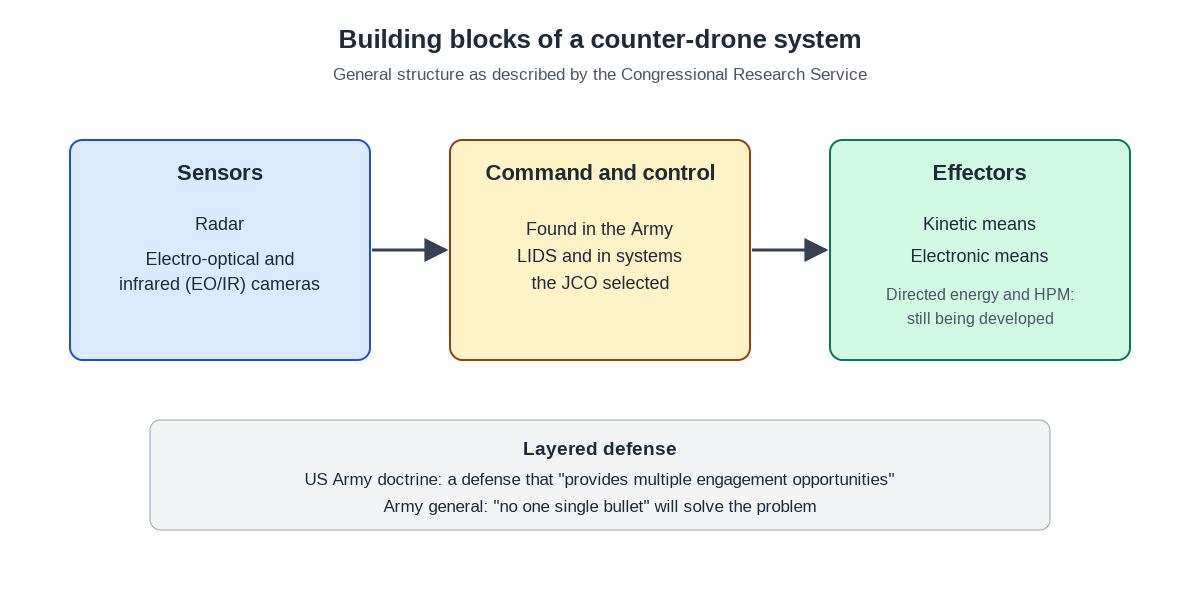
In the report, a counter-drone system has three broad parts. There are sensors such as radar and electro-optical/infrared (EO/IR) cameras, a command and control system, and kinetic and electronic ways to respond. The Army's Low, Slow, Small UAS Integrated Defeat System (LIDS) is built from these elements, and both the Army and the Air Force have deployed it.
Army doctrine calls the practice of stacking these tools "layered defense" and defines it as a defense that provides multiple engagement opportunities. One Army major general put it this way: "no one single bullet is going to solve this problem." Picture several guards each watching part of a building. The real difference is that the work is shared not by people but by sensors, command and control systems and several kinds of response.
Where this meets lasers
Directed-energy weapons (DEW) also appear in the same report. Some Defense Department officials see lasers and other directed energy, along with high-power microwave (HPM) systems, as possible cheaper options. The comparison is with the interceptor missiles normally used for air and missile defense.
Limits are part of the picture too. The Army's directed-energy effort for its mobile short-range air defense vehicle (M-SHORAD) has reportedly faced delays. And even if each shot costs less than an interceptor missile, the up-front cost of building these systems in large numbers could balance or cancel out that advantage.
Read this way, lasers are still one candidate that could be added to a layered defense. How lasers and microwaves differ is explained in Lasers and high-power microwaves: two kinds of directed energy. The Army's tests of directed energy at US bases are covered in The US Army E-HEL laser contract and the directed-energy pilot at US bases.
What to read next
- Counter-drone systems: why one device is not enough: how sensors and response tools share the work.
- The cost of drone defense: the money side of counter-drone defense, using figures from official sources.
- Loitering munitions: between missile and drone: where drones that strike their targets came from.
- Iran's April 2024 Attack on Israel: Drones, Missiles and a Multinational Defence: a large attack in the same region three months later, told from official records.