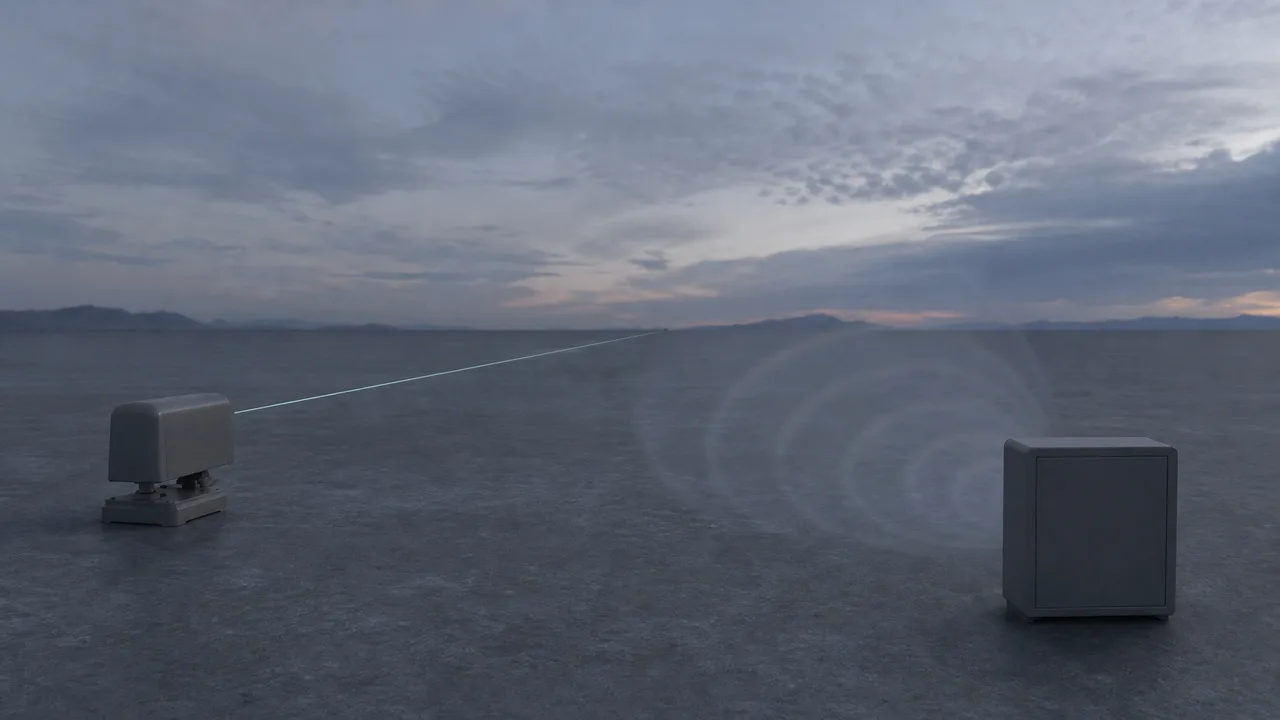
Picture a laser that brings down one drone, and a microwave device meant to stop the electronics of several drones at once. One uses a needle-thin line of light. The other sends invisible waves out over a wide area. They look very different, yet U.S. defense sources put both under one name.
What do they share, and why are they developed separately? This article sets the two weapons side by side: which electromagnetic waves they use, what they affect, and what official sources say each one could be used for. Rather than judging which is better, it looks at how they differ and at the conditions attached to each trait.
Same family, different waves
The family is called directed-energy weapons (DEW). The U.S. Department of Defense defines them as weapons that use concentrated electromagnetic energy, rather than kinetic energy, to incapacitate, damage, disable or destroy enemy equipment, facilities and personnel. Instead of throwing an object such as a bullet or a missile, they send the energy itself.
The Congressional Research Service (CRS) report on Defense Department directed-energy weapons places two kinds in this family. One is high-energy laser (HEL) weapons. The other is high-power microwave (HPM) weapons. Other branches exist, such as particle-beam weapons, but that report leaves them out.
How the terms relate, and what "laser weapon" means, is laid out first in What is a laser weapon? Film versus reality. This article opens the two boxes of that term diagram one at a time.
Both are electromagnetic waves, with different wavelengths
The light from a laser and a microwave are the same kind of wave. Both are electromagnetic waves, with electric and magnetic properties together. Radio waves, microwaves, visible light, X-rays and gamma rays all sit on one continuous electromagnetic spectrum. Lasers, like radio transmitters and microwave ovens, are man-made sources of electromagnetic radiation.
The difference is wavelength. A shorter wavelength means a higher frequency and higher energy, and a longer wavelength means lower ones. That light is an electromagnetic wave is explained in Light basics: waves, wavelength, frequency and photons. Why the behavior changes with wavelength is covered in Why wavelength matters: visible and invisible light.
NASA gives the microwave region as wavelengths from 1 mm to 1 m. In frequency, that is 300 MHz to 300 GHz, which CRS describes as the highest-frequency part of the radio waves. Visible light spans 0.4–0.7 µm and infrared spans 0.7–100 µm. Next to microwaves, measured in millimeters and meters, the wavelengths of light sit far toward the short end.
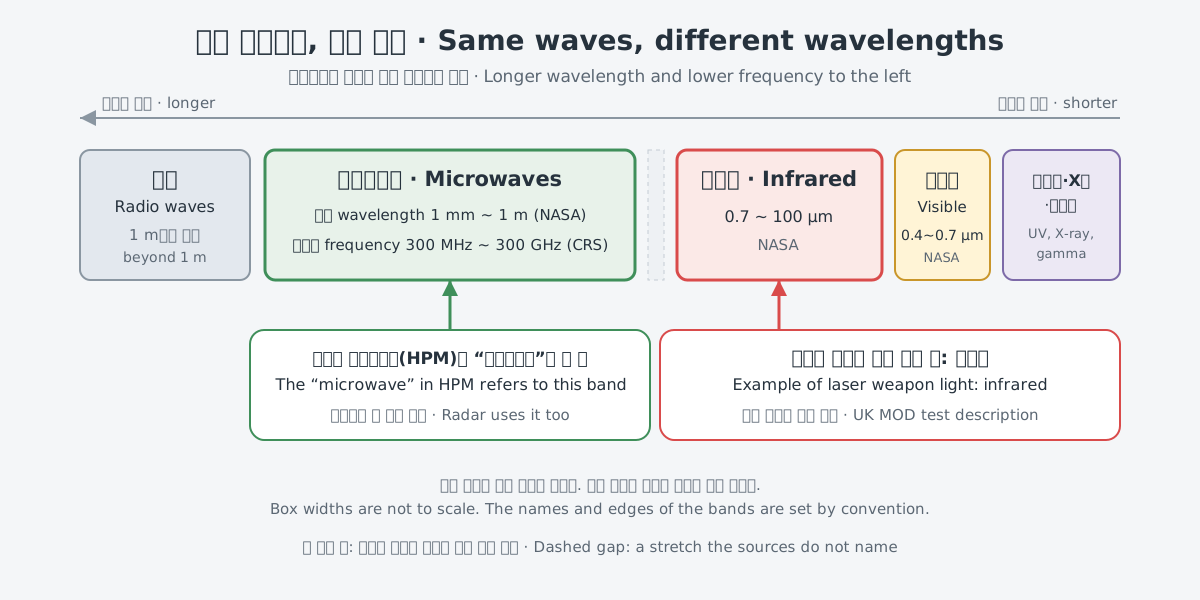
Where on this band does laser weapon light fall? The UK Ministry of Defence described a laser weapon tested in December 2024 as a device that sends "an intense beam of infra-red light" toward its target. The U.S. military also uses infrared and ultraviolet lasers for communications and intelligence collection.
The microwave band has a familiar neighbor. Radar uses it, and radars work on different radio and microwave frequencies depending on their purpose. How radar measures distance is explained in Radar: measuring distance and motion with radio waves.
Lasers: a narrow beam that stays on one spot
A laser weapon's beam is narrow. The lit area might be several millimeters to several inches across. It affects what it hits, while generally not affecting, at least not directly, separate objects nearby. This is called precision engagement.
The narrow beam has a cost. To disable a target, the beam has to stay focused on one spot, and CRS puts that time at "within seconds, depending on the laser power." After one target, turning to the next takes several more seconds. A laser weapon can take on only one target at a time.
Why the beam has to stay, when light arrives almost at once, is explained in Why a laser weapon does not finish "the instant it fires". The laser does not hold the beam on one spot by itself. The other blocks of a laser weapon are shown in A laser weapon is more than a laser: the system at a glance.
HELs might be used by ground forces for short-range air defense, counter-drone work, and countering rockets, artillery and mortars. They might also be used to "dazzle," or briefly disable, satellites and sensors, or to damage them.
High-power microwaves: a wider spread that reaches electronics
A high-power microwave weapon aims at something else. HPM weapons could offer a way to disable enemy electronics and communications systems without kinetic energy. The target is not one spot on a surface but the electronics inside.
The way it spreads is different too. HPM weapons could produce effects over wider areas than lasers, by disabling any electronics within their electromagnetic cone.
The CRS appendix says they can disable any unprotected electronic system inside the cone, so they can disable numerous systems at once, including swarms of drones. Two conditions come with this. The system must be inside the cone, and it must be unprotected.
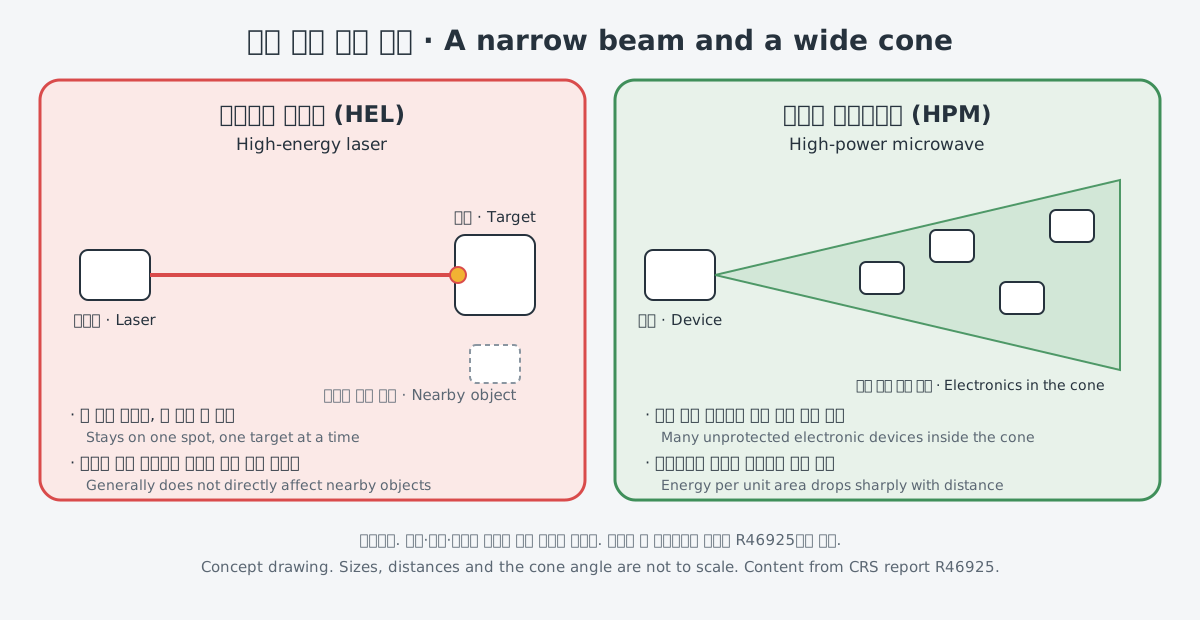
A flashlight and a ceiling light give a rough picture. A flashlight lights one patch of wall, while a ceiling light falls on everything in the room at once. The real thing differs in many ways. A high-power microwave is not visible light, it may have no effect on protected equipment even inside the cone, and it weakens sharply with distance.
That weakening is the first limit of HPM. HPM beams are more diffuse than lasers and cannot be focused as tightly, so the energy per unit area drops sharply over distance. That can limit the range at which they work in operations.
The wide reach also causes a problem in the other direction. Because the weapon can affect all unprotected electronics in range, steps must be taken so friendly equipment is not affected when it is used.
HPM weapons also have potential strengths. Beyond deep magazines, low cost per shot, fast engagement and graduated responses, HPM weapons may offer more. They can disrupt targeted electronic systems for a while or for good, while leaving others unaffected. They would cause little to no collateral damage to buildings and other structures, which could make them useful in urban areas or in situations short of war.
Nonlethal uses against people have also been considered. The CRS primer on directed-energy weapons (IF11882) says HPM weapons have been considered as nonlethal "heat ray" systems for crowd control. Such anti-personnel HPM weapons, however, could not tell soldiers from civilians and could affect civilians inside the cone.
Uses named in official sources, side by side
The table below gathers the points above in one place. The last column names the source.
| Item | High-energy laser (HEL) | High-power microwave (HPM) | Source |
|---|---|---|---|
| Wave used | Light; the test case is infrared | Microwaves (wavelength 1 mm–1 m) | UK MOD, NASA |
| Where the effect lands | The lit area, several millimeters to several inches across | Unprotected electronics inside the electromagnetic cone | CRS R46925 |
| Targets at once | One target, several seconds to the next | Many systems inside the cone at once (with conditions) | CRS R46925 |
| Uses named in official sources | Short-range air defense, counter-drone, counter-rocket, artillery and mortar, dazzling sensors | Disabling electronics and communications systems, area defense against missile salvos and drone swarms (analysts' view) | CRS R46925, IF11882 |
| Main limits named | One target at a time, line-of-sight targets only, rain and fog | Sharp weakening with distance, effects on friendly equipment, may not work on protected targets | CRS R46925 |
The entries can differ from system to system. The strengths and limits are specific to each system, so not all of them may apply equally to every system. A fuller table of laser strengths and limits is in Strengths and limits of laser weapons.
A few HPM program names appear in official sources. The Air Force's THOR (Tactical High-Power Microwave Operational Responder) is a technology demonstrator designed by the Air Force Research Laboratory (AFRL) with industry partners. It aims at a counter-drone weapon for short-range air base defense. CHIMERA, unlike THOR, aims to engage drones at greater distances, and little unclassified information about it exists.
In the July 2024 CRS report, the Army's IFPC-HPM appears as a transportable, containerized system being developed to counter drone swarms. The same report carries the Army's plan to deliver four prototypes by the fourth quarter of fiscal year 2024. The Army then meant to plan for a possible move to a program of record in fiscal year 2025. The CRS primer updated in early 2026 says the department is not known to have any directed-energy programs of record.
A demonstrator, a prototype and a program of record are different stages. A program of record is the stage where a prototype has become an acquisition program. How to tell these stage words apart in the news is covered in How to read laser weapon news: "kW-class", "range" and "cost per shot". Public laser cases are gathered in Laser weapon programs that have been made public.
Why the two are kept together
Official sources draw the two weapons as partners rather than rivals. According to a CRS report quoting Army budget documents, IFPC-HPM is to be paired with IFPC-HEL as part of a layered defense to protect fixed and semi-fixed sites. The Government Accountability Office (GAO) report of April 2023 also titles a figure on its summary page "Notional Depiction of High Power Microwave and High Energy Laser Defending an Installation."
Looking back at the table, the two weapons do not overlap much. A laser handles one target at a time, narrowly and precisely. HPM can reach many unprotected electronic devices inside its cone at once, but it weakens sharply with distance. The words "paired" and "layered defense" in official sources can be read alongside these differences.
The same interest shows up at sea. The CRS report on shipboard lasers says operations in the Red Sea and the Gulf of Aden in 2023–2025 highlighted magazine depth and cost exchange ratios. They also drew attention to lasers (and HPM weapons) as a way to counter drones while using fewer of a ship's limited air-defense missiles. GAO wrote that the department and the military departments have developed a range of HPM capabilities, for purposes such as engaging missile or drone swarm attacks against a base.
The hurdles are written down as well. GAO notes that the department has had trouble, for several reasons, getting these technologies out of the lab and into the field. A recent pilot program that brings lasers and a microwave system together appears in the news explainer The US Army E-HEL laser contract and the directed-energy pilot at US bases.
Both weapons also share the work with existing means such as missiles and air-defense guns. That story continues in Lasers, interceptor missiles and guns: how they share the work.
What to read next
- Lasers, interceptor missiles and guns: how they share the work: sets lasers and other defensive means side by side by cost, magazine, weather and platform.
- Laser weapon programs that have been made public: gathers laser weapon cases that governments have officially announced.
- Eye safety and international rules: the protocol on blinding laser weapons: looks at the international rule that bans laser weapons designed to blind.
- A history of laser weapons: from chemical to electric lasers: follows the path to today's electrically powered laser weapons.
- "Electronic warfare: the invisible contest": covers the contest across the whole electromagnetic environment, microwaves included.