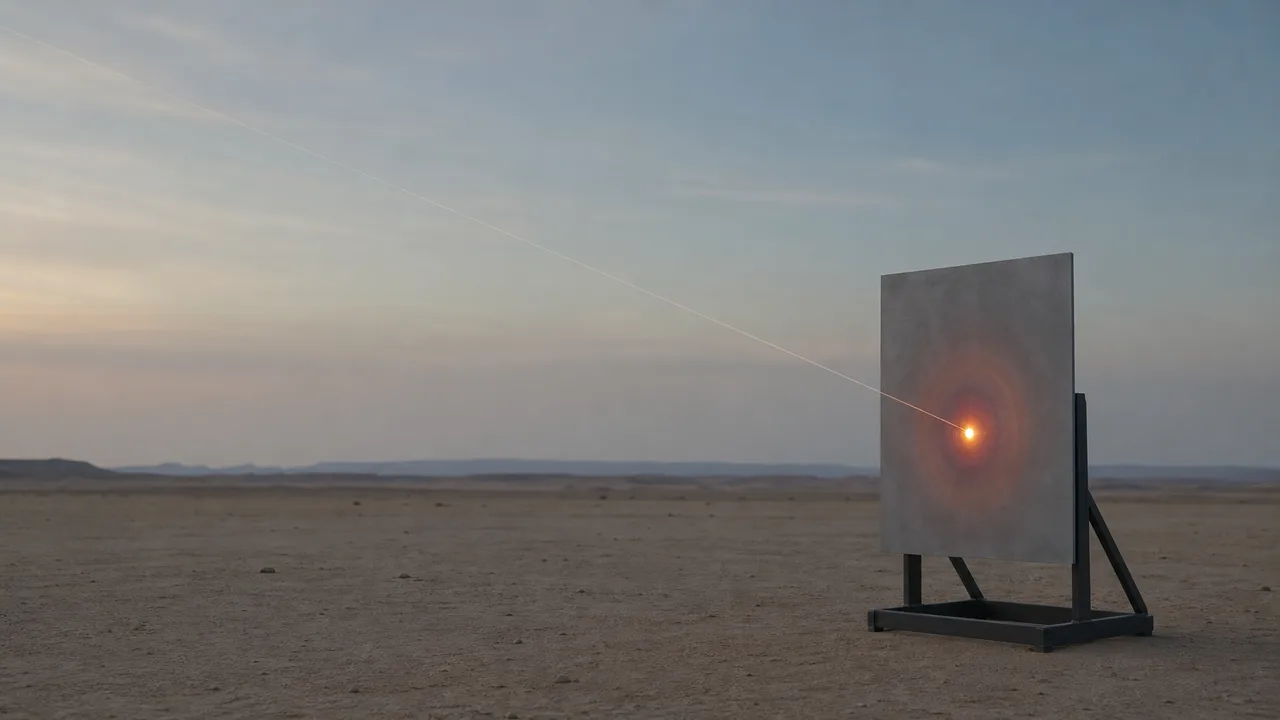
As "What is a laser weapon?" explains, the light of a laser weapon reaches the target almost instantly. Damage builds up only while the light stays on the same spot. The Congressional Research Service (CRS) covers this in its directed energy weapons report. A high-energy laser (HEL) weapon held on one spot of a target can cause disabling damage "within seconds," depending on the laser power.
The light arrives almost at once, so why does it take seconds? There is a step between the light arriving and the target being damaged, and that step is heat. The light has to turn into heat, and the heat has to build up in one place, before anything happens.
Arrival is instant, heating takes time
Light is so fast that, over any distance you can see, it arrives the moment it is fired. There is no need to work out an intercept course in advance, as an interceptor missile must, so this counts as an advantage of laser weapons.
But arriving is not the end of the job. What the light does is put energy into the spot it hits, and a material is damaged only when that energy builds up and its temperature rises. Temperature does not rise in an instant.
Put a pot of water on a gas stove and the flame touches the bottom of the pot as soon as it is lit. Even so, the water does not boil at once; it boils only after heat has had time to build up. A real laser weapon is different. It heats not the whole bottom of a pot but one small spot, the target moves, and there is air in between.
Two relations from the article on laser units apply here. Energy is power multiplied by time, and intensity (irradiance) is power divided by area. Put together, the energy that goes into one place is set by both the intensity at that spot and how long the beam stays there.
How light becomes heat: absorption and reflection
When light reaches a surface, not all of it goes in. Some of it bounces off the surface, which is reflection. Some light may pass straight through the object.
The rest disappears inside the material and leaves its energy behind. This is called absorption, and the absorbed energy becomes heat. Reflected light leaves without heating the spot.
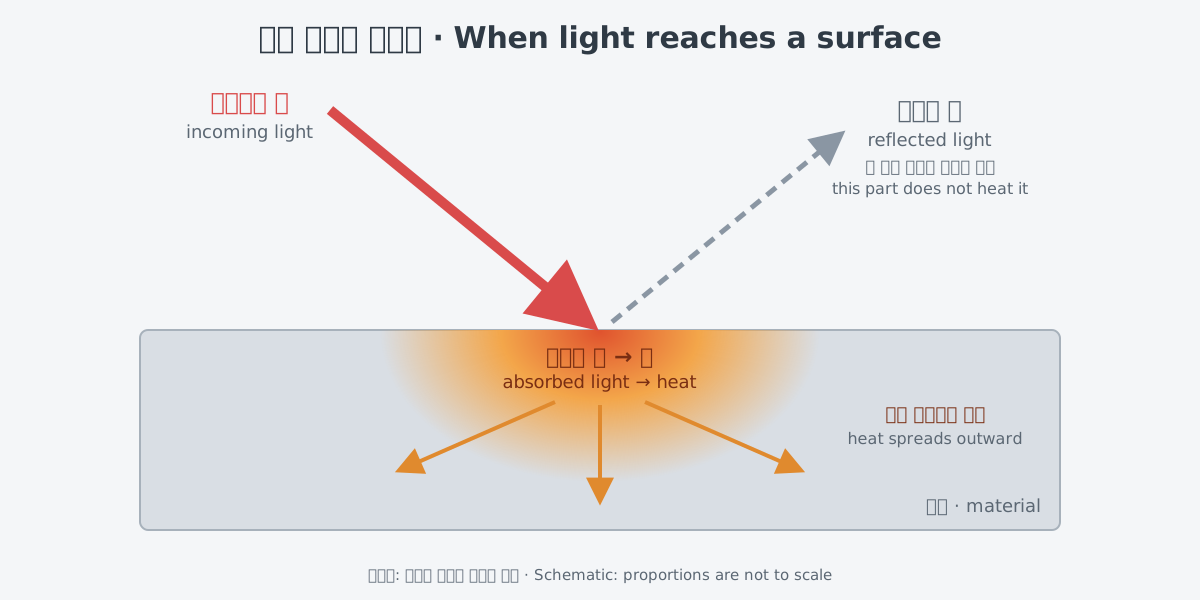
Heat made by absorption does not stay put. Over time it moves into the surrounding material. This is one reason very short laser pulses are used to process materials. If the hit area is removed before the heat has time to move outward, the zone around it that is damaged by heat stays small.
When light shines continuously, this same property gets in the way. Some heat keeps leaking into the surroundings while the light is still adding more, so the heat left in one spot is less than the energy put in. That is one reason the temperature takes time to rise.
Staying on one spot: the idea of dwell time
Dwell time is how long the beam stays on the same spot of a target. CRS makes the same point in two reports, one on Navy shipboard lasers and one on directed energy weapons. A laser can cause disabling damage within seconds "by remaining focused on a particular spot on the target." Holding the beam on one spot is part of the claim.
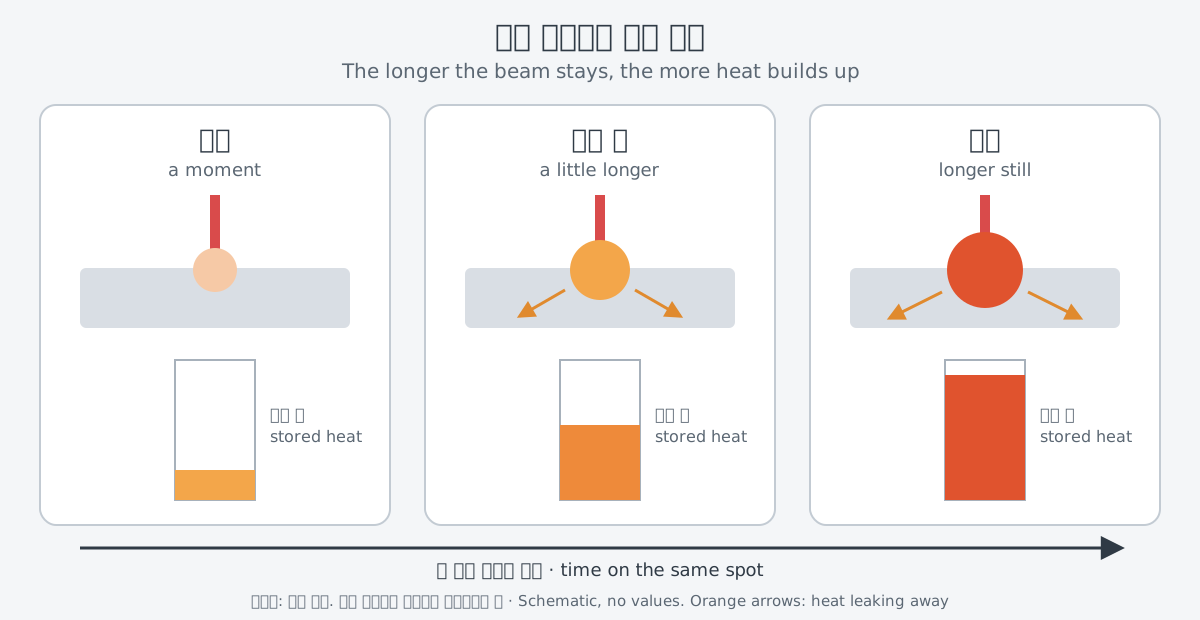
In the directed energy weapons report, the same sentence carries a condition: "depending on the laser power." More power puts more energy in during the same time. Even at the same power, a beam squeezed into a smaller spot has a higher intensity, so the same heat builds up faster. With a lower intensity, the beam has to stay longer to have the same effect.
The spot is small. The directed energy weapons report puts the area lit by the laser at several millimeters to several inches in diameter. Because the energy is packed into such a small spot, even a small shift can move the beam off the place where heat was building up. How long it takes depends on power, distance and air, and it differs from system to system.
What makes it take longer: distance, air, shake
What lengthens the dwell time comes down to whatever lowers the intensity reaching one spot.
| Factor | What happens | Further reading |
|---|---|---|
| Distance | The beam spreads and the air absorbs more of the light | "Why a beam spreads" |
| Air | Water vapor, dust and smoke absorb and scatter the light. Turbulence can blur the beam | "Light through air" |
| Shake | The beam wobbles, so the same light is shared over a wider area | "Gimbals, pointing and tracking", "Fast steering mirrors" |
A beam of a given size spreads a little the farther it travels. When the same power lands on a wider spot, the intensity drops. Absorption by the air also generally grows with distance to the target, so it is less of a problem at short range than at long range.
The air also takes light away. Water vapor, sand, dust, salt particles, smoke and other substances in the air absorb and scatter light. Atmospheric turbulence, the irregular churning of the air, can blur the beam. Adaptive optics, which make rapid, fine corrections to the beam in response to turbulence, can reduce its effects.
One effect is tied directly to time. If a laser keeps firing in the same direction for a while, it can heat the air the beam passes through, and that air can then blur the beam. This is called thermal blooming. CRS says it generally becomes more of a concern as beam power increases.
The last factor is shake. Small, rapid wobbling in where the beam points is called jitter. If the beam lands on a slightly different place from moment to moment, the same light is shared over a wider area. Less heat then builds up in any one place.
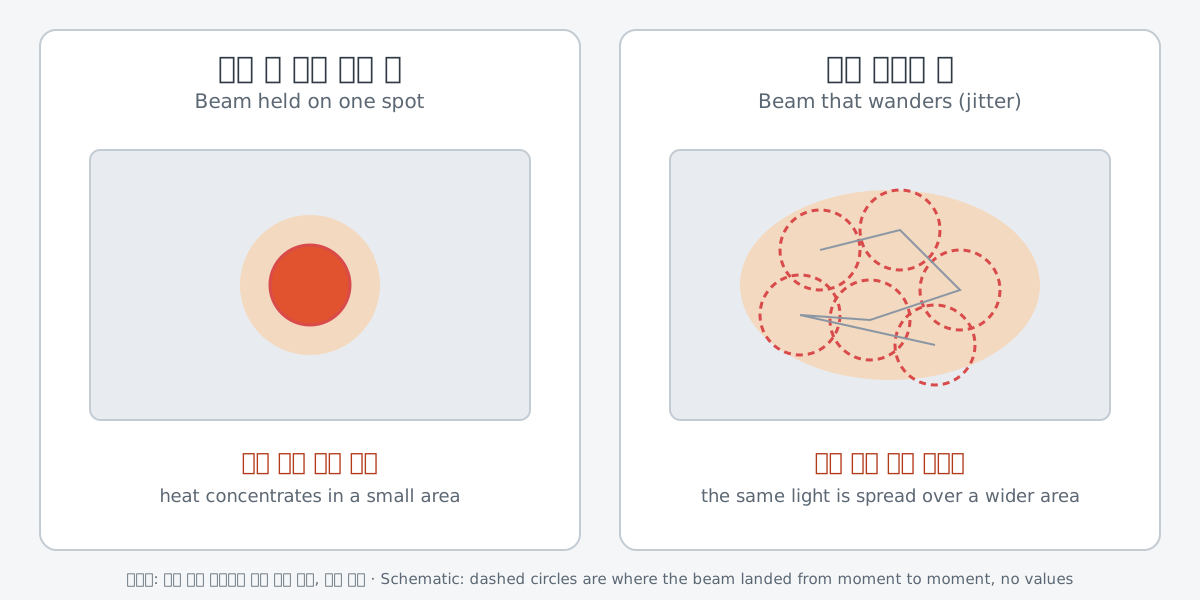
Jitter is still listed as a problem to solve. CRS cites a U.S. Navy budget document for fiscal year 2025 that lists the remaining technical challenges. Along with atmospheric turbulence and beam control, it names "precision target tracking with low jitter in high clutter conditions."
The limits that follow
Because it takes time, a laser weapon has limits. According to CRS, a laser weapon can attack only one target at a time, needing several seconds to disable it and several more to switch to the next. These seconds add up, so the number of targets it can handle in a given period is limited. Installing more than one laser, as far as space and energy allow, can ease this limit.
Weather is tied to time as well. When the air takes light away and the intensity drops, the same effect takes longer, or may not happen at all. CRS writes that lasers might not work well, or at all, in rain or fog, so they are not an all-weather solution.
Strengths and limits beyond time continue in "Strengths and limits of laser weapons". Terms that appear in the news, such as "kW-class" and "range," are covered in "How to read laser weapon news".
What to read next
- "Strengths and limits of laser weapons": sets the time limits in this article alongside the other strengths and limits.
- "Lasers, interceptor missiles and guns: how they share the work": the one-target-at-a-time limit leads into how lasers share the work with other means.
- "Light through air: absorption, scattering, turbulence, thermal blooming": goes through each way the air weakens a beam.
- "A laser weapon is more than a laser: the system at a glance": shows where the equipment that holds the beam on a target sits in the whole system.
- "Gimbals, pointing and tracking: holding the beam on one spot": covers the equipment that keeps a beam on one spot of a moving target.
- "Fast steering mirrors: small, quick mirrors that cancel shake": the hardware side of reducing jitter.