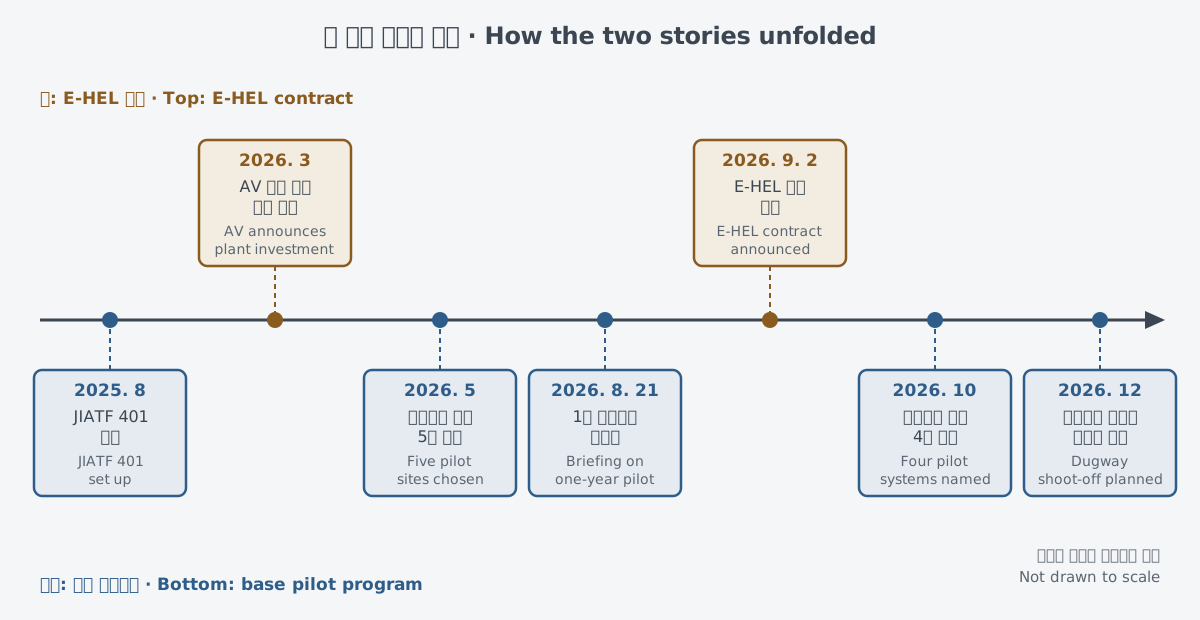
On September 2, AeroVironment (AV), a US company that builds counter-drone lasers, announced a $464.8 million contract with the US Army. A little over a month later, reports said four directed-energy weapons (DEW) had been picked for trials at military bases inside the United States.
The two stories came out separately, but they overlap. An AV laser appears in both, and the same counter-drone task force is involved in each. So what has been decided, and what is still unknown?
Government statements appear here only as quoted by the media. For that reason, this piece keeps what the company announced apart from what the media reported.
What was announced
In a September 2 press release, AV said it had won a contract for the E-HEL (Enduring-High Energy Laser) program. The award came from the US Army Portfolio Acquisition Executive for Fires. It is worth $464.8 million and takes the form of an Other Transaction Agreement. The same amount appeared in a Janes story that day, which cited an Army statement.
E-HEL buys high-energy laser (HEL) weapons. In the Janes story, the Army statement framed the program as a way to buy weapons that counter unmanned aerial systems. The statement highlighted "a low cost-per-shot and a magazine that regenerates with the system's power supply."
The second story broke in early October. In an October 6 article, Military Times reported that the Pentagon had named four directed-energy weapons for a homeland counter-drone pilot. In that account, these are the first systems the military will field and test at US bases under a program ordered by Congress.
The pilot is run by a counter-drone task force called JIATF 401 (Joint Interagency Task Force 401). Per Air & Space Forces Magazine, the pilot is a requirement in the 2026 National Defense Authorization Act.
What is publicly known
First, the E-HEL contract. The last column shows who made each statement.
| Item | What was made public | Source |
|---|---|---|
| Contract | A $464.8 million award to AV from the US Army's Portfolio Acquisition Executive for Fires (PAE Fires) | AV press release. Same amount in Janes, citing an Army statement |
| Contract type | Other Transaction Agreement (OTA) | AV press release |
| Deliveries | "Dozens" of LOCUST X3 laser weapon systems over the next few years. No exact number given | AV press release |
| Stated power | A 30 kW system, not tied to one platform | AV press release |
| Platforms | Integration with vehicles such as the Army's Joint Light Tactical Vehicle (JLTV), with palletized options, and a study of the Infantry Squad Vehicle (ISV) | AV press release |
| Support | Ongoing system support and training | AV press release |
| Production site | Ramp-up backed by a $30 million investment in AV's Albuquerque, New Mexico, facility, announced in March | AV press release |
| First deliveries | Delivered over the year for government acceptance testing | Janes (an AV executive) |
AV called the award the first-ever production contract for high energy laser weapon systems in US history. That label is the company's own, and Military Times presents it the same way.
The production rate is a separate matter from the contract quantity. In Janes' report, AV is ramping up production of Locust systems overall to 20–30 a year, and plans to go beyond that in the next 12 to 24 months. That figure does not count the systems under the E-HEL contract.
AV said the E-HEL program builds on the Army's multi-purpose high-energy laser prototypes that the Army is using now. The company's release also points to a test that came before the contract, at White Sands Missile Range, led by JIATF 401 and PAE Fires. In AV's account, that test showed safe counter-drone operations in US airspace and led to a safety agreement between the Pentagon and the FAA. This is the thread that ties the two stories together.
Next, the base pilot. Here the basis is media reporting, not a company announcement.
| Item | What was reported | Outlet |
|---|---|---|
| Run by | JIATF 401, launched in August 2025 to coordinate counter-drone activities, policies and procurement across the joint force, federal agencies, and state and local levels | Military Times, Air & Space Forces Magazine, DefenseScoop (launch and role) |
| Length | One year | Janes (task force briefing on August 21) |
| Approach | Systems placed on bases, run and maintained by actual service members | Janes (the task force director) |
| Sites | Five sites chosen in May. More may be announced | Military Times, DefenseScoop |
| Systems | Three lasers and one microwave system | Military Times (citing a Defense Department release), Air & Space Forces Magazine |
| Purpose | Real-time data on how the systems perform, what they cost and what it takes to operate and maintain them | Military Times (citing the department) |
| Coordination | The services, US Northern Command (NORTHCOM) and the Federal Aviation Administration (FAA) | Military Times |
| Next step | A comparison event, or "shoot-off," for additional laser and microwave systems at Dugway Proving Ground, Utah, in December | Military Times (citing the department) |
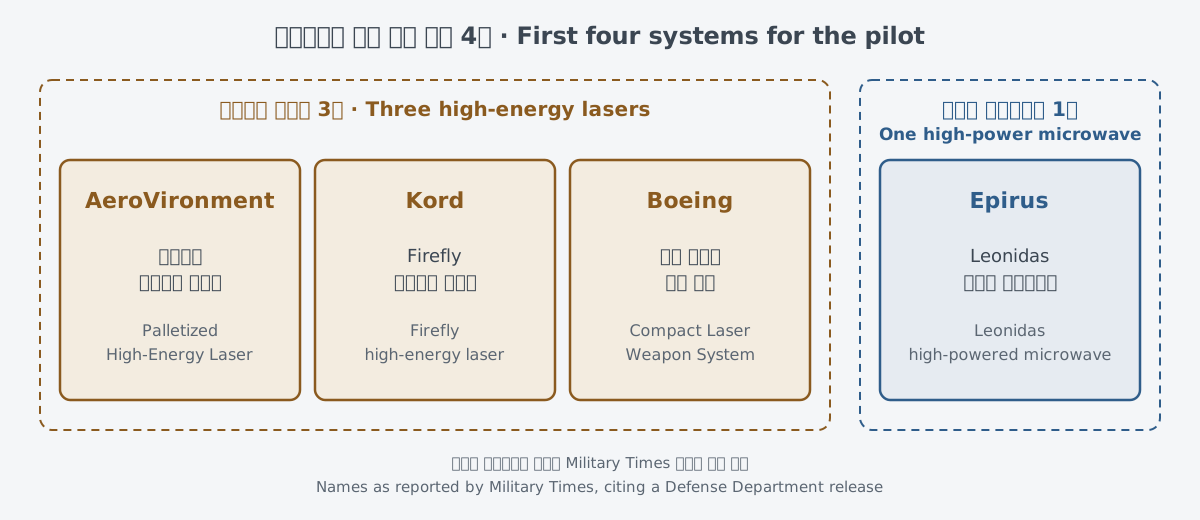
The four are AV's Palletized High-Energy Laser, Kord's Firefly high-energy laser, Boeing's Compact Laser Weapon System and Epirus' Leonidas high-power microwave (HPM). This list follows the Defense Department release as quoted by Military Times.
Descriptions of the AV system differ slightly between the two outlets. In Air & Space Forces Magazine, it features the 30 kW LOCUST X3. Military Times only described it as the LOCUST laser in a roll-on, roll-off configuration. Boeing's system comes in 2 kW and 5 kW versions, according to the same magazine.
According to Military Times, the Defense Department release also quoted the task force director, an Army brigadier general. In his words, high-energy lasers and high-powered microwave systems are "tools that can be effectively used in a layered drone defense." The pilot, he added, will test them in an operational environment to learn how best to integrate and sustain them to defend the homeland.
The technology, explained
A directed-energy weapon sends energy in one direction instead of firing a projectile. The name covers several kinds of weapons, and this pilot includes both lasers and microwaves. The current focus, the task force director told DefenseScoop in August, is "high-energy lasers and then high-power microwaves."
What does "30 kW" tell a reader? The kW is a unit of power, and power is energy delivered per second. That one number does not say how many seconds the beam stays on or how tightly it is focused. Power, energy and intensity: W, J and W/cm² covers this in detail.
Janes offers a clue about how the beam is made. Janes reported that the LOCUST X3 laser is "spectrum beam combined" and provides up to 30 kW of directed energy. The article does not explain the method further.
AV's press release names neither the way the beams are combined nor the kind of laser source inside. For the basics, see What is a laser?.
The Army statement's phrase "a magazine that regenerates with the system's power supply" reads as energy drawn from a power source instead of shells. That does not mean the cost of one shot was announced. Cost is one of the things the pilot says it will collect data on.
Firing lasers at bases inside the United States also means thinking about aircraft overhead. Military Times reported that on April 10 the FAA cited a safety review: with proper safety controls, the lasers tested "do not pose undue risk to passenger aircraft." That review looked at aircraft in the airspace. It is a different matter from laser safety classes, which are based on human eyes and skin and are covered in Laser safety: classes and how to read eyewear labels.
Limits and open questions
The biggest gap in the pilot is placement. Military Times noted that the October Defense Department release did not say which system goes to which base or how many of each will be fielded. The cost of the systems and of the pilot as a whole was not given either.
The link between the two stories is also open. The Pentagon release also does not say whether the AV pilot systems come from the E-HEL buy, according to the same outlet.
Reports differ on whether these four systems also take part in the December shoot-off. In Military Times, the shoot-off is an event for additional laser and microwave systems. In Air & Space Forces Magazine, the four appear as systems selected for the shoot-off.
The E-HEL side has gaps in its numbers too. AV's only figures are "dozens" for the quantity and "the next few years" for the timing. The power appears only as a 30-kilowatt class, with no measurement conditions stated.
The original wording of the Army statement and the Pentagon release is another open question. The December shoot-off at Dugway Proving Ground has only been announced as a plan. These announcements contain no results from it.