
Picture a ship with several drones flying toward it. It can stop them with interceptor missiles or guns, and these days lasers come up too. So which of the three is best?
Public official sources do not ask the question that way. They lay out a few yardsticks: the money each engagement costs, how many shots are on board, the weather, and the bulk, weight and power needs of the equipment. Then they look at how the three differ on each one. This article takes those yardsticks from two reports by the U.S. Congressional Research Service (CRS) and a South Korean government release, and puts the three means in one table.
The two reports are R44175, on U.S. Navy shipboard lasers, and R46925, on Defense Department directed-energy weapons as a whole. Below they are called the shipboard laser report and the Defense Department report.
There is more than one way to defend the sky
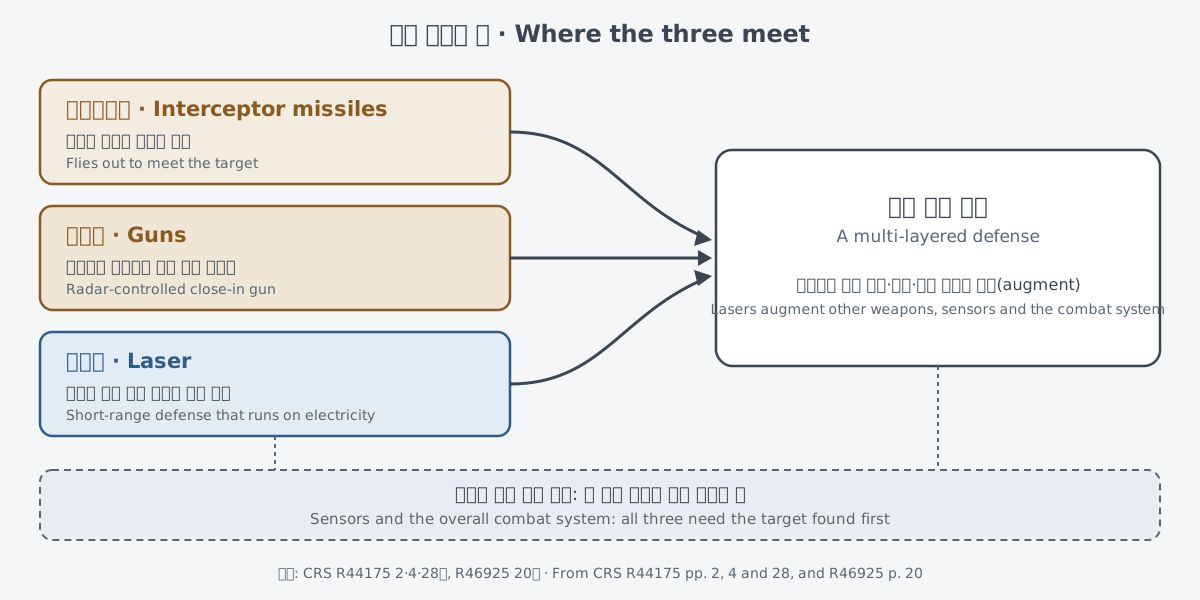
The U.S. Navy has several ways to counter missiles and drones headed toward its ships. It jams the attacker's sensors or guidance, uses decoys of various kinds to lure missiles away, and shoots them down with air-defense missiles and guns. The shipboard laser report explains that using these and other measures together reflects a long-standing Navy approach of building a multi-layered defense against enemy missiles.
The laser is a new means placed on top of those layers. The conclusion that lasers add to existing weapons rather than replace them is covered in Strengths and limits of laser weapons. This article goes one step further and asks which yardsticks set the three apart when they are combined.
Three means in a line each: interceptor missiles, guns and lasers
Interceptor missiles fly out to meet the target. That is why they must calculate a course to meet it. On ships, surface-to-air missiles (SAMs) are used to shoot down drones and anti-ship missiles.
Guns hit targets in the sky with rounds. This article uses the U.S. Navy's shipboard Close-In Weapon System (CIWS) as the example. It is essentially a radar-controlled Gatling gun.
Lasers gather light onto one spot on a target to damage it, and the kind used as a weapon is the high-energy laser (HEL). Navy ships would use high-energy lasers first to jam or confuse intelligence, surveillance and reconnaissance sensors. They would also counter small boats and drones, and possibly anti-ship missiles later. They would generally be short-range defensive weapons, countering targets at about one mile to perhaps eventually a few miles.
South Korea's laser anti-air weapon has a similarly narrow job. A July 2024 government policy briefing said it can strike small drones and multicopters at close range with precision. To start with what a laser weapon actually does, and does not do, see What is a laser weapon? Film versus reality.
All three share one step before they fire. The target has to be found and tracked first. Radar is the best-known sensor for that job, and how it works is in Radar: measuring distance and motion with radio waves. Missiles and guns each get their own story in "Surface-to-air missiles: ground systems that guard the sky" and "Anti-aircraft artillery in the missile age."
Yardstick one: the cost of each engagement
Surface ships now face two key limits in defending against drones and anti-ship missiles. One is limited depth of magazine. The other is an unfavorable cost exchange ratio. An unfavorable ratio means the missile fired to bring down one drone can cost more, perhaps much more, than the attacker spent to build or buy that drone.
Navy air-defense missiles cost several hundred thousand dollars to several million dollars each to procure, depending on the type. Such a ratio is not always a problem. Against an adversary with only a few drones or missiles, it can be acceptable because it saves sailors' lives and prevents very expensive damage to ships. Against an adversary with many drones and anti-ship missiles, it can become a very expensive and potentially unaffordable way to defend ships.
A laser's cost per shot is counted differently. Many current U.S. programs use solid-state lasers that run on electrical power, so the cost per shot equals the cost of the electricity for that shot. An October 2021 Navy paper estimates about $1 to less than $10 per shot, depending on beam power, and much of that is the fuel used to make the electricity. South Korea's policy briefing likewise says its laser anti-air weapon needs no separate ammunition and runs on electricity alone, so "one shot costs only 2000 won."
The two numbers cannot simply be divided. The missile figure is the price of buying one missile, while the laser figure is what one more shot costs once a laser is bought and installed. The Navy paper also attaches the condition "after procurement" when it says laser engagements are cheap.
Buying and developing the laser system costs extra. That up-front investment may be larger than for traditional weapons.
Guns have no number to compare, because neither report gives the price of one gun round. So that cell in the table below holds no figure. What a "cost per shot" figure actually counts is in How to read laser weapon news: "kW-class", "range" and "cost per shot". A cost diagram that includes the system price is in Strengths and limits of laser weapons, mentioned above.
Yardstick two: how many shots are on board, and reloading
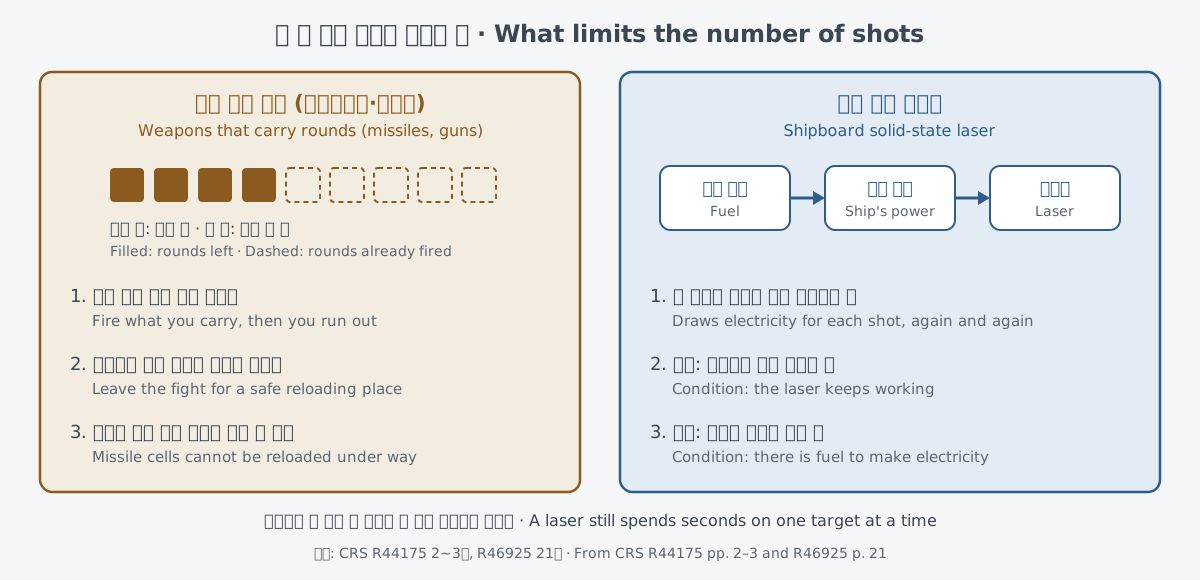
A shallow magazine means the number of shots is tied to the rounds carried. With its air-defense missiles and close-in guns, a surface ship can shoot down only a certain number of drones and anti-ship missiles. Then it runs out of missiles and gun ammunition. On this yardstick, interceptor missiles and guns stand on the same side.
What comes after running out is harder. The ship may have to leave the fight for a safe reloading location, which can be hundreds of miles away. Then it spends more time traveling back to the battle area. The vertical launch cells that hold missiles cannot be reloaded while the ship is under way, so the ship must return to a port or a calm anchorage.
A shipboard solid-state laser draws electricity from the ship's overall power supply. It can fire over and over as long as the laser keeps working and the ship has fuel to generate electricity. So the limit is not rounds but whether the laser keeps working and the ship has fuel. CRS sees in this a potential for lasers to improve depth of magazine and the cost exchange ratio dramatically.
A water bottle and a tap show the difference: a weapon that carries rounds is like a bottle, used up and then refilled. A laser is closer to a tap you can keep running while the tank holds out. In reality the laser's "water" is not free, since it needs fuel, and it stops if the laser breaks down. These conditions on a deep magazine are looked at more closely in Strengths and limits of laser weapons.
Yardstick three: weather and line of sight
Atmospheric conditions such as rain, fog and obscurants can limit the range and beam quality of directed-energy weapons. Traditional weapons are less affected by these factors. Both CRS reports say in the same sentence that lasers might not work well, or at all, in rain or fog, so they are not an all-weather solution. "Traditional weapons are less affected" lumps missiles and guns together, and neither report compares the two separately.
Line of sight also limits lasers. Laser light travels through the air on an essentially straight path, so it can engage only targets within line of sight, not those over the horizon or hidden behind objects. How wavelength relates to air is the background in Why wavelength matters: visible and invisible light. Each way the air weakens a beam is taken up in "Light through air: absorption, scattering, turbulence, thermal blooming."
Some limits remain even in clear weather. A laser engages only one target at a time, needs several seconds to disable it, and several more seconds to turn to the next one. So it can disable only so many targets within a given time. Why light that arrives almost instantly still takes seconds is the topic of Why a laser weapon does not finish "the instant it fires".
Yardstick four: size, weight and power
Size, weight and power (SWaP) is a shorthand for a device's bulk, its weight and the power it uses. Meeting SWaP and cooling requirements for today's platforms is still an open question for the technology. Some directed-energy systems are small enough to fit on military vehicles. Many, though, need larger or fixed platforms, which can limit where they go and how useful they are.
On a ship, many devices share the power, and the shipboard laser report quotes a March 2019 press report on one destroyer design. That design gave more power to a new air-defense radar, leaving little for other uses such as a laser. The Navy's director of surface warfare said that to fit a laser on that ship, the Navy would have to remove something or use "very aggressive power management." In that design, the radar that finds targets and the laser had to share the same generating capacity.
The one-target-at-a-time limit also comes back to this yardstick. It can be eased by installing more than one laser, but only as far as space and energy allow. It works much like the way the Navy installs multiple close-in guns on certain ships. To see where power and cooling needs arise within a laser system, start with A laser weapon is more than a laser: the system at a glance.
Traditional weapons are less affected not only by atmospheric conditions but also by SWaP and cooling requirements. This, too, lumps traditional weapons together, and neither report gives the size and power of a single missile launcher or gun.
Here are the four yardsticks in one table. Each cell names the report and page where its content appears. R44175 is the shipboard laser report, and R46925 is the Defense Department report.
| Yardstick | Interceptor missiles | Guns (shipboard close-in gun) | Lasers |
|---|---|---|---|
| Cost of each engagement | Procurement cost of one Navy air-defense missile, several hundred thousand to several million dollars depending on type (R44175 p. 3) | No figure in either report | Marginal cost per shot about $1 to less than $10, much of it fuel. System price is separate (R44175 p. 3; R46925 pp. 1, 17) |
| Shots on board and reloading | As many as carried. When they run out, the ship goes to a reloading place; missile cells cannot be reloaded under way (R44175 pp. 2–3) | As much ammunition as carried (R44175 p. 2) | Again and again while the laser works and there is fuel (R44175 p. 3) |
| Weather and line of sight | Traditional weapons are less affected by atmospheric conditions; said of traditional weapons as a group (R46925 p. 17) | Same sentence; said of traditional weapons as a group, with nothing on guns alone (R46925 p. 17) | Might not work well, or at all, in rain or fog. Only targets within line of sight (R46925 pp. 17, 20–21) |
| Size, weight and power | Traditional weapons are less affected by SWaP and cooling; said of traditional weapons as a group (R46925 p. 17) | Same sentence; said of traditional weapons as a group, with nothing on guns alone (R46925 p. 17) | Many systems need larger or fixed platforms (R46925 p. 17). A 2019 press report: one destroyer design gave more power to a new radar, leaving little for a laser (R44175 p. 17) |
The cells are not scores. Each one carries the conditions a source gave for that means. The laser cells carry different conditions in the first two rows and the last two. Electricity shapes shots and cost, light passing through air shapes weather and line of sight, and power and cooling shape size and weight.
"Using them together," according to official sources
The Navy's view sits in one sentence of an October 2021 Navy paper quoted in the shipboard laser report. The Navy expects laser weapon systems to augment other weapons, sensors and the overall combat system. Because they do so in complex ways, the paper adds, it is hard to assign a specific combat value to each system's share.
The same report gives an example. Take a laser with enough power for small boats and drones but not for anti-ship cruise missiles. It can still let the ship use fewer air-defense missiles on drones and keep more for those cruise missiles. It explains that saving a limited stock of missiles helps the whole defense.
The Army's account is similar: it is developing directed-energy weapons against drones and against rockets, artillery and mortars. The aim is more air and missile defense capability and lower lifecycle costs through lighter logistics demands. Directed-energy weapons include high-power microwave weapons as well as lasers. How the two branches differ is set side by side in Lasers and high-power microwaves: two kinds of directed energy.
The South Korean government release describes what its laser anti-air weapon counters and what it costs. It does not say how the weapon shares roles with existing air-defense weapons.
The question that remains is how much of each to use. The Defense Department report leaves Congress with the question of the appropriate balance between directed-energy weapons and traditional munitions within the military's portfolio of capabilities. Setting the three means side by side, then, is less about picking one and more about seeing which place each fills in a multi-layered defense.
What to read next
- Laser weapon programs that have been made public: tries these yardsticks on cases that governments have officially announced.
- Lasers and high-power microwaves: two kinds of directed energy: how the two branches of directed energy differ in principle and use.
- Eye safety and international rules: the protocol on blinding laser weapons: what the international rule on laser weapons sets out.
- "Layered missile defense: why defense comes in layers": how a multi-layered defense is put together.
- "Counter-drone systems: why one device is not enough": the many means used to stop drones.