Shine sunlight through a prism and the white light fans out into a rainbow. What makes red land in one place and violet in another? The answer is wavelength. The color of light is set by its wavelength.
Wavelength belongs to the wave picture of light, and it always comes paired with frequency. But light also has particle-like properties that the wave picture alone does not explain. That particle is the photon, and the energy of one photon is tied to wavelength too.
Wavelength, frequency and photon come up again and again in the laser articles. The sections below start from the basics of waves and take these terms one at a time. Along the way they show where ultraviolet, visible and infrared light divide, and what happens when light meets matter.
Light is a wave: wavelength and frequency
In high school physics, a wave is a pattern that repeats as it travels. The length over which the pattern repeats is the wavelength. The time for one full oscillation is the period, and the number of waves passing a point per unit time is the frequency. Frequency is measured in hertz (Hz): one cycle per second is 1 Hz.
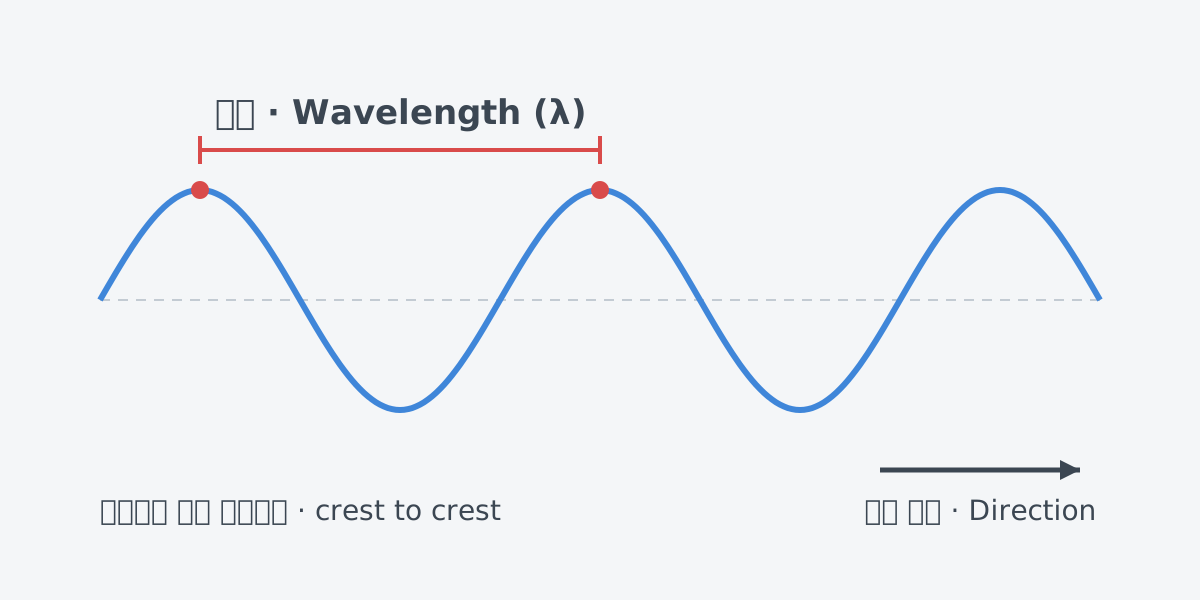
The speed of a wave equals its wavelength times its frequency. This holds for all types of waves, and light is no exception. If c is the speed of light in vacuum, then c equals the wavelength λ times the frequency f. Because the speed is fixed, a shorter wavelength means a higher frequency.
The speed of light in vacuum is fixed by the International System of Units (SI). The International Bureau of Weights and Measures (BIPM) sets c at 299 792 458 m/s in its SI Brochure. The U.S. National Institute of Standards and Technology (NIST) gives the same number.
The value was fixed in 1983, when the meter was redefined. Since then the speed of light is not a value that changes with each measurement. It is fixed by definition, and the meter is built on it.
Put a wavelength of 500 nm into this relation and the frequency comes out at about 6.0 × 10¹⁴ Hz. Wavelength and frequency are a pair: knowing one fixes the other. The laser articles on this site mostly quote the wavelength.
Where light sits in the electromagnetic spectrum
Visible light is one part of the electromagnetic spectrum. Maxwell's equations describe light as an electromagnetic wave, and electromagnetic waves are classified into categories such as radio, infrared and ultraviolet. They can also travel through the vacuum of space.
Wavelengths in this article are written in nm and μm. According to the BIPM SI Brochure, nano (n) is 10⁻⁹ and micro (μ) is 10⁻⁶. So 1 μm is 1000 nm.
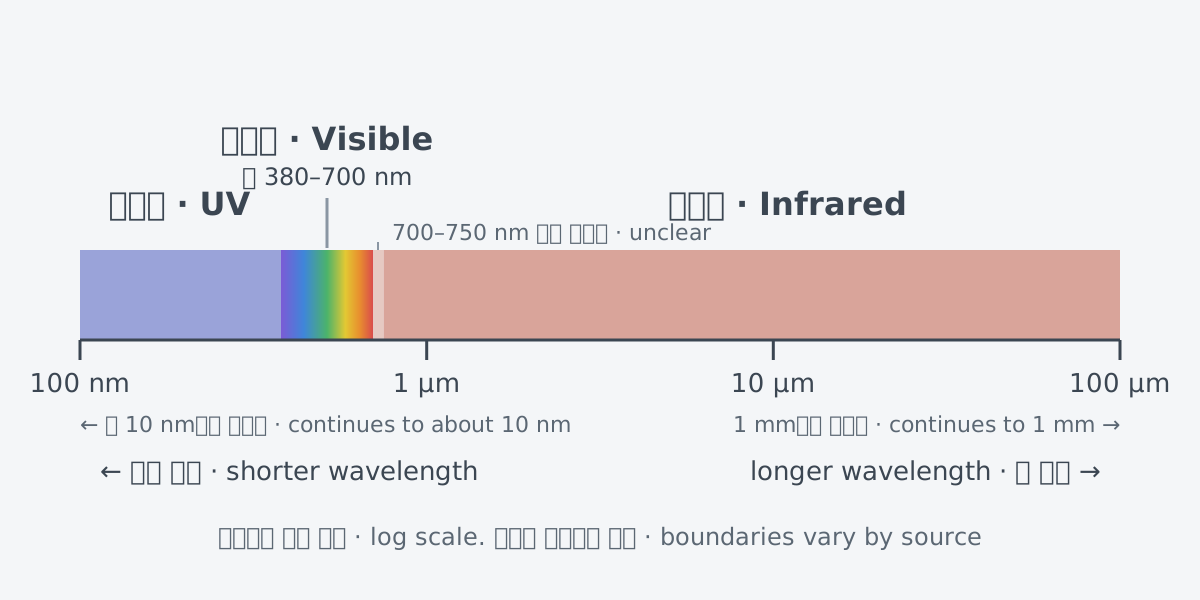
The human eye can detect wavelengths of about 380–700 nm, by NASA's figures. Violet has the shortest wavelength and red the longest. The range differs a little by source: the OpenStax textbook gives about 400–750 nm and says the divisions are not perfectly distinct.
Ultraviolet lies on the short-wavelength side of visible light. Ultraviolet runs from 400 nm down to about 10 nm in that textbook. So the region around 380–400 nm is classed as violet visible light by some sources and as ultraviolet by others.
Infrared lies on the long side. Where it starts depends on where visible light is taken to end. NASA puts that end at about 700 nm and OpenStax at about 750 nm. The region around 700–750 nm can therefore be read as the red end of visible light or as the start of infrared.
Infrared is divided again into several named bands. The table below is the division given by the reference work RP Photonics, which puts the upper limit of visible light at 700–800 nm.
| Band (abbreviation) | Wavelength |
|---|---|
| Near infrared (NIR) | about 750–1400 nm |
| Short-wavelength infrared (SWIR) | 1.4–3 μm |
| Mid-wavelength infrared (MWIR) | 3–8 μm |
| Long-wavelength infrared (LWIR) | 8–15 μm |
| Far infrared (FIR) | 15 μm–1 mm |
The band names and limits differ from one standard to another. As RP Photonics explains it, the international standard ISO 20473:2007 starts far infrared at 50 μm, and its "mid-infrared" covers the whole range from 3 to 50 μm. The name is similar, but it is not the same thing as the mid-wavelength infrared (MWIR) in the table.
The U.S. OSHA Technical Manual divides infrared into IR-A (0.780–1.400 μm), IR-B (1.400–3.00 μm) and IR-C (3.00–1000 μm). Both the names and the limits differ from the table. At the long-wavelength end, the boundary between infrared and microwaves is not well defined either. So when you meet "near infrared" or "mid infrared" in a news item or paper, check which definition it uses.
Light also comes in packets: photons and energy
The wave picture alone cannot account for some effects of light. Experiments in the early twentieth century showed that light also has particle-like properties, which is called wave-particle duality. The unit in this particle picture is the photon: a particle of light that moves at the speed of light and carries one quantum of energy.
The energy of one photon depends only on its frequency. It equals the Planck constant h times the frequency f. Using the relation above to replace f with wavelength gives the following.
E = h × f = h × c ÷ λ
- E: energy of one photon
- h: the Planck constant; the SI Brochure sets its value at 6.626 070 15 × 10⁻³⁴ J s
- c: speed of light in vacuum
- λ: wavelength
In the equation, the wavelength λ sits in the divisor. So the shorter the wavelength, the more energy one photon carries, and doubling the wavelength cuts that energy in half. Along the spectrum, the energy of one photon rises from infrared to visible light and on to ultraviolet.
For wavelengths in nm, remembering the product hc as 1240 eV·nm makes the arithmetic easy. The eV is the electronvolt, a unit used for photon energy. For a 500 nm photon, 1240 divided by 500 gives about 2.5 eV.
Think of light as a handful of sand and of a photon as one grain. The total weight depends on how many grains there are and how heavy each grain is.
But a real photon is not a grain that takes up space, and the analogy cannot show how light spreads like a wave. For this article, take away only this: light exchanges energy in units of single photons.
When light meets matter: reflection, refraction, absorption
When light meets matter, it can be transmitted, reflected, absorbed, refracted, polarized, diffracted or scattered. Which of these happens depends on the object and on the wavelength of the light. Three of them follow here: reflection, refraction and absorption.
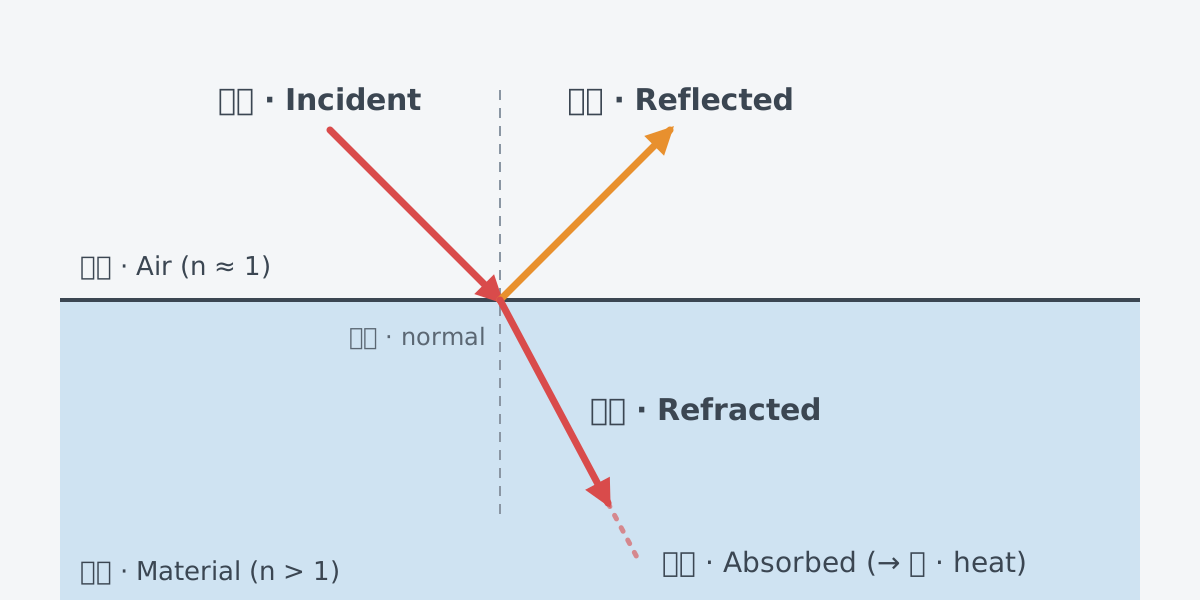
Reflection. The angle of incidence equals the angle of reflection. Both are measured from the line perpendicular to the surface, called the normal. A surface that is smooth compared with the wavelength, such as a mirror, sends light back in one direction. A rough surface, such as paper, scatters it in many directions.
Refraction. When light enters another material, its speed changes and its direction bends. If v is the speed of light in a material, the index of refraction n is c ÷ v, and it is always at least 1. Air has an index of about 1.00 and water about 1.33. Light going from a lower index to a higher index bends toward the normal.
The index also depends on wavelength, so different wavelengths bend by different angles. This is why the prism at the top of this article split white light into colors.
Absorption. In NASA's account, absorption occurs when photons of the incoming light hit atoms and molecules and make them vibrate. The absorbed energy is later released as heat, in the form of longer-wavelength infrared.
Wavelength and frequency give the shape of the wave, and the photon is the unit of energy. The refractive index tells how fast light travels in a material. Keep these four in mind and the later articles will read much more easily.
Read next
- "Why wavelength matters: visible and invisible light": continues this article's story of wavelength and the spectrum.
- "Interference and diffraction: how light adds up and spreads": covers effects that exist because light is a wave.
- "How a fiber guides light: core and cladding": builds on the reflection and refraction here.
- "The three parts of a laser: gain medium, pump and resonator": looks at what a laser is made of.