
In July 2024, a South Korean government news service ran a headline saying that the country's laser anti-aircraft weapon would be deployed within the year. In January of the same year, the UK Ministry of Defence announced a trial of its DragonFire laser weapon. A U.S. Congressional Research Service report lists lasers that have gone to sea on Navy ships since 2014. The three documents differ in country, in stage and in wording.
So how far have they actually come? The first answer comes from what governments and militaries have announced themselves, not from news stories. This article gathers official announcements from South Korea, the United States, the United Kingdom, Germany, France and Japan, and sorts them by who said what and when.
The weapons covered here are high-energy laser (HEL) weapons. In discussions of U.S. Navy shipboard lasers, a laser with a beam power of at least 10 kW is generally counted as a high-energy laser.
How cases were chosen: official announcements only
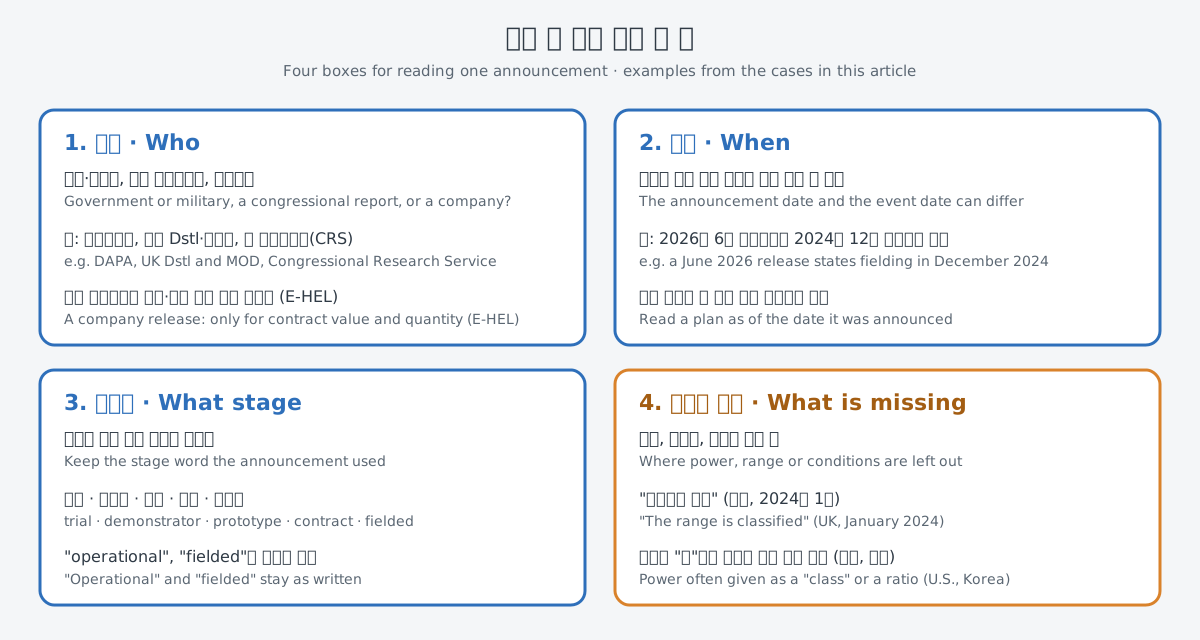
Each case gets four things only. They are the body that announced it, the date, the words used, and the stage, such as a trial, a contract or fielding. Stage words are copied exactly as the announcement used them. How "tested," "fielded" and "deployed" differ is laid out in How to read laser weapon news: "kW-class", "range" and "cost per shot".
The evidence is government and military press releases and websites, plus reports by the Congressional Research Service (CRS). CRS is a research agency of the U.S. Congress, not part of the military, but it quotes Navy and Army budget documents and announcements word for word. Press reports that CRS passes on with the word "reportedly" are left out. A company press release is used only for contract details such as value and quantity.
Power and range appear only when the announcement gives a number, and only in its own words. The cases are not compared on performance or put in any order of merit. Each announcement measures and discloses things differently, so numbers placed side by side easily take on the wrong meaning. What laser weapons do well and where they struggle is collected first in Strengths and limits of laser weapons.
South Korea: the laser anti-aircraft weapon
The Korean case can be followed through two announcements from the Defense Acquisition Program Administration (DAPA). The first is a DAPA item on the government news service Korea.kr dated July 11, 2024. On that day DAPA said it had signed a production contract for the Block-I laser anti-aircraft weapon on June 25.
The weapon fires a laser made in optical fiber straight at a target to disable it, making precision strikes on small drones and multicopters at close range. Development began in August 2019 at a cost of 87.1 billion won, with the Agency for Defense Development leading system development. It was judged fit for combat use in April 2023, which completed development. The plan at the time was to deliver it to the military and put it into service from 2024.
The second is a DAPA press release dated June 1, 2026. It names the weapon Cheongwang ("heavenly light") and states that it was fielded in December 2024. DAPA adds the phrase "the world's first among laser anti-aircraft weapons." That is the announcing agency's own description.
The main subject of the 2026 release is a part. The laser source, the key part that makes the light, was made in Korea at the end of May 2026. Korean-made sources are to be used from future production units. During system development, DAPA used an imported laser source because the technology was not yet mature and drone threats were growing fast.
That the system fires light that is invisible and silent was already covered in What is a laser weapon? Film versus reality.
What about numbers? Neither announcement gives the Block-I system's power in kW or its range in km. The 2024 item says "close range." The 2026 release gives only a ratio: the Korean source improves power and other key performance by "about 50% or more" over the imported one.
The "several hundred kilowatts" in the 2024 item is a plan for a technology project to raise laser source power that far. The 2026 release says Block-II development will continue to improve power and precision and make the system smaller and lighter.
The United States: ships and ground vehicles
The United States has several programs, not one. CRS report R44175 (updated January 12, 2026) covers the Navy side. CRS report R46925 (updated July 11, 2024), which covers directed energy weapon (DEW) programs across the Department of Defense, covers the Army side.
The dates and stage words below are as these two reports give them. The longer path that led to lasers on ships is traced in A history of laser weapons: from chemical to electric lasers.
Ships. In August 2014 the Navy installed its first shipboard prototype laser, LaWS, on USS Ponce, and that December it declared LaWS an "operational" system. When Ponce was decommissioned in October 2017, LaWS was removed from the ship. On May 22, 2020, the Navy announced that USS Portland had used the prototype laser LWSD to disable a drone in an at-sea test on May 16.
Two later efforts appear in Navy budget documents quoted in the CRS report. The dazzler ODIN was developed and fielded with research funds, without being a program of record, and eight ODIN units are listed as operational in the fleet. HELIOS included the development of a laser weapon system in the 60 kW class, and the system was installed on the destroyer USS Preble. According to the fiscal year 2026 budget documents, HELIOS testing and fleet sustainment ran from the first quarter of fiscal 2024 to the fourth quarter of fiscal 2025.
Ground vehicles. An official Army article in September 2014 already described HEL MD, a high-energy laser demonstrator mounted on a truck. It mentioned a track record of engaging and destroying mortar rounds, along with an official's remark that the technology still needed to "further mature." The July 2024 edition of R46925 names three major programs managed by the Army Rapid Capabilities and Critical Technologies Office (RCCTO). Two of them are lasers.
- DE M-SHORAD. This program seeks to integrate a 50 kW laser on a Stryker combat vehicle to give short-range air defense support to brigades.
- IFPC-HEL. Army budget documents group a vehicle, a "300 kW class [>250 kW]" laser subsystem, a power and thermal subsystem and a beam control subsystem into one system. The plan as of July 2024 was to receive four prototypes in the third quarter of fiscal year 2025 and become a program of record at that point.
Power and cooling come along whenever a laser goes on a vehicle or ship, and A laser weapon is more than a laser: the system at a glance explains why.
The latest U.S. case here is E-HEL. On September 2, 2026, the Army announced in an official article an other-transaction agreement with the company AeroVironment for E-HEL production. The $464.8 million value and the delivery of dozens of systems over the next few years come from the company's release. The background is in The US Army E-HEL laser contract and the directed-energy pilot at US bases.
The United Kingdom: range and ship trials
The UK has posted an announcement on the government site GOV.UK at each step of one laser, DragonFire. The first came on January 19, 2024, from the Defence Science and Technology Laboratory (Dstl) and the Ministry of Defence. In a trial at the Hebrides Range, DragonFire achieved the "UK's first" high-power firing of a laser weapon against aerial targets.
That announcement contains one important sentence about numbers. "The range of DragonFire is classified," and as a line-of-sight weapon it can engage any visible target. Dstl leads DragonFire on behalf of the Ministry of Defence, and both the Army and the Royal Navy are considering the technology for their future air defense.
On December 11, 2024, came the announcement that the British Army had fired a high-energy laser weapon from an armored vehicle for the first time and destroyed flying drones. The trial took place at Radnor Range in mid-Wales. The release calls the effort a "capability demonstrator programme" meant to discover and test how the Army might use directed energy weapons in the future.
A Defence Equipment and Support (DE&S) official called it "still an emerging technology." The Ministry of Defence said it would assess the steps needed to develop laser weapons for frontline use.
The Ministry of Defence announcement of November 20, 2025, is about a contract. The company MBDA received a £316 million contract to deliver new DragonFire systems to the Royal Navy from 2027. The same release gave a plan to fit DragonFire to a Royal Navy Type 45 destroyer by 2027. It also described the trials it reported against high-speed drones at the Hebrides range.
Other countries: what governments themselves have said
Germany. An article on the German armed forces (Bundeswehr) website dated April 10, 2026, presented the country's laser weapon demonstrators. It explains a demonstrator as a laser system that shows and tests part or all of a laser weapon's functions in practice. The demonstrator from a naval program, tested on the frigate Sachsen, is to be ready for harbor protection or self-protection at sea in 2029. The newest demonstrator at the test range, "Laserwaffendemonstrator 24," is to be market-ready from 2028.
The same article lists limits too. Atmospheric effects such as fog, rain or dust can reduce the effect of the laser beam, and lasers need a strong power supply and capable cooling. It also describes laser weapons as a future complement to traditional weapon systems.
France. On June 8, 2022, France's defense procurement agency (DGA) notified the anti-drone laser contract L2AD to the company CILAS. The contract is for an operational prototype laser that can identify, track and neutralize mini and micro drones. It aimed to deploy that prototype at the 2024 Olympic and Paralympic Games. The prototype grows out of the HELMA-P demonstrator, evaluated in 2020–2021.
Then from June 12 to 14, 2023, the DGA, the French Navy and CILAS tested HELMA-P aboard the air-defense frigate Forbin in the Mediterranean. The French Navy wrote that these trials open the way to further prototype development, with a view to fitting it on Navy ships in time.
Japan. In September 2020, Japan's Ministry of Defense, with ATLA in charge, evaluated a research project in advance: "Research on a vehicle-mounted laser device (for countering short-range UAVs)." The project builds a prototype laser device on a vehicle to establish technology for countering attacks by several small drones working together. Prototype work runs in fiscal years 2021–2023, and the planned total cost is about 3.3 billion yen for prototype research. It is a research project to establish technology, not a purchase of weapons.
Table of cases: who announced it, when, and what was said
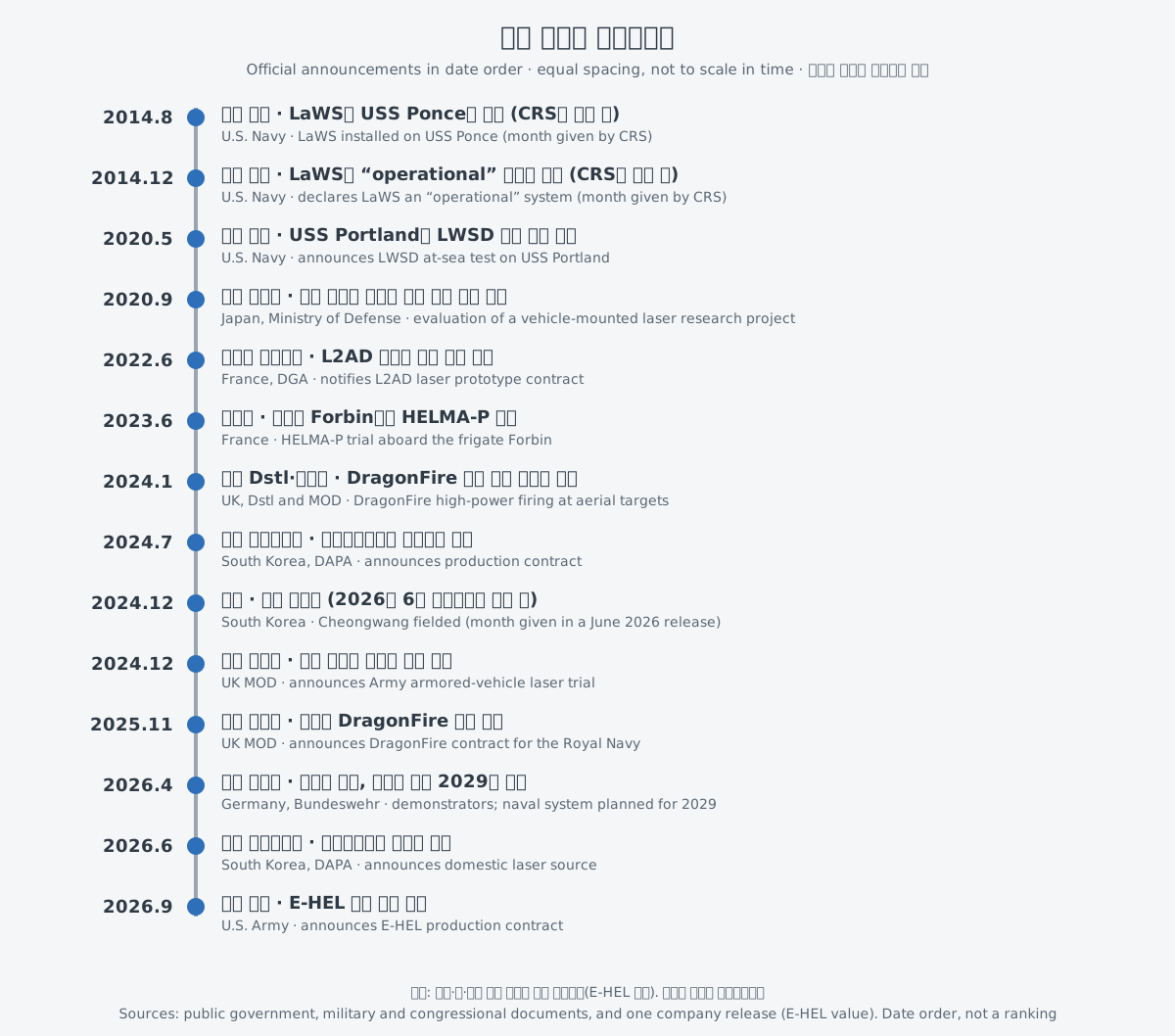
The table is in date order. Announcement dates come first, and U.S. cases without an announcement date use another date. LaWS uses the dates of events given by CRS, while ODIN, HELIOS and the two Army programs use the date of the CRS report edition that carries them. The two French rows use the pages' publication dates, and the Japanese row uses the month of the project evaluation.
| Date | Country | Program | Announced by | What was said (short) | Stage word |
|---|---|---|---|---|---|
| August and December 2014 | United States | LaWS | Navy events as given in CRS R44175 | Installed on USS Ponce, declared "operational" | prototype, operational |
| September 2014 | United States | HEL MD | Official Army article | Demonstrator on a truck, "still need to further mature the technology" | demonstrator |
| May 22, 2020 | United States | LWSD | Navy announcement (quoted in CRS R44175) | Disabled a drone in an at-sea test | test |
| September 2020 | Japan | Research on a vehicle-mounted laser device (for countering short-range UAVs) | Ministry of Defense, ATLA in charge (project evaluation) | Prototype research in fiscal years 2021–2023, planned total cost about 3.3 billion yen | research |
| June 16, 2022 | France | L2AD (HELMA-P) | Defense procurement agency (DGA) | Operational prototype contract notified on June 8, aimed at the 2024 Olympics | prototype, contract |
| June 22, 2023 | France | HELMA-P | French Navy | Trial aboard the frigate Forbin on June 12–14 | trial |
| January 19, 2024 | United Kingdom | DragonFire | Dstl and MOD | "UK's first" high-power firing at aerial targets, range classified | trial |
| July 11, 2024 | South Korea | Laser anti-aircraft weapon | DAPA (Korea.kr) | Production contract on June 25, "deployed within the year" | production contract |
| July 11, 2024 | United States | DE M-SHORAD, IFPC-HEL | CRS R46925 (quoting Army budget documents) | 50 kW, "300 kW class," program of record planned after four prototypes | prototype |
| December 11, 2024 | United Kingdom | Army armored-vehicle laser | MOD and Dstl | First firing from an armored vehicle, drones destroyed, "still an emerging technology" | capability demonstrator |
| November 20, 2025 | United Kingdom | DragonFire | MOD | £316 million contract, Royal Navy deliveries from 2027 | contract |
| January 12, 2026 | United States | ODIN, HELIOS | CRS R44175 (quoting Navy budget documents) | Eight ODIN units operational, HELIOS 60 kW class, testing ended | fielded, testing |
| April 10, 2026 | Germany | Naval program demonstrator and others | Bundeswehr | Tested on the frigate Sachsen, planned for 2029 | demonstrator |
| June 1, 2026 | South Korea | Cheongwang | DAPA | Fielded in December 2024, laser source made in Korea | fielded |
| September 2, 2026 | United States | E-HEL | Official Army article (value and quantity from the company release) | Other-transaction agreement for production, $464.8 million, dozens of systems to be delivered | production contract |
Here are the same announcements on a single timeline. What the timeline shows is what each country made public and when. It cannot tell you which country is ahead.
Questions an announcement leaves open
Where are the power and range? Only two of the fifteen rows give a power number, and both are U.S. rows. DE M-SHORAD is given as "50 kW," while HELIOS and IFPC-HEL are given as classes: "60 kW class" and "300 kW class [>250 kW]." The Korean releases give a ratio and a future goal instead of the Block-I system's power, and the UK release calls the range "classified." If a news story has a number that the announcement does not, ask where that number came from.
Does the same word mean the same stage? Trial, demonstrator, prototype, contract, fielded and operational sit in different places from one announcement to the next. The Navy's ODIN was "fielded" without being a program of record, and LaWS was both a prototype and "operational." Treating the same word in two countries' announcements as the same stage is an easy mistake.
Are plans kept apart from results? The IFPC-HEL move to a program of record in 2025, DragonFire on a ship by 2027 and Germany's 2029 are all plans as of their announcements. Only a later announcement can say whether a plan was met. So a plan should always be read together with the date it was stated.
First within what? The UK wrote "UK's first," and DAPA wrote "the world's first among laser anti-aircraft weapons." Both come with a stated scope, and both are the announcing body's own words. Neither is a ranking that anyone checked against other countries' announcements.
What cautions do announcements add themselves? The DE&S official's "still an emerging technology," the 2014 Army remark about the need to "further mature the technology," and the Bundeswehr's limits of weather, power and cooling are examples. If a news story leaves such lines out, the original is worth reading.
A five-point checklist for testing a story against its source is in How to read laser weapon news: "kW-class", "range" and "cost per shot".
What to read next
- Lasers, interceptor missiles and guns: how they share the work: how the cases gathered here share the work with other means of defense.
- Lasers and high-power microwaves: two kinds of directed energy: high-power microwaves, which appear in the same program groups, such as IFPC-HPM, one of the three Army programs.
- A history of laser weapons: from chemical to electric lasers: the road that led to these cases.
- Eye safety and international rules: the protocol on blinding laser weapons: the international rules around laser weapons.