News stories about laser weapons often come with the same picture. A red streak cuts across the sky, and at its end a drone falls in a shower of sparks. It is only an illustration, but after seeing it enough times, a few ideas start to feel like facts.
The ten statements below are ideas of that kind. Decide whether each one is true (O) or false (X) before you read the answer. After each answer there is a link to an article that covers the topic in depth.
Questions about light and the eye
Question 1. When a laser weapon fires, the beam shows up as a line in the sky.
X, false. In most conditions you cannot see a laser beam from the side as it crosses open air. The eye only sees light that enters it, and the beam keeps going forward. When it meets dust, mist or smoke, some light is scattered sideways, and only then does the path appear.
The light itself may also sit at a wavelength the eye cannot see. In a 2024 report on a British Army trial, the UK Ministry of Defence said the laser sends an intense beam of infrared light toward its target. South Korea's Defense Acquisition Program Administration likewise described its laser air-defense weapon as invisible to the eye and silent. Read more: Why You Can't See a Laser Beam from the Side
Question 2. The light travels at light speed, so the target breaks the moment it is hit.
X, false. The first half is right. Laser light reaches the target almost at once.
Reaching a target and damaging it are two different things, though.
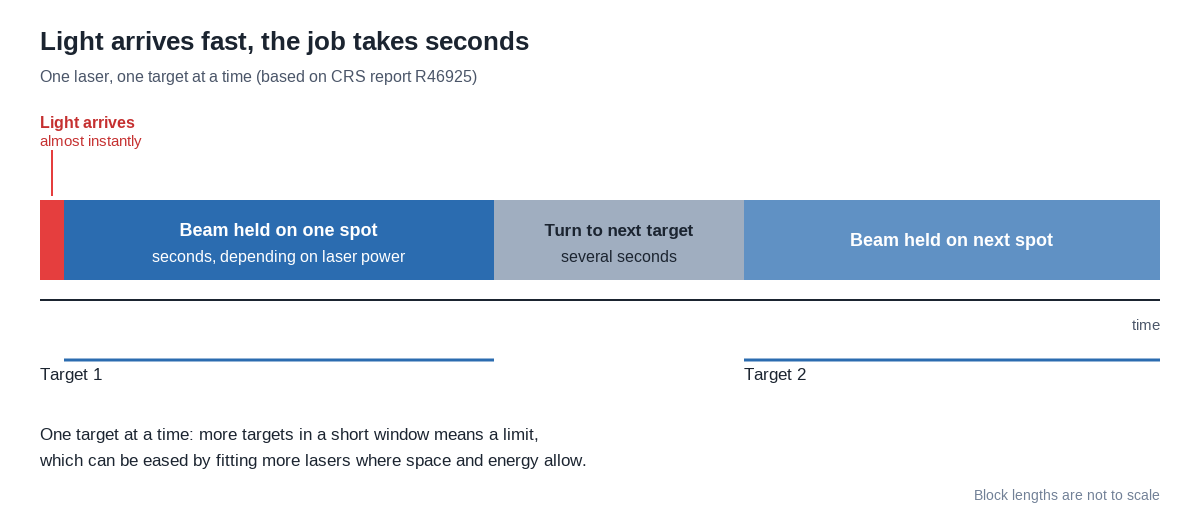
The Congressional Research Service (CRS) report on directed-energy weapons (DEW), R46925, says a laser kept focused on one spot can cause disabling damage "within seconds, depending on the laser power." The light needs time to heat the target, and during that time the beam has to follow one point on a moving object. The time the beam stays on that point is called dwell time. Read more: Why a laser weapon does not finish "the instant it fires"
Questions about magazines and cost
Question 3. A laser weapon uses no ammunition, so its magazine never runs out.
Closer to X, because conditions apply. The CRS report says directed-energy weapons could offer deeper magazines than traditional munitions, a measure called depth of magazine, "assuming access to a sufficient power supply."
The CRS report on Navy shipboard lasers (R44175) is more specific. A shipboard solid-state laser draws on the ship's electrical supply. It can be fired again and again as long as the laser keeps working and there is fuel on board to make electricity. "Endless" comes with two conditions: as long as the equipment holds up, and as long as there is power.
Electricity is not the only issue. Cooling needs, and the size, weight and power (SWaP) of the whole system that a vehicle or ship must carry, also have to fit. CRS lists meeting these needs as a question of technical maturity. Read more: Strengths and limits of laser weapons
Question 4. A laser weapon is cheap to fire once.
O, true. Keep the scope of "fire once" in mind, though.
Many current U.S. programs are solid-state lasers that run on electricity, so the cost of one shot equals the cost of the power for that shot. Citing a Navy information paper from October 2021, CRS puts the recurring cost of a shipboard solid-state laser shot at about $1 to less than $10, depending on beam power. Much of that is the fuel used to make the electricity.
The cost of building the equipment is not in that number. CRS also notes that directed-energy weapons may need a larger up-front investment than traditional weapons before a working system can be fielded. The shot is cheap; the whole system is not necessarily cheap. Read more: The cost of drone defense
Questions about air and distance
Question 5. Light ignores the weather, so a laser fires the same in rain or fog.
X, false. CRS warns that rain or fog can weaken a laser badly or stop it altogether, so a laser cannot serve as an all-weather tool. Water vapor, sand, dust, salt particles and smoke in the air absorb and scatter light. Atmospheric turbulence blurs the beam's focus.
The laser also creates a problem of its own. When it fires in one direction for a while, it heats the air along its path, and the heated air then spreads the beam. This effect is thermal blooming, and it generally grows into a bigger worry as beam power rises. Read more: Light through air: absorption, scattering, turbulence, thermal blooming
Question 6. A laser beam stays the same width no matter how far it goes.
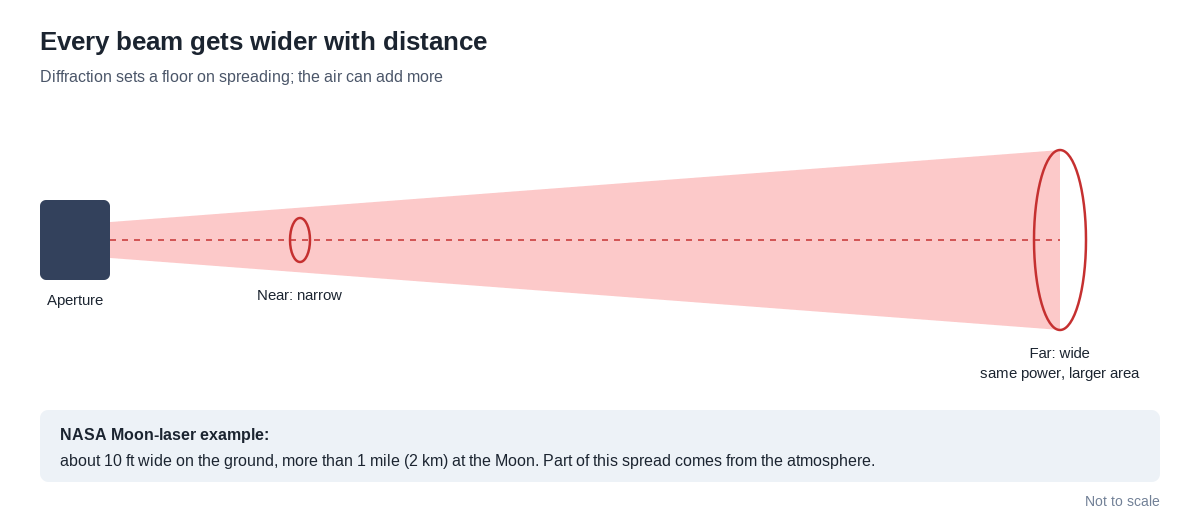
X, false. A beam of fixed width widens as it travels, because of diffraction. Lasers follow this rule too, and the amount of widening is measured as beam divergence. Whether a laser shines on the ground or carries data in space, its beam spreads out, and the light grows thinner as it does.
How much do they spread? Laser shots to the Moon give one example.
According to NASA, a beam that leaves the ground about 10 feet (a few meters) across can grow to more than 1 mile (2 km) wide at the lunar surface. Part of that spread comes from scattering in Earth's atmosphere. One point carries over to weapons: the farther the target, the larger the area that the same power is shared over. Read more: Why a beam spreads: divergence, focus and aperture
Question 7. A laser reaches far, so it can hit targets beyond the horizon.
X, false. Laser light travels through the air on an almost straight path. That limits high-energy laser (HEL) weapons to targets within line of sight. They cannot engage targets over the horizon or targets hidden behind something in between.
The UK's January 2024 announcement about DragonFire said the same thing: its range is kept secret, but the weapon needs a clear line of sight to its target. A laser has no way to arc over an obstacle the way a shell can. Read more: What is a laser weapon? Film versus reality
When many come at once
Question 8. If several drones arrive together, one laser can handle all of them at the same time.
X, false. The CRS report says an HEL weapon engages a single target at a time. It needs several seconds on one target and several more to turn to the next. So there is a limit to how many targets it can disable in a given period.
The time bar above answers this question too. CRS adds that the limit can be eased by fitting more than one laser, as far as space and energy allow. The answer is more lasers, not one laser handling many targets at once. Read more: Strengths and limits of laser weapons
Questions about names and rules
Question 9. Laser weapons and microwave weapons are the same thing under different names.
X, false. Both belong to the broad family of directed-energy weapons, but they work differently. According to CRS, laser weapons emit a narrow beam. High-power microwave (HPM) weapons can act over a wider area, for example by disabling the electronics inside their electromagnetic cone.
One is closer to a needle held on a single point; the other is closer to a wave that spreads out. Real systems differ widely in power, range and effect, so this comparison does not fit every device. Strengths and limits also differ from one system to the next. Read more: Lasers and high-power microwaves: two kinds of directed energy
Question 10. Laser weapons built to blind people permanently are banned by an international treaty.
O, true. On October 13, 1995, a review conference of the Convention on Certain Conventional Weapons (CCW) adopted the text of Protocol IV on blinding laser weapons by consensus, without a vote. Article 1 forbids using lasers purpose-built to leave people permanently blind, whether they look with bare eyes or through corrective aids such as glasses. Parties also may not pass these weapons on to other countries or to armed groups.
Read the scope of the ban carefully. Article 3 of the same protocol puts one case outside the ban. Blinding that happens as a side effect of legitimate military use of lasers, including lasers aimed at optical equipment, is not covered.
According to the UN Office for Disarmament Affairs (UNODA), Protocol IV had 111 parties as of 2026. Read more: Eye safety and international rules: the protocol on blinding laser weapons
The answers together
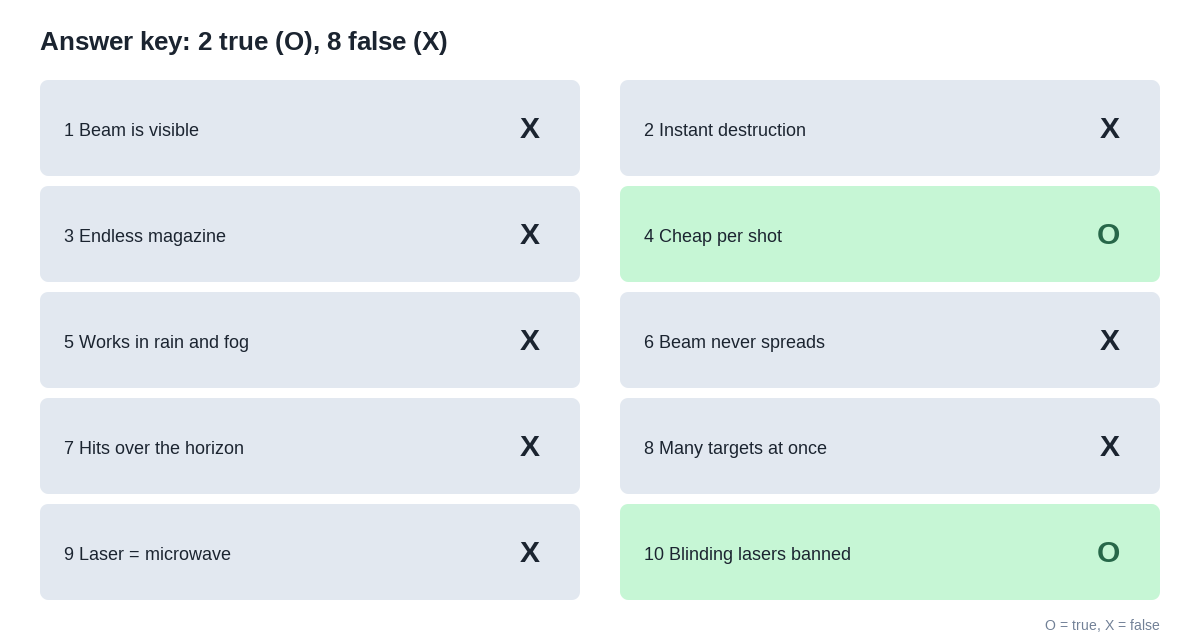
That makes two O answers and eight X answers. Many X answers do not mean laser weapons are hype. The low cost per shot and the near-instant arrival of the light appear in official sources as real advantages.
The false statements share one habit. Most of them dropped a condition, with words such as "always," "endless" or "at the same time." When you read a claim about a laser weapon, look first for where the conditions sit: power and cooling, weather, distance and the number of targets.
What to read next
- What is a laser weapon? Film versus reality: the basic article behind all ten questions.
- Strengths and limits of laser weapons: the conditions behind Questions 3, 4 and 8, gathered in tables.
- Movie Lasers, Fact-Checked: Can You See the Beam, Hear the Shot?: Question 1, tested against film scenes.