In May 2021, South Korea's Agency for Defense Development (ADD) announced a piece of laser technology. It had merged the light of five 1 kW fiber lasers into a single 5 kW beam. The same release said the technology could later be used in a laser air defense weapon system. A little over three and a half years later, in December 2024, the laser air defense weapon "Cheongwang" was fielded.
What happened in between, and in what order? News stories mix terms such as "Block-I", "Cheongwang", "Block-II" and "300 kW". Put the releases from the Defense Acquisition Program Administration (DAPA) and ADD in date order, and it becomes clear which stage each term refers to.
The names first: Block-I, Cheongwang, Block-II
"Laser air defense weapon" is the name of a program. It covers South Korea's own development and fielding of a directed-energy weapon (DEW) that uses a laser to disable small targets in the sky. "Block" means a batch or step: the program is split into stages, each with better performance than the last.
Block-I is the first stage. A 2024 government article described it as a system that fires laser light generated in optical fiber directly at a target. It is aimed at small unmanned aircraft (sUAS) and multicopters at short range. The same article called it the first project of a "Korean-style Star Wars project".
"Cheongwang" (天光, "light from the sky") is the name given to Block-I. The form "laser air defense weapon (Block-I) Cheongwang" appears from DAPA's June 2026 release onward. Block-II is the next stage, and a September 2026 budget document puts the word "mobile" in front of it.
The base technology: five 1 kW lasers into one
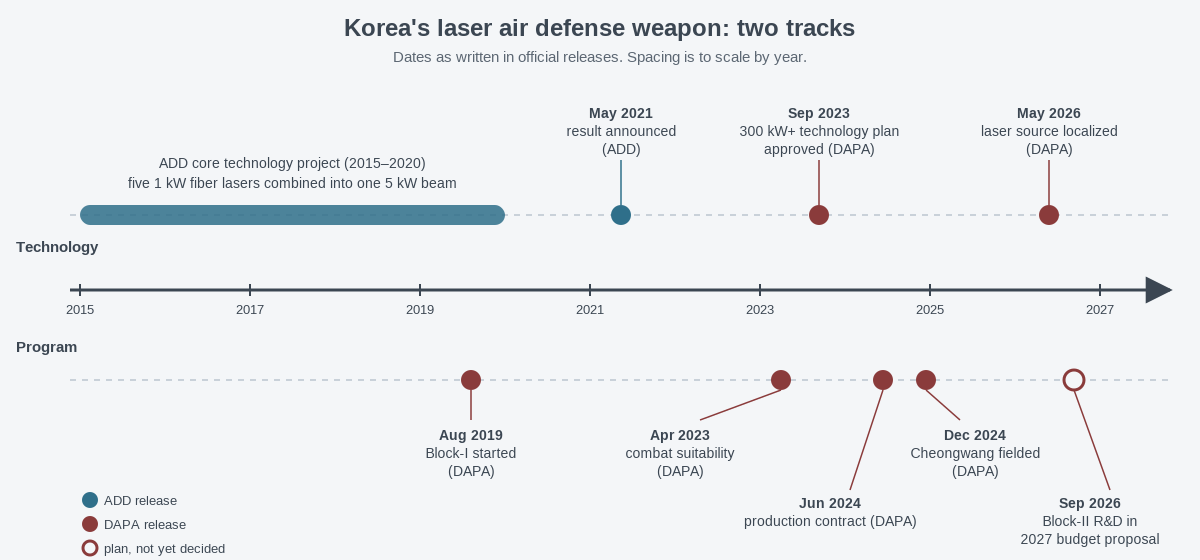
The first entry on the timeline is a technology project, not a weapon. From 2015 to 2020, ADD studied fiber laser technology for five years under DAPA's leading core technology program. The result was one 5 kW-class high-quality laser built from five 1 kW-class laser modules.
ADD called the method "wavelength-controlled beam combining". It merges several laser beams of different wavelengths into one beam. The announcement did not say which optical element brings the light onto one path. This family of methods is usually called spectral beam combining (SBC).
The principle is explained in "Spectral beam combining in detail".
Why combine at all? A single fiber can deliver only so much power, so beam combining, which bundles light from several fibers, is one route to more power. The release does not say what light source went into the actual weapon. The 2021 announcement reported the outcome of a technology project, and ADD added a plan to focus its research on lasers of tens of kilowatts and hundreds of kilowatts.
From development to production: 2019–2024
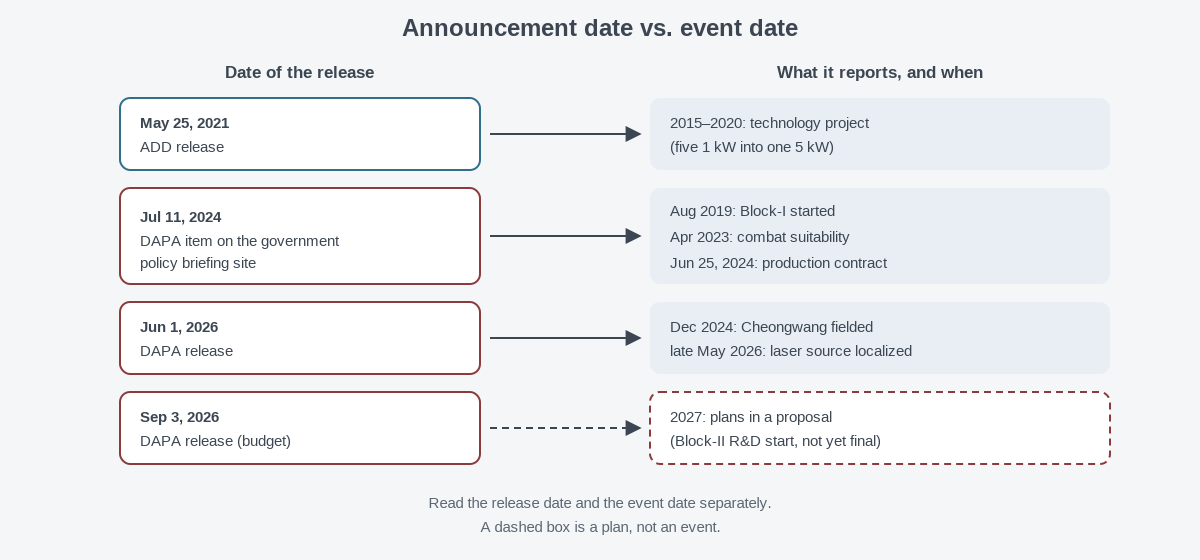
The program's first date is August 2019. A DAPA item carried on the government's Korea Policy Briefing site on July 11, 2024 says the project started in August 2019 with a budget of 87.1 billion won. ADD led system development, and Hanwha Aerospace took part as the prototype company.
The next milestone is the combat suitability assessment. This assessment judges whether the military can actually use the system, and the 2024 article says the system "succeeded in system development" by passing it. The article only says "April of last year". Since it was published in 2024, the assessment was in April 2023.
The production contract was signed with Hanwha Aerospace on June 25, 2024. DAPA announced it on July 11 and held a production kickoff meeting in Daejeon that day. The same article said deliveries to the military would start that year and gave a cost of 2,000 won per shot. The reason given was that the weapon needs no separate ammunition, only electricity.
That 2,000 won is best read as the cost of firing one more time. It does not include the price of buying the system or the cost of developing it. "How to read laser weapon news" explains how to read such numbers.
Fielding and a homegrown laser source: 2024–2026
Cheongwang was fielded in December 2024. That date comes not from an announcement at the time but from DAPA's release of June 1, 2026. The release said Cheongwang was fielded "as the world's first among laser air defense weapons". That is the agency's own wording.
The center of that release was a part. In late May 2026, the laser source, the core component that makes the light in a laser weapon, was localized. The domestic laser source completed a defense standard in May and is due to be used starting with Cheongwang's production units.
The release also explains why a domestic source was not used from the start. DAPA said that when development began, the technology was not yet mature and drone threats were growing fast. So an imported laser source was used during system development. Localization then ran in parallel with system development.
According to the same release, only a few countries, such as the United States, Israel, China and Germany, are known to develop and produce laser sources on their own. Their technology transfer and export are tightly controlled.
With the new part, the weapon's localization rate (by value) rose from 76% to 90%. ADD led this localization work, with Hanwha Systems as the prototype contractor. The 2024 government article named Hanwha Aerospace as the prototype company for system development. So when a news story names a company, it helps to check which year's document it comes from.
Next steps on paper: 300 kW, Block-II and the 2027 budget proposal
Official statements about what comes after Cheongwang fall into three groups.
The first is the July 2024 plan. The head of DAPA's guided weapons program bureau said the agency would develop a laser air defense weapon with more power and range. He added that a core technology project would raise laser source power to the level of hundreds of kilowatts.
The second is an earlier decision from September 2023. On September 6, DAPA's third Advanced Technology Program Management Committee approved a plan for high-power laser technology development. The goal was output of 300 kW or more, enough to intercept large drones, multiple rocket launcher rounds and subsonic guided missiles. The plan at the time was to start in 2024 after a feasibility study.
No official announcement of when that project actually began can be found yet.
The third is the 2027 defense budget proposal, released by DAPA on September 3, 2026. It says Block-I investment is set to grow and that R&D on a "mobile laser air defense weapon Block-II" will newly begin. Block-II aims at a smaller, lighter weapon that can move and performs better. A separate line in the same document's future defense technology section reads "securing hard-kill technology based on high-power lasers (new, 12.1 billion won)".
The 12.1 billion won is for that technology line, and the document does not give separate amounts for Block-I and Block-II. A government proposal is submitted to the National Assembly and becomes final only after the Assembly reviews it. So on the timeline, this entry is a written plan, not an event.
There was company news around the same time. In a release on October 15, 2026, Hanwha Systems said it had held a drone intercept demonstration at an army exercise the day before. It used Cheongwang and a 30 kW-class vehicle-mounted laser. What that release covered and what it left out is set out in "Hanwha Systems shows the Cheongwang laser and a 30 kW-class vehicle-mounted laser" and "November letter No. 5".
What to check when reading the timeline
Separate the announcement date from the event date. The December 2024 fielding first shows up in the June 2026 release, and the April 2023 assessment in the July 2024 article. When a story says "announced in a given month", check when the event it describes took place.
Check whose words they are. "World's first" is wording used separately by DAPA in June 2026 and by Hanwha Systems in October 2026. It is not a ranking that anyone verified against other countries' announcements. "Laser weapon programs that have been made public" puts official statements from several countries in one table.
Keep plans and results apart. The 2023 "start in 2024", the 2024 "hundreds of kilowatts" and the 2027 budget proposal are all plans. Which of them actually began will be known only from later official announcements.
Gaps are part of the record. Cheongwang's (Block-I) output in kW and range in km appear in none of the official documents gathered here. The public numbers are the 5 kW of the 2021 technology project, the 300 kW-plus goal of 2023, the localization rates and the budget amounts. If a news story gives an output figure for Cheongwang, it is worth asking first which document it came from.
What to read next
- Laser weapon programs that have been made public: to compare with official statements from other countries in one table.
- How to read laser weapon news: "kW-class", "range" and "cost per shot": to read the 2,000 won and kW figures more closely.
- Spectral beam combining in detail: the principle behind the "wavelength-controlled beam combining" in the 2021 announcement.
- How Weapons Are Bought: The Defense Acquisition Process: where system development, production and fielding sit in the acquisition process.
- A map of Korean defense technology: to see other Korean weapon systems alongside the laser air defense weapon.