Tank crews and helicopter pilots usually cannot see the light. Someone far away may be measuring range with a laser rangefinder or marking a spot with a target designator, but if the wavelength is invisible, nothing seems to be happening.
A laser warning receiver is a device that notices that light on the crew's behalf. What it detects and how it turns light into a signal can be explained from principles alone. Public specifications show only part of the picture.
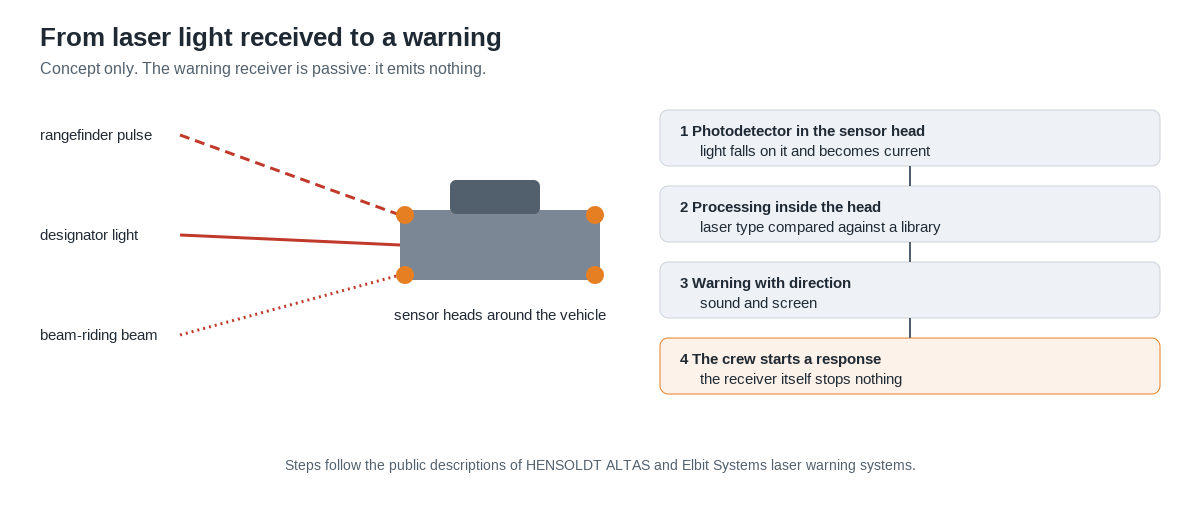
What it detects: rangefinders, designators, beam riders
Lasers are more common on the battlefield than you might think. The Congressional Research Service (CRS) writes that watt-class solid-state lasers are used in many military roles, including target rangefinders, imagers and target designators. The handheld JETS device the U.S. Army put under contract in 2016 can also point out a target with its laser so that precision munitions can find it.
The laser designator has been in use for a long time. The Army's Ground/Vehicular Laser Locator Designator (G/VLLD), for example, marked moving or parked targets for laser-homing missiles like Hellfire.
Warning systems sort this light into types. The ALTAS-2Q from Hensoldt picks up rangefinders and target designators, and the ALTAS-2QB adds laser beam riders. What a beam rider is, as a guidance method, is covered in a separate article on beam-riding guidance. Elbit lists the laser sources its vehicle systems detect, classify and locate: rangefinders, designators, beam riders, infrared illuminators and training lasers.
Turning light into current: a passive sensor
A warning receiver gives off no light of its own. Hensoldt calls such equipment a passive system that detects, tracks and alerts. Rather than sending out a signal and catching the echo, as radar does, it waits for light that someone else has sent.
The basic principle of the part that catches the light is the same as in a photodetector. A photodiode is a light sensor that produces a current or voltage when light falls on the PN junction of a semiconductor.
ALTAS identifies the type of laser by checking it against a stored library. Its signal processing happens inside the sensor heads, with no separate processing box. Catching the light and judging what it is both happen inside one unit.
What the public specifications show
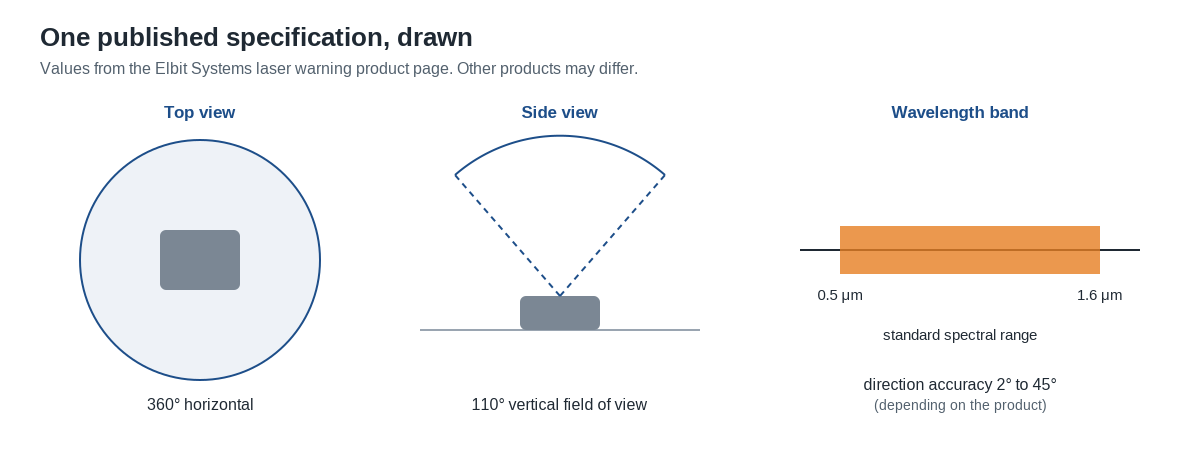
The numbers a manufacturer publishes give a sense of what the equipment aims for. Elbit's product page for its vehicle laser warning systems lists threat detection coverage of 360° horizontally with a 110° vertical field of view. In other words, it is meant to catch light coming from any side of the vehicle.
The same page lists a standard spectral range of 0.5 to 1.6 micrometers (μm). That is the span of wavelengths the receiver can take in. Direction accuracy is 2° to 45°, depending on the product. The system reports not just that light arrived but which way it came from.
These figures come from one company's product page. They may not apply to other companies' products or other models, and values such as detection range or sensitivity are not given on that page.
The problem of false alarms
Reducing false alarms gets as much attention as detection in these systems. Elbit claims a high probability of detection together with few false alarms.
The same page claims the system is not set off by reflections, lightning, gunfire, or the vehicle's own radio and electro-optical equipment. These are the manufacturer's claims, and without public test data the actual performance cannot be checked.
Where they are fitted
Public sources mention both air and ground. Hensoldt's laser warners fly on helicopters and small transport aircraft, while Elbit offers warning systems built for armored vehicles.
There is news on the production side too. In a press release, Elbit Systems announced a new site in Sweden to build and service laser warning systems. It will be the company's first such center in Europe, with opening expected in 2027.
The company calls these systems a core part of the self-protection equipment on military platforms. The full story is in Elbit Systems Sweden plans Europe's first production and maintenance center for its laser warning systems, expected in 2027.
After the warning
The warning receiver itself stops nothing. Its job ends at telling the crew. Once alerted to a laser threat, the crew can start an appropriate response, as Hensoldt puts it. Elbit says its design aims to give users as much time and flexibility as possible to protect themselves.
Elbit's vehicle warning systems are described as integrating with a range of countermeasures, and Hensoldt's ALTAS is a central part of AMPS, the company's missile protection system for aircraft. The bigger picture of defending beyond the armor leads to the active protection system (APS).
Further reading
- Laser Designators: Pointing Out a Target with Light: one kind of light a warning receiver notices
- Laser Rangefinders: Measuring Range from Light's Round Trip: lasers that measure distance
- Photodetectors: How a Photodiode Turns Light into a Signal: how light becomes current
- Active protection systems: defending beyond the armor: the bigger picture after the warning