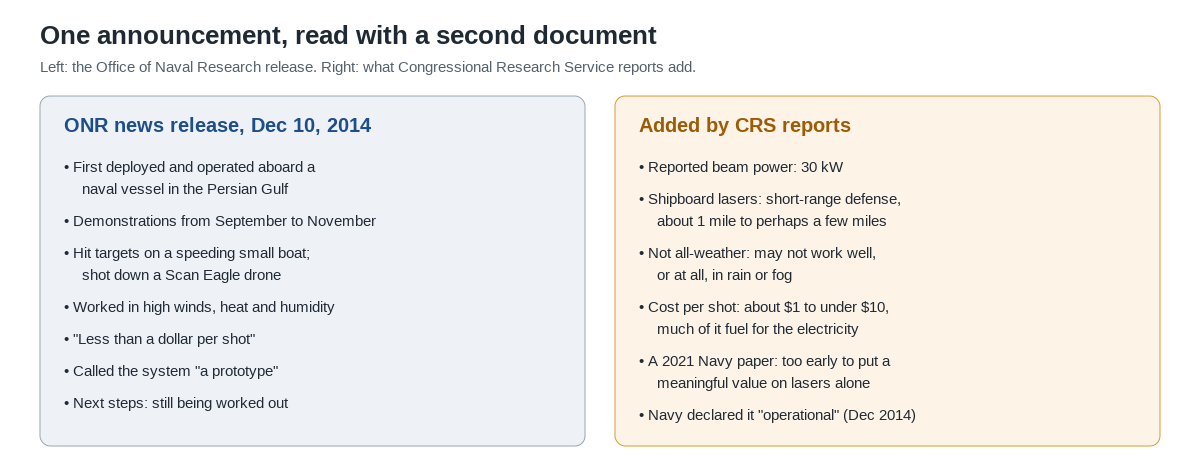
"Historic Leap." That was the title of the December 10, 2014, news release in which the U.S. Office of Naval Research (ONR) announced demonstrations of LaWS, the Laser Weapon System. A Congressional Research Service (CRS) report on Navy shipboard lasers contains a different line: such lasers cannot be all-weather weapons.
The release reported that a laser weapon had been demonstrated from September to November aboard USS Ponce, deployed in the Persian Gulf. It put first the fact that the laser worked on a warship that was actually deployed.
The release, however, gives no power and no range. Set CRS reports on the same system beside it, and those blanks start to fill in.
LaWS before the deployment
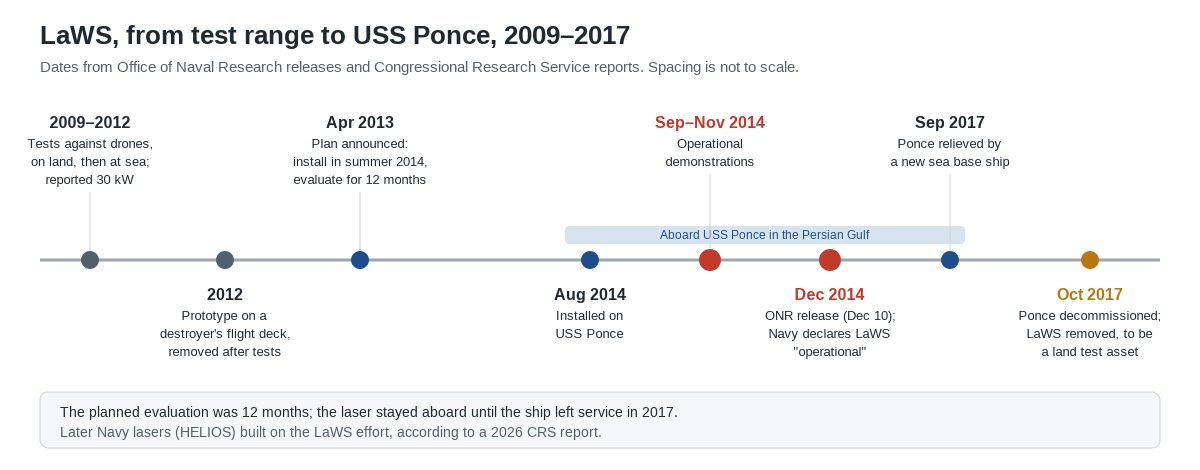
LaWS did not appear out of nowhere in 2014. Between 2009 and 2012, the Navy tested a prototype high-energy laser (HEL) called LaWS against drones, first on land and then on a ship at sea. In 2012 a prototype went onto the flight deck of the destroyer USS Dewey and was removed once the tests ended.
The deployment plan came on April 8, 2013: LaWS would go on USS Ponce and be evaluated in a real operating setting against swarming boats and drones. The plan was to install it in the summer of 2014 and evaluate it for 12 months.
Ponce was a converted amphibious ship. At the time it was working as a temporary forward base at sea in the Persian Gulf. It was not a quiet test range but a ship on an actual mission, and that was the point of the trial.
Six welding lasers
Look inside LaWS and you find an unexpected part. A 2015 CRS report describes a prototype that gathered light from six commercial, off-the-shelf welding fiber lasers. Each produced 5.5 kW, for 33 kW in total.
The reason for the choice was cost. The Navy wanted to lean as much as possible on existing technology and parts to keep development and purchase costs down. In effect, lasers that cut and joined metal in factories went to sea on a warship.
The six beams were never merged into one. They stayed separate, and a beam director overlapped them on one spot on the target. This method is called incoherent beam combining.
There is another way: lock the phases of the six beams so they become one true beam. That would need more complex internal optics and electronic controls. LaWS took the simpler path. The difference between the two methods is covered in Incoherent Beam Combining: Side by Side, No Rhythm or Color to Match.
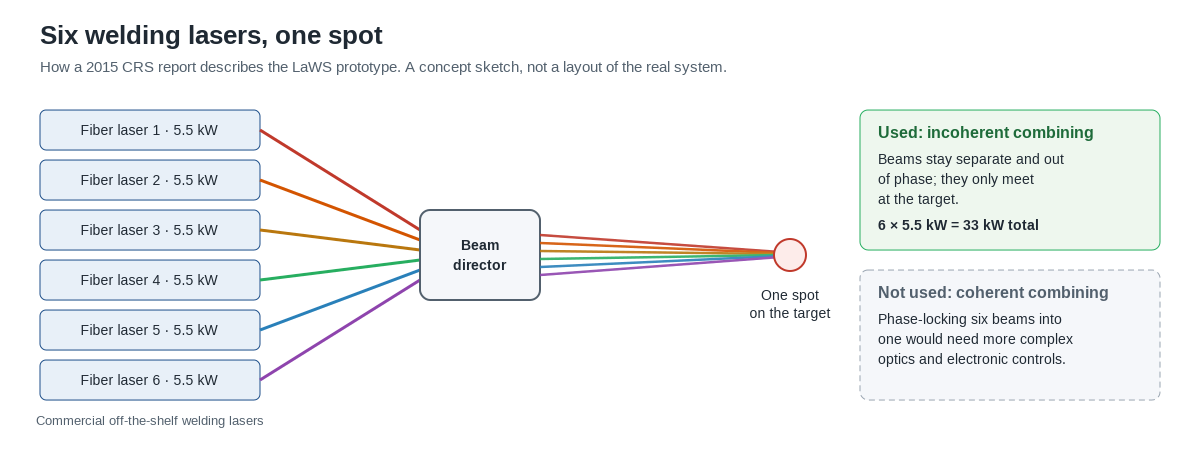
The power figure differs slightly between documents. In the 2026 edition of the CRS report, LaWS has a "reported beam power" of 30 kW. The 33 kW figure adds up the six lasers, while 30 kW is the reported power of the beam the system produced.
Autumn 2014 in the Persian Gulf
LaWS was installed on Ponce in August 2014, and operational demonstrations ran from September to November.
Three test results appear in the release. LaWS hit targets mounted on a speeding small boat coming toward the ship. It brought down a Scan Eagle drone and took out other moving targets on the water. Sailors worked with it every day for months, and in their account it performed flawlessly in high winds, heat, and humidity.
The chief of naval research, Rear Adm. Matthew L. Klunder, was quoted too. In his words, the team ran the prototype through "extremely tough paces," and it destroyed the designated targets with "near-instantaneous lethality."
Part of what made the event historic, in the release's telling, was that LaWS worked smoothly alongside the ship's existing defense systems.
What the release did not say
Read the release line by line and three things stand out.
First, the scope of "first." The release used the words "for the first time" about LaWS operating on a Navy ship deployed in the Persian Gulf. The "first" in the release is the first operation aboard a deployed ship. As noted above, a laser had already been tested on a ship at sea between 2009 and 2012.
Second, what the system was called. To Klunder himself, it was "a prototype."
Accuracy and lethality data from Ponce were to guide the Navy's next laser development program. Industry teams would build prototypes that could go on destroyers or the Littoral Combat Ship in the early 2020s.
Third, the schedule. Next steps and timeframes were still being worked out as the demonstration data were analyzed. The release gave no power, no range, and no distance to the targets.
"Near-instantaneous" also deserves a careful reading. Laser light reaches the target at once, but the beam has to stay on the target for a while before damage occurs. The reason is the subject of Why a laser weapon does not finish "the instant it fires".
What "a dollar per shot" means
The line from the release that traveled farthest was about cost. Klunder spoke of "less than a dollar per shot." Lasers run on electricity, the release went on, and can fire as long as there is power. In a release issued before the installation, the same officer spoke of about $1 per shot.
The CRS report puts conditions on that number. Its estimate for the recurring cost of one shot from a solid-state laser runs from about $1 to less than $10, depending on beam power. Much of that is the cost of fuel to make the electricity. The cost of buying the system is not part of that figure.
A 2021 Navy paper quoted in the same report goes further. In its view, buying laser systems costs roughly as much as buying existing weapons. It is also too early to put a meaningful value on what lasers alone contribute. How to read "cost per shot" in the news is covered separately in How to read laser weapon news.
Limits of weather and range
High winds, heat, and humidity all appear in the release. Rain and fog do not.
The limits of shipboard lasers get a section of their own in the CRS report. The beam needs a clear line of sight to the target, and the air absorbs, scatters, and stirs the light. For these reasons, shipboard lasers cannot be all-weather weapons. In rain or fog they may work poorly or not at all.
Thermal blooming is another limit. A laser that fires in one direction for a while heats the air it passes through, and that air spreads the beam.
Range is also short. In the report, high-energy solid-state lasers on ships are short-range defense weapons. They would generally engage targets from about one mile out to perhaps a few miles someday.
After 2014
In December 2014, the Navy gave LaWS on Ponce the label of an "operational" system. The planned evaluation was 12 months, yet LaWS stayed in the Persian Gulf until Ponce was relieved in September 2017 by the new Expeditionary Sea Base ship Lewis B. Puller.
When Ponce was decommissioned in October 2017, LaWS came off the ship. The Navy planned to refurbish it as a land-based test asset for its next shipboard laser, HELIOS. In the 2026 edition of the CRS report, HELIOS development built on LaWS and a later demonstrator.
According to a January 2024 news report quoted by CRS, Rear Adm. Fred Pyle recalled a ship called the Ponce that "had a laser on it" about fifteen years earlier. The Navy, in his words, was still working on that technology. Space, weight, power, and cooling can be a challenge on today's surface combatants, he went on.
LaWS showed that a laser weapon could run for years aboard a ship on an actual mission. It also left open problems: weather, range, and a ship's power and space. Read the 2014 release together with the 2024 remarks, and you can see how long those problems last.
Further reading
- A history of laser weapons: from chemical to electric lasers: where LaWS stands in the move beyond chemical lasers
- Laser weapon programs that have been made public: laser weapons announced by various countries after LaWS
- Incoherent Beam Combining: Side by Side, No Rhythm or Color to Match: how six beams overlap on one spot