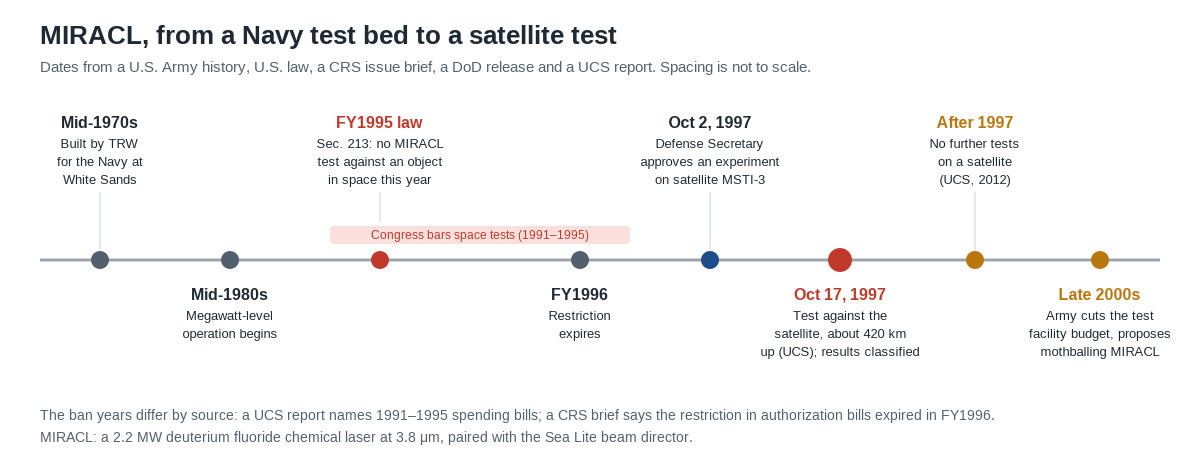
"The Secretary of Defense may not carry out a test of the Mid-Infrared Advanced Chemical Laser (MIRACL) transmitter and associated optics against an object in space." So begins a ban for fiscal year 1995, unless a law specifically allowed the test. It comes from Section 213 of the U.S. National Defense Authorization Act for Fiscal Year 1995. Congress had written the name of a single laser into law to block one use of it.
In October 1997, after the ban had ended, the United States used this laser at White Sands Missile Range in New Mexico. It was pointed at MSTI-3, one of the nation's own Air Force satellites in orbit. The U.S. Department of Defense (DoD) presented the test as a defensive experiment to learn how vulnerable U.S. satellites are to lasers. Others saw a test of the ability to attack satellites.
The same test was read in opposite ways.
What kind of laser MIRACL was
MIRACL stands for Mid-Infrared Advanced Chemical Laser. A history published by the U.S. Army Medical Department says TRW built it for the Navy at White Sands in the mid-1970s. No U.S.-built chemical laser had reached the megawatt class in continuous operation before it. Its power was 2.2 MW, and its lasing medium was deuterium fluoride (DF).
A chemical laser produces its light from a chemical reaction rather than from electricity. Even by the time of a 2002 National Defense University (NDU) report, chemical lasers were the only kind of high-energy laser (HEL) able to reach megawatt power. MIRACL works at a wavelength of 3.8 μm and had operated at the megawatt level at White Sands since the mid-1980s.
MIRACL was first meant to test how a ship might defend itself. At full power, however, it suffered propagation losses as its light crossed the air, and the Navy gave up on chemical lasers because of the losses at those wavelengths. How wavelength changes the way light travels through air is covered in Why wavelength matters: visible and invisible light.
Sending the beam to a target was the job of a beam director called Sea Lite. Together, MIRACL and Sea Lite were tested against drones flying at 500 mph, supersonic Vandal missiles, and satellites in orbit.
The test Congress had blocked
For years, pointing this laser into space was barred by law. Section 213, quoted above, carries the heading "Extension of Prohibition": the fiscal year 1995 ban carried on a ban from earlier years.
A report by the Union of Concerned Scientists (UCS) places the ban in defense spending bills for 1991 through 1995. A brief from the Congressional Research Service (CRS) places it in defense authorization bills. Both see it ending in 1996, or in fiscal year 1996 in the CRS wording.
Approval and test, October 1997
Once the ban ended, the DoD moved. On October 2, 1997, Defense Secretary William S. Cohen approved an experiment using MIRACL against the Air Force satellite MSTI-3.
A DoD news release that day set out the purpose. The experiment would help make U.S. satellite systems less vulnerable by collecting data to improve the computer models used to plan protection for U.S. satellites. The target was the third satellite of the Air Force's MSTI program, which had already outlived its useful life.
The release also addressed law and safety. The experiment, it stated, was consistent with U.S. policy and with U.S. and international law; it would not destroy the satellite, create orbital debris, or put other satellites at risk. The debris left by satellites destroyed with missiles is covered in Anti-Satellite Tests and Space Debris.
According to the CRS brief, the test took place on October 17, 1997. The UCS report puts the target satellite in orbit at an altitude of 420 km.
What was made public
As of the 2012 UCS report, the results of the test were still classified. Only a few sentences are public.
The UCS report relays two things the DoD reported. The system followed the satellite and put light on it, and a lower-power laser either briefly dazzled or damaged a sensor on the satellite. Alongside MIRACL, the test used a lower-power 30 W laser meant mainly for alignment and satellite tracking, and MIRACL itself was damaged during the test. The public wording stops at "dazzled or damaged," and nothing more has been disclosed.
A defensive test, or an offensive capability test?
Interpretations split over what the test meant. A 2001 edition of the CRS brief sums up the divide briefly. The DoD insisted it was a defensive test to assess the satellite's vulnerability to laser attack, while others viewed it as a test of an offensive antisatellite (ASAT) capability.
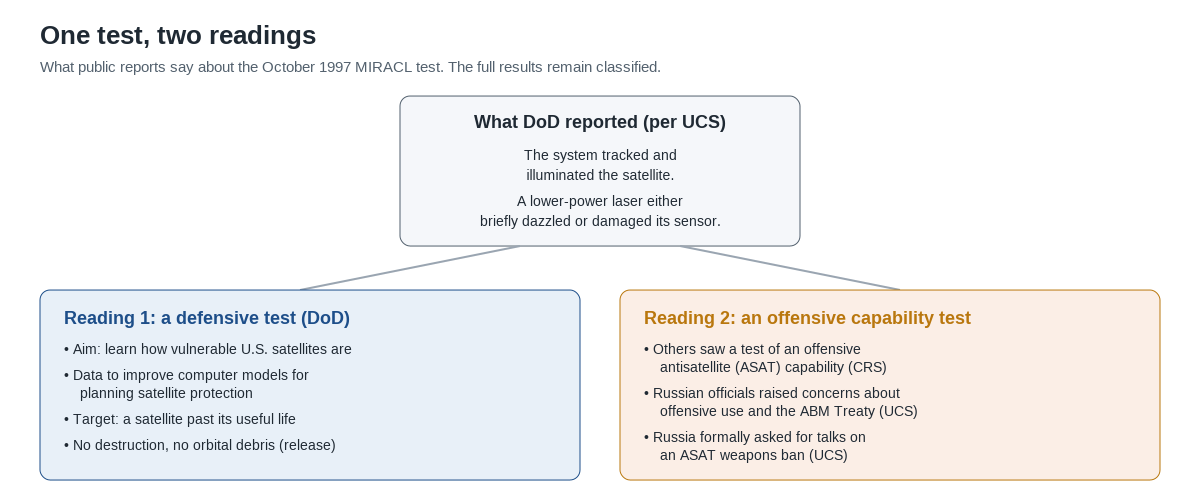
Reactions from abroad also made it into public reports. The UCS report records that Russian officials voiced concern about the system's offensive capabilities and about whether it violated the Anti-Ballistic Missile (ABM) Treaty. Russia formally asked for negotiations on a ban on ASAT weapons.
Because the results are classified, no public material backs either reading. What the treaties limited is covered in Arms Control Treaties: What INF and New START Limited.
MIRACL after the test
Up to the 2012 UCS report, MIRACL had not been tested against a satellite again since 1997. Its funding shrank steadily. In the late 2000s, the Army sharply cut the budget of the High Energy Laser Test Facility that housed MIRACL and proposed mothballing the laser itself.
MIRACL also shared the problems of chemical lasers in general. The Army history says some U.S. high-energy lasers of the time could have been adapted as weapons, but none were developed that way. Testing showed them to be too big, too heavy, too costly, and too dangerous. It also points out that deuterium fluoride systems give off deadly waste gases.
The 1997 test put a single laser beyond a technical trial and into the middle of a debate over space policy. The shift of laser weapons from chemical to electric lasers continues in A history of laser weapons: from chemical to electric lasers.
Further reading
- Anti-Satellite Tests and Space Debris: tests that destroyed satellites with missiles, and the debris they left
- Space situational awareness: what passes near satellites: keeping watch on satellites in orbit
- A history of laser weapons: from chemical to electric lasers: what came after chemical lasers like MIRACL