Drawings of a laser beam usually show two parallel lines, as if ruled with a straightedge. The edges of a real beam are not parallel like that. A beam has a narrowest place, and it widens little by little away from it.
What is a laser? went as far as two points: laser light spreads too, and a wider beam spreads less. The next questions come after that. What shape does the spreading take, and why does a beam that starts wide stay narrow for longer?
The answer starts with the Gaussian beam, which describes the cross-section of a beam, and moves on to the beam waist, its narrowest place. From there it follows the Rayleigh length, which measures the narrow stretch around the waist, and the beam divergence, the angle at which a beam opens up far away.
Laser light spreads too: what diffraction leaves behind
When light passes a small opening and spreads out beyond it, that is diffraction. "Interference and diffraction: how light adds up and spreads" pictured it as round secondary waves leaving each point of the wavefront and spreading out beyond the opening.
In a laser beam, diffraction works in the same direction: it widens the beam. Strong light whose power passes a certain threshold can narrow itself inside a material. Even in that special case, diffraction is treated as the effect on the other side that spreads the beam. This article follows an ordinary beam without that effect, and where it stays narrow and where it widens.
The Gaussian beam: brightest at the center
A beam is not evenly bright across its cross-section. In most applications a laser beam has the shape of a Gaussian beam, and lab measurements normally use a beam of this shape too. The intensity of a Gaussian beam is highest at the center and falls smoothly toward the edges.
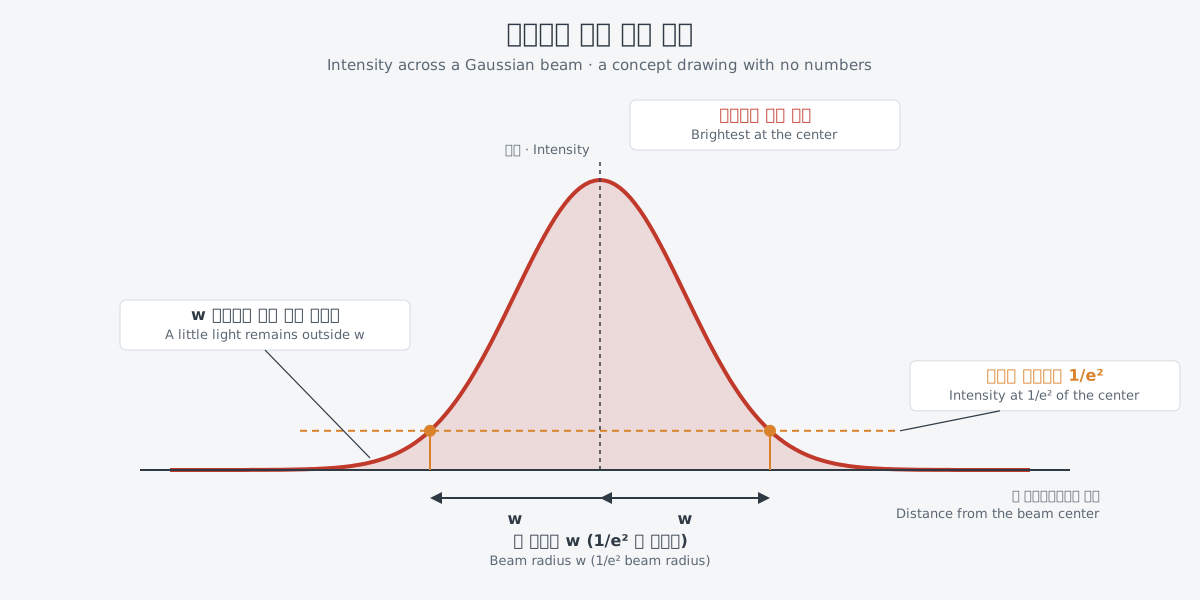
The edge does not stop sharply, as if cut with a knife. So to talk about the width of a beam, you first have to decide where the beam ends. In this article the beam radius w is the 1/e² beam radius: the distance out to where the intensity drops to 1/e² of the center value.
A little light remains outside w. A textbook note works through a beam sent near the tip of a prism. By its calculation, a circle 1.5 times the beam radius holds roughly 99% of the power of a Gaussian beam. So w is less a fence where the light ends and more a ruler for measuring width.
You can also compare how bright the center is. Picture the same energy spread evenly over a circle of radius w. The center fluence, the energy per area, of a Gaussian beam is twice that even value.
Beam waist and Rayleigh length: the stretch where a beam stays narrow
The narrowest place of a beam is its beam waist, and its radius there is written w₀. Away from the waist the beam radius grows. Close to the waist, though, the beam holds its width and barely grows.
The measure of this narrow stretch is the Rayleigh length. For a beam with waist radius w₀, the Rayleigh length L is as follows.
L = π n₀ w₀² / λ₀
Here λ₀ is the wavelength of the light, and n₀ is the refractive index of the material the beam passes through at that wavelength. For a rough estimate in air, n₀ can be set to 1. The thing to notice is that the waist radius appears squared.
A special thread of light called a filament keeps a narrow diameter well beyond the normal Rayleigh range of Gaussian beam propagation. Read the other way around, this means that for an ordinary beam the Rayleigh length is the yardstick for how far it stays narrow.
Divergence: the angle at which a beam opens up far away
Much farther from the waist than the Rayleigh length, the beam looks different. Such a far region is often called the far field. There, the edges of the beam are treated as two nearly straight lines, and the angle between them is measured. This angle is the beam divergence.
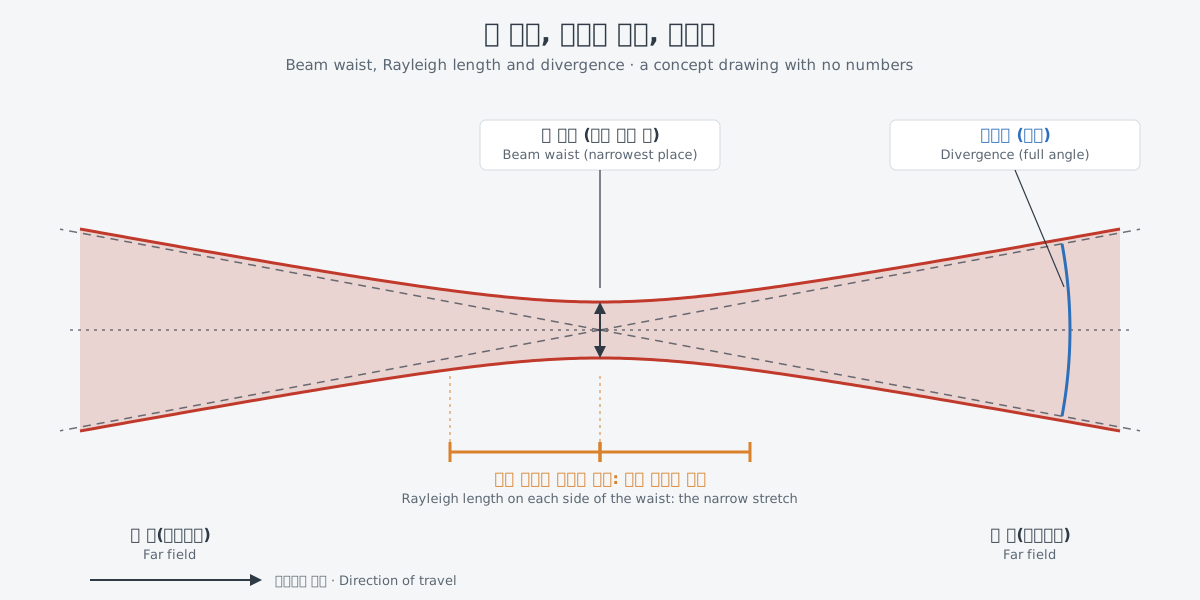
Public lab material draws beams in these terms. An explanatory figure in a journal from MIT Lincoln Laboratory shows a laser beam with power P and diameter D that travels to the far field with a divergence angle θ.
One thing to watch when reading numbers: an angle measured from the center line of the beam to one edge is half the angle measured between the two edges. So when you see a divergence value, first check which way it was measured.
Here is a rough estimate. Take a beam whose divergence, measured as the full angle between the two edges, is 1 mrad (0.001 rad). After 1 km its diameter grows by about 1000 m × 0.001 = 1 m.
The numbers are round values picked to show the principle, not the values of any device. The estimate treats the edges as straight lines far beyond the Rayleigh length, so it leaves out the way air scatters light.
Why a larger aperture spreads less
An aperture is an opening that light passes through, or the size of that opening. With lasers the word covers the size of the lenses and windows the beam passes through as well as the width of the beam itself. In this article, a larger aperture is read as a beam that starts out wide, that is, a beam with a wider waist.
Go back to the Rayleigh length formula. The formula shows that the larger the waist radius, the longer the Rayleigh length. Because the radius is squared, the effect is strong: a waist 10 times wider gives a narrow stretch 100 times longer.
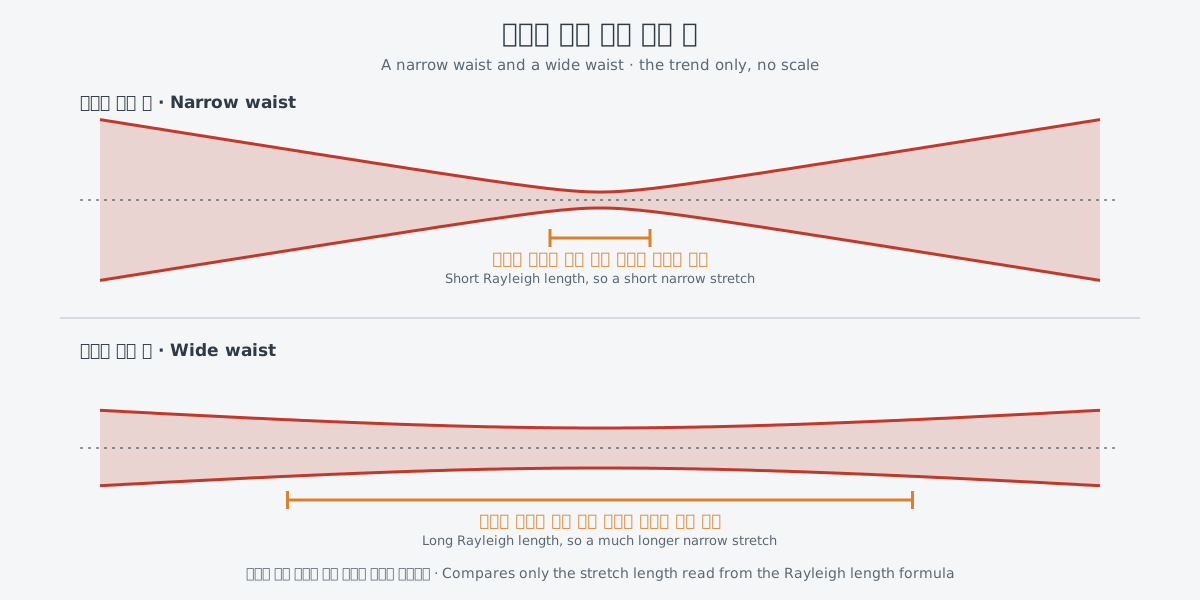
Numbers make the gap clear. A rough estimate for light with a wavelength of 1 µm gives a Rayleigh length of about 3.14 m for a waist radius of 1 mm. Widen the waist radius to 10 mm and it becomes about 314 m. A beam that starts wide keeps its starting width that much longer.
The wavelength is in the formula as well. It sits in the denominator, so with the same waist, doubling the wavelength halves the Rayleigh length. This points the same way as the line in "What is a laser?": the smaller the beam and the longer the wavelength, the more it spreads.
Focus: a lens cannot squeeze light to a point
Now gather light instead. A lens takes parallel light arriving from one direction and brings it to one fixed place on its focal plane, a focal length f away from the lens. Light arriving from a different direction goes to a different place on the focal plane.
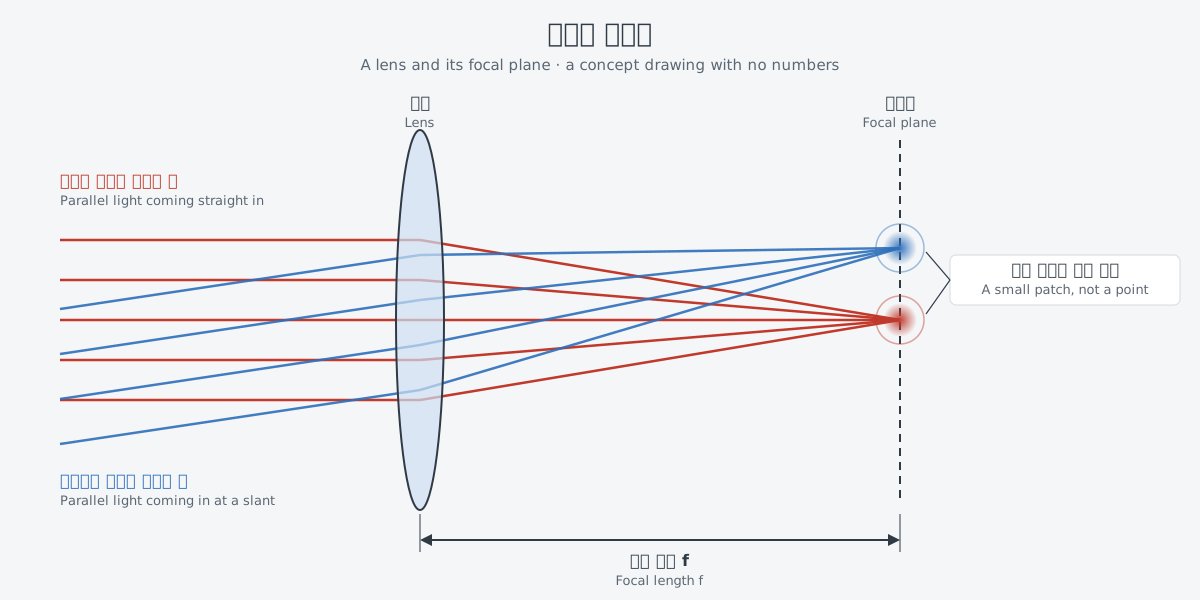
That gathered place does not become a point with no size. In optical imaging, where a lens forms an image, light passing a round opening with a hard edge also diffracts strongly. The Airy disk gives a pattern with side lobes around it, and this pattern blurs the image.
Reading the Rayleigh length formula backward shows something else. The smaller the waist, the shorter the Rayleigh length, so the narrow stretch gets shorter too. Cut the waist radius to one tenth and that stretch shrinks to one hundredth. So the tighter the light is gathered, the shorter the distance past that place before it starts to widen again.
Picture an hourglass whose narrow part gets shorter as its neck gets thinner. A real beam is different. The glass of an hourglass fixes its shape. In a beam, the wavelength and the waist size set the length of the narrow stretch through the Rayleigh length formula, with diffraction underneath.
Real beams over real distances: beam quality, air, public examples
Beams have a quality, too. One phrase used to talk about it is "diffraction limit," which also appeared in Why beam combining is needed, and its three approaches. The Lincoln Laboratory journal article uses the name diffraction-limited beam for a beam that can be focused down to the size diffraction allows. It adds that such beams are desirable to reach high intensity at the focus.
Light going in and light coming out of one device can differ a lot in quality. A diode-pumped solid-state laser runs on low-cost diode light of low beam quality, yet its output beam can be made close to the diffraction limit. This counts as one important advantage of this kind of laser.
Over long distances, air joins in, as in the Moon laser example from "What is a laser?" NASA's article on laser beams sent between Earth and the Moon says the laser photons pass twice through Earth's thick atmosphere, which tends to scatter them. A light beam a few meters wide on the ground can spread to more than 2 km by the time it reaches the Moon's surface. On the way back it grows much wider still.
That figure comes right after the part about the atmosphere. So the 2 km should not be read as the size of diffraction alone. The 1 km estimate above leaves out the share of the air as well.
Optical communication in space also has to deal with spreading beams. Just like lasers on the ground, the beams of optical communication lasers in space spread out, and as the light thins, the data it carries gets harder to recover. NASA's overview of optical communications explains that its terminals use narrower beam widths than radio frequency (RF) systems and send a relatively narrow beam pointed directly at a receiver.
What to read next
- "Beam quality: M², divergence and brightness": why beams with the same power gather differently far away, told through the values that measure beam quality.
- Why beam combining is needed, and its three approaches: why diffraction-limited beams and brightness matter when many beams are merged into one.
- "Mirrors, lenses and coatings: optics for strong light": the lenses that gather light, seen as components.