Laser weapon news usually arrives one item at a time. "Country X shot down a drone with a laser." "A kW-class system was tested." Read one by one, the bigger picture is hard to see.
What shows up if you put them all on one line?
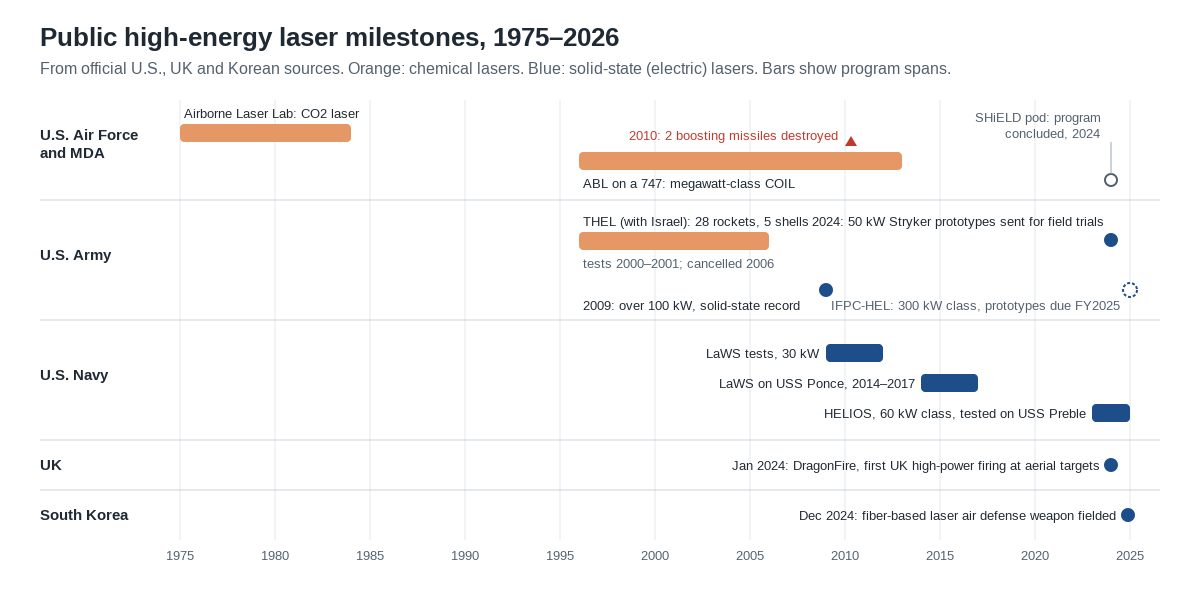
Here a high-power laser generally means a high-energy laser (HEL), with a beam power of 10 kW or more. Tests and deployments of such lasers from 1975 to 2026 are set out here on one line. The timeline is drawn from records published by the U.S., UK and South Korean governments. Programs in other countries are not on this timeline.
Each entry has four parts: country and agency, date, what happened, and the published power. Where no power was published, the cell is left empty.
The 1970s and 1980s: a CO2 laser on an aircraft
The United States ran the Airborne Laser Lab program from 1975 to 1984. A modified NKC-135A aircraft carried a carbon dioxide laser with a wavelength of 10.6 μm, and in tests it intercepted small air-to-air missiles and drone aircraft. It is the earliest high-energy laser test in the official sources used here.
1996–2012: the chemical laser era
The two U.S. programs on this timeline that began in the mid-1990s both used chemical lasers. The Tactical High Energy Laser (THEL) began in 1996 as a program shared by the United States and Israel, built around a deuterium fluoride chemical laser. During 2000–2001 operational tests it brought down 28 Katyusha rockets and 5 artillery rounds.
Even so, THEL was cancelled in January 2006. The reasons were a string of setbacks, rising costs and worry that the system was too big for vehicles.
Also in 1996, the U.S. Air Force began the Airborne Laser (ABL) program to put a laser on a Boeing 747. The test aircraft carried a megawatt-class chemical oxygen-iodine laser. On February 3 and 11, 2010, it destroyed a boosting rocket and then a boosting missile. It retired on February 14, 2012.
That program has its own article, "2010: YAL-1, the 747 Laser Intercept Test and the End of the Program."
2009: a solid-state laser passes 100 kW
The turning point comes in 2009. That year Northrop Grumman ran a solid-state laser above 100 kW for several minutes. It was part of the Joint High Power Solid State Laser (JHPSSL) program, and a U.S. Army article called it a world record at the time.
Solid-state lasers run on electricity rather than chemicals. That is why the timeline's color changes from orange (chemical) to blue (electric) around this point. The difference between the two is covered in A history of laser weapons: from chemical to electric lasers.
2009–2025: U.S. Navy shipboard lasers
The Navy's prototype solid-state laser LaWS was tested against drones in 2009–2012, first on land and then aboard a ship. Its reported beam power was 30 kW. In 2010–2011 another prototype, MLD, was mounted on a ship and engaged a small boat.
In August 2014 LaWS was installed on the amphibious ship USS Ponce, and that December the Navy declared it an "operational" system. When Ponce was decommissioned in October 2017, LaWS came off with it.
HELIOS, a 60 kW-class laser weapon, was installed on the destroyer USS Preble. Navy budget documents, quoted in a Congressional Research Service (CRS) report, date its testing and fleet support from early fiscal 2024 to the end of fiscal 2025.
The same fleet also has ODIN. As its name (Optical Dazzler Interdictor, Navy) says, it is an optical dazzler, a different kind of device from a high-energy laser that damages a target. It has been installed on eight Arleigh Burke-class destroyers, and eight units are operating in the fleet. That is why it is not plotted on the timeline.
The 2020s: the Army and Air Force leave the test range
The U.S. Army's DE M-SHORAD program puts a 50 kW laser on a Stryker vehicle. Citing press reports, CRS says four prototypes went to the Middle East in February 2024 so that soldiers could try them. Early feedback was reportedly "not overwhelmingly positive," and officials said results on test ranges differ greatly from the tactical environment.
Higher power is planned. The Army's IFPC-HEL includes a 300 kW-class laser subsystem, meaning more than 250 kW, and four prototypes were due in the third quarter of fiscal 2025. Some programs ended instead. The Air Force's SHiELD, meant to hang as a pod on aircraft, concluded in 2024 and was never installed on a fighter test bed.
2024: the UK and South Korea
Official records outside the United States also pick up in 2024. On January 19, 2024, the UK government made an announcement about DragonFire. At the Hebrides range it had fired at aerial targets, the first high-power laser weapon shot of this kind in the UK. It said the range is classified and did not publish the power.
In South Korea, the Defense Acquisition Program Administration said its laser air defense weapon Cheongwang was fielded in December 2024. It is a weapon system based on a high-power fiber laser, and in 2026 the agency announced it had built the core laser source domestically. This record also gives no power figure.
How to read published power
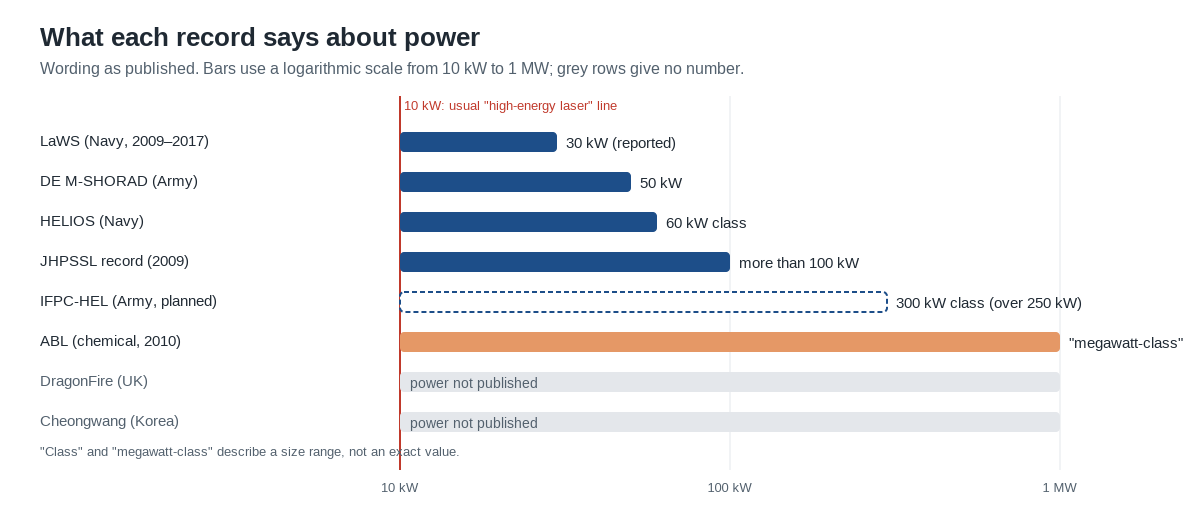
Put the power cells side by side and the wording varies: "30 kW (reported)," "60 kW class," "300 kW class (over 250 kW)," "megawatt-class," and "not published." "Class" describes a size range, not an exact value. The 10 kW mark is the line a CRS report gives for calling a shipboard laser high-energy.
The timeline also leaves things out. Success on a test range does not mean a usable weapon. THEL and ABL both ended after successful tests, and DE M-SHORAD's first field feedback was mixed. The order for reading numbers in news is laid out in How to read laser weapon news: "kW-class", "range" and "cost per shot".
Further reading
- A history of laser weapons: from chemical to electric lasers: the story behind the timeline
- Laser weapon programs that have been made public: more background on the systems listed here
- 2010: YAL-1, the 747 Laser Intercept Test and the End of the Program: the last big test of the chemical laser era