Shine a laser pointer at the wall of a dark room and a sharp dot appears. Yet the line of light running from the pointer to the wall is barely visible. The light is clearly traveling along that path, so why can't you see it?
The answer lies in what "seeing" means. Light is not visible just because it passes by; some of it has to enter your eye. The key to the puzzle is scattering, the way part of the light gets knocked sideways.
Light has to reach your eye
All light travels in straight lines. The exception is when an obstacle reflects it (like a mirror), bends it (like a prism) or scatters it (like gas molecules in the air).
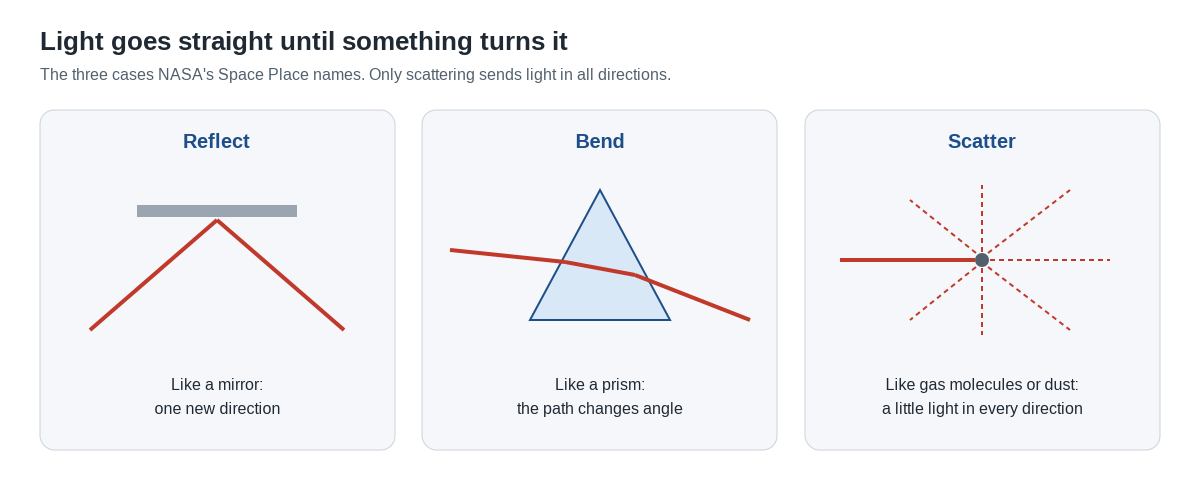
Laser light differs in that it leaves in one direction from the start. An ordinary source such as a light bulb sends light out in all directions, but a laser gives a focused, narrow beam that travels in one direction. So most of a pointer's light heads straight for the wall and only spreads out in all directions once it hits the wall. Some of that spread-out light reaches your eye wherever you stand in the room, so the dot is easy to see.
A guide from the optics company Edmund Optics says the same. In most conditions, you cannot see a laser beam as it crosses the air. With nothing at all to scatter it, the beam shows up only as a spot where it hits its target. Your eyes see only the light that actually enters them.
Why laser light leaves in one tight direction is explained in What is a laser? How it differs from a light bulb. What it means for light to be a wave with a wavelength is covered in Light basics: waves, wavelength, frequency and photons.
Light knocked sideways: scattering
So when can you see the beam from the side? When something along its path sends part of the light sideways. Light in the air runs straight until it meets a dust speck or a gas molecule, such as oxygen or nitrogen. What happens next depends on the light's wavelength and on the size of what it hits.
Light hitting small particles and spreading in many directions is what scattering means. Dust and water particles scatter light just as gas molecules do, and more particles in the air mean more scattering.
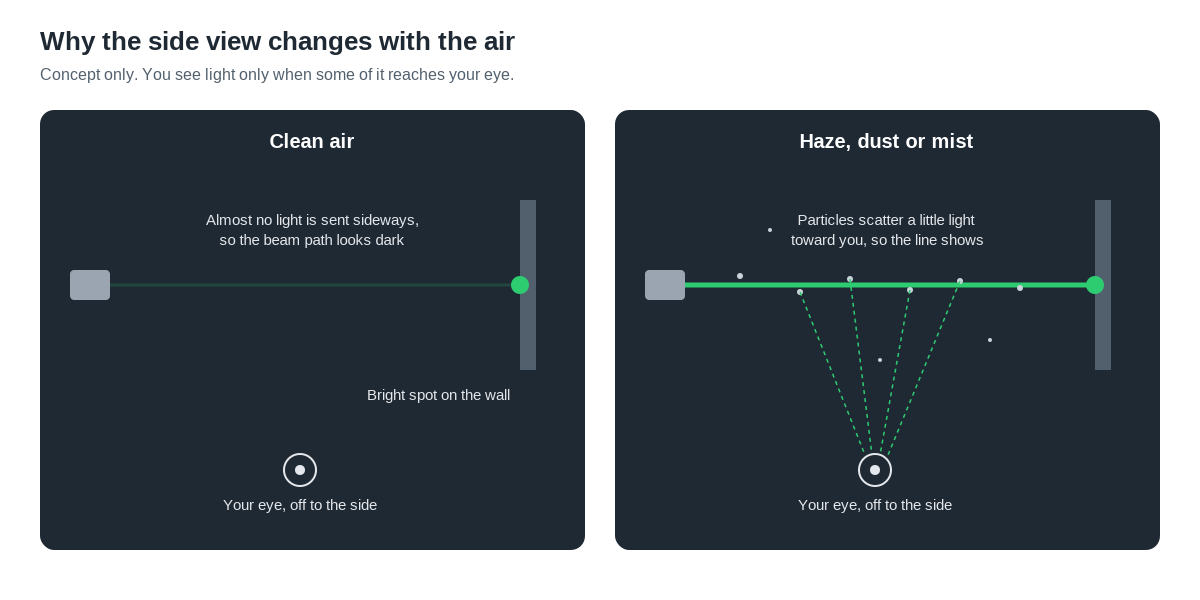
A physics Q&A page run by the University of Illinois once took up a beam in smoke. Smoke is made of tiny particles, and they send light off in all directions, including toward someone standing to the side. Without the smoke, no light comes your way, so you cannot make out where the beam runs.
Clear indoor air still has molecules, so scattering never stops completely. But so little light comes sideways that the beam stays faint even in a dark room. Add fog, dust or smoke and there are far more particles to scatter the light. A little light then leaks sideways along the whole path, and a green or red line appears.
A flashlight makes a handy comparison. On a foggy night its beam shows as a column of light, while on a clear night only the spot it lands on is lit. A real laser beam differs because it starts out as a narrow beam aimed in one direction. In the same haze, it shows up as a thin line rather than a wide column.
When a beam can be seen
Apply all this to a laser beam, and two things matter most for seeing it from the side. The first is particles in the air. The more dust, fog, smoke and water droplets there are, the more light leaks sideways and the sharper the line becomes. With almost nothing to scatter the light, the beam shows only as a spot at its end.
The second is color. Our eyes are far more sensitive to green, and the UK Civil Aviation Authority (CAA) notes that at equal laser power green looks much brighter. Even when the same amount of light leaks sideways, a green beam stands out more.
The green laser lines sometimes seen across the night sky come from both at once. Molecules, dust and water droplets in the air scatter a little of the light sideways, and our eyes respond especially well to that green.
Why the sky is blue and space is black
Sunlight, too, meets the gas molecules and particles of the atmosphere and is thrown off in every direction, so in daytime the whole sky looks bright. Gas molecules are smaller than the wavelengths of visible light, and they scatter the shortest wavelengths, violet and blue, the most. This is called Rayleigh scattering, after Lord Rayleigh, who first explained it in the 1870s, and it is also why the sky looks blue. The sky looks blue rather than violet because our eyes are more sensitive to blue light, and the sun also gives off more energy as blue light than as violet.
The higher you go, the fewer molecules there are to scatter light, so scattering weakens and the sky slowly darkens. Space looks black because hardly any molecules are there to scatter light. Space is full of sunlight, but with almost nothing in its path, you see neither a line of light nor a bright sky. A laser beam that is hard to see in a clean room is a small-scale version of that dark sky.
Beams in films and beams in real life
In films, lasers in space battles fly as bright lines. Apply the same idea to space, and someone off to the side would struggle to see a beam where there is almost nothing to scatter it. Film beams owe more to what looks good on screen than to physics, and the gap between film and real laser weapons is covered in What is a laser weapon? Film versus reality.
Scattering and loss in the air also matter for equipment that has to send a laser beam a long way. How absorption and scattering eat away at the light is explained in Light through air: absorption, scattering, turbulence, thermal blooming.
What to read next
- What is a laser? How it differs from a light bulb: why laser light leaves in one tight direction
- Light through air: absorption, scattering, turbulence, thermal blooming: four ways air eats away at laser light
- Why You Must Never Point a Laser at an Aircraft: when the green line in the night sky reaches a cockpit