Picture the scene. A space fighter fires a red beam, there is a "pew," a glowing bolt flies across the screen, and the enemy ship bursts into flames the moment it is hit. The scene is so familiar that nothing about it feels strange.
Yet it hides at least four physics questions: is there a sound, is the beam visible, can you watch it fly, and does the target blow up?
Add the spy-movie favorite, a red laser grid in a dark room, and you have five scenes to treat as a quiz.
For each one, guess first, then read the answer.
Scene 1: A "pew" in space
Question. If you fire a laser in the vacuum of space, does it make a sound?
Answer: no. Sound is a mechanical wave, carried by matter that shakes. In air, a molecule pushes its neighbor, which pushes the next one, and the sound spreads. It looks a bit like a row of falling dominoes, each one passing the push along.
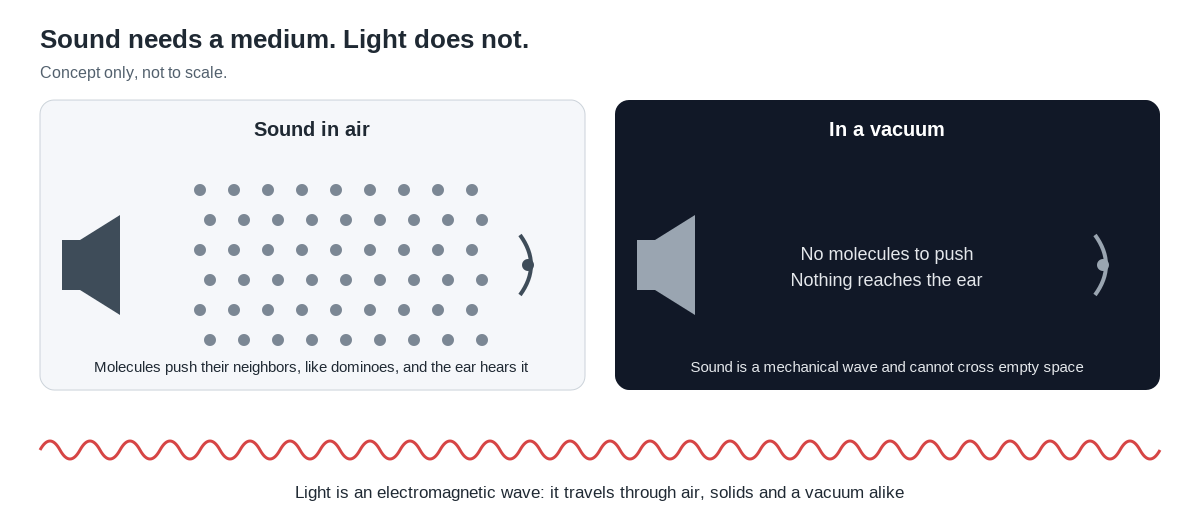
The vacuum of space has almost no molecules to push. NASA's guide to electromagnetic waves puts it in one line: sound cannot cross the vacuum of space because nothing is there to carry the mechanical wave. Light is different. It is an electromagnetic wave, so it needs no medium and passes through air, solids and empty space alike.
So even standing next to someone firing a laser in space, you would hear nothing through the air. Laser weapons on the ground are quiet too. Korea's Defense Acquisition Program Administration, describing its laser anti-air weapon, said the laser is "invisible and makes no noise." The movie "pew" is a sound effect added for the audience.
Scene 2: Colored beams across black space
Question. Would a laser fired in space show up from the side as a red or blue line?
Answer: hardly at all. You see light only when it enters your eye. To see a beam's path from the side, something along that path has to send a little light sideways toward you. That process is called scattering.
This is also why space is black: there are very few molecules there to scatter light. With nothing to scatter it, no light reaches your eye even if you stand right beside the beam. The idea is covered in more depth in Why you can't see a laser beam from the side.
Color is a second problem. The human eye typically sees wavelengths from 380 to 700 nm, with violet near 380 nm and red near 700 nm.
The laser system the British Army tested in 2024 sends an intense beam of infrared light at its target. Infrared has longer wavelengths than red, so you would not see it even with scattering. Which wavelengths real weapons use is picked up in What is a laser weapon?.
Scene 3: A bolt of light you can follow
Question. On screen, the glowing bolt flies like a bullet. Could your eyes follow real laser light in flight?
Answer: no. The speed of light in a vacuum is 299,792,458 m per second. The U.S. National Institute of Standards and Technology (NIST) lists this value as "exact" in its table of constants, with no uncertainty.
Slicing time into small pieces shows how fast that is. Light covers about 30 cm in 1 nanosecond (a billionth of a second) and about 300 m in 1 microsecond (a millionth of a second). In 1 millisecond (a thousandth of a second) it goes about 300 km, and in 1 second about 300,000 km.
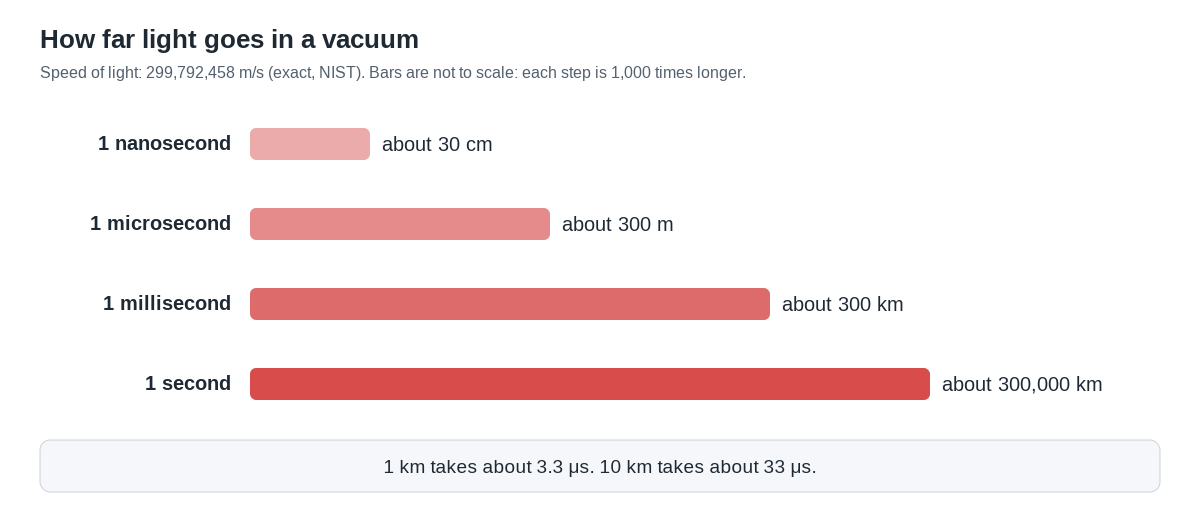
A target 1 km away is reached in about 3.3 μs, and even one 10 km away in about 33 μs. No human eye can split a few tens of millionths of a second, so firing and arrival look like the same instant. A glowing bolt hanging in the air as it travels is a piece of screen design.
Scene 4: The target explodes on contact
Question. If light arrives almost instantly, shouldn't the target burst the moment it is hit?
Answer: arriving and damaging are two different things. What laser light does is deliver energy to the spot it hits, and that energy is absorbed and becomes heat. For a material to fail, heat must build up in one place and raise the temperature, and temperature does not jump in an instant.
The Congressional Research Service (CRS) report on directed energy weapons notes both sides. Laser light reaches a target almost instantly, but the laser must stay focused on one spot to cause disabling damage, which can take seconds depending on the laser power. "Instantly" is the travel time of the light; "seconds" is the time for heat to build.
The time a beam stays on the same spot is called dwell time. Why it takes seconds, and what stretches that time, continues in Why a laser weapon does not finish "the instant it fires".
Scene 5: A red laser grid in a dark room
Question. Red laser lines crisscross a corridor in front of a vault, and the hero twists through the gaps. Would the lines really be that sharp?
Answer: half right. Some films show a character sprinkling smoke or powder to reveal hidden lines, and that part fits the physics. Smoke is made of tiny particles that send light in all directions, including toward someone standing to the side. A physics Q&A page at the University of Illinois makes the reverse point: without the smoke, no light comes to your eyes, so you cannot see the beam's path.
In a dark room with clean air, the story changes. The lines are nearly invisible, and you see only the dots where the light lands on a wall or a body. Bright red lines hanging in mid-air from the start are the part that does not fit.
The eye is the other thing the scene glosses over. Beams brush across faces as if nothing happens, but laser hazards vary widely with power.
The U.S. Food and Drug Administration (FDA) sorts lasers by laser safety class. Even the class that covers laser pointers (IIIa, IEC 3R) can be momentarily hazardous to view directly, depending on power and beam area. Class IV (IEC 4), which includes laser light show projectors, is listed as an immediate eye and skin hazard from either the direct or the reflected beam. What separates the classes is laid out in Laser safety: classes and how to read eyewear labels.
Scorecard for the five scenes
Put the five scenes on one page and the result looks like this. Four are wrong, and only the last is half right, when there is smoke.
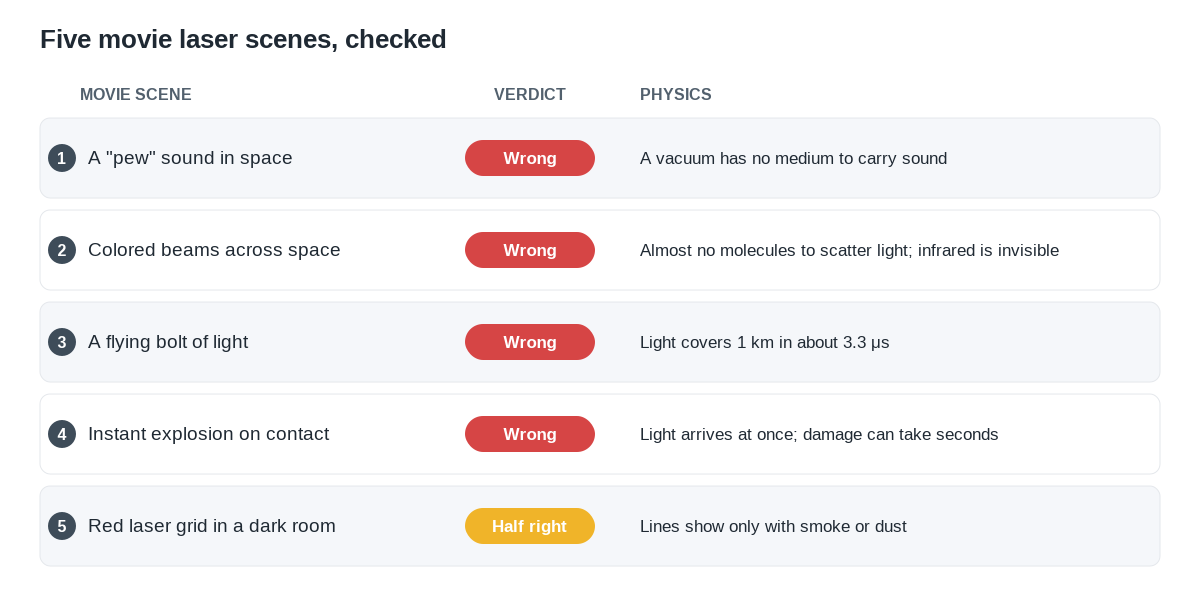
| Scene | Verdict | Physics |
|---|---|---|
| A "pew" in space | Wrong | A vacuum has no medium to carry sound |
| Colored beams across space | Wrong | Almost no molecules scatter light, and infrared beams are invisible anyway |
| A flying bolt of light | Wrong | Light covers 1 km in about 3.3 μs |
| Instant explosion on contact | Wrong | Light arrives at once, but damage can take seconds depending on power |
| A red laser grid in a dark room | Half right | The lines show only with smoke or dust |
This is no reason to blame the movies. Film a silent, invisible beam as it really is and the audience cannot tell what happened. So films give light a color, a sound and a speed. To understand real lasers, take that costume off: they are quiet, usually invisible, arrive almost instantly, and do their work while heat builds up.
What to read next
- Why you can't see a laser beam from the side: scattering, the idea behind scenes 2 and 5
- Why a laser weapon does not finish "the instant it fires": where the "seconds" in scene 4 come from
- What is a laser weapon? Film versus reality: what real laser weapons do and where they are used