Does it make sense to spend an interceptor missile on one small drone? As drones become common, many militaries are working on that question, and lasers keep coming up as one possible answer. On December 28, 2025, the Israel Ministry of Defense announced that it had handed the first unit of its Iron Beam laser air defense system to the military.
This article follows the public record of Iron Beam, from a joint program with the United States in the 1990s to that first delivery. It then looks at counter-drone lasers in the United States, the United Kingdom, France, Germany, the Netherlands and South Korea, noting the stage that official announcements give for each. Last, it gathers the limits that official sources point out themselves. This article reflects information as of October 2026.
Why lasers for drones
Why drone defense needs more than one device is covered first in Counter-drone systems: why one device is not enough. A laser is one slot in that toolbox. The threat here is the unmanned aerial system (UAS), usually called a drone.
The first reason is cost. Compared with traditional munitions, high-energy laser (HEL) weapons might need less logistics support and cost less per shot, according to a 2024 report by the Congressional Research Service (CRS). Many current U.S. programs use solid-state lasers that run on electricity, so the cost per shot equals the cost of the power used to fire it.
The second reason is depth of magazine. An interceptor missile can only be fired as many times as there are missiles on board, and then the launcher must be reloaded. A laser can have a deeper magazine, on the condition that it has a sufficient power supply. When the U.S. Army announced its E-HEL program in September 2026, it described this as "a magazine that regenerates with the system's power supply."
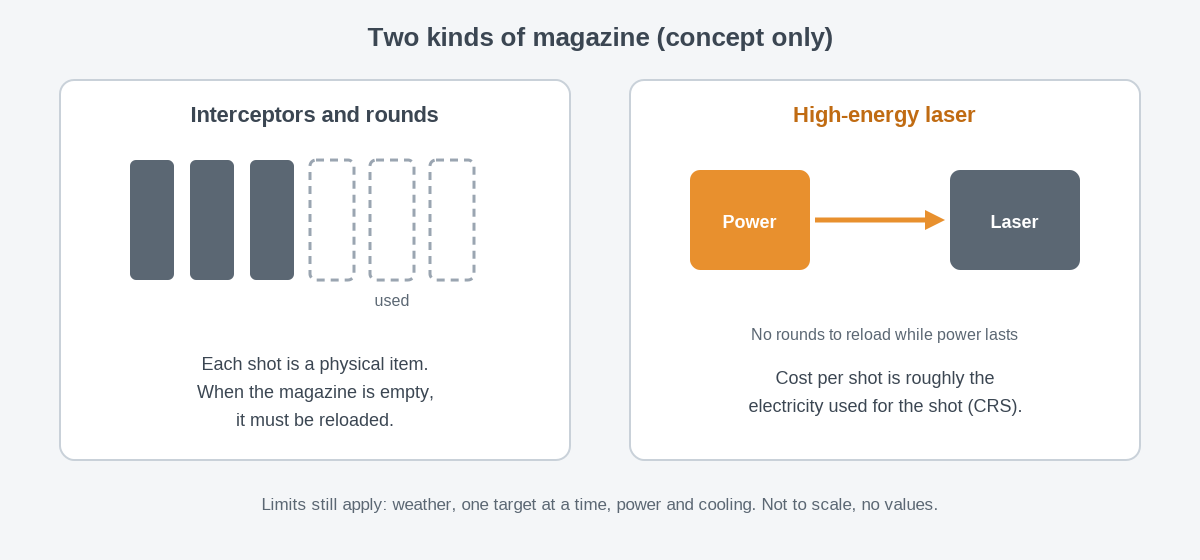
The right panel of the figure is only a concept. In practice, power and cooling decide how large and heavy the system is, and weather and the number of targets limit when a laser can be used. How the cost per shot is counted is covered separately in The cost of drone defense.
Iron Beam's roots: from Nautilus to Iron Dome
Israel's work on laser air defense began as a joint program with the United States. Israel's main laser program, called Nautilus, started in 1996. Its goal was to develop, together with the United States, a laser system that could shoot down Katyusha rockets, artillery shells and mortar shells.
The program did not last. In 2006 the Pentagon cancelled it. Israel then turned to Iron Dome, a program that relies on interceptor rockets rather than lasers. Today's well-known Iron Dome grew out of the gap the laser left.
The name Iron Beam comes later. A 2018 CRS report, citing press reports, says Israel started the Iron Beam program in early 2014. The idea was to use a high-power laser against short-range rockets, artillery and mortar rounds, and UAVs, working alongside Iron Dome. As of the 2018 edition, it was still unknown when the Israel Defense Forces (IDF) would deploy it.
The larger shift in laser weapons, from chemical lasers to lasers that run on electricity, is told in A history of laser weapons: from chemical to electric lasers.
Iron Beam: from funding to first delivery
On April 24, 2024, a supplemental appropriations law was enacted in the United States (Public Law 118-50). Its Israel Security Supplemental Appropriations Act, 2024, sets aside $1.2 billion for the Government of Israel to procure the Iron Beam defense system against short-range rocket threats. The country that dropped the joint laser program in 2006 now set aside money for Israel to buy a laser system.
The first system reached the military 20 months later. The handover took place on December 28, 2025, at a ceremony held at Rafael's main site in the north of the country. There the ministry's Directorate of Defense Research & Development (DDR&D) and the prime contractor, Rafael, handed the first Iron Beam laser system over to the IDF. Elbit Systems was responsible for the laser source.
Iron Beam has a supporting role. It will be integrated into the Israeli Air Force and join the multi-layered air defense network as a capability that complements Iron Dome, David's Sling and Arrow. In tests against a range of threats, the system intercepted rockets, mortars and UAVs.
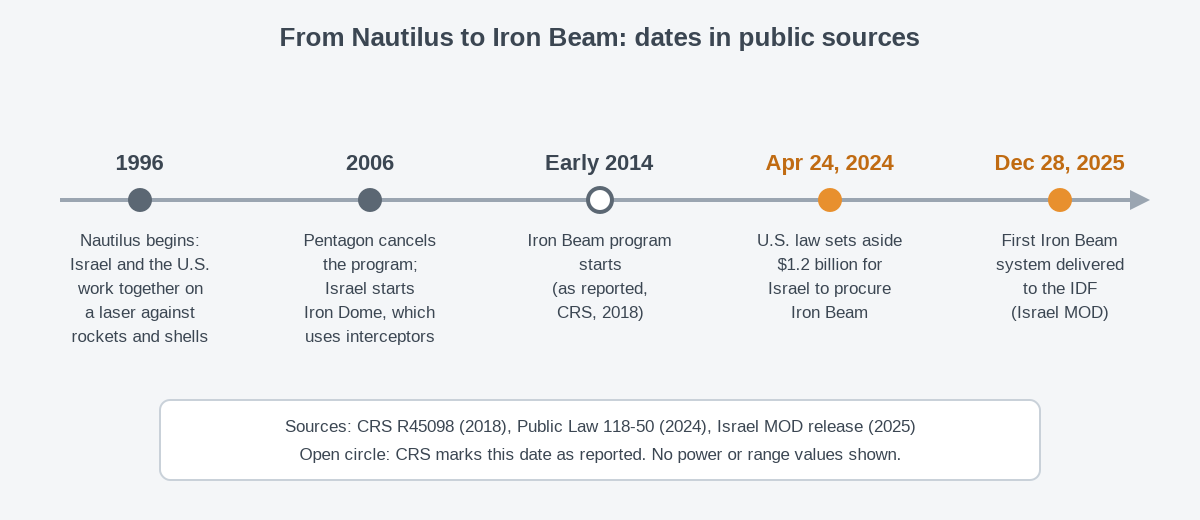
Judgments in an announcement belong to the people who made them. The defense minister said that "for the first time globally" a high-power laser interception system had reached full operational maturity. The ministry's director general said the delivery completed the first phase, the move from development to serial production, with more systems already being built.
What about numbers? No power or range values for Iron Beam appear in the Israeli ministry's announcement. If a news story quotes such figures, it is worth asking first where they came from.
United States: from shipboard prototypes to a first production contract
The United States first took on drones at sea. From 2009–2012 the Navy tested a prototype solid-state laser called LaWS against UAVs, first on land and then aboard a ship at sea.
On May 16, 2020, the amphibious ship USS Portland used a prototype laser, LWSD, to disable a UAV during a test at sea. The Navy announced the result on May 22.
Destroyers came next. HELIOS aims to develop and field quickly a 60 kW-class high-energy laser and a dazzler in one system. Its intended uses include countering UAVs, small boats and surveillance sensors. The system was installed on the destroyer USS Preble.
The Army put lasers on vehicles. DE M-SHORAD mounts a 50 kW laser on the Army's Stryker vehicle. The goal is short-range air defense for combat brigades.
In February 2024, the Army sent four prototypes to the Middle East so soldiers could test them against aerial threats. The July 2024 edition of a CRS report gives this as reported in the press. Early soldier feedback was described as "not overwhelmingly positive," and officials were quoted saying that lab and test range results differ greatly from the tactical environment.
On September 2, 2026, the U.S. Army announced an other-transaction agreement with AeroVironment for production under the E-HEL program. The Army said it was the first contract it had signed to produce a high-energy laser weapon. The contract value and a related pilot program at U.S. bases are covered in The US Army E-HEL laser contract and the directed-energy pilot at US bases.
Europe and Korea: test ranges, contracts, fielding
The United Kingdom tested a naval laser and an Army laser in the same year. On January 19, 2024, DragonFire carried out the first high-power laser weapon firing in the UK against targets in the air, at the Hebrides Range. The Ministry of Defence and the Defence Science and Technology Laboratory (Dstl) announced the trial and noted that DragonFire's range is classified. On December 11, the government announced that the Army had, for the first time, fired a laser from an armored vehicle, the Wolfhound troop carrier, and destroyed flying drones.
The announcement of November 20, 2025, was about a contract. MBDA received a £316 million contract under which new DragonFire systems go to the Royal Navy starting in 2027. DragonFire is also to be fitted to a Type 45 destroyer by 2027. In this release the ministry put the cost per shot at £10.
France signed a contract ahead of the Olympics. On June 8, 2022, the French defense procurement agency (DGA) notified CILAS of the L2AD counter-drone laser contract. Worth up to 10 million euros, it buys an operational prototype that can identify, track and neutralize mini and micro drones weighing 100 g–25 kg. The goal was to deploy the prototype at the 2024 Olympic and Paralympic Games.
On April 10, 2026, the German armed forces (Bundeswehr) presented demonstrators at their test range. JUPITER, a German-Dutch project, places laser weapon technology in a module of the Boxer vehicle and is meant for use against both drones and munitions. Laser demonstrator 24, aimed mainly at drones, is to be market-ready from 2028. The demonstrator of the Navy project HoWiSM is planned to be ready in 2029 for harbor protection and self-protection at sea.
The Netherlands recorded its next step in a letter of intent with the Australian company EOS, signed by the state secretary for defense and announced on September 24, 2026. The two plan to develop the laser technology further into a defensive weapon the military can use. If that succeeds, the Netherlands intends to buy a number of laser systems. Details are in Dutch defence ministry signs letter of intent with EOS to develop and possibly build a counter-drone laser weapon.
On June 25, 2024, South Korea signed a mass production contract for its laser anti-air weapon (Block-I) with Hanwha Aerospace. The Defense Acquisition Program Administration (DAPA) announced it on July 11. The system can precisely strike small UAVs, multicopters and similar targets at short range, and DAPA put the cost of one shot at 2,000 won. A DAPA release of June 1, 2026, names the weapon Cheongwang and says it was fielded in December 2024.
In its 2026 release DAPA also called Cheongwang the "world's first" among laser anti-air weapons. Placed next to the Israeli minister's "for the first time globally," the two "firsts" are statements by two agencies that draw the boundary in different ways. Neither is a ranking that anyone checked against other countries' announcements.
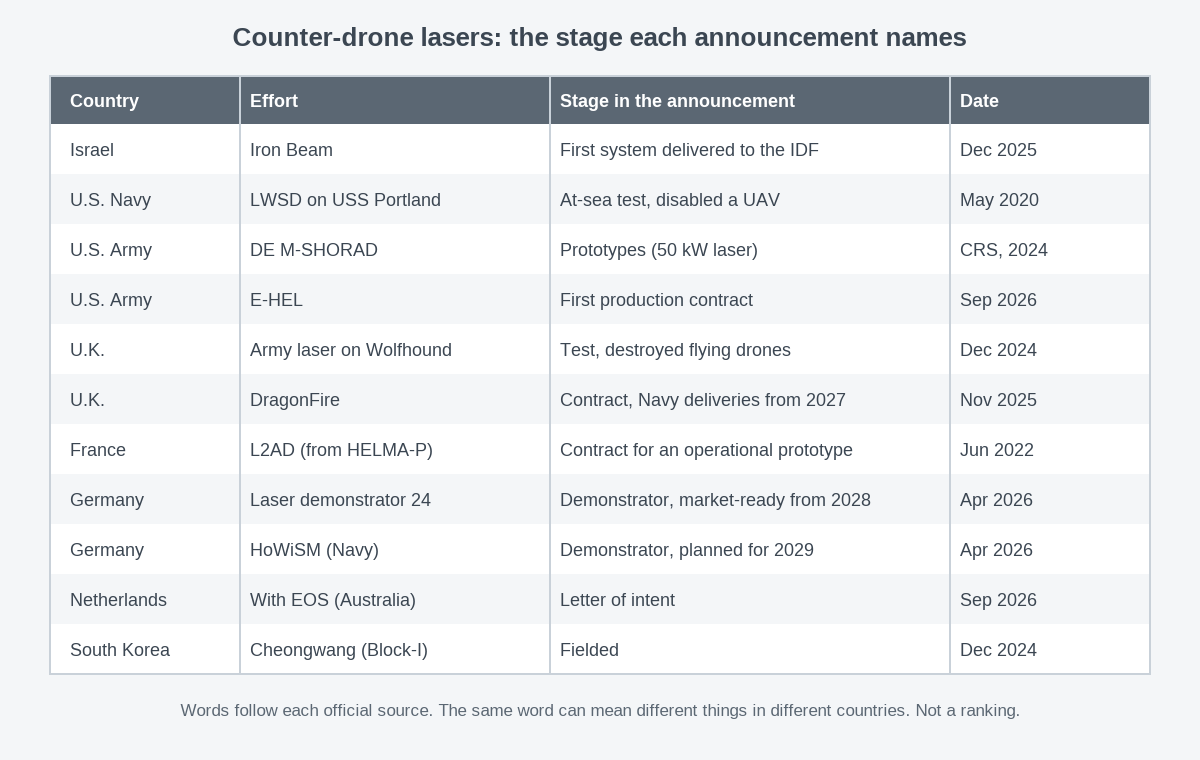
The words in the table are the words each announcement used. Fielded, delivered, production contract and demonstrator are used in different places by different countries, so the same word does not always mean the same stage. Each country's full set of announcements is in Laser weapon programs that have been made public. How these words differ is covered in How to read laser weapon news: "kW-class", "range" and "cost per shot".
Limits named in official sources
Official sources from countries testing lasers write down limits along with the advantages. Weather comes first. In rain or fog, a laser may work poorly or not at all, CRS says, so it cannot cover every kind of weather. Fog, rain and dust can also weaken the beam, and shimmering air near the ground can affect precision.
The air the beam passes through is another issue. A laser that keeps firing in the same direction heats the air along its path, and the heated air blurs the focus of the beam. This is called thermal blooming. What happens to light in the atmosphere is explained in more detail in Light through air: absorption, scattering, turbulence, thermal blooming.
The number of targets is limited too. A high-energy laser engages one target at a time, takes several seconds per target, and several more to turn to the next. That caps how many targets it can handle in a given time.
The system itself carries a load. Needs for size, weight and power (SWaP), along with cooling, can shorten the reach of a directed-energy weapon (DEW) and lower its beam quality. Manufacturing technology is another hurdle, along with the high quality needed in lasers, optics, cameras and mechatronics.
The gap between test range and field also remains. The DE M-SHORAD soldier feedback above is one example. It is also worth noting that the Iron Beam release describes the laser as a complement to existing air defense systems. How lasers share the work with interceptor missiles and guns is covered in Lasers, interceptor missiles and guns: how they share the work.
What to read next
- Laser weapon programs that have been made public: each country's announcements from this article, one by one, with dates and stage words.
- Strengths and limits of laser weapons: weather, target numbers and power, starting from the principles.
- Lasers and high-power microwaves: two kinds of directed energy: another approach grouped under directed-energy weapons.
- "Stopping Drone Swarms with High-Power Microwaves": an article in the same counter-drone series that is still being written.