Light usually warms whatever it falls on. Yet in the mid-1980s, in a laboratory in New Jersey, laser light was used to do the opposite and cool atoms down. In the middle of a vacuum chamber, where six laser beams met, a pea-sized ball of glowing atoms hung in place. The roughly one million sodium atoms gathered inside were moving at only about 30 cm per second.
How can shining light on atoms make them slower and colder? There are two clues. A single particle of light gives an atom a very small push, and a moving atom sees the color of light slightly shifted. Combining these two ideas to cool and trap atoms earned the 1997 Nobel Prize in Physics.
Temperature is how fast atoms move
The temperature of a gas describes how fast its atoms are moving. According to the 1997 Nobel announcement, the atoms and molecules in room-temperature air dart about at around 4,000 km/h. Atoms that fast leave the spot you are trying to observe almost at once.
Why not simply make the gas cold? A gas that is cooled normally turns into a liquid first and then freezes solid. The atoms then sit so close together that single atoms become even harder to study. In a vacuum the atoms can be kept sparse enough not to freeze, but even at -270°C they still move at about 400 km/h.
Speeds drop sharply only very close to absolute zero (-273°C). One-millionth of a degree above it is called 1 µK, or one microkelvin. At that temperature, a free hydrogen atom moves at 25 cm per second, under 1 km/h.
People building atomic clocks faced the same problem. At room temperature, atoms dart about like a cloud of bees, so there is little time to measure the vibrations inside them. Slower atoms can be watched for longer.
The small push of one photon
Light can be described as a stream of particles called photons. A photon has no mass in the ordinary sense, but it does carry momentum. So a photon that hits an atom can hand its momentum over to that atom.
Not just any light will do. An atom takes in only photons whose energy matches its inner structure, its energy levels. Because a photon's energy is proportional to the light's frequency, each kind of atom accepts light of a set color. The basics of absorption and emission also appear in Light basics.
When an atom absorbs one photon from a beam coming toward it, it picks up that momentum and slows a little. After a very short time, normally about a hundred-millionth of a second, the atom gives out a photon. The recoil from this spontaneous emission points in a different direction each time. The kick taken in always comes from one side, while the kick given out goes any way, so after countless repeats the atom's speed falls a great deal.
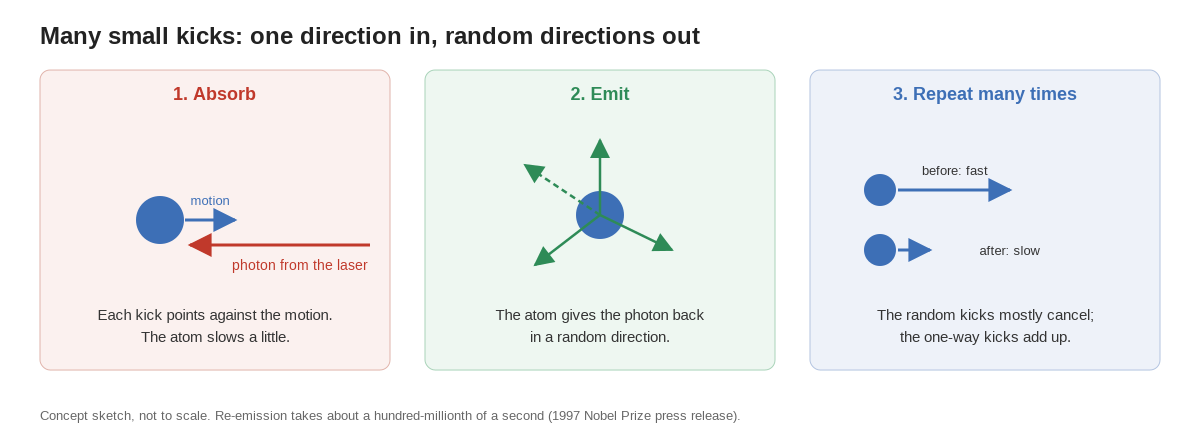
Picture a sled hit again and again by snowballs thrown from straight ahead. Each hit is small, but together they bring the sled to a stop.
A real atom differs from the sled in two ways. It accepts only light of the right color, and it throws the light straight back out in another direction.
These small kicks still add up to a lot. The Nobel announcement compared their strength, under the right conditions, to throwing a ball upward on a planet with 100,000 times Earth's gravity.
Slowing only the atoms coming closer: Doppler cooling
One problem remains. Atoms move in every direction, and light that pushes all of them would speed some of them up. The trick is to push only the atoms moving toward the light. This is where the Doppler shift comes in.
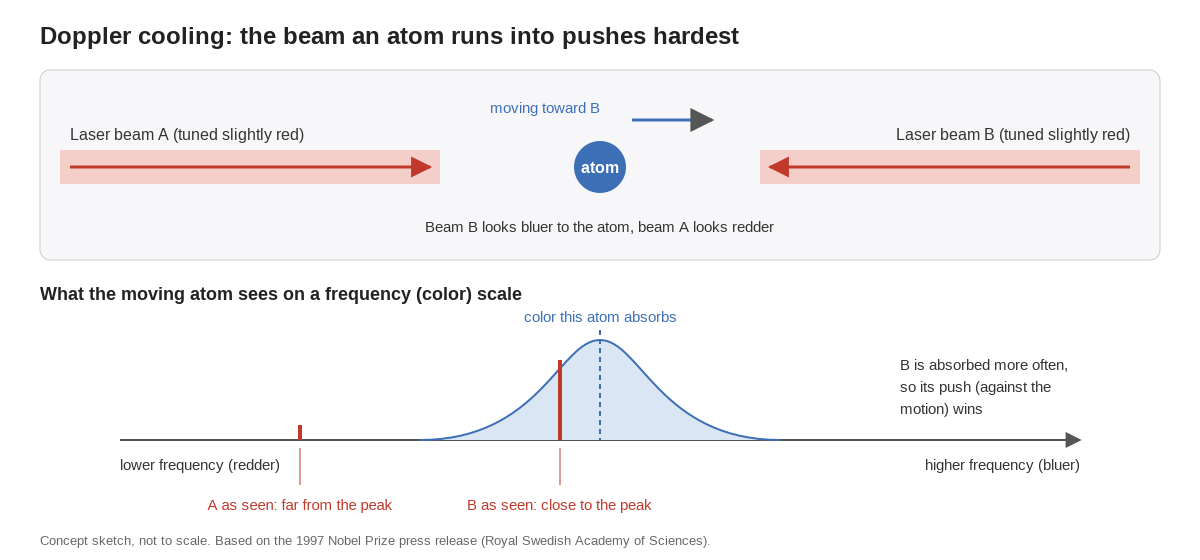
A train whistle sounds higher as the train approaches. In the same way, an atom racing toward a beam sees the light's frequency as slightly higher. So the beam must be set a little lower in frequency than the color a resting atom absorbs, slightly toward the red.
Light tuned like this does little to atoms at rest or moving away, and is absorbed best by atoms running into it.
What happens with beams aimed at each other from both sides? If the atom moves right, the right-hand beam is absorbed more and pushes it left. If it moves left, the left-hand beam pushes it right. Whichever way the atom moves, it feels a force against its motion.
Optical molasses in six beams of light
Around 1985, Steven Chu and his colleagues worked out this method at Bell Laboratories in Holmdel, New Jersey. Their setup had six beams, two facing each other along each of three directions at right angles. Sodium atoms flying through the vacuum were first stopped by an opposing beam, then guided into the spot where the six beams crossed.
All six beams were tuned slightly redder than the color a resting sodium atom absorbs. Whichever way an atom tried to escape, it met photons of the right energy and was pushed back toward the middle. A pea-sized glowing cloud formed there, visible to the naked eye and holding about one million atoms. This was named Doppler cooling.
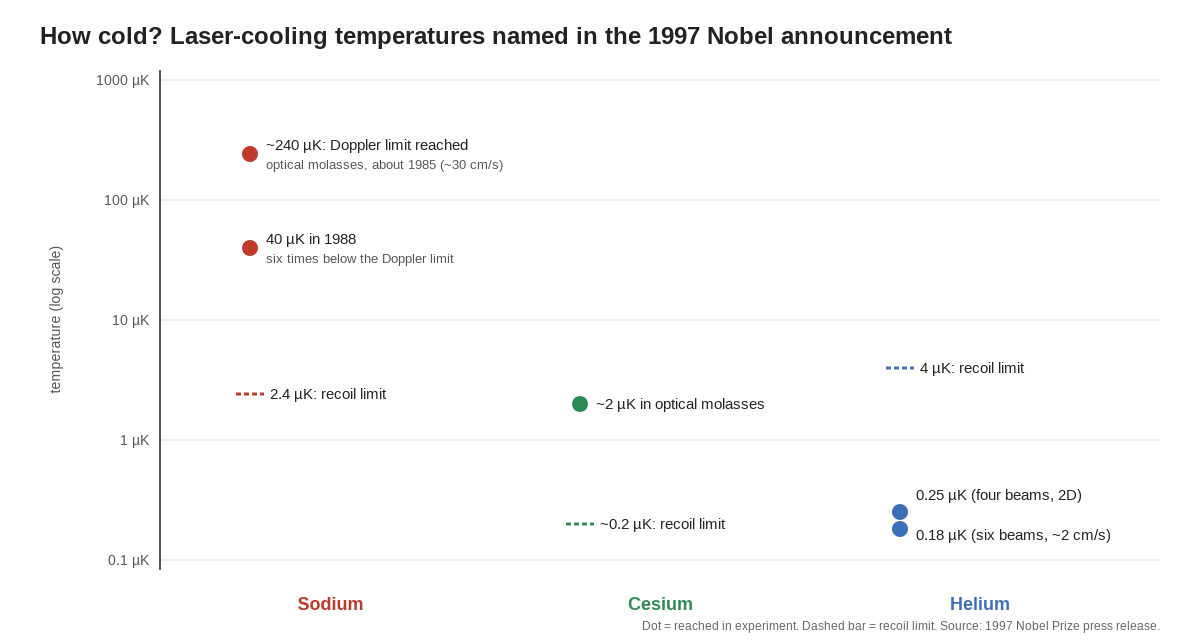
Where the beams cross, atoms move as if wading through a thick liquid. That gave the name "optical molasses." With the lasers switched off, the measured temperature was about 240 µK, which for sodium means a speed of about 30 cm/s. This matched a theoretical value, the Doppler limit, then thought to be the lowest temperature Doppler cooling could reach.
Holding the cooled atoms in place was a separate task. Atoms in optical molasses are cooled but not captured, so gravity pulls them out in about one second. The magneto-optical trap (MOT), built in 1987, added two magnetic coils to the same six beams so that the force drawing atoms to the center became stronger than gravity. The device that switches laser frequency quickly in experiments like these is covered in Acousto-Optic Modulators.
Colder than the theoretical floor
William D. Phillips began trapping and cooling atoms with lasers soon after he arrived in 1978 at the U.S. National Bureau of Standards (NBS), now NIST. His first aim was a more accurate atomic clock.
In the early 1980s he built the Zeeman slower, a device that uses a magnetic field and an opposing laser beam to slow an atomic beam. In 1985 he stopped sodium atoms and held them in a purely magnetic trap.
Once Chu's optical molasses appeared, Phillips measured the temperature of the atoms inside it with care. One method let the atoms fall under gravity and tracked their fall with a measuring laser. The 1988 result was 40 µK. That is six times lower than the Doppler limit, the supposed floor.
Was the theory wrong? The Doppler limit had been worked out for an overly simple model atom. A real sodium atom has a more complex set of lowest energy levels.
In Paris, the group of Claude Cohen-Tannoudji at the École Normale Supérieure had already worked out such complex cooling schemes on paper. The new process was named Sisyphus cooling, after the figure from myth who reaches the top of a hill only to find another uphill slope.
There is still another floor. The temperature matching the recoil an atom gets from giving out one photon is called the recoil limit. It is 2.4 µK for sodium and about 0.2 µK for the somewhat heavier cesium. Phillips and the Paris team cooled cesium atoms in optical molasses to about 2 µK, roughly ten times the recoil limit.
The Cohen-Tannoudji group went below even the recoil limit. As long as the slowest atoms keep taking in and giving out photons, the recoil leaves them with some temperature. So between 1988 and 1995 the group developed a method that used the Doppler effect to switch only the slowest atoms into a "dark" state that absorbs no photons.
Working with helium, whose recoil limit is 4 µK, they reached 0.25 µK in two dimensions with four beams and 0.18 µK in three dimensions with six. At that point the helium atoms crawl along at about 2 cm per second.
The October 1997 announcement
The Royal Swedish Academy of Sciences announced on 15 October 1997 that the year's Nobel Prize in Physics would go jointly to three people. They were Steven Chu of Stanford University, Claude Cohen-Tannoudji of the Collège de France and the École Normale Supérieure in Paris, and William D. Phillips of NIST in Gaithersburg, Maryland. Each received one third of the prize.
The prize was "for development of methods to cool and trap atoms with laser light." The announcement explained that single atoms could now be studied very precisely, down to their inner structure. The result came from a chain of work rather than one experiment. Doppler cooling and optical molasses, magnetic traps and careful temperature measurements, and theory and experiment that pushed past each limit all fed into it.
Where cold atoms work
The announcement also looked ahead. It named more precise atomic clocks for space navigation and accurate positioning, and atom interferometers that measure gravity very precisely. Chu had built an atomic fountain that sprays cooled atoms upward from a trap like jets of water.
The announcement expected this to give atomic clocks a hundred times more precise than those of the time. The discovery of Bose-Einstein condensates made from atomic gases also rests on this technique.
Laser-cooled atoms now work inside the U.S. time standard. NIST's fountain clocks NIST-F1 and F2 use six infrared laser beams to gather cesium atoms into a ball and cool them close to absolute zero. Vertical beams then toss the ball about 1.3 m high. The atoms rise through a microwave-filled cavity and fall back, and cesium's resonance frequency of 9,192,631,770 Hz defines the second.
The two microwave pulses are about one second apart, against a few milliseconds in a beam clock, and that long gap makes the fountain far more sensitive.
Atomic clocks also connect to defense. The U.S. military solved the problem of sharing precise time around the world with the satellite navigation system GPS, and NIST describes atomic clocks as essential to today's GPS. Because GPS signals can be blocked or faked, physicists have begun building atomic clocks small enough to carry and trying them out aboard ships and aircraft. Chip-scale atomic clocks and defense research programs are covered in Quantum Sensors: The Precision Defense Is Hoping For.
In a laser weapon, the laser is a tool that piles energy onto a target to heat it. In laser cooling, the light's color is set just beside the color one atom absorbs, and the laser becomes a tool for draining away the atom's motion. The same light does opposite jobs depending on what it is tuned to.
What to read next
- Quantum Sensors: The Precision Defense Is Hoping For: how far clocks and sensors built from cooled atoms have come in defense.
- How GPS Works: Satellites Carrying Clocks: how atomic clocks on satellites fix a position.
- What is a laser weapon? Film versus reality: the other side of the story, where light heats a target.