An attack helicopter's rocket launcher holds a number of slender rockets. The Hydra 70 rocket, 2.75 inches or about 70 mm across, dates from the Cold War and originally had no guidance at all. Once it left the launcher, its path could not be corrected.
Insert one small segment in the middle of that rocket, though, and its character changes. It becomes a precision-guided weapon that homes on a spot lit by a laser. The U.S. APKWS (Advanced Precision Kill Weapon System) is one example. This article looks at what was inserted, what changed as a result, and why the name keeps coming up in counter-drone systems.
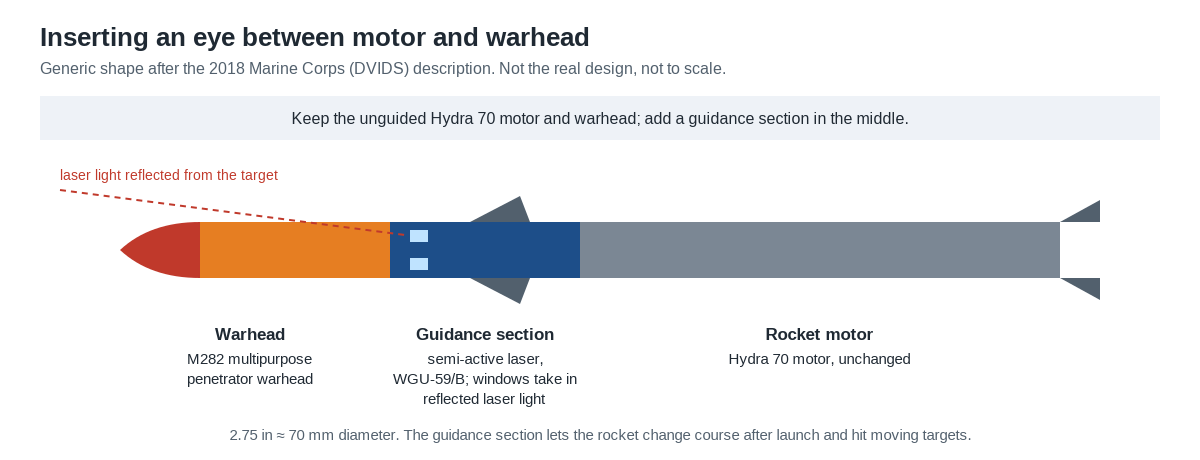
A segment between motor and warhead
A 2018 Marine Corps article on the Defense Visual Information Distribution Service (DVIDS) describes the rocket in three parts. They are the motor, the M282 warhead and the guidance unit. APKWS II adds a guidance unit, the WGU-59/B, that uses semi-active laser guidance, to the middle of the existing 2.75-inch rocket. It turns the unguided Hydra 70 into a highly accurate precision-guided munition (PGM).
The key point is that the existing motor and warhead are kept, rather than building a new rocket from scratch. With the guidance unit in place, the rocket can change course after launch and hit moving targets.
An eye that follows light: semi-active laser guidance
The guidance unit gives off no light of its own. In semi-active laser guidance, a separate laser designator lights the target, and the round's seeker follows the laser light bouncing off it. Lighting and following are split between two pieces of equipment, hence "semi-active."
This approach reached missiles and bombs before rockets. The U.S. Army's Redstone Arsenal history office records the 1972 goal for HELLFIRE: a helicopter-launched anti-tank weapon with laser semi-active guidance. A laser seeker was one of its key parts. Ground and vehicle laser designators from the same period marked targets for laser-homing weapons like it.
The principle is explained in detail in Laser-Guided Bombs: Following a Reflected Laser Spot.
What guidance adds to an unguided rocket
The same Marine Corps article sums up three changes. First, the smaller warhead can still destroy a point target while greatly reducing collateral damage. So targets close to friendly forces can be struck more safely.
Second, because it replaces a larger 5-inch high-explosive warhead, an aircraft can carry more of them. Third, the weapon itself becomes more accurate.
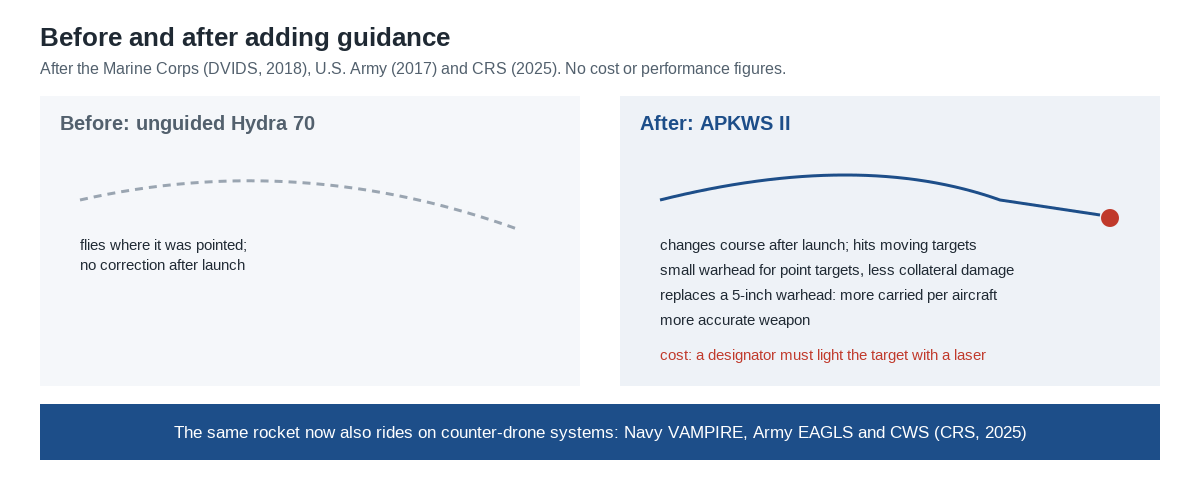
There is a cost. Because the method is semi-active, a separate designator has to light the target with a laser. The same condition applies to laser-guided bombs. What happens in weather where light struggles to get through is covered in Laser Designators: Pointing Out a Target with Light.
From helicopters to fighters, and abroad
A January 2017 U.S. Army article describes one scene of the rocket leaving the United States. APKWS rockets delivered to the Iraqi Army Aviation Command in December went into operations within days.
The equipment came through a Navy foreign military sale, and the Army handled the software integration that let Iraq's Bell 407 helicopters fire it. An official in the article said the system lets units swap standard rockets for a laser-guided rocket capability. The article also repeats a claim by the manufacturer, BAE Systems, of a hit rate above 93%.
The rocket that began on helicopters spread to fixed-wing aircraft. The Air & Space Forces Magazine weapons page says the U.S. Air Force bought the system to meet an urgent operational need. An F-16 first fired it in combat in June 2016. The first weapons came from Navy stocks.
A name that returns in the drone era
Today the rocket's name comes up most often in counter-drone systems. A 2025 Congressional Research Service (CRS) report says the services have sought to reuse older-generation missiles, built for air or ground targets, as counter-drone interceptors. Some experts see this as a cheaper option than conventional surface-to-air missiles. APKWS appears in three such systems: the Navy's VAMPIRE, the Army's EAGLS and the Army's Containerized Weapon System (CWS).
A footnote in the same report gives the rocket's background. Hydra-70 started life as a weapon fired from aircraft at ground targets; only later was it reworked to fire upward from the surface. BAE Systems said in 2021 that trials of a ground-fired APKWS against drones were under way. According to the magazine page, the Air Force's counter-drone work led to the AGR-20 FALCO, which adds an infrared seeker for fire-and-forget use against airborne targets.
The various routes to low-cost interceptors against cheap drones continue in Low-Cost Interceptors for Cheap Drones: The Return of the Guided Rocket.
What to read next
- Laser Designators: Pointing Out a Target with Light: the side that marks the spot the rocket follows
- Laser-Guided Bombs: Following a Reflected Laser Spot: the same principle applied to bombs
- Low-Cost Interceptors for Cheap Drones: The Return of the Guided Rocket: the counter-drone side of the story
- The Thanh Hoa Bridge, 1972: How Laser-Guided Bombs Changed Bombing: the event that first showed laser guidance on a large scale