Picture the job of protecting a single base. Birds cross the sky, approved drones pass through, and now and then a small aircraft of unknown origin comes closer. Could one radar and one type of interceptor handle all of that?
In October 2024, U.S. Army Major General David Stewart described countering drones as a "layered defense, and no one single bullet is going to solve this problem." This article looks at what those layers actually stack up. It covers overlapping sensors, mixing tools of different kinds and layers that change with the place being protected. It also covers what holds them together and the problems that remain.
This article reflects the situation as of October 2026. It draws on public U.S. sources and leaves out operational detail such as the distances or positions each layer covers.
What "layered" means
Small unmanned aircraft systems (UAS), or drones, are awkward to defend against. Many drones fly at a size, speed and altitude that cause trouble, and they are becoming more common, flexible, affordable and sophisticated. These traits are widely regarded as a serious technical and operational burden for the U.S. Department of Defense. The defenses vary just as much, from full air defense systems down to handheld jamming devices.
A 2025 Congressional Research Service (CRS) report says the Department is gathering such systems to build what Army doctrine calls a "layered" defensive capability against drones. The doctrinal definition, quoted in one of its footnotes, centers on a defense that "provides multiple engagement opportunities." Army officials and some commentators have called layered defenses against drones an imperative for military forces.
What goes into the layers? Using threats like cruise missiles as its example, a 2023 Government Accountability Office (GAO) report lists three ingredients for an integrated and layered defense. They are sensors that find and follow threats, interceptors such as guns, surface-to-air missiles or directed energy weapons (DEW), and a command and control (C2) system. The drone defense systems described below use the same three ingredients.
Think of several sieves stacked on top of each other. Whatever slips through the first one gets another chance to be caught by the second. Real defenses differ. Each layer is not just a different mesh but a different kind of equipment, and people and the command and control system decide which layer takes on what.
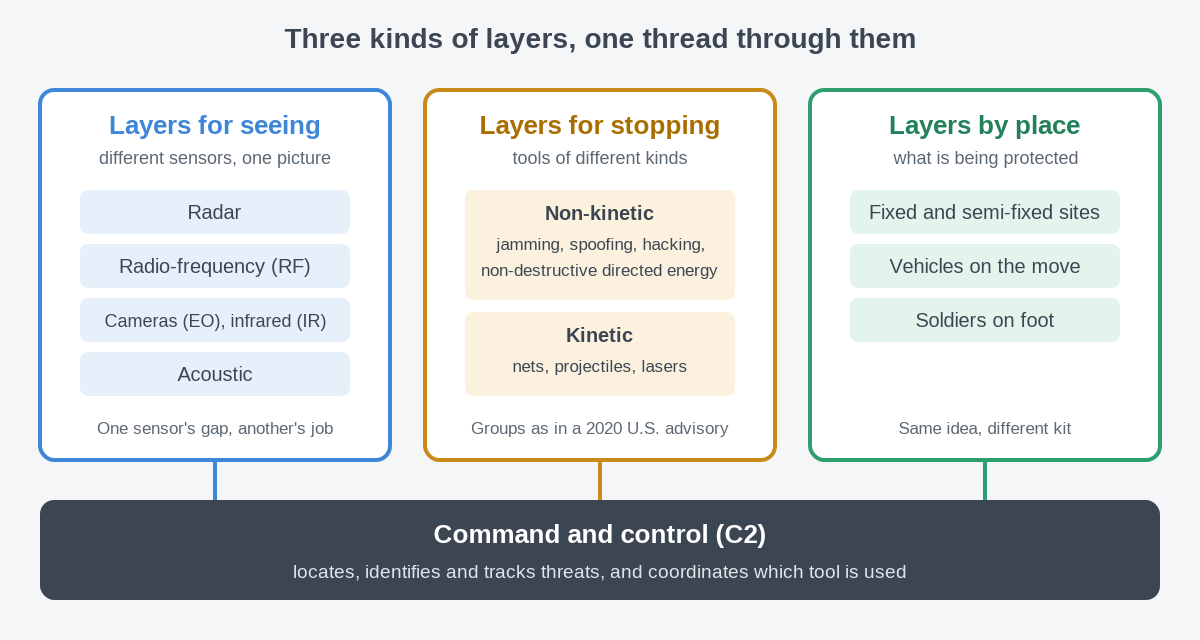
How ballistic missile defense splits its layers by flight phase is covered in "Layered missile defense: why defense comes in layers." Here the layers of drone defense are split three ways: layers for seeing, layers for stopping and layers by place.
Layers for seeing: stacking sensors
There are several ways to find a drone. Four U.S. agencies issued a joint advisory in August 2020: the Federal Aviation Administration (FAA), the Department of Justice, the Federal Communications Commission (FCC) and the Department of Homeland Security. According to it, drone detection and tracking systems commonly use radio-frequency (RF) sensing, radar, electro-optical (EO) cameras, infrared (IR) or sound, alone or combined.
One method alone is sometimes not enough. Cameras, infrared and acoustic sensors and radar do not always detect small drones, because their signatures and size are small. A further method listens for the radio signals used to control the drone. The methods can be put together for a stronger, layered way of detecting, and they often are.
Merging data from several sensors is called data fusion. In drone detection, data fusion could improve a detection system by overcoming or easing the problems and drawbacks of individual sensors. Gathering the dots each sensor draws into one shared picture is the subject of "Integrated air defense and sensor fusion."
Each sensor type gets its own article in this series, still being written. They are "Radars That Find Small Drones," "Finding Drones by Their Radio Signals: RF Detection and Direction Finding" and "Finding Drones with Cameras, Infrared and Sound."
Layers for stopping: mixing different tools
The tools for stopping a drone fall into two broad groups. In the grouping used by the joint advisory, jamming, spoofing, hacking and non-destructive directed energy weapons are non-kinetic. Nets, projectiles and lasers are kinetic. Documents differ on where lasers belong, and this site's "Counter-drone systems: why one device is not enough" shows them under directed energy instead.
The interim systems endorsed in 2020 by the Joint Counter-small UAS Office (JCO) already drew on several groups. They mixed sensors, command and control systems, and both kinetic and non-kinetic effectors. The Department is still exploring many options: new ground-launched interceptors that may cost less, gun-based answers, electronic warfare, directed energy, and high-power microwave (HPM) systems.
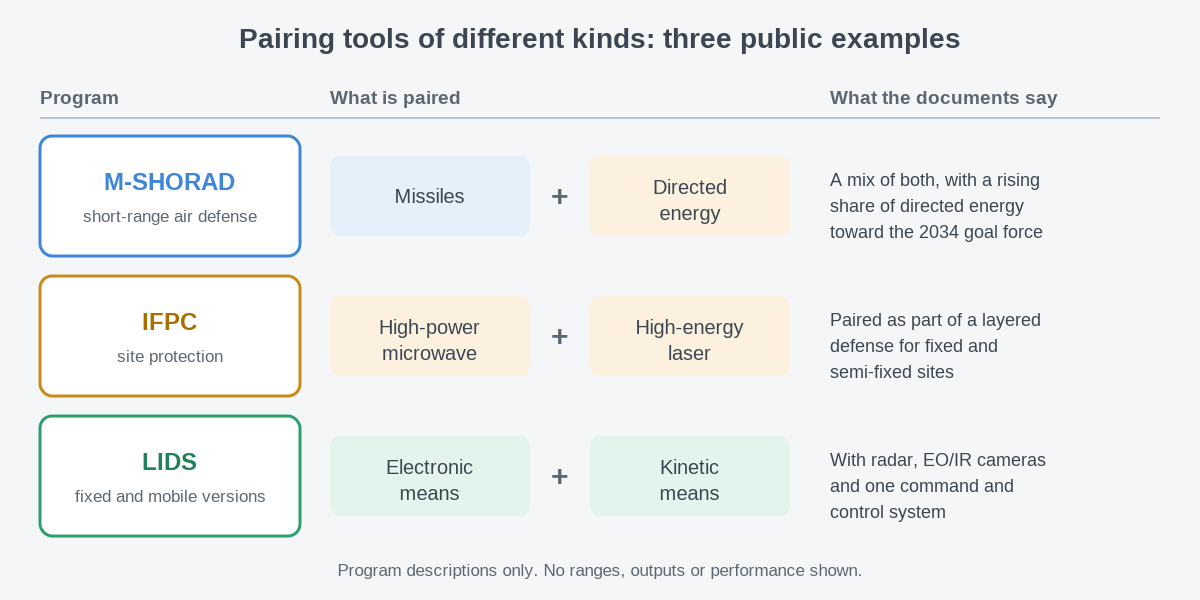
Some public programs go further and pair two different kinds of tools on purpose. Under the Army's Air and Missile Defense 2028 strategic plan, Maneuver Short-Range Air Defense (M-SHORAD) battalions are to combine directed energy with missile-based systems. The share of directed energy is to grow as the 2034 objective force is fielded.
Fixed-site protection offers another example. IFPC-HPM, now in development, is a high-power microwave system aimed at swarms of small drones (Group 1 and Group 2). The Army plans to pair it with IFPC-HEL, a high-energy laser (HEL) system, within a layered defense for fixed and semi-fixed sites. The Low, Slow, Small UAS Integrated Defeat System (LIDS) keeps electronic and kinetic means inside one system.
Different layers for different places: bases, vehicles, soldiers
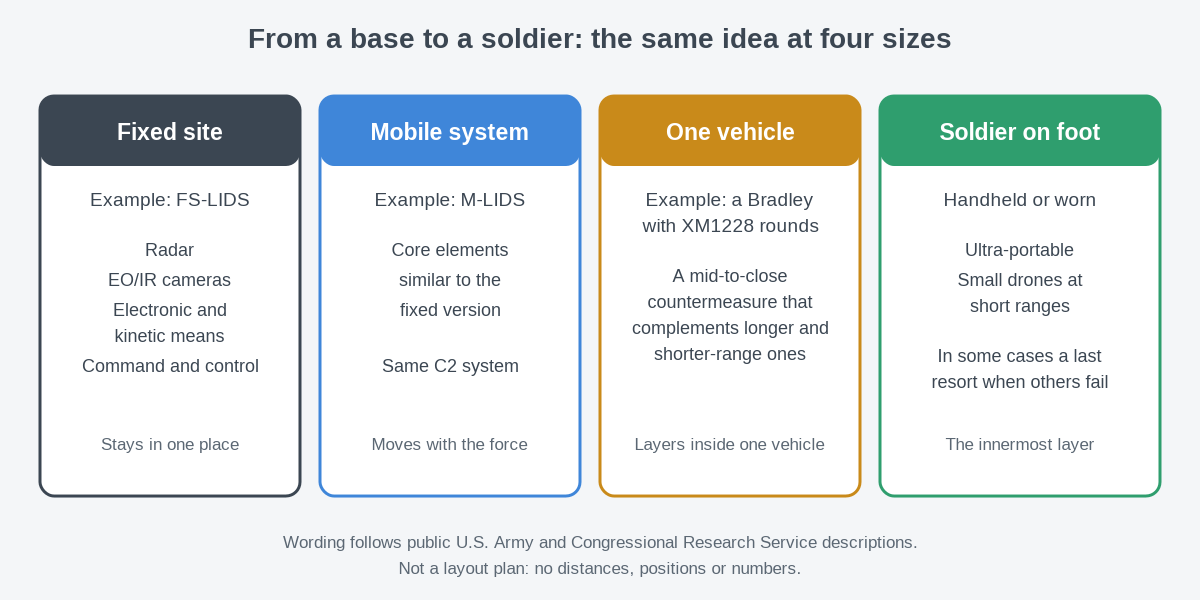
When the place being protected changes, the shape of the layers changes too. In 2023, then-Army Chief of Staff General James McConville described the goal of counter-drone development. It is a linked set of capabilities that commanders can scale and tailor for forces on vehicles, on foot, at fixed sites and at semi-fixed sites. He described that suite as supporting a layered defense and including active, passive and deep sensing.
LIDS is a good example. It is a family of systems made up of a fixed-site version (FS-LIDS) and a mobile version (M-LIDS). Both share similar core parts: radar, EO/IR cameras, a command and control system, and electronic as well as kinetic ways to respond. Both run on FAADC2, short for Forward Area Air Defense Command and Control, the Army's own system.
Layers can also exist inside a single vehicle. Army ammunition program staff describe the XM1228 (BADGER), a counter-drone round for the Bradley infantry fighting vehicle, as a countermeasure for middle and close distances. It works alongside countermeasures that reach farther and ones that act closer in, building a layered defense that mixes kinetic and non-kinetic tools. The same approach extends beyond one vehicle to tying brigade assets together within a division.
At the innermost layer stands a single soldier. Handheld and soldier-worn equipment is made to be ultra-portable and to be used against small drones close by. In some cases it is also the last resort, used when nothing else has worked or nothing else is available.
Command and control holds the layers together
The more sensors and tools there are, the more the links between them matter. Command and control systems find where aerial threats are, work out what they are and follow them. They also coordinate picking and using the countermeasure that best fits each threat. However many layers there are, the job of coordinating between them falls to command and control.
That link is still unfinished. In 2020 the JCO approved three command and control systems for use across the services. The same CRS report also notes observations that the Department lacks common counter-drone command and control software and that some hardware may work only with particular command and control systems.
How the steps from detection to defeat connect is covered separately in a forthcoming article in this series, "The Counter-Drone Chain: Detect, Identify, Track, Defeat."
What layers do not solve
Having many layers does not end the problem. The problems named in public sources fall into five groups.
The first issue is money. Army and Department officials have recognized cost as a key challenge for counter-drone operations. The fact sheet for the Department's 2024 strategy lists "reducing the cost imbalance between unmanned systems and countermeasures" as an objective. The stopping tools are not the only cost, since Army officials have also named the high cost of detection technology such as radar.
The second is testing. Some experts contend that when certain counter-drone systems were test-fired against unrealistic aerial targets, the results overstated how well they work. Checking that each layer does its part requires targets that resemble the real thing.
The third is speed. The Army expects to keep evaluating and fielding new counter-drone systems to keep pace with technology. In September 2024, an Army colonel said some of what the service had decided to buy three years earlier was already being outclassed.
The fourth is judgment. GAO says commanders deciding to use directed energy weapons will likely need to weigh benefits such as lower cost against limits such as time on target. Compared with kinetic weapons, directed energy weapons may fall short on range, so deciding whether and when to use them may be difficult.
The last is the law. When the 2020 U.S. joint advisory came out, Congress had given four departments alone, Defense, Energy, Justice and Homeland Security, the authority for limited detection and mitigation. That authority covered drones that threaten designated facilities and assets. The FAA also said it does not back mitigation by any party lacking express authority from Congress.
The picture has changed since then. On December 18, 2025, the defense authorization law for fiscal year 2026 (Public Law 119-60) was signed, and the SAFER SKIES Act came with it. It lets law enforcement and correctional agencies at the state, local, tribal and territorial level carry out specified counter-drone activities once they complete the required training. Under current law that authority ends on December 31, 2031, and an agency must get authorization from the Federal Communications Commission (FCC) before operating a system that emits radio waves.
U.S. law (47 U.S.C. 302a) bars most non-federal entities from making, importing, selling or using transmitters built to block or jam wireless communications, so civilian use of jamming devices is illegal in most cases.
How the price of one shot and of one system is counted is set out in "The cost of drone defense."
Where this meets lasers
In this structure, the high-energy laser (HEL) enters as one layer among several. M-SHORAD mixes missiles with directed energy, and IFPC pairs a high-power microwave with a high-energy laser. GAO's own wording, too, has directed energy "complementing" kinetic weapons within an integrated, layered defense.
The U.S. congressional and audit reports and military sources cited here describe the laser as one layer among several. What lasers do well and where they struggle is the subject of "Strengths and limits of laser weapons." How lasers differ from microwaves is explained in "Lasers and high-power microwaves: two kinds of directed energy."
What to read next
- Lasers, interceptor missiles and guns: how they share the work: sets out, side by side, the part each tool plays in the stopping layers.
- Integrated air defense and sensor fusion: looks more closely at the seeing layers and command and control.
- Layered missile defense: why defense comes in layers: shows how the same idea works in ballistic missile defense.
- The US Army E-HEL laser contract and the directed-energy pilot at US bases: looks at the Army's effort to add lasers to the layers that protect bases.
- Articles in this series still being written: "Lasers Against Drones: From Iron Beam to National Prototypes," "Stopping Drone Swarms with High-Power Microwaves" and "Using Drones to Catch Drones: Interceptor Drones."