Suppose one drone heads toward a base. There are several ways to stop it. But when dozens arrive together, the math changes. Whether the defender fires interceptors or aims a laser, it deals with one target at a time.
That raises a question. Could an invisible radio wave spread wide enough to stop the electronics of many drones in one go? High-power microwave (HPM) weapons are an attempt to answer it.
This article follows public sources to see why HPM comes up against drone swarms, what it costs, and how far U.S. and British programs have come. The article reflects the situation as of October 2026.
One at a time, or many at once
The U.S. Department of Defense defines directed energy (DE) weapons as weapons that use concentrated electromagnetic energy, not kinetic energy, to disable or destroy enemy equipment, facilities, or people. The group includes high-energy lasers (HEL) and HPM. Both use electromagnetic waves, but they spread in different ways.
A laser sends a narrow beam, while HPM sends energy that spreads out like a cone. Congressional Research Service (CRS) report R46925 says HPM could reach a wider area than a laser by disabling all electronics inside that cone. In the same passage, it notes a view held by some analysts: when many missiles or drones come at once, HPM might defend an area better.
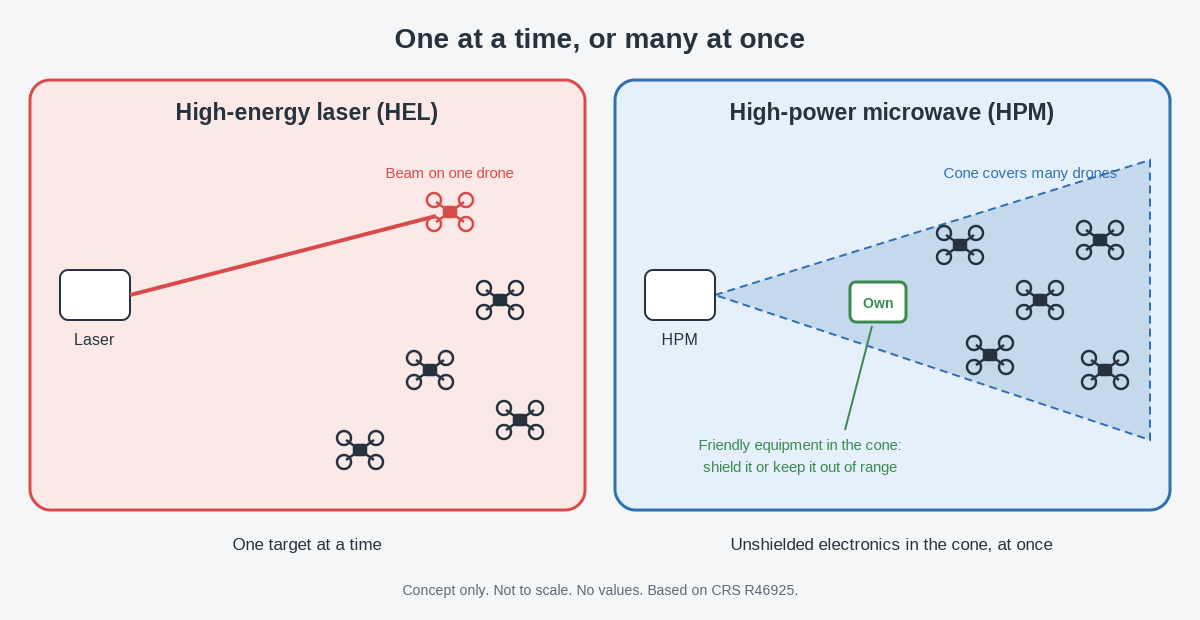
Think of a flashlight and a ceiling lamp. The flashlight lights one spot, and the lamp lights the whole room. The real difference is that HPM sends radio waves, not light, and it acts only on unshielded electronics, not on everything it reaches.
What microwaves do to a drone
Microwaves are the highest-frequency radio waves, from 300 MHz to 300 GHz. Frequency here is the same idea taught in high school physics.
A drone packs a lot of electronics into a small airframe.
The British Ministry of Defence described its 2025 trial weapon this way. Its radio waves, at high frequency, upset or harm the key electronic parts inside a drone, and the drone then crashes or stops working properly. It does not blow the airframe apart. It stops the brain that keeps the airframe flying.
In 2020, four U.S. agencies issued a joint advisory: the Federal Aviation Administration (FAA), the Department of Justice, the Federal Communications Commission (FCC), and the Department of Homeland Security. It sorts counter-drone tools into two groups, non-kinetic and kinetic. Nets, projectiles, and lasers are kinetic. The non-kinetic group holds jamming, spoofing, and hacking, along with "non-destructive directed energy weapons."
A beam that spreads like a cone
The main strength usually named for HPM is that it can disable every unshielded electronic system in its cone. That means many systems, including drone swarms, at once. Yet the same spreading also creates weak points. There are three main limits.
The first is range. An HPM beam spreads more than a laser beam and cannot be squeezed as tightly, so the energy per unit area falls sharply with distance. This can limit how far away the weapon is effective.
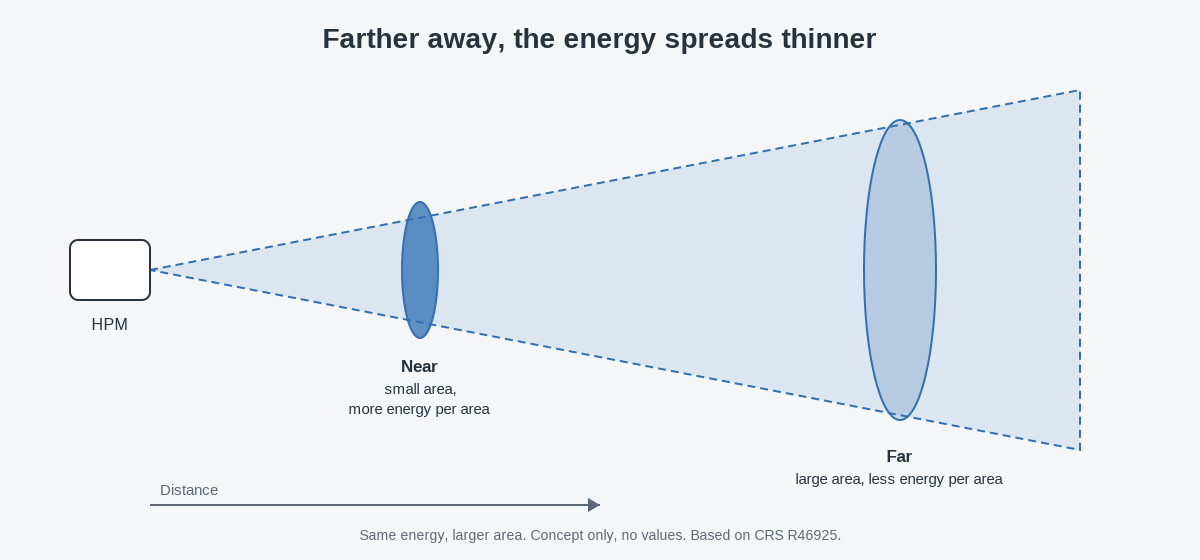
The second is friendly equipment. HPM can affect every unshielded electronic system within range, so friendly systems must be shielded or kept out of range when it is used. Third, it may not work against shielded targets.
What about cost? Some Defense Department officials say directed energy and HPM could be cheaper options than conventional interceptor missiles. Yet a low cost per shot does not make the whole system cheap. The up-front cost of building these systems at scale could offset or erase that advantage.
How to compare these costs is covered in the cost structure of drone defense.
Public U.S. programs
THOR is a technology demonstrator built by the Air Force Research Laboratory (AFRL) with industry partners. Its focus is defending air bases at close range. It fits in a standard 20-foot shipping container, which lets it ride in a C-130 transport aircraft.
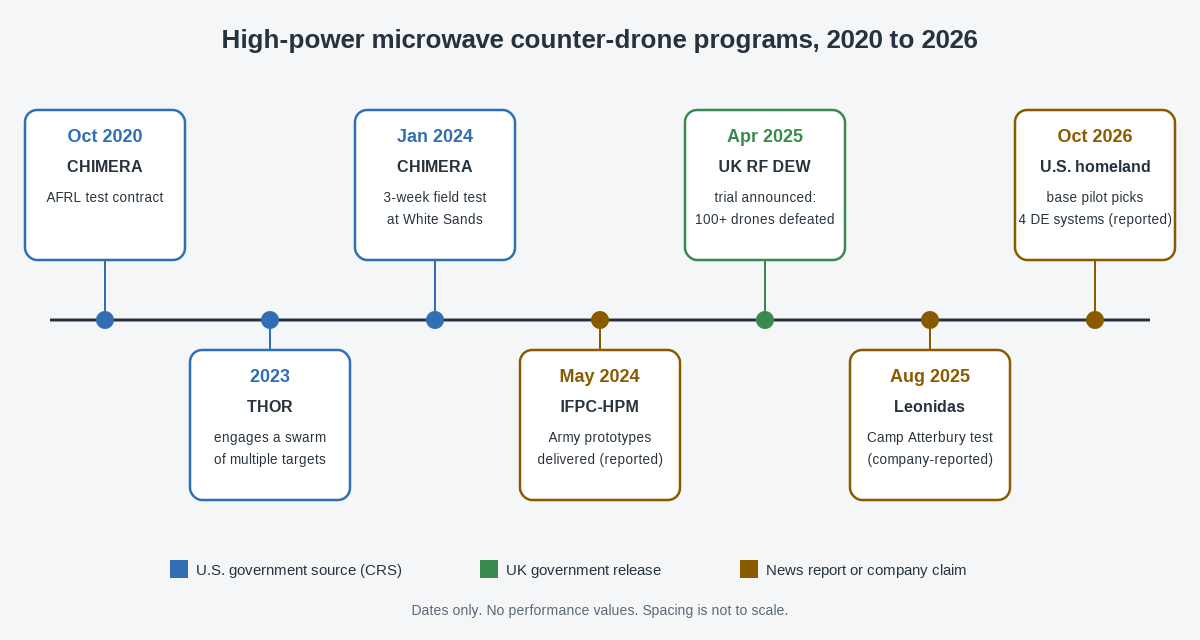
Air Force press releases cited by CRS say THOR completed two years of testing and, in 2023, took on a swarm of several targets. That work fed into a later prototype effort called Mjölnir.
The same lab signed a test contract in October 2020 for a system called CHIMERA. It is meant to engage drones farther out than THOR. In January 2024, during three weeks of field testing in New Mexico at White Sands, it acquired aerial targets and tracked them from start to end of their flights. Public information on it is limited.
The U.S. Army is developing IFPC-HPM within its Indirect Fire Protection Capability (IFPC) program. It is a container-based system that can be moved, and its target is swarms of Group 1 and Group 2 drones.
Group 1 drones are typically small enough to carry and launch by hand. Group 2 drones are typically medium-sized, mobile, and launched from a catapult. Army documents describe the system as paired with the laser version, IFPC-HEL, so the two guard fixed and semi-fixed sites in layers.
The Army's plan was to build, test, and hand over four prototypes before the last quarter of fiscal year 2024 ended. News reports said a company called Epirus delivered the final two on May 15, 2024. As of a 2025 CRS report, both the laser and microwave versions of IFPC still seemed to be in development or testing.
The Marine Corps has moved too. Reports said it was looking at a lighter, easier-to-move version of IFPC-HPM. The fiscal year 2025 National Defense Authorization Act also gave a Marine Corps air defense weapons program $14.4 million above its request. The extra money was meant to speed up work on a counter-drone high-power microwave.
The British radio frequency weapon trial
On April 17, 2025, the British Ministry of Defence announced results from a trial of a radio frequency directed energy weapon (RF DEW) demonstrator. The trial was held on a range in West Wales, and no earlier British Army exercise against drone swarms had been this large. In one engagement it brought down two swarms, and over the whole series it tracked and defeated more than 100 drones.
These figures come with conditions. The cost per shot is an "estimated" 10 pence, and only "if developed into operational service" could it offer a low-cost complement to missile-based air defense. The stated reach is up to 1 km, and it works against threats that electronic warfare cannot jam.
British spending on this research and development has passed £40 million so far. A partnership of Defence Equipment and Support (DE&S) and the Defence Science and Technology Laboratory (Dstl) ran the project. An industry group led by Thales UK built the demonstrator.
A sergeant who took part described what is still missing. Soldiers picked up the demonstrator fast and found it simple to operate. To be a strong asset in layered air defense, though, it would need more range and more power.
Base defense trials and open questions
In 2026 the United States moved to testing directed energy weapons at homeland bases. According to news reports, the Defense Department chose four systems for a counter-drone pilot at home on October 5, 2026. Under this program, which Congress ordered, they become the first such systems the military places and tests on U.S. bases. Of the four, the only microwave system is Epirus's Leonidas, and the other three are lasers.
The selected company's announcement says Congress set up the pilot in the fiscal year 2026 National Defense Authorization Act. Joint Interagency Task Force 401 (JIATF-401) leads it, working with the FAA, U.S. Northern Command, and others.
The company says that in August 2025, in a live-fire event at Camp Atterbury in Indiana, it disabled every one of 61 target drones. One of those engagements, it says, stopped a group of 49 drones with a single pulse. These are company figures, not government ones.
In August 2026, task force director Brig. Gen. Matt Ross said the science is proven: both lasers and high-power microwaves can defeat a drone. The task now, he said, is learning how to use them well in real operations.
The wider footprint of microwaves, and its possible effect on nearby systems, is also seen as a concern.
The friendly equipment problem from earlier comes back in the real setting of a base.
What about civilians? Under the U.S. joint advisory, only four federal departments have authority from Congress to detect and mitigate drones: Defense, Energy, Justice, and Homeland Security. Even that authority is limited to protecting covered facilities and assets. Using any counter-drone tool, kinetic or not, may run into federal criminal laws, such as bans on interfering with communications and damaging aircraft.
U.S. law defines an unmanned aircraft as an aircraft, and damaging or disabling an aircraft is a crime. Someone without authority who brings down a drone with such equipment could be breaking the law.
Where this meets lasers
In public programs, HPM and lasers show up as partners rather than rivals. The Army's IFPC-HPM is meant to pair with IFPC-HEL in a layered defense, and the 2026 homeland pilot also brought in three lasers and one microwave system together. One stays on a single drone for a while, and the other reaches wide in one go.
The general differences between the two are covered in Lasers and high-power microwaves, and the laser side's limits in Strengths and limits of laser weapons.
What to read next
- Lasers and high-power microwaves: compares the two weapons grouped under directed energy.
- Drone swarms: looks at how flying together differs from a true swarm.
- Counter-UAS systems: explains why drone defense is a set of tools, from detection to defeat.
- Lasers Against Drones: From Iron Beam to National Prototypes: an article on public laser programs.