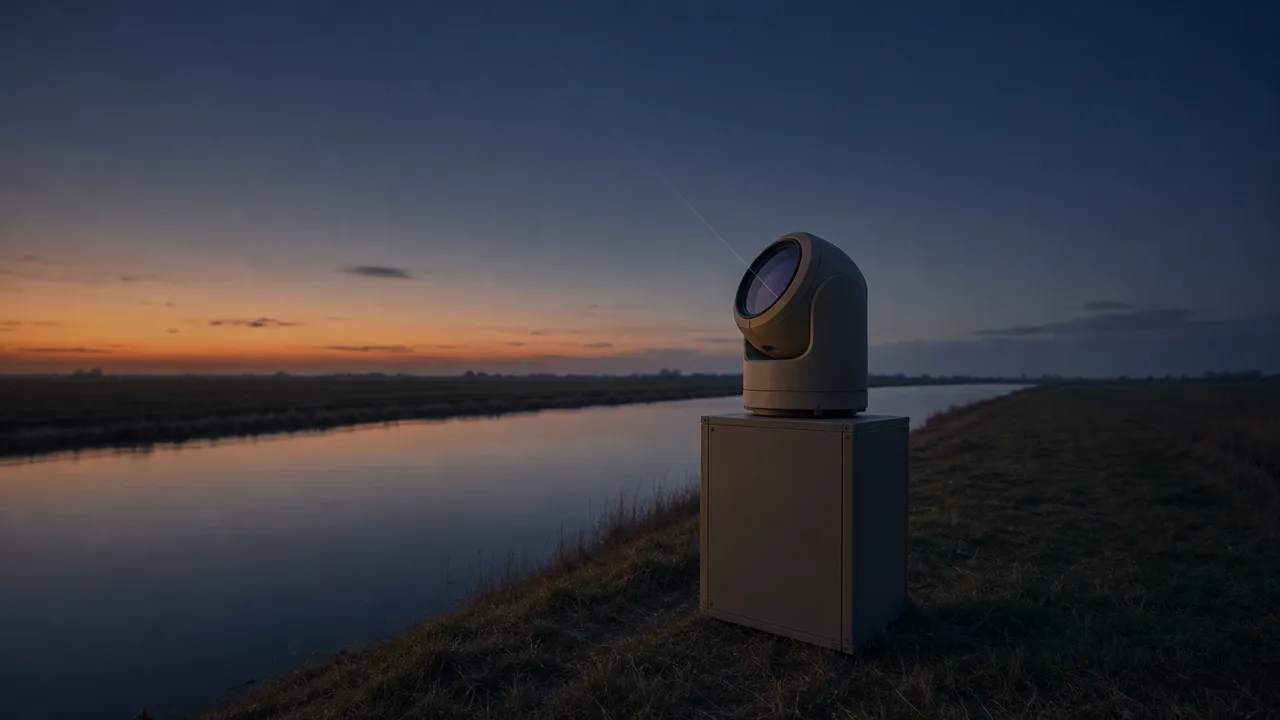
A country now wants to add laser light, alongside missiles, to its air defence against drones. On the morning of September 24, the Dutch defence ministry announced a plan to develop a high-energy laser (HEL) weapon together with the Australian company EOS (Electro Optic Systems). For that reason, a letter of intent was signed that week.
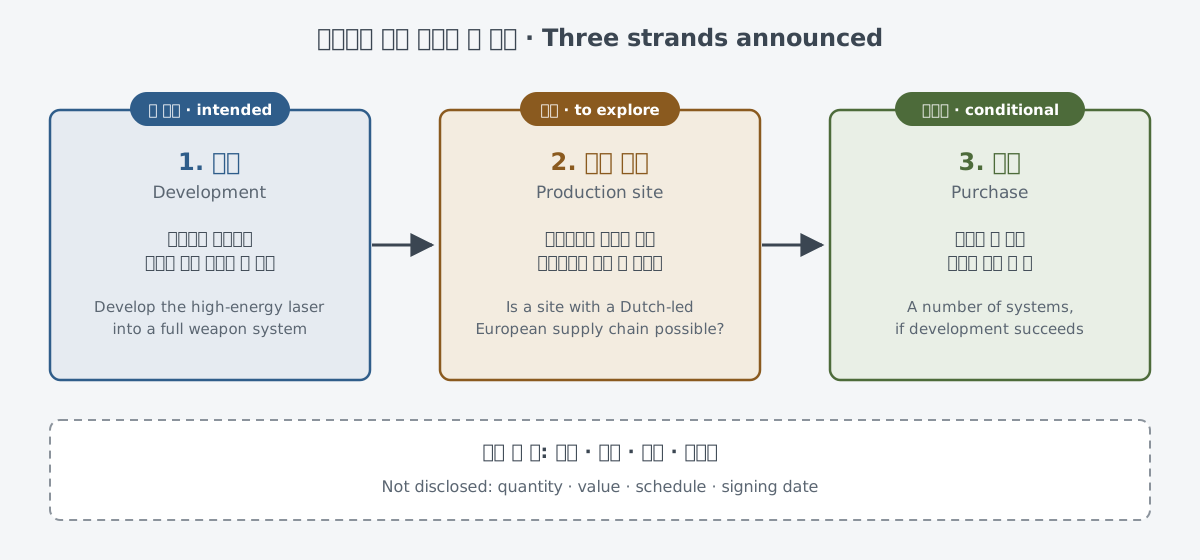
What exactly was signed? The verbs in the announcement give it away: "intend to develop," "explore whether a production site is possible," "intend to buy a number of systems if development succeeds." There is not a single fixed number. What the text sets out is a direction and a condition.
This letter passes on what the ministry and the company each said, and how two media outlets reported it. It also looks at the company's "100 kW-class" label: what that label tells you, and what it leaves out.
This letter in brief
- On September 24, the Dutch defence ministry announced that its State Secretary for Defence had signed a letter of intent that week with the Australian company EOS on a high-energy laser weapon.
- The published plan is to develop the laser further into a full weapon system, to explore a production site with a Dutch-led European supply chain, and to buy a number of systems if development succeeds.
- No announcement gave the quantity to be bought, the program value, a schedule or the exact signing date.
What was announced
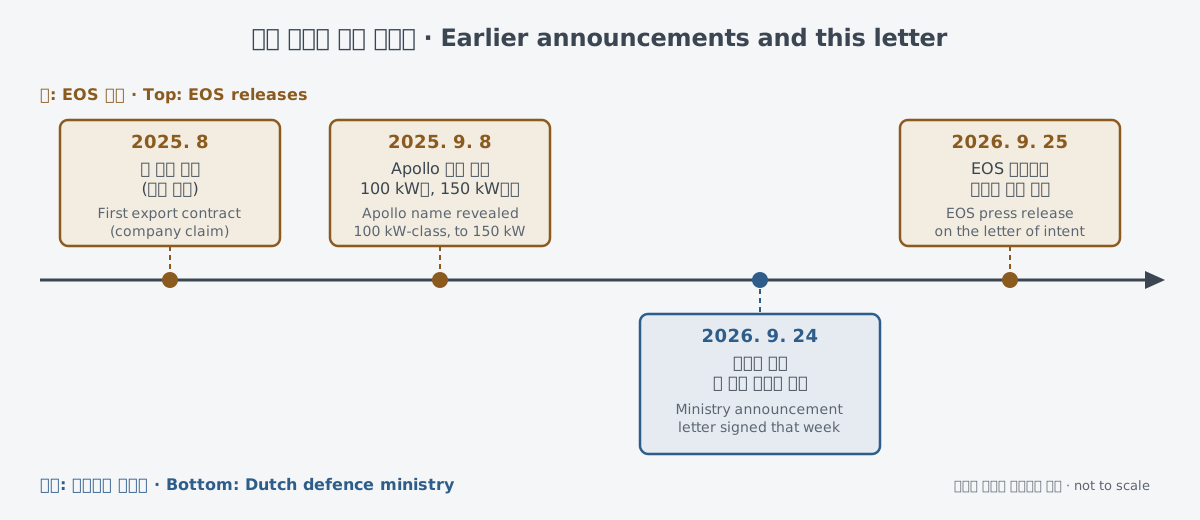
The first announcement is a news item from the Dutch Ministry of Defence (Ministerie van Defensie). It went up at 9:05 a.m. on September 24 and is written in Dutch, so every quote below is translated by this site. In the ministry's words, "the Ministry of Defence and the Australian company EOS plan to develop laser technology further, together, into a defensive weapon the armed forces can actually use." For that reason, the State Secretary for Defence (staatssecretaris) signed a letter of intent "this week."
A day later, on September 25, EOS put out a press release in English. In the company's account, the letter covers further work on its Apollo high-energy laser weapon technology. Apollo is designed for counter-drone defence, which means stopping drones.
There were also two media reports. Defence Industry Europe covers the European defence industry. On the day of the announcement, it reported that the Netherlands plans to work with EOS to turn high-energy laser technology into an operational counter-drone weapon. Its summary of the letter: joint development and "a potential Dutch production base."
The defence intelligence outlet Janes went over the story again on October 5. In its account, the letter is about developing the company's high-energy laser into an operational counter-unmanned aircraft system (C-UAS), and it was signed during the week of September 21.
What is publicly known
The last column of the table shows who said each thing: the ministry, the company or the media.
| Item | What was announced | Who said it |
|---|---|---|
| Development | Intends to develop the high-energy laser further into a full weapon system | The ministry. EOS: the two will "explore pathways for the Apollo High Energy Laser Weapon to become a fully operational weapon system for the Netherlands" |
| Production site | Will explore together whether a production site with a Dutch-led European supply chain is possible | The ministry, EOS |
| Where production happens | The company wants to do development and production in the Netherlands "in principle." Under the intended arrangements, production would be in the Netherlands | The ministry ("in principle"), EOS ("under the intended arrangements"), Defence Industry Europe |
| European base | This would make the Netherlands the European location for EOS | The ministry, Defence Industry Europe |
| Purchase | Intends to buy a number of laser systems if development succeeds | The ministry. EOS: "subject to further work" |
| Stated power class | "100 kW-class," scalable to 150 kW | The EOS 2025 press release, and Janes, quoting EOS. No number in the ministry item or in this EOS release |
| Packaging | Containerised or vehicle mounted | The EOS 2025 press release, Janes |
The purchase sentence comes with a condition. The ministry's text says the Netherlands intends to buy a number of laser systems "if development succeeds," and EOS opens its version with "subject to further work." The matching Janes sentence runs differently. It tacks "with the Dutch MoD procuring laser weapon systems" onto the production-site study, and the condition drops out of view.
The ministry's Dutch phrase "een aantal" means "a number of." It does not fix how many.
Much of the announcement is about production. In its 2025 release, EOS pitched Apollo as ITAR-free and fully controlled by the company. In that pitch, partners can adopt it, localise it and sustain it as their own.
"Production in the Netherlands" in this letter points the same way. Still, that is the company's claim, and the ministry item says nothing about ITAR.
The technology, explained
The ministry describes the high-energy laser as "a system that converts energy into a high-power laser beam." A laser is a device that amplifies light of a specific wavelength and sends it out as a narrow beam in one direction. The basics of that light are in What is a laser? A high-energy laser weapon belongs to the wider family of directed-energy weapons (DEW), which send energy in one direction instead of firing a round.
The advantage the ministry points to is ammunition. Since obtaining and resupplying ammunition is not an issue, the ministry writes, this weapon "can" be more effective and more cost-efficient than kinetic air defence with, for example, missiles. Kinetic air defence here means defence that stops a threat with something fired at it, like the missiles in the ministry's example.
Three sources pass on the same point in different ways. The ministry only says it "can" be so. EOS states it flatly, calling Apollo "a more effective and more cost-efficient complement to traditional kinetic air defence." Defence Industry Europe, relaying the ministry, adds the qualifier "in some circumstances," which does not appear in the ministry's own text.
Either way, none of these announcements gives a cost per shot. For now, cost efficiency reads as an expectation held by the ministry and the company, not as a figure.
The "100 kW-class" label is the company's own class, used in the EOS 2025 press release and repeated by Janes as EOS' words. The same release says Apollo is scalable to 150 kW. The kW is a unit of power, and power is the energy delivered each second. That one number cannot tell you how many seconds the beam stays on, or how tightly it is focused.
The sources also do not say whether the 100 kW is the power in the beam, or what was measured under which conditions. How to read "kW-class" is covered in Power, energy and intensity: W, J and W/cm².
How Apollo would reach 150 kW is not in the announcements either. The general ways to raise laser power are in Why beam combining is needed, and its three approaches. The kinds of lasers that can become high-energy lasers are in Laser types at a glance: gas, solid-state, fiber, semiconductor. Those articles cannot tell you which light source Apollo uses or how it builds up its power.
What is new
EOS first put out the Apollo name in a press release dated September 8, 2025, from London. The same release says that in August that year the company secured the "world's first export contract" for its 100 kW-class high-energy laser weapon with a European NATO member state. "World's first" is the company's wording, and the release does not name the country.
The story a year ago was an export contract announced by the company. This time a national defence ministry put out its own item. It said it will look at further development of the laser together with the company, and at a production site in its own country. A country that says it intends to buy has also put in an official text that it will join the development work and the production-site study.
Some things have not changed. The "100 kW-class" label and the "scalable to 150 kW" figure were already in the company's release a year ago, and the ministry item gives no power figure at all.
Limits and open questions
The biggest gap is the numbers. Defence Industry Europe reported that no planned quantity, programme value or delivery schedule was disclosed. The ministry's own text says only "a number of," with no amount and no year. The EOS release and the Janes story give no quantity either.
The signing day is blank too. The ministry's September 24 item says "this week," the EOS release dated September 25 says "this week," and Janes says "the week of 21 September." No source pins down which day of that week it was.
The letter of intent itself is not attached to the ministry item. So there is no way to tell when "in principle in the Netherlands" might change, or how "if development succeeds" will be judged.
The ministry's line that the high-energy laser "has proven very effective against drones" comes with no evidence attached. The ministry item does not say in which tests, or under what conditions, that was shown. The same sentence in the EOS release is the company's own assessment.
The announcements also do not say whether the Netherlands has a containerised or a vehicle-mounted version in mind. The partner country and value of the 2025 export contract cannot be learned from these sources either.
What to read next
- What is a laser? How it differs from a light bulb: for the properties of laser light behind "converts energy into a beam."
- Power, energy and intensity: W, J and W/cm²: how to read a number like "100 kW-class" when it shows up in the news.
- The US Army E-HEL laser contract and the directed-energy pilot at US bases: what another country's counter-drone laser news made public, and what it left blank.