Picture a small drone heading toward a base. The defenders have a few options. They can cut its radio link, fire a gun, or launch a missile.
And there is one more option that comes up often these days: send up a drone of their own to catch it.
Such a drone is called an interceptor drone. This article follows U.S. congressional reports and government announcements to see where interceptor drones fit among counter-drone tools, how they differ from missiles, and what two public cases show. It also looks at how costs are compared and which laws apply to civil use. This article reflects the situation as of October 2026.
The full picture of drone defense is in "Counter-drone systems: why one device is not enough." This article takes one tool out of that toolbox.
Where interceptor drones fit
In August 2020 the Federal Aviation Administration (FAA), the Justice Department, the Federal Communications Commission (FCC) and the Department of Homeland Security issued a joint advisory. It splits the ways of stopping a drone into two broad groups. Non-kinetic solutions include jamming, spoofing, hacking and directed energy weapons (DEW) of a non-destructive kind. Kinetic solutions physically disrupt or disable a drone, and the list names nets, projectiles and lasers.
Interceptor drones usually belong to the kinetic group. Drones that use nets, and drones that sacrifice themselves to attack an intruding drone, both sit here. Public sources also describe interceptor drones in non-kinetic forms. Coyote, covered below, comes in both.
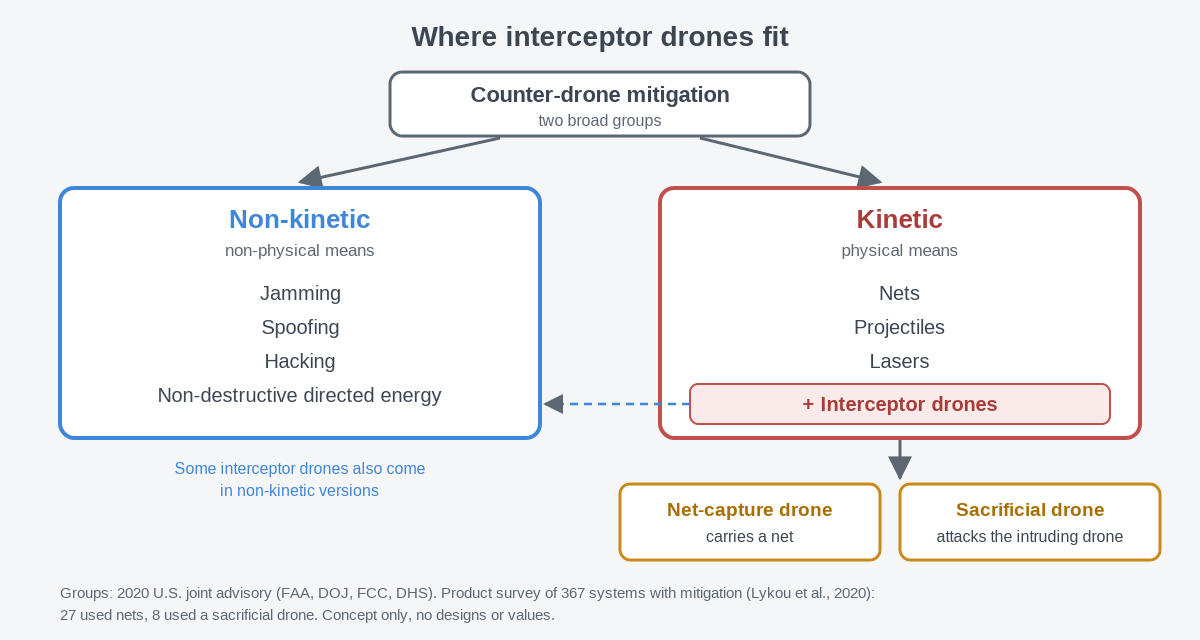
How common are they on the market? A 2020 survey in the journal Sensors found no fewer than 545 counter-drone products in open sources and press releases. Among the 367 systems with mitigation features, signal jamming was the most common method at 76%, while kinetic methods appeared in 15%. Within the kinetic group, 27 systems used nets and 8 used a sacrificial UAV that can strike intruding drones.
These counts cover public products around 2020, so they do not reflect the wider attention interceptor drones have drawn since then.
How they differ from missiles
An interceptor drone and an interceptor missile look alike at first. Both rise from the ground to stop something coming in. So what is different?
A 2025 report by the Congressional Research Service (CRS) points to one difference while describing Coyote. Unlike ordinary surface-to-air missiles, Coyote is reported to be able to stay aloft, wait, and attack again if needed.
A soccer defender gives a rough picture. The defender does not just clear the ball and stop; the defender stays close to the attacker and waits for another chance. A real system differs from a human defender. Coyote is a one-way design that does not come back.
The two ways an interceptor missile stops its target, a direct hit or a nearby blast, are covered in "Hit-to-kill and blast fragmentation: two ways interceptors stop targets." Drones that wait over a target area and then dive on it appear in "Loitering munitions: between missile and drone."
A public case: the U.S. Army's Coyote
Coyote is the interceptor the U.S. Army chose for the LIDS family, its systems for countering low, slow and small drones. The CRS report describes Coyote as an interceptor drone that is launched from the ground, guided by radar and used only once. It comes in both kinetic and non-kinetic versions.
Its roots go back a long way. Advanced Ceramics Research, an Arizona company, first developed it in the early 2000s, and Raytheon bought that company in 2015. Prototypes of Howler, a counter-drone system built around Coyote and a forerunner of LIDS, reached Army units in 2019.
Coyote does not work alone. In the fixed-site version, FS-LIDS, Ku-band radars plus electro-optical and infrared cameras handle detection and tracking, and an electronic warfare system for stopping drones sits beside the Coyote interceptors. The Army's FY2025 budget request set aside a separate $117.4 million for Coyote interceptors for LIDS.
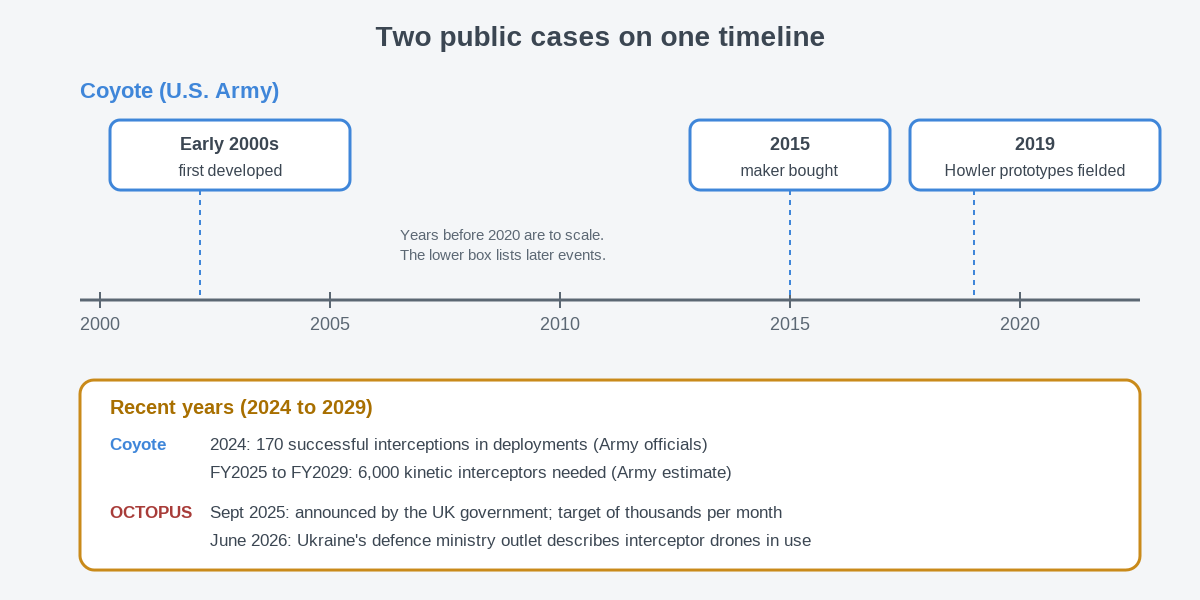
There is a record of use. Army officials said that as of 2024, Coyote had intercepted targets successfully 170 times while deployed in Europe, Africa and the Middle East. The Army estimates it will need 6,000 kinetic Coyote interceptors and hundreds of non-kinetic ones from FY2025 to FY2029.
There is a limit too. Coyote is effective against drones, but in the words of Army officials it does not always pay off in cost when the target is a cheap drone. Army budget documents put the unit cost at about $129,538, a figure that can change from year to year with the variant, the quantity bought and other production factors.
The Pentagon has also studied interceptors of this kind as a group. Frank Kendall, who led the Air Force at the time, spoke about this in 2023 congressional testimony. He said his service works alongside the Joint Counter-small Unmanned Aircraft Systems Office (JCO) and leads its "low collateral effects kinetic interceptor evaluations."
A public case: Ukraine and OCTOPUS
The second case starts with a government announcement. A UK government press release dated 10 September 2025 named Project OCTOPUS, a new air defense interceptor drone, as the first joint project under a technology-sharing agreement with Ukraine. The plan is to mass-produce it in the UK for Ukraine, with a stated target of thousands per month.
In that announcement, interceptor drones cost far less than regular air defense missiles. They fly fast to meet incoming drones and missiles and wreck them before they arrive.
The OCTOPUS drone was designed by Ukraine with help from UK scientists and technicians. The UK government says it is meant to stop variants of the Shahed one-way attack drone. It adds that the drone costs less than 10% as much to make as its targets.
Interceptor drones also appear in an official Ukrainian outlet. ArmyInform, the news agency of Ukraine's defense ministry, marked one year of the Unmanned Systems Forces in a June 2026 article. It wrote that interceptor drones, rather than air defense missiles, are used against incoming strike drones.
Some care is needed here. "Thousands per month" is an announced target, not a confirmed production figure. The statements about cost and use also come from the governments of a country at war and one of its backers. They are not independently checked values.
The cost question
Talk of interceptor drones always comes with talk of money. CRS explains an unfavorable cost-exchange ratio this way, in a report on the Pentagon's low-cost drone effort, Replicator. One side has to answer with something far more expensive, such as an interceptor missile, than the uncrewed system it targets. If stopping one cheap drone takes one costly missile, the defender's budget drains faster the more often it succeeds.
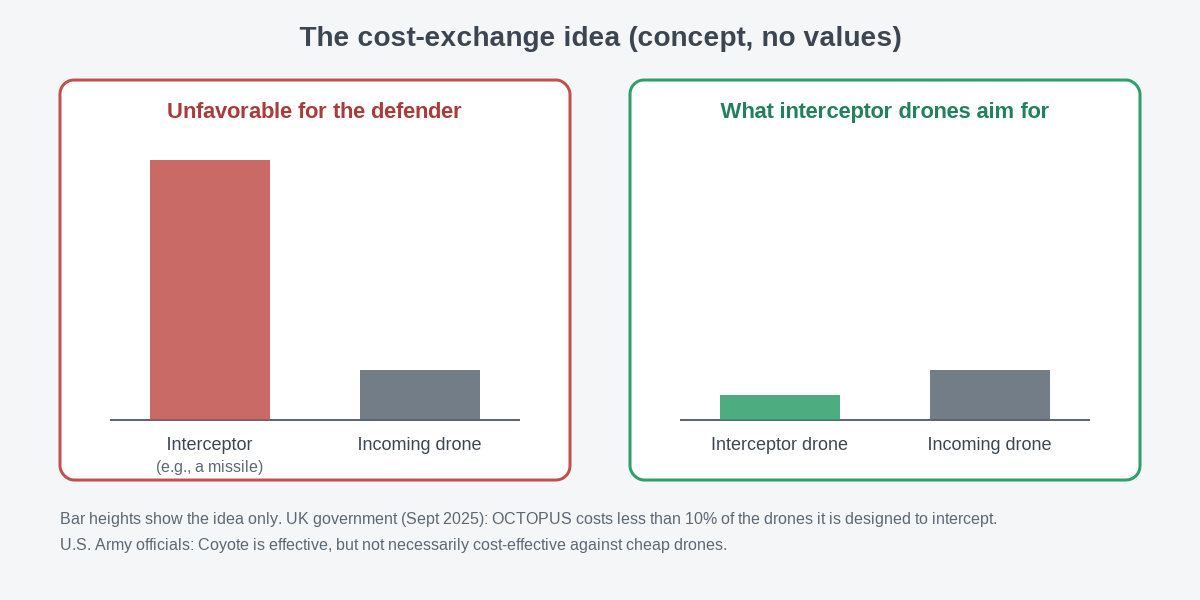
Interceptor drones aim to tip that scale the other way. The UK government, too, put the price front and center when it presented OCTOPUS, saying it costs less than 10% of its targets.
That does not mean interceptor drones solve the cost problem. As noted above, U.S. Army officials said Coyote does not always pay off in cost against cheap drones. How drone prices and defense costs are compared is explained in "The cost of drone defense."
Civil use and the law
Could an airport or a stadium simply launch a drone with a net? The 2020 paper mentioned earlier, which looks at airport security, says trained security staff could use kinetic measures such as launching net-capture drones. It adds a condition: only when the measures fit aviation rules and are authorized by the civil aviation authority. In the paper's view, finding and catching the drone's pilot matters more than chasing a flying object.
U.S. law is more explicit. Under the 2020 joint advisory, an "aircraft" in law means a device made or used to fly through the air. A 2018 law defined an unmanned aircraft as an aircraft flown with no way for a person on or in it to step in directly.
The Aircraft Sabotage Act (18 U.S.C. § 32(a)) makes it a crime to damage, destroy or disable an aircraft. The Aircraft Piracy Act (49 U.S.C. § 46502) makes it a crime to seize or control one with wrongful intent. Whether an interceptor drone catches a target in a net or knocks it down, what it does can touch these laws.
Authority was also narrow. When the 2020 advisory came out, Congress had allowed only four departments to carry out limited detection and mitigation: Defense, Energy, Justice and Homeland Security. The advisory added that the FAA did not back mitigation systems used by anyone who lacked express permission from Congress.
The law has changed since then. The SAFER SKIES Act was signed on 18 December 2025 as part of the defense authorization law for fiscal year 2026. Under set conditions, it lets state, local, tribal and territorial police and correctional agencies take certain steps to detect and mitigate drones.
In July 2026 the Justice Department and Homeland Security put out an interim rule in the Federal Register to carry it out. The rule sets two levels of training and certification, one for detection and warning and one for mitigation. The agencies' own employees use the authority, and contractors may not run the mitigation equipment. The new authority goes to these public agencies; private operators of airports or venues, and private individuals, are not named in it.
Non-kinetic versions face limits too. U.S. law (47 U.S.C. § 302a) bars most non-federal entities from making, importing, selling or using transmitters designed to jam or disrupt radio communications. In other words, in the United States a private party that uses a jamming device against drones breaks the law.
Where this meets lasers
Laser weapons and interceptor drones are both discussed as ways to bring down the cost of each defense when many cheap drones come in. The joint advisory lists lasers as a kinetic solution, and as this article showed, interceptor drones usually sit in that group too.
The difference is just as clear. An interceptor drone must fly out and reach its target, while a high-energy laser (HEL) must hold its beam on one spot of the target. What lasers do well and what they find hard compared with other tools is covered in "Strengths and limits of laser weapons."
What to read next
- Counter-drone systems: why one device is not enough: the whole toolbox that interceptor drones belong to.
- The cost of drone defense: a closer look at how costs are compared.
- The Shahed series: same name, different drones: the kind of drone interceptor drones are meant to stop.
- Loitering munitions: between missile and drone: the other side of drones that wait and then strike.
- Still being written in the same series: "The Counter-Drone Chain: Detect, Identify, Track, Defeat," "The Return of the Anti-Aircraft Gun," "Lasers Against Drones: From Iron Beam to National Prototypes," and "Low-Cost Interceptors for Cheap Drones."