In autumn 2020, attack videos shot by drone cameras played on digital billboards in Baku, the capital of Azerbaijan. Two years later, a photo of an Iranian-origin drone over Kyiv became the cover of a US intelligence report. In April 2024, drones and missiles flew together from Iranian territory toward Israel.
All three scenes feature drones. Yet where those drones came from, how big they were and who recorded what happened differ a good deal. This article sets the 2020 Nagorno-Karabakh war, the war in Ukraine since 2022 and the attacks in the Middle East since October 2023 side by side, using public records.
What is compared is where the drones came from and how they were used, as the records state. This is not a scorecard of whose drones worked better. This article reflects the situation as of October 2026.
What is being compared
A drone is the flying part of an unmanned aerial system (UAS). To line up the drones of three wars, the same questions have to be asked of each. There are four here.
Where did the drones come from? What kinds appear in the records? What do the records say they were used for? And who kept those records?
The record keepers differ, too. Some records are statements by governments and militaries, and some are counts by a UN monitoring mission. Others are reports by the US Congressional Research Service (CRS), which gathers reporting for members of Congress. Think-tank writing is mixed in as well, and this article labels it "analysis."
Karabakh 2020: imported drones and videos on screens
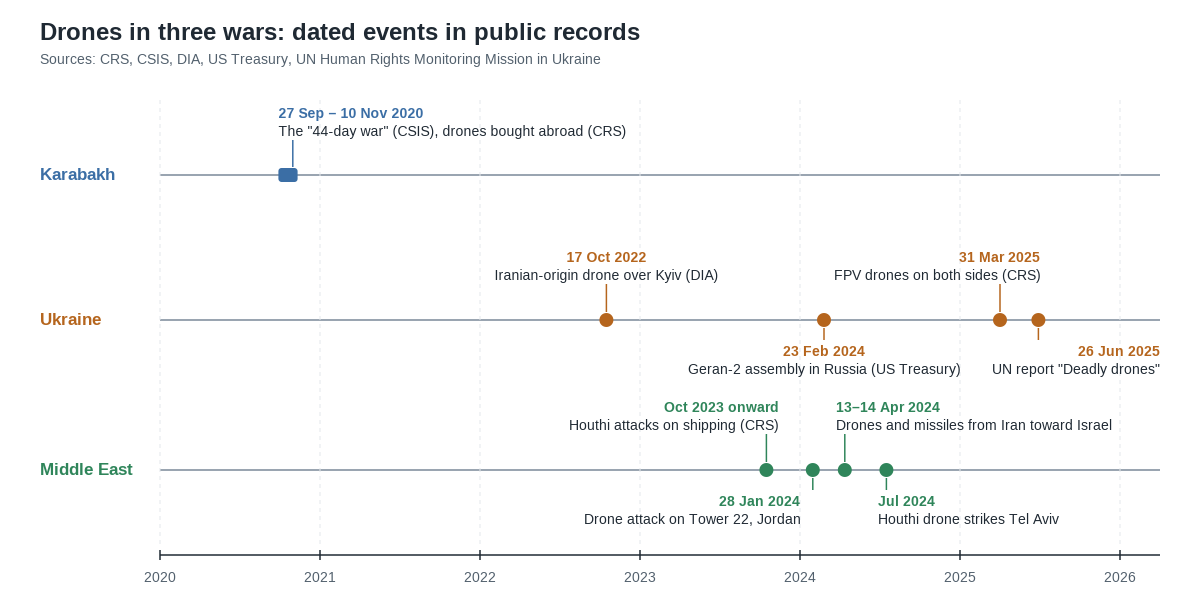
On September 27, 2020, major fighting erupted again between Azerbaijani forces and the Armenian forces defending Nagorno-Karabakh. In its analysis, the US think tank CSIS (Center for Strategic and International Studies) called it the "44-day war." The fighting ended with a Moscow-brokered truce on November 10. The background and course of the war are in the article The 2020 Nagorno-Karabakh War.
What stands out in this war is where the drones came from. During the war, Azerbaijan relied heavily on drones, and the CRS report notes that these included equipment bought from Turkey and Israel. Armed drones and loitering munitions bought from Israel were used as well. Loitering munitions are often called kamikaze drones.
The two armies started from a similar base. Russia is a major arms supplier to both Armenia and Azerbaijan, and both countries mainly operate Russian and upgraded Soviet-era equipment. That includes tanks and artillery.
The CSIS analysis goes into the kinds of drones in a little more detail. Drones of Russian, Turkish, Israeli and domestic design flew both reconnaissance missions to support artillery and strike missions. Armenia's drones were smaller, domestically built systems focused on reconnaissance. Azerbaijan acquired the Turkish TB2 early in 2020, and some reports put the sale as late as June that year.
One reason this war's drones drew so much notice is video. Azerbaijani drones stayed at the center of attention throughout the war. The high-definition cameras on the TB2s were used to make many propaganda videos. Clips showing Armenian troops and equipment being hit went up online and played on screens in Baku.
Ukraine: long-range drones and small drones near the front
The records of the war in Ukraine show two very different groups of drones. One is long-range one-way attack drones that fly to distant cities and infrastructure. The other is small drones used close to the front line.
One of the documents that publicly confirmed the origin of the long-range drones is the Defense Intelligence Agency (DIA) report "Iranian UAVs in Ukraine: A Visual Comparison." Its cover photo shows an Iranian-origin drone over Kyiv during an attack on October 17, 2022. The report found that photos of debris and parts from Ukraine matched systems shown at military expos and similar venues in the Middle East. It wrote that this confirmed Russia's use of several kinds of lethal Iranian drones in the war.
The names changed, too. Iran's Shahed-136 is called the Geran-2 in Russia, and the Shahed-131 is called the Geran-1. Why several aircraft end up under one name is covered in The Shahed series.
What comes next sets Ukraine apart from Karabakh. A US Treasury statement came out on February 23, 2024. It said Russia's Alabuga special economic zone had a deal with the Russian military to put together Geran-2 drones that Iran had sent. The zone was also expanding its ability to make many of the parts for these Iranian-designed drones inside Russia.
This is not a finished product bought abroad but a transferred design being assembled and produced in another country. A statement on April 25 that year said Russian forces had used such drones in Ukraine on key infrastructure and civilian sites.
The small drones are a story about both sides. A CRS report of March 31, 2025, says Russia and Ukraine are both reported to be making more and more drones for the battlefield. Both equipped front-line units with first-person view (FPV) one-way attack drones carrying explosives, to supplement artillery shells and conventional missiles. What an FPV drone is can be found in FPV drones.
The Ukrainian government also makes its drone programs public. On UNITED24, its fundraising site, the "Army of Drones" is run by three bodies: the Ministry of Digital Transformation, the State Special Communications Service and the Armed Forces General Staff. It includes regular drone purchases at the military's request and a pilot training course. The site says more than 1,400 drones were bought in the project's first 3 months.
There is also a record of harm to people. On June 26, 2025, the UN Human Rights Monitoring Mission in Ukraine (HRMMU) published a report called "Deadly drones."
It found that better technology and higher production mean short-range drones are used more and more. They are now among the main causes of civilian deaths and injuries in Ukraine. In September 2026 alone, the mission counted at least 328 civilians killed and 2,105 injured. Long-range weapons (missiles and drones) accounted for 53% of those casualties and short-range drones for 23%.
The Middle East: drones from Iran and groups it backs, and the defenders
The Middle East record is closer to a bundle of separate events than a single war. Those launching drones also differ: the Iranian government, the Houthi movement in Yemen, and militias in Iraq and Syria.
April 13, 2024, is recorded in a CRS report as the first time Iran launched kinetic military action against Israel. Drones, ballistic missiles and cruise missiles were fired from Iranian territory toward Israel. Reports say that once they were in the air, Israel and its partners, the United States, Jordan, France and the United Kingdom, brought down most of them.
In the Red Sea, merchant ships became the target. Starting in October 2023, Houthi forces struck merchant ships dozens of times and put warships at risk in dozens more incidents. The Houthi military capabilities listed by CRS include rockets, ballistic and cruise missiles, and uncrewed aircraft, surface craft and underwater craft. In July 2024, a drone launched by the Houthis struck Tel Aviv, Israel.
Where did these drones come from? A CRS report from January 2024 says Iran gave the Houthis parts and know-how for building long-range missiles, rockets and drones. The September 2024 version adds that, according to US officials, Iran supports the Houthis with both supplies and advice. That is a different path from the purchases in Karabakh and from the transfer and local assembly seen in Ukraine.
On January 28 of the same year, a drone attack on Tower 22, a US base in Jordan, killed three US service members and injured more than 40. US defense officials blamed militia groups in Iraq and Syria that Iran backs. In the months before, these groups had stepped up drone and rocket attacks on US forces and allies in the region.
The records also show an aircraft family that links Ukraine and the Middle East. In Iraq, US forces recovered parts of Shahed-series one-way attack drones of Iranian origin. Among them were the Shahed-101, Shahed-131 and Shahed-136. Similar drones have been used in Houthi attacks on shipping in the Red Sea and in Russian strikes on Ukrainian cities and energy infrastructure.
The three wars in one table
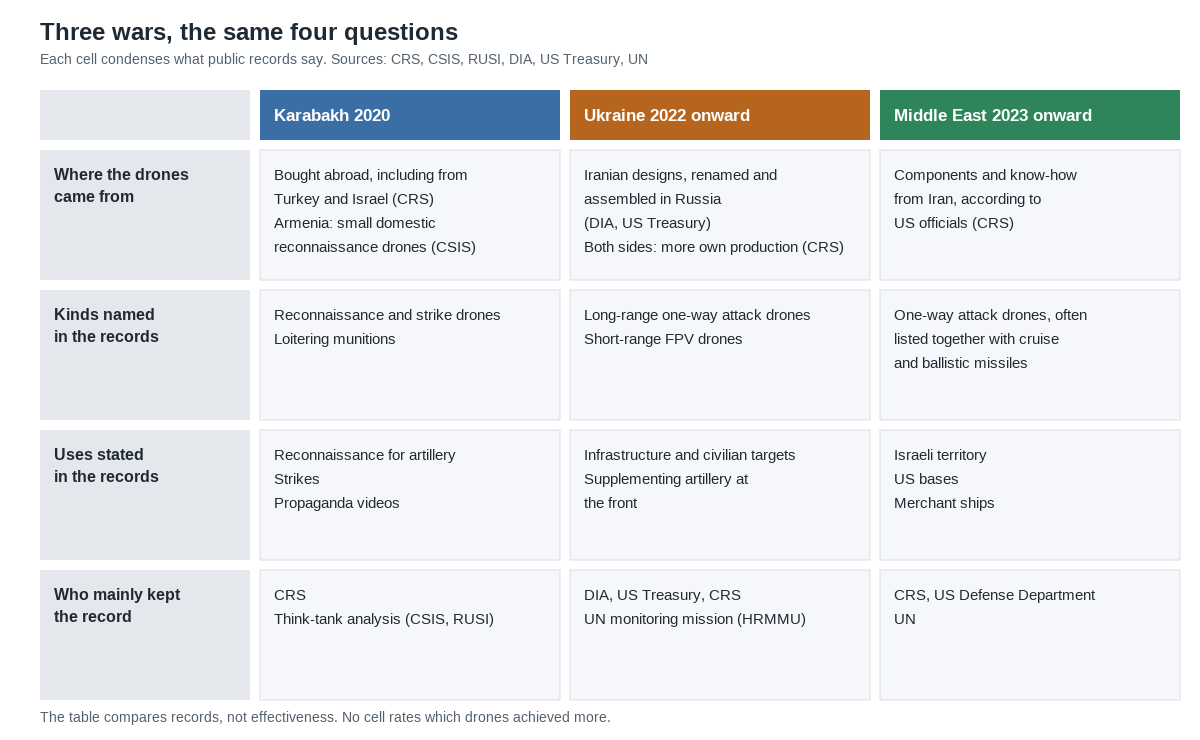
Put in a table, the differences show first. At the center of the Karabakh record are drones bought from Turkey and Israel. In Ukraine, a design transferred from Iran was assembled inside Russia, while both sides also built large numbers of small drones themselves. In the Middle East, US officials point to Iranian components and technical support.
The kinds differ as well. The Karabakh record names reconnaissance and strike drones and loitering munitions. The Ukraine record names long-range one-way attack drones and short-range FPV drones together. In the Middle East record, drones often appear in the same sentence as cruise and ballistic missiles.
The uses written down differ too. In Karabakh, reconnaissance for artillery, strikes and propaganda videos stand out. In Ukraine, attacks on infrastructure and civilian targets appear alongside supplementing artillery at the front. In the Middle East, Israeli territory, US bases and merchant ships at sea are recorded as targets.
Each cell in the table condenses what the records say. It should not be read as saying one war's drones achieved more than another's.
Who counted the numbers
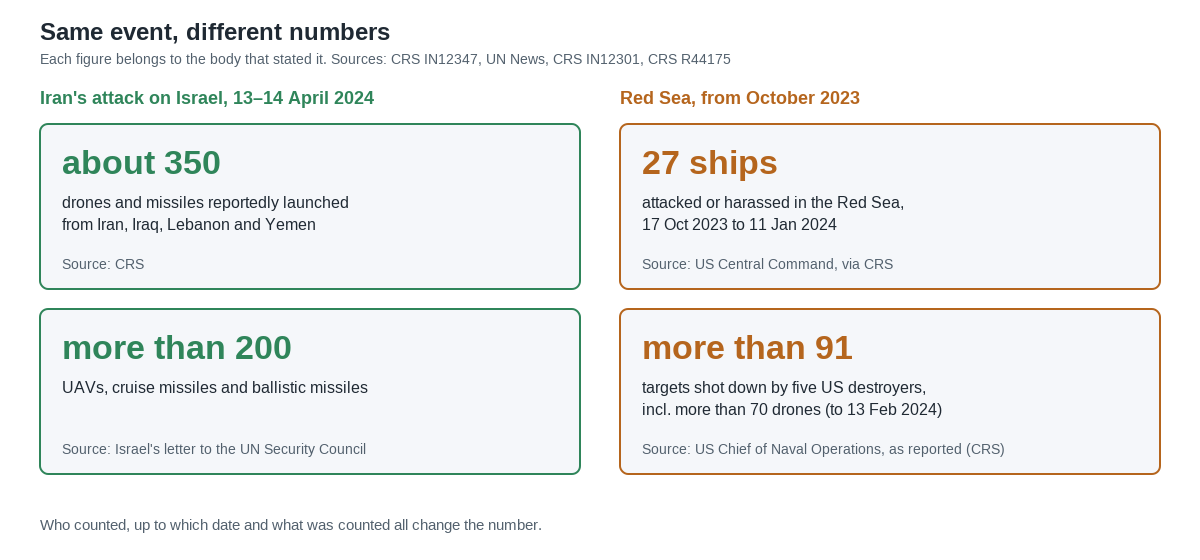
It is common for the same event to carry different numbers in different records. For the April 2024 attack, CRS wrote that Iran and allied groups reportedly launched about 350 drones and missiles from Iran, Iraq, Lebanon and Yemen. Israel's letter to the UN Security Council described an attack "of more than 200 UAVs, cruise missiles, and ballistic missiles." Iran's letter called the attack an exercise of the right of self-defense set out in the UN Charter.
The Red Sea numbers also depend on who counted and when. US Central Command (CENTCOM) reported that, as of January 11, 2024, the Houthis had attacked or harassed 27 ships there since October 17, 2023. On February 13, 2024, the US Chief of Naval Operations reportedly said that five destroyers in the area had shot down more than 91 targets, including more than 70 drones.
Counting attacks on merchant ships is even trickier. A note on a CRS figure says an attack with several targets may count as one incident, unreported incidents are left out, and the data are approximate.
The civilian figures for Ukraine come from the UN monitoring mission. For Karabakh, CRS, drawing on official statements and reports, gives over 6,000 deaths in combat and over 150 civilians killed. Those numbers cover the whole war, not only people killed by drones.
Videos and numbers both call for care. The CSIS analysis says drones played a large role in the war but their capabilities ought not to be exaggerated. In its view, individual weapons do not change the nature of warfare.
An analysis by RUSI, a British think tank, points out that the published videos were selected as examples of Azerbaijani successes. What appears on screen is only part of a war.
Where this meets lasers: the defender's bill
The side doing the defending counts costs. For Ukraine, CRS wrote that the United States sent Stinger missiles to help defend against Russian aircraft, cruise missiles and drones. The United Kingdom, it added, sent air-to-air missiles to be used as ground-launched interceptors against drones. In the Red Sea, US Navy destroyers shot down drones and missiles, and CRS noted that surface-to-air missiles may have been used for many of them.
The CRS report on Navy shipboard lasers sums up the limits in two terms. One is depth of magazine. A ship can down only a set number of drones and anti-ship missiles with its surface-to-air missiles and close-in gun rounds before it runs out. Vertical launch cells cannot be refilled while the ship is underway, so the ship has to head to a port or sheltered, calm waters.
The other is the cost exchange ratio. The missile used to shoot down a drone can cost much more than the adversary spent to build that drone. The same report puts the procurement cost of Navy air-defense missiles at between a few hundred thousand and a few million dollars each, by type. Against an adversary with only a few drones and missiles, that cost can be acceptable as the price of protecting sailors and ships.
CRS wrote that the Red Sea and Gulf of Aden operations of 2023–2025 put both problems in the spotlight, especially when many drones had to be shot down. Those operations drew attention to lasers and high-power microwave (HPM) weapons, which could take on drones while saving a ship's limited supply of missiles and at a more affordable cost.
How defenders view drones is on record too. The US Defense Department sees unmanned systems as an "urgent and enduring threat" to US personnel and facilities overseas. It names drones as the most significant of them at this time. An Army general described counter-drone work as "layered defense, and no one single bullet is going to solve this problem."
Lasers come up as a candidate for a new line on this bill. That does not mean one system stops everything. When a news story mentions "cost per shot," How to read laser weapon news shows how to check what was counted. A framework for comparing drone defense costs is in The cost of drone defense.
What to read next
- The 2020 Nagorno-Karabakh War: Forty-Four Days That Spotlit Drones: the background and course of the first war.
- The Shahed series: same name, different drones: how to read a name that appears in both Ukraine and the Middle East.
- Counter-drone systems: why one device is not enough: how the defender's equipment fits together.
- The Russia-Ukraine War: A Timeline from Public Records Since 2022: the major dates of the war in Ukraine as a whole.
- Drones in the War in Ukraine: A Timeline from 2022; Iran's April 2024 Attack on Israel; Houthi Drones in the Red Sea: articles in the same series, still being written, that cover each event in more detail.