In the summer of 2022, Ukraine's government fundraising platform opened an unusual appeal. People could send money for a drone, or box up a drone they already owned and send that instead. Three years later, the same government's news pages describe military units ordering drones from an online marketplace.
What changed in between? This article follows, date by date, how Ukraine changed the way it builds, buys and hands out small drones, including first-person view (FPV) drones. It draws on material from the Ukrainian government and the U.S. Congressional Research Service (CRS). For what FPV flying is, see FPV drones: flying through the drone's eyes.
This article reflects the situation as of October 2026. The war is ongoing, so every number here is a date, a rule or a production figure published by a government or a congressional body.
Summer 2022: an "Army of Drones" that began with donations
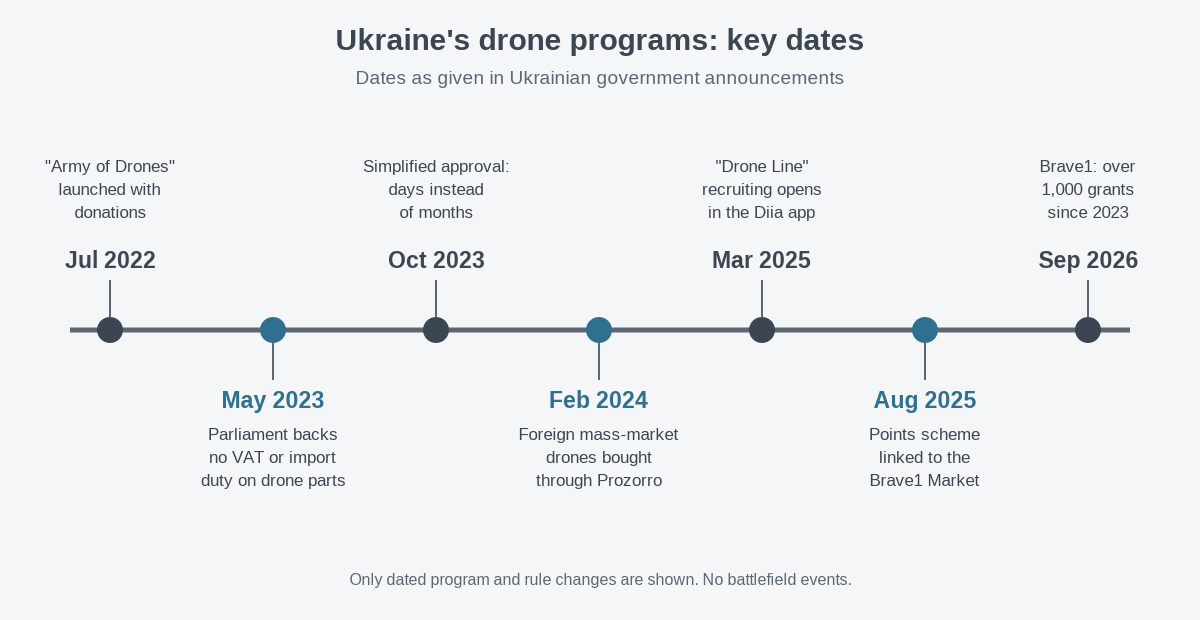
On July 1, 2022, Ukraine's Ministry of Digital Transformation announced that it was gathering an "Army of Drones." Its partners were the General Staff of the armed forces and the UNITED24 fundraising platform. Despite the name, it was a program, not a unit. Alongside steady drone purchases, it bundled repairs, quick replacement of broken aircraft and a pilot training course.
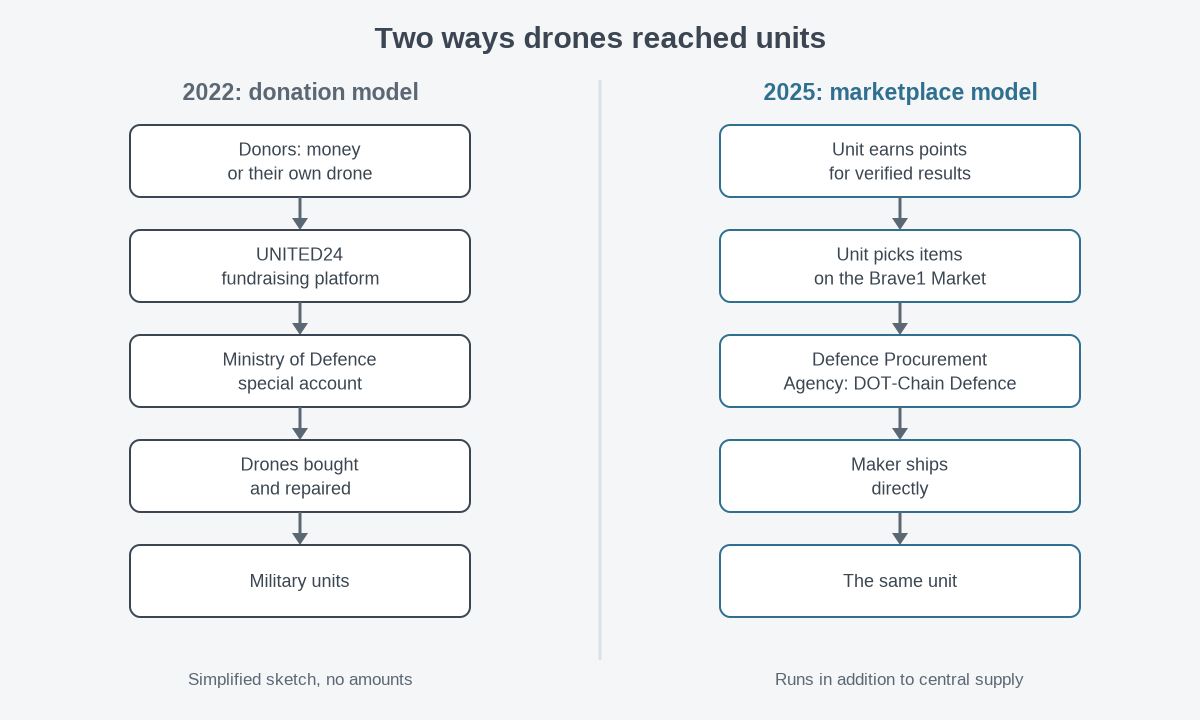
There were two ways to take part: donate money for a drone, or send a drone you already had. All donations went into a special Ministry of Defence account at the National Bank. A few days later, UNITED24 quoted the Deputy Prime Minister and Minister of Digital Transformation as saying that over UAH 200 million had been raised in the first days.
The first aircraft bought included commercial drones that anyone could purchase. The UNITED24 fundraiser page presents the Army of Drones as a project run jointly by the General Staff, the State Special Communications Service and the Ministry of Digital Transformation. Over 1,400 drones were bought in the project's first 3 months.
Its list puts commercial products such as the DJI Mavic 3 next to military drones. A year later, the head of the State Special Communications Service recalled that household quadcopters had been the most common type early in the war.
Changing the rules to grow the factories
A program that began with donations soon reached the rules that govern drone makers. From 2023, the changes fall into three groups: taxes, approval for use, and the way the state buys.
Taxes came first. On May 29, 2023, Ukraine's parliament, the Verkhovna Rada, backed bills 9275 and 9276. For the period of martial law, they remove VAT and import duty on drone components. The aim was better conditions for building and repairing drones inside Ukraine.
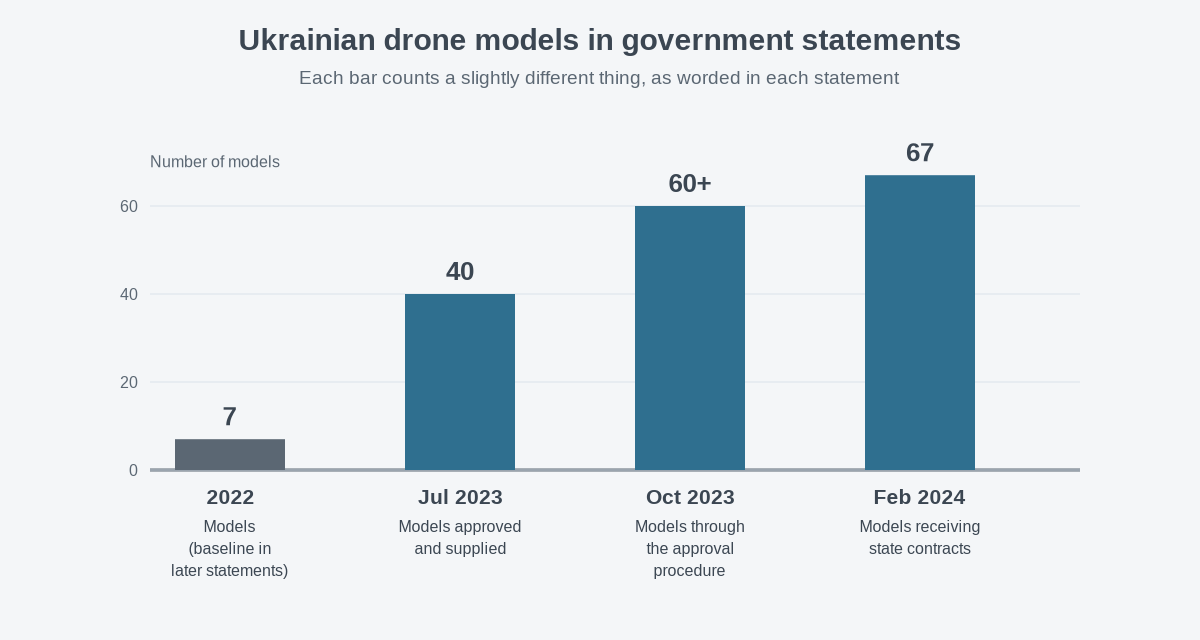
Next came approval. A new model needs approval before the military can use it, and that process used to take a long time. After the rules changed in October 2023, the Ministry of Defence approved new drone models under a simplified procedure for the first time. It took a few days instead of months, and the newly approved models included reconnaissance and FPV drones.
The last change was in buying. A Cabinet decision on February 1, 2024, let the state buy foreign mass-market drones through the Prozorro public procurement system. The examples given were products such as the Mavic, Autel and Matrice. It works as a framework agreement: the buying body posts a notice describing the drone it needs, and registered sellers then compete in an auction.
2023 in numbers
On February 8, 2024, the Ministry of Digital Transformation released the Army of Drones results for 2023. About 200 companies now work on drones and related products, and 67 drone models receive state contracts. In 2022, there had been only 7 such models.
Figures on money and rules came with it. In 2023, the government set aside UAH 40 billion for drones. About 20 laws and regulations were adopted over a year and a half, and the margin was raised to 25%.
In the same release, the minister said 100 times more drones were produced and bought in 2023 than in 2022. The plan he gave for 2024 was 1 million FPV drones plus hundreds of other drone types. One is a minister's statement and the other is a plan; neither is a separate statistical table.
As spending grew, oversight tools were described too. An online monitoring system was set up, with access for the National Anti-Corruption Bureau, and every drone now goes through an official price check.
People and units: training, drone companies, recruiting
More aircraft need more people to fly them. On July 29, 2022, less than a month into the program, schools had graduated about 400 military operators. At that point, two schools were teaching drone flying as a regular course.
A year later the numbers looked very different. By July 2023, training for 10,000 pilots had been organised with 26 training centers across the country. A second stage would train 10,000 more, including FPV drone pilots. By the February 2024 statement, about 20,000 operators had been trained with donated funds.
New units appeared as well. The Ministry of Digital Transformation formed and equipped drone strike companies together with the General Staff, and there were 11 such units in July 2023. These units follow a new approach to training, management and drone doctrine.
Recruiting moved to the phone. On March 3, 2025, the Ministry of Digital Transformation opened a "Drone Line" service in the government's Diia app to take applications for drone units.
The project came from the President's initiative. The Land Forces command, the State Border Guard Service, the Ministry of Defence and the Ministry of Digital Transformation coordinate it. FPV pilot is first on the list of specialties, and Ukrainian citizens aged 18–55 can apply.
The story of a military branch built only around drones is told separately in another article in this series, "Ukraine's Unmanned Systems Forces: A Military Branch for Drones."
A new buyer: points and a marketplace
The path from money to drones also gained a new branch. Brave1 sits underneath it. Brave1 is a government initiative for developing defense technology, run by the Innovation Development Fund. It started as a grant program for defense startups.
From 2023 to mid-September 2026, Brave1 funded defense technology development with UAH 6.2 billion, and Ukrainian developers received more than 1,000 grants.
In August 2025, a new model of the "Army of Drones Bonus" started. Units receive points based on verified combat results, and they spend those points on drones, electronic warfare equipment and other items from Ukrainian makers on the Brave1 Market. The Defence Procurement Agency signs the contracts with makers through a digital system called DOT-Chain Defence, and the maker ships straight to that unit.
This route does not replace central supply; it runs in addition to it. By August 25, 2025, units had ordered 22,000 items on the marketplace, among them FPV drones, reconnaissance drones and electronic warfare equipment, worth more than UAH 1 billion.
By December 23, 2025, four months later, orders over the marketplace's first five months had reached UAH 10 billion. More than 300 products are listed, and when an item was in stock, delivery took 13 days on average from order. The marketplace runs on free-market lines, with the soldier as the main customer.
How others recorded it, and how to read the numbers
The research arm of the U.S. Congress has recorded this change as well. A September 2024 CRS report noted how Ukrainian officials describe uncrewed aircraft systems (UAS), or drones. In their words, drones play a critical role in the Ukrainian military's resistance to Russia's full-scale invasion. The Ukraine Defense Contact Group (UDCG), a group of countries supporting Ukraine, has "capability coalitions" by field, and drones are one of them.
A March 2025 CRS report on counter-drone systems has a sentence based on press reports. By those reports, both Russia and Ukraine have built growing numbers of battlefield drones. Both have also reportedly given front-line forces FPV one-way attack drones with explosives, to add to artillery shells and conventional missiles.
A May 2026 CRS paper on U.S. Army small drones adds a comparison. Some observers have argued that the Army's small drones remain too expensive next to commercial products and the drones used in Ukraine.
When reading government statements, start with what was counted. The "40" in the July 2023 statement was the number of approved drone models. Three weeks later, the minister's "40" was the number of companies with state contracts. Both appear next to "only 7 last year," yet they count different things.
Plans and results should also be read apart. The 1 million FPV drones for 2024 was a plan announced in February 2024. How many were actually built is a different figure that has to be checked on its own. It is also worth remembering that when the minister said production had grown 100 times in August 2023, he added that this was still not enough.
What to read next
- FPV drones: flying through the drone's eyes: what FPV flying means, the U.S. rules, and U.S. Army programs.
- The cost of drone defense: as cheap drones multiply, how defenders compare the cost of different tools, lasers included.
- The Russia-Ukraine War: A Timeline from Public Records Since 2022: where the dates in this article sit in the war as a whole.
- Drones in the War in Ukraine: A Timeline from 2022: an article in the same series that collects official records about drones by date.