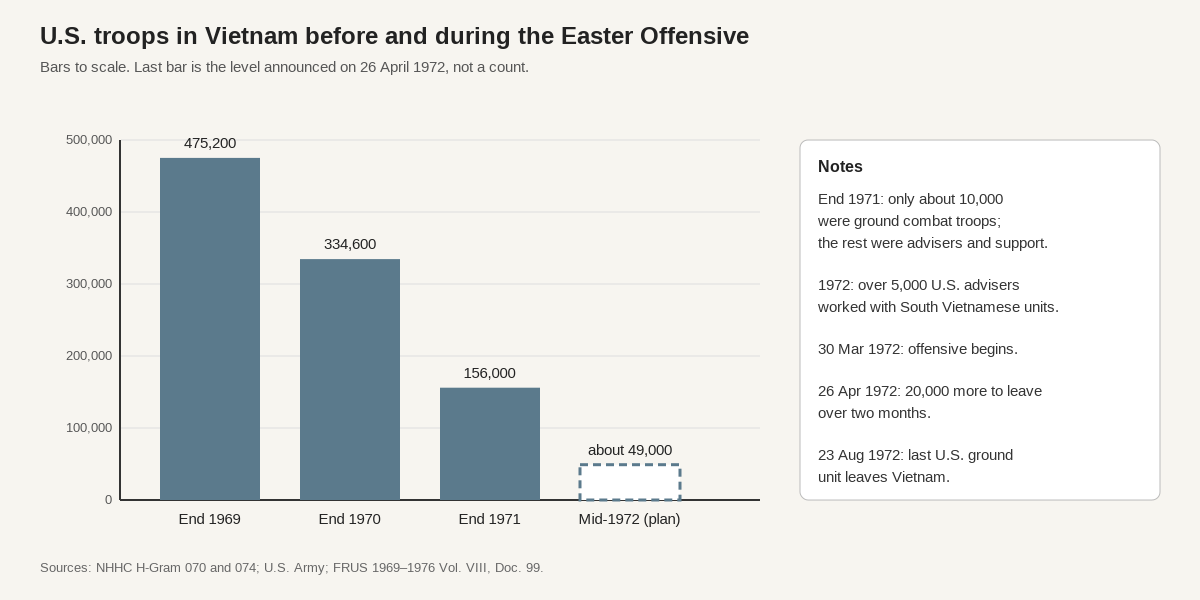
At the end of 1969, 475,200 U.S. troops were in Vietnam. Two years later, at the end of 1971, the figure was 156,000, about one third of the earlier level. Only about 10,000 of them were ground combat troops. The rest were advisers and support personnel.
That was the situation at noon on 30 March 1972, when North Vietnamese forces crossed the Demilitarized Zone. Americans call what followed the Easter Offensive. Washington had spent years asking whether South Vietnam could hold on its own without U.S. troops, and now the battlefield demanded an answer.
Vietnamization and a shrinking U.S. force
On 8 June 1969, President Nixon met South Vietnam's President Thieu on Midway Island and announced the first withdrawal. After that, the U.S. pullout never stopped. South Vietnamese forces had to fill the gap, and the United States called this plan "Vietnamization."
One question hung over the whole Nixon administration, as the State Department's Office of the Historian puts it. Could South Vietnam build the combat power, logistics and leadership to face the North alone?
The numbers show how fast the drawdown went. The Naval History and Heritage Command (NHHC) gives 475,200 U.S. troops at the end of 1969, 334,600 a year later and 156,000 at the end of 1971. Yearly U.S. deaths fell from 11,780 to 6,173 to 2,414.
The Tet Offensive four years earlier came in 1968, the year with the most U.S. deaths (16,899). In 1972 more than 5,000 U.S. advisers still worked with South Vietnamese units. Yet almost no U.S. ground combat units were left to fight.
30 March 1972: three thrusts
North Vietnam spent most of 1971 getting ready. By early 1972 it had moved tens of thousands of soldiers, hundreds of tanks and large stocks of supplies into attack positions. The Office of the Historian says Hanoi expected a battlefield win to turn into a win at the peace talks.
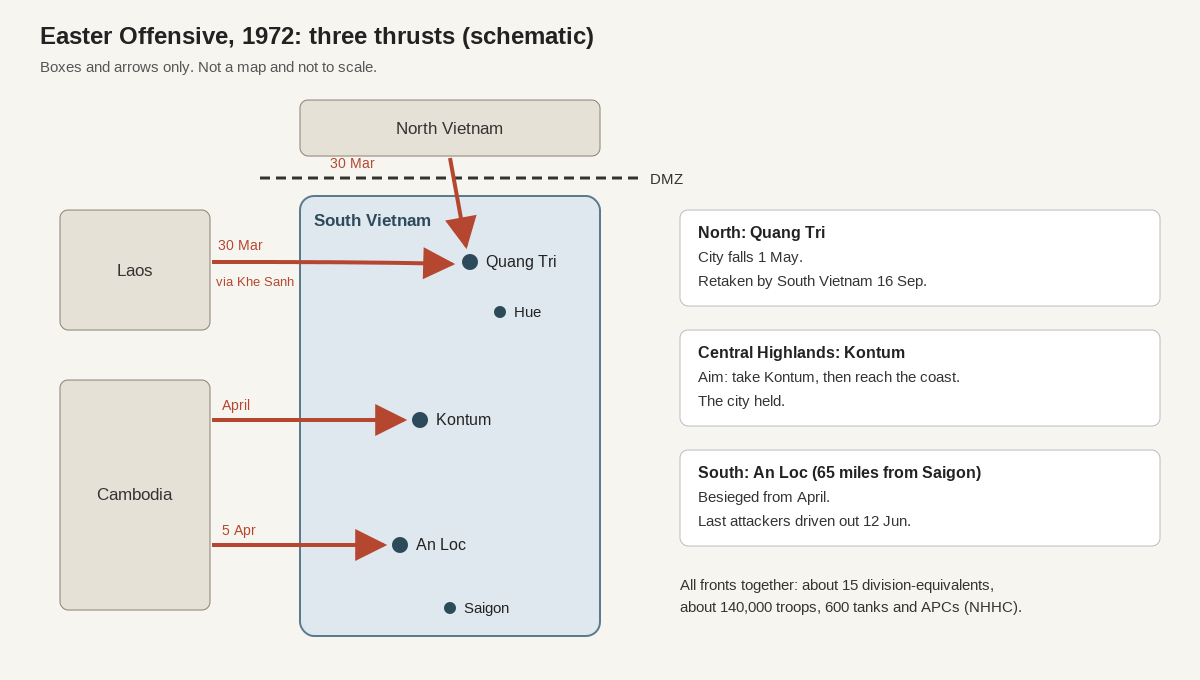
The first thrust went straight across the DMZ. Thirty thousand troops and 100 tanks entered Quang Tri, the northernmost province of South Vietnam, while a division coming from Laos passed Khe Sanh and hit the western flank. The attack was timed for the heavy monsoon rains, which badly limited U.S. and South Vietnamese air strikes.
The second thrust came from Cambodia on 5 April. Three divisions entered Binh Long Province and surrounded its capital, An Loc. An Loc sits on a main road 65 miles, about 105 km, northwest of Saigon.
The third thrust aimed at Kontum in the Central Highlands. The plan was to take Kontum, push on to the coast and cut South Vietnam in two. Across all three fronts, NHHC estimates about 15 division-equivalents, roughly 140,000 men, plus 600 tanks and armored personnel carriers.
Nixon gave a different count in his 26 April address. He said three North Vietnamese divisions had crossed the DMZ, and that three more had soon invaded farther south.
Quang Tri lost, An Loc and Kontum hold
Quang Tri City fell on 1 May. On the single road south toward Hue, 20,000 refugees became mixed in with retreating troops. NHHC writes that North Vietnamese forces on both sides of the road fired indiscriminately at the crowds, and the route became known as "the Road of Horror."
The two sides gave different civilian death tolls. The South Vietnamese government reported about 5,000, and the North Vietnamese side said 2,000. Losing a provincial capital was a heavy blow to the standing and credibility of the Saigon government.
An Loc held out under siege from April. The North Vietnamese drive there peaked on 16 May, and South Vietnamese troops pushed the last attackers out of the city on 12 June.
At Kontum, the North Vietnamese paused for three weeks after their early gains. South Vietnamese forces used that time to regroup and keep the city.
More from the air and sea, less on the ground
Nixon did not back down. He sent big air and naval reinforcements to Guam and to bases across Indochina. On 4 May he chose to lay mines in North Vietnam's ports and to start Operation Linebacker, a sustained air offensive. When the carrier Saratoga arrived on 17 May, six U.S. carriers were working to turn back the offensive.
Ground forces moved the other way. In his 26 April address, Nixon said Vietnamization was going well and that 20,000 more troops would leave over two months, leaving about 49,000. On 23 August, the 3rd Battalion of the U.S. Army's 21st Infantry became the last U.S. ground unit to leave Vietnam.
These steps, together with heavy air strikes on the battlefields and stronger South Vietnamese defenses, brought the offensive to a halt. According to the Office of the Historian, Hanoi's Politburo then entered serious negotiations for the first time.
An antitank missile sent in a hurry
The push across the DMZ came with many tanks. The Army's Redstone Arsenal history office says this created an urgent combat need for the TOW antitank weapon that no plan had foreseen. On 14 April the Department of the Army ordered helicopter-mounted TOW equipment taken out of storage and sent to Vietnam.
In the fighting at Kontum on 2 May 1972, TOW became the first American-made guided missile fired in combat by U.S. soldiers. From 10 May to 22 July, South Vietnamese marines trained on TOW, and during that program a ground-launched TOW was fired in combat for the first time.
TOW is an antitank guided missile (ATGM). It keeps receiving steering signals along a wire after launch. How it works, and how such missiles changed over three generations, is covered in the antitank guided missile article.
Quang Tri in September, and numbers that differ
On 16 September, South Vietnamese forces retook Quang Tri. It was the only provincial capital the offensive actually captured. Most of the remaining North Vietnamese forces pulled back into Cambodia, Laos and North Vietnam, but about 10% of South Vietnam's territory stayed in their hands. That effectively ended the Easter Offensive.
The human cost survives only as estimates. NHHC estimates about 100,000 North Vietnamese casualties, of whom about 40,000 were killed. South Vietnamese Army deaths were about 32,000, and 39,587 for the whole year.
More than 25,000 South Vietnamese civilians died, and close to a million became refugees. Estimates of destroyed North Vietnamese tanks and armored vehicles range widely, from 250 to 700. Both North and South Vietnam claimed victory.
Where lasers come in
In April 1972, while the offensive was under way, North Vietnam's Thanh Hoa Bridge, which had survived years of bombing, fell to just a few laser-guided bombs. The Johns Hopkins Applied Physics Laboratory (APL) uses this as an example of an air-launched weapon that homes on a bright spot lit by a laser.
The device that puts that spot on the target is a laser designator. The seven-year story of the bridge is told in The Thanh Hoa Bridge, 1972.
What remained
On 11–12 October, Kissinger and Le Duc Tho agreed on a peace settlement, but President Thieu rejected it. When talks stalled again, on 14 December Nixon ordered heavy B-52 raids deep into North Vietnam, and the peace agreement was signed on 27 January 1973. The United States left the war and got its prisoners back.
Neither Vietnamese side kept the agreement, though, and the fighting went on. In 1972, with heavy U.S. air and naval support, South Vietnamese forces held two of the three threatened cities and took back the third. Whether they could stand alone without that support remained an open question, and the story continues with the Fall of Saigon in 1975.
What to read next
- The Tet Offensive: When the Military Result and Public Opinion Split: compare it with the offensive of the year with the most U.S. deaths
- Anti-tank guided missiles: rockets versus guided missiles: how TOW, first used in combat in 1972, works
- The Thanh Hoa Bridge, 1972: How Laser-Guided Bombs Changed Bombing: laser-guided bombs in the same spring
- Operations Linebacker I and II (1972): Precision-Guided Weapons and the B-52: the bombing of North Vietnam that same year
- The Fall of Saigon, 1975: The End of the Vietnam War: the last chapter after the Paris agreement