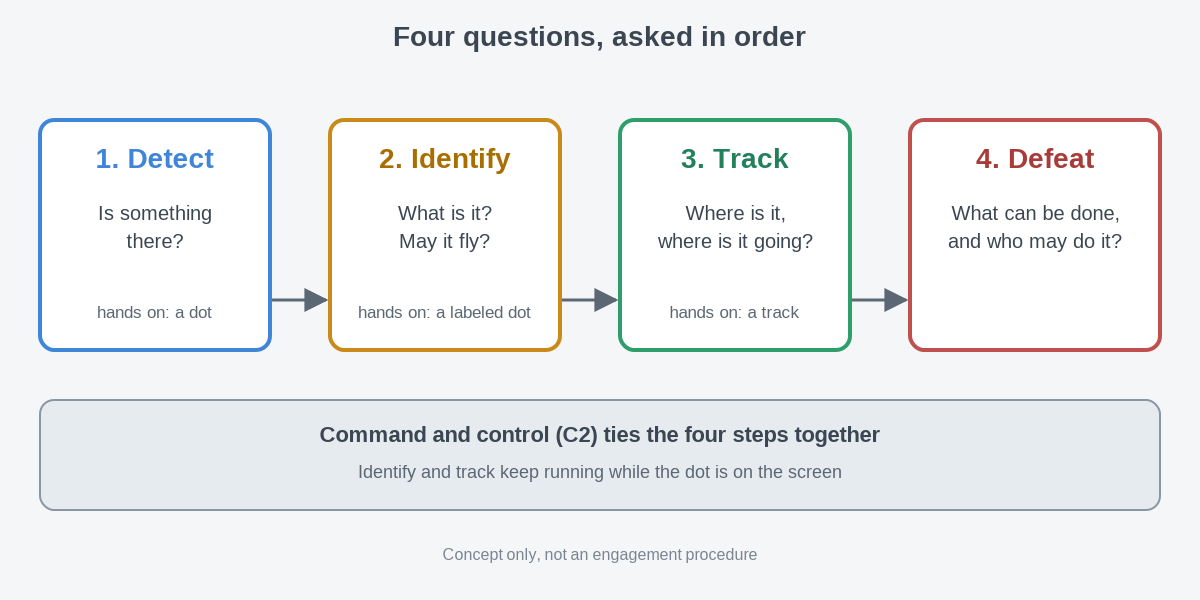
Picture a small dot appearing on a base perimeter screen. Questions follow one after another. Is something really there, what is it, where is it going, and what can be done about it?
Counter-drone work answers these four questions in turn. This article calls the four steps detect, identify, track and defeat.
"Counter-drone systems: why one device is not enough" showed the toolbox. This article looks at the order. It follows U.S. public sources to see what each step asks, what one step passes to the next, and which laws come into play at each step. This article reflects the situation as of October 2026.
First, why the target is hard. A 2025 report by the Congressional Research Service (CRS) points to how small many drones are, how fast they go and how high they fly. Drones also keep getting more common, cheaper and more capable, and the report says this is widely seen as a hard technical and operational problem for the Pentagon. The responses vary widely too, running from full air defense systems down to jamming devices a person can carry.
Slightly different names in different documents
The names of the steps vary a little from one document to the next. Section 130i of U.S. law, which lets the Pentagon protect certain facilities inside the country, uses three words: detect, track and mitigate. While reviewing the FY2017 defense authorization bill, the House Armed Services Committee wrote detect, track and neutralize.
Program descriptions use more words. A Marine Corps fixed-site counter-drone program (I-CsUAS) aims at detecting, identifying, tracking and defeating Group 1–3 drones. NINJA, from the Air Force Research Laboratory, uses the radio link between a drone and its operator, and its design names five steps: detect, track, locate, identify, defeat.
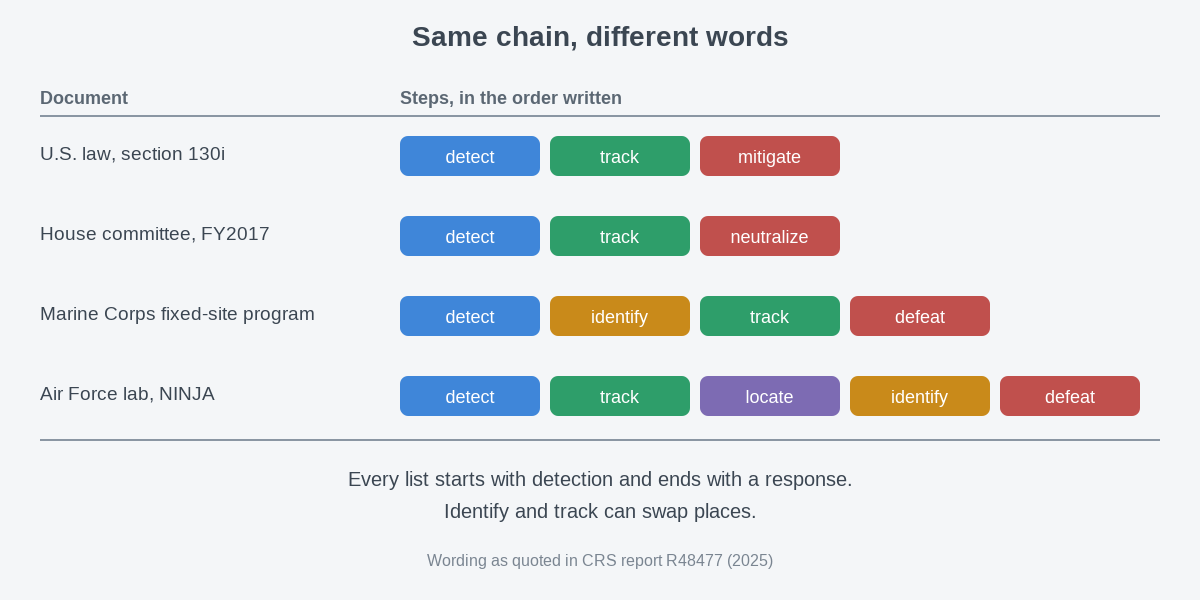
The word count and order differ, but some things stay the same. The list always starts with detection, and it always ends with a step where something is done. Identify and track swap places depending on the document.
A chain is a handy picture. If an early link breaks, the later links have nothing to work on. A real system differs from a chain, though. Identifying and tracking do not finish once; they keep running while the dot is on the screen, and several sensors may handle the same step at once.
Detect: something is there
Detection answers one question: is anything up there? In August 2020 the Federal Aviation Administration (FAA), the Justice Department, the Federal Communications Commission (FCC) and the Department of Homeland Security issued a joint advisory. It says systems that detect and track drones usually lean on one or more of these: radar, radio frequency (RF), electro-optical (EO), infrared (IR) or acoustic sensing.
These methods pick up two kinds of things. One is the physical sign that a drone is there: reflected radio waves, heat or sound. The other is the signals going to or from the drone.
Sensing can also be split into cooperative and noncooperative kinds. Cooperative means the drone announces itself. Noncooperative means outside sensors find it even when it says nothing. A 2022 review in the journal Sensors lists noncooperative sensors as active and passive radar, detection of the drone's radio signals, sound, images, and data fusion that merges them.
What detection hands on is a single dot that has no name yet. Each way of finding drones gets its own article in this series. They are "Radars That Find Small Drones," "Finding Drones by Their Radio Signals: RF Detection and Direction Finding" and "Finding Drones with Cameras, Infrared and Sound."
Identify: what is it, and may it fly?
Identification holds two questions. Is it a drone? And if so, is it a drone that is allowed to fly?
Cooperative information helps with the second question. The FAA defines Remote ID as the ability of a drone in flight to broadcast its identity and location so that others can receive it. When a drone seems to fly unsafely or where it is not allowed, Remote ID also helps the FAA and law enforcement find the control station.
Detection catches drones that follow the rules and drones that do not. Whether a detected flight actually breaks FAA rules has to be worked out by further analysis before any response. Not every dot on the screen is a threat.
The first question is harder than it sounds. One paper that surveys camera-based drone detection notes that drones and birds move in many similar ways. As a result, both false alarms and misses run high. It also names the growing number of drone models and hazy air as causes.
What sensors use to tell birds from drones continues in "Drone or bird: what sensors look at."
Track: keeping hold of it
Tracking keeps finding out where the dot is now and where it is heading. Take one camera-based example from the review above. Detections go to a tracker that handles many targets at once, and the tracker estimates where the aircraft is in three dimensions and how fast it moves. A single dot becomes a path that continues over time.
With several sensors, there is one more job. The system has to decide whether the dot seen by radar and the dot seen by a camera are the same object. This is called data association: matching one sensor's observation with the others so the data can be combined. Data fusion can raise detection performance by overcoming or easing the problems and weak points of each sensor.
Think of following one friend with your eyes in a crowded train station. A real system differs in one way. Instead of one pair of eyes, several sensors of different kinds see the same object separately, and their views must be matched. Combining many sensors into one picture is covered in "Integrated air defense and sensor fusion."
Defeat: the last step and the narrowest door
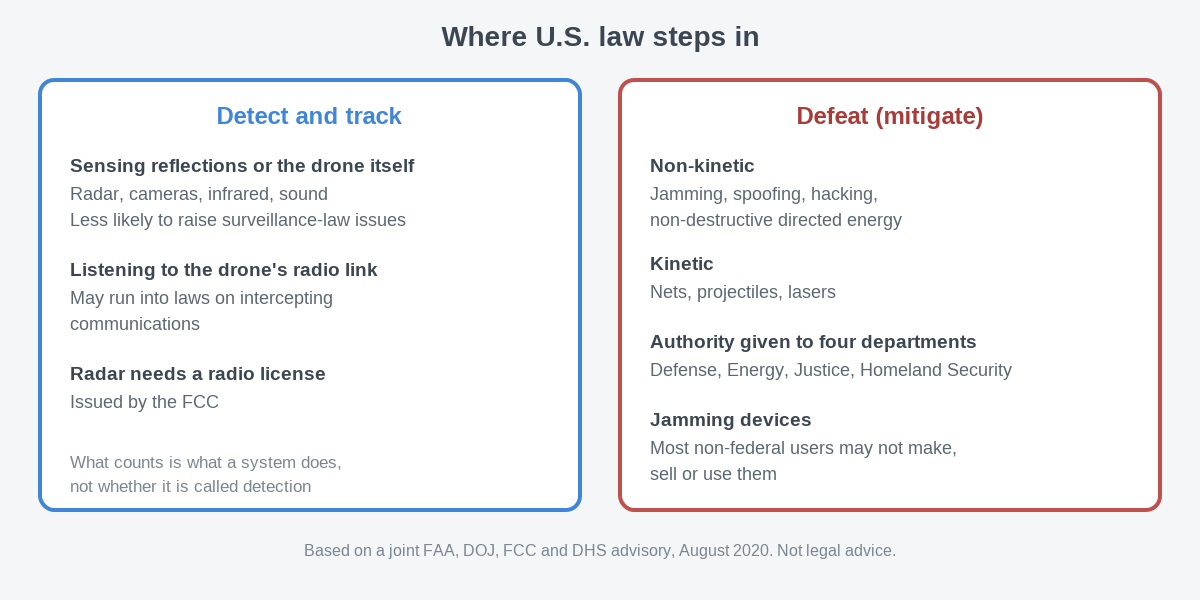
Even the name of the last step changes between documents. The joint advisory calls it mitigation and splits it into two broad groups, non-kinetic and kinetic. The non-kinetic group includes jamming, spoofing, hacking and directed energy weapons (DEW) of a kind that does not destroy the drone. The kinetic group includes nets, projectiles and lasers.
Groupings can differ between documents too. This advisory puts lasers on the kinetic side, while the "Counter-drone systems" article on this site drew lasers in the directed energy group.
Why call this step "the narrowest door"? The reason is the law. As of the 2020 advisory, the U.S. Congress had allowed limited detection and mitigation activity by only four departments: Justice, Homeland Security, Defense and Energy. The FAA says it does not back mitigation systems used by anyone who lacks express authority from Congress.
Jamming devices face an even clearer line. U.S. law (47 U.S.C. 302a) bars most non-federal entities from making, importing, selling or using transmitters built to jam, block or disrupt wireless signals. In practice, when a place other than a federal agency uses a jamming device to stop drones, it will in most cases fall under this ban.
Detection is not free of the law either. The same advisory says legal limits depend not on broad labels such as detection versus mitigation, but on what each system actually does and how it is used.
Methods that sense waves bouncing back, such as radar or cameras, are less likely to raise surveillance-law problems. Radio methods that track a drone by listening to its link with the controller can run into laws on intercepting communications. Using radar to detect drones requires a radio license from the FCC.
A vendor's word is not enough either. The FAA has seen large gaps between what vendors claimed and how systems actually worked, and the advisory urges non-federal entities to test any detection system they consider for themselves.
What ties the steps together: command and control
Four steps working on their own do not make a chain. What joins them is command and control (C2). The CRS report describes C2 systems as tools that find where aerial threats are, identify them and follow them. They also coordinate which countermeasure suits each kind of threat and how it is put to use.
Notice that three of the four steps overlap with the work of C2. In the last step, choosing and using a countermeasure is also something C2 coordinates.
Linking the steps is still a task inside the U.S. military. In 2020 the Pentagon's joint office for countering small drones (JCO) endorsed three C2 systems for the services. The same report also passes on an observation that the Pentagon lacks common C2 software for counter-drone systems and that some counter-drone hardware works only with certain C2 systems.
Where this meets lasers
A laser weapon stands at the far end of the four steps, on the defeat side. Before a high-energy laser (HEL) fires, the first three steps must give their answers. Without knowing that something is there, what it is and where it is, a laser has nothing to do.
Holding a beam on one spot of a moving object, which takes pointing and tracking, is covered in "Gimbals, pointing and tracking: holding the beam on one spot." What lasers do well and what they find hard compared with other means is in "Strengths and limits of laser weapons."
What to read next
- Counter-drone systems: why one device is not enough: the means used at each step and how the Pentagon organizes the work.
- Drone or bird: what sensors look at: a closer look at why identification is hard.
- Integrated air defense and sensor fusion: the sensor fusion that tracking and C2 rely on.
- The cost of drone defense: the money side of the defeat step.
- Articles in progress in this series: "Lasers Against Drones: From Iron Beam to National Prototypes" and "Layered Counter-Drone Defence: How the Layers Fit Together."