Watch drone footage on a windy day and something seems off. The aircraft bobs around, yet the picture stays oddly calm. A camera bolted straight to the airframe could not do that, so something must sit in between.
The cameras and sensors a drone lifts into the sky are called its payload, and the mount that holds them and soaks up the shaking is called a gimbal. This article looks at why payloads always fight with weight, what a gimbal does, and what civil and military drones actually carry. It draws on U.S. regulations, published manufacturer specifications, and U.S. Army and NASA material. The field moves fast, so treat this as a picture as of October 2026.
Payload: the job the aircraft carries
The aircraft itself is a container built to fly. What rides in that container and does the real work is the payload. On a photo drone the payload is the camera; on a drone that samples the air it is the measuring gear.
Often there is more than one. The U.S. Army's Gray Eagle can carry several payloads at once, and the Army's list includes electro-optical/infrared cameras, synthetic aperture radar (SAR) and a communications relay. Notice that the relay does not look at anything, yet it still counts as a payload.
The Army even splits these payloads among different program offices. The Robotic Unmanned Sensors office (PM-RUS) handles the electro-optical/infrared and SAR payloads, while another office handles the relay payload. The aircraft and its payloads are treated as separate things and managed separately.
The weight budget
The rules show first why a lighter payload helps. U.S. regulation 14 CFR Part 107 defines a small unmanned aircraft as one that weighs less than 55 pounds at takeoff. That weight includes everything on board or attached to the aircraft. Add one more camera, and you move that much closer to the legal limit.
Manufacturer specifications show the same arithmetic. For the DJI Matrice 350 RTK industrial quadcopter, the aircraft with its gimbal mount weighs about 3.77 kg without batteries and about 6.47 kg with two batteries. Its maximum takeoff weight is 9.2 kg. Subtract, and the aircraft with batteries has about 2.73 kg of room left before it reaches that maximum.
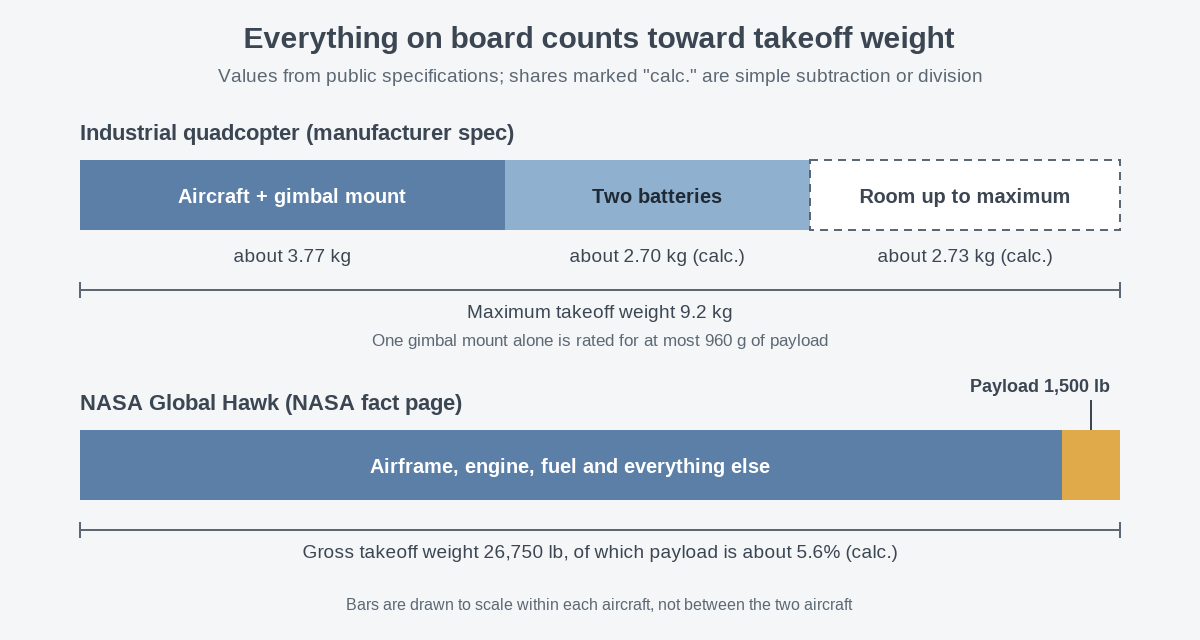
That room is not free to use as you like. The same specification lists a separate limit of 960 g for the payload on one gimbal mount. Each mount has its own limit, and so does the aircraft as a whole.
Large drones face the same budget. NASA's Global Hawk weighs 26,750 lb in total at takeoff, and that figure includes a 1,500 lb payload capability. Divide one by the other and the payload comes to about 5.6% of the takeoff weight. Even on a big aircraft, the part that does the job is a small slice of the whole.
The demands of fitting gear onto a platform are bundled as size, weight and power (SWaP). A payload has to share not only weight but also space and electricity with the aircraft. The power side continues in Drone power.
Gimbals: a steady view from a shaking aircraft
A gimbal is the same device this site's glossary and laser articles describe. Its basic layout is easy to see in a laboratory optical mount. The part holding the optic turns on two pairs of bearings set at right angles, so the tilt in each direction can be set on its own. Keeping the two motions from mixing is the main strength of this kind of mount.
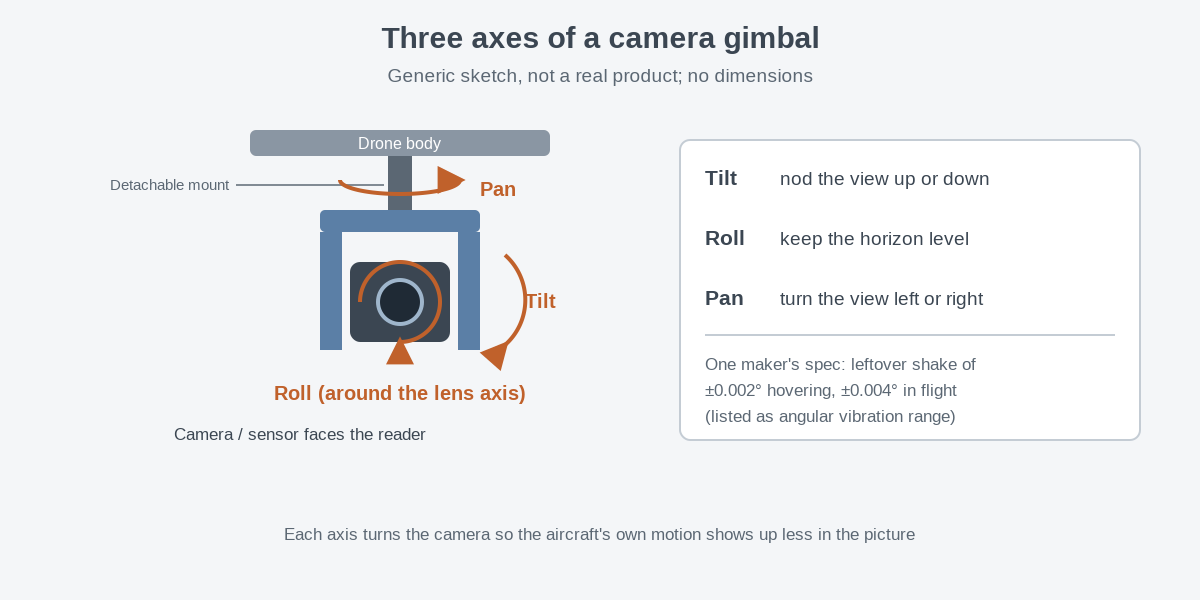
A drone camera gimbal usually adds one more axis. The DJI Zenmuse H30 specification lists three stabilized axes: tilt, roll and pan. Tilt nods the view up or down, roll keeps the horizon level, and pan turns the view left or right.
Why go to such lengths over a bit of shaking? A 2010 paper from the Naval Postgraduate School (NPS) explains that motion of the platform and of the optics causes jitter, which hurts pointing accuracy and blurs images. It names heat, mechanical vibration, sound, loads, and heating and cooling equipment as causes. A drone, with spinning propellers and gusting wind, puts all of these in one place.
A gimbal is a little like using your elbow and wrist to keep a cup of water from spilling while you walk. The real thing is different. Each gimbal axis can only turn so far, and the gimbal cannot remove the shaking completely.
The H30 specification lists the leftover shake as ±0.002° when hovering and ±0.004° in flight, so it is larger in flight. The same specification adds that the mechanical range listed for each axis is a structural limit, not the range the gimbal can be controlled over.
What goes on board: cameras, thermal, lidar, laser rangefinders
Many current payloads pack several sensors into one housing. A single H30 series unit holds a zoom camera, a wide camera, a laser rangefinder and a near-infrared auxiliary light. The H30T adds an infrared thermal camera, whose sensing element is an uncooled vanadium oxide (VOx) microbolometer. The housing weighs 920 ±5 g.
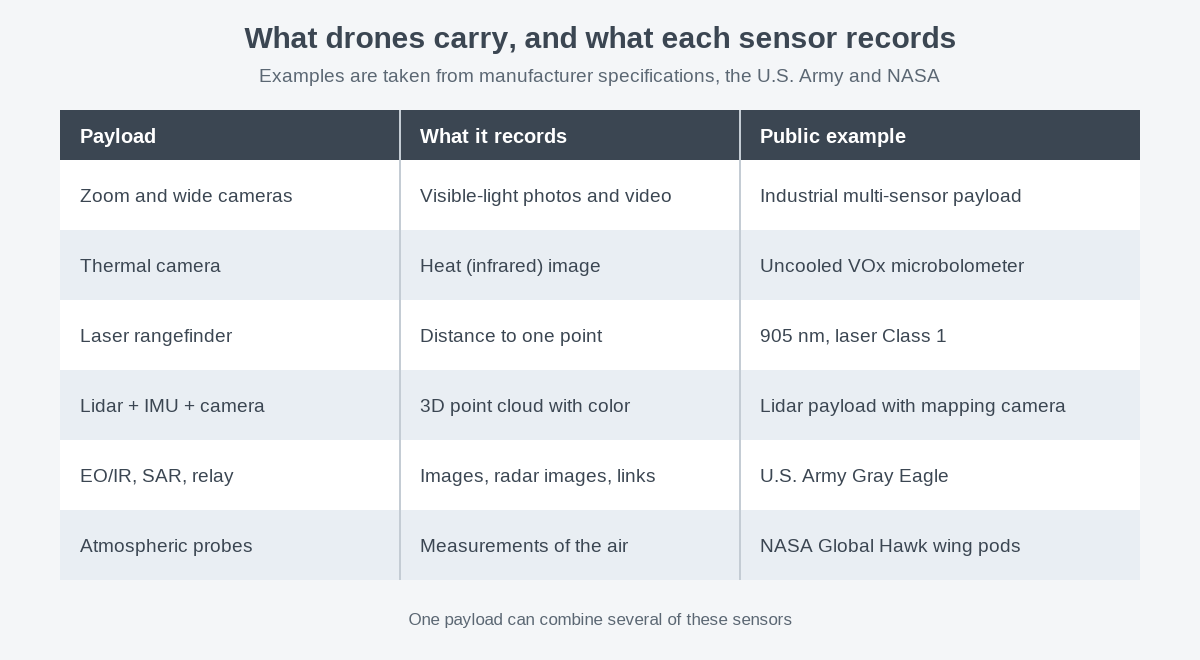
Some payloads measure the shape of the ground in 3D. The Zenmuse L2 puts lidar, an inertial measurement unit (IMU) and an RGB mapping camera into one payload. The point cloud the lidar builds can be colored by reflectivity, height, distance or the camera's color. An IMU combines gyroscopes and accelerometers in one package to measure changes in angle and speed.
The specifications also show how a payload attaches. The H30 connects through a detachable DJI SKYPORT mount. The Matrice 350 RTK supports five gimbal layouts, such as one facing down, one facing up, or two facing down. It accepts payloads from other companies only if they are built with the DJI Payload SDK and certified.
The military has the same idea of swapping payloads. A U.S. Army ground robot program splits its system into a universal controller, a set of payloads that can be swapped, and a shared mobile platform. The Army says a standard built with industry works like apps on a smartphone. Payloads can be updated with new technology without replacing the whole platform.
Civil and military uses
In science, the payload is the research instrument. On NASA's Global Hawk, two yellow-and-black pods hang below the wings and hold probes that measure the atmosphere. For a 2014 atmospheric experiment over the western Pacific, the aircraft carried 13 instruments. Researchers reach the onboard sensor packages directly during flight through dedicated satellite links.
In industry, payloads see what people cannot easily see for themselves. A thermal camera turns invisible heat into a picture, and lidar records the shape of the ground and of structures as a point cloud. The physics of seeing heat is covered in Thermal imaging sights, and military uses of lidar in Military lidar.
Military payloads tend to be larger and heavier. The U.S. Army says Gray Eagle carries 1,075 lb (488 kg) of payload inside and outside the airframe, and its list includes an electro-optical/infrared camera with laser designation. How such sensors connect to surveillance work is covered in ISR drones.
Limits and open problems
The numbers on a spec sheet come with conditions. The Matrice 350 RTK's maximum flight time of 55 minutes was measured with no wind, no payload, at about 8 m/s, until the battery ran down to 0%. The maker itself notes that real flight time depends on flight mode, accessories and the environment. A real flight with a payload on board should not be expected to match that figure.
Sensors depend on the weather too. The H30 specification says the laser rangefinder's measuring range can change with gimbal angle, ambient light, and weather such as rain or fog. The L2 specification says that when the laser beam hits more than one object, the transmitted power is split and the reachable range drops.
Toughness has fine print as well. The H30's IP54 dust and water rating means it can meet the international standard under controlled laboratory conditions, and the rating can drop as the unit wears with long use. There are legal limits too: Part 107 does not allow a small unmanned aircraft to carry hazardous material.
Where this meets lasers
Lasers show up again and again in payload lists. The H30's laser rangefinder uses light at a wavelength of 905 nm, and its laser safety class in the specification is Class 1. Lidar also measures distance with a laser, and the Gray Eagle list includes laser designation.
Gimbals link to laser weapons as well. A laser weapon's beam director has to hold the beam on one spot from a moving platform, and the NPS paper mentioned above studies exactly that problem. Steadying a drone camera and keeping a laser beam on target against jitter start from the same question.
What to read next
- Gimbals and tracking: holding a beam on one spot: how gimbals help a laser weapon point its beam.
- Laser rangefinders: how the laser rangefinder inside a payload measures distance with light.
- ISR drones: why staying aloft matters: how sensor payloads connect to surveillance missions.